1. Formation of ions
What an ion is
- An ion is a charged atom (or group of atoms) formed when an atom loses or gains electrons
- The number of electrons transferred equals the size of the charge:
- lose 1 electron → 1+ charge
- lose 2 electrons → 2+ charge
- gain 1 electron → 1− charge
- gain 2 electrons → 2− charge
Cations and anions
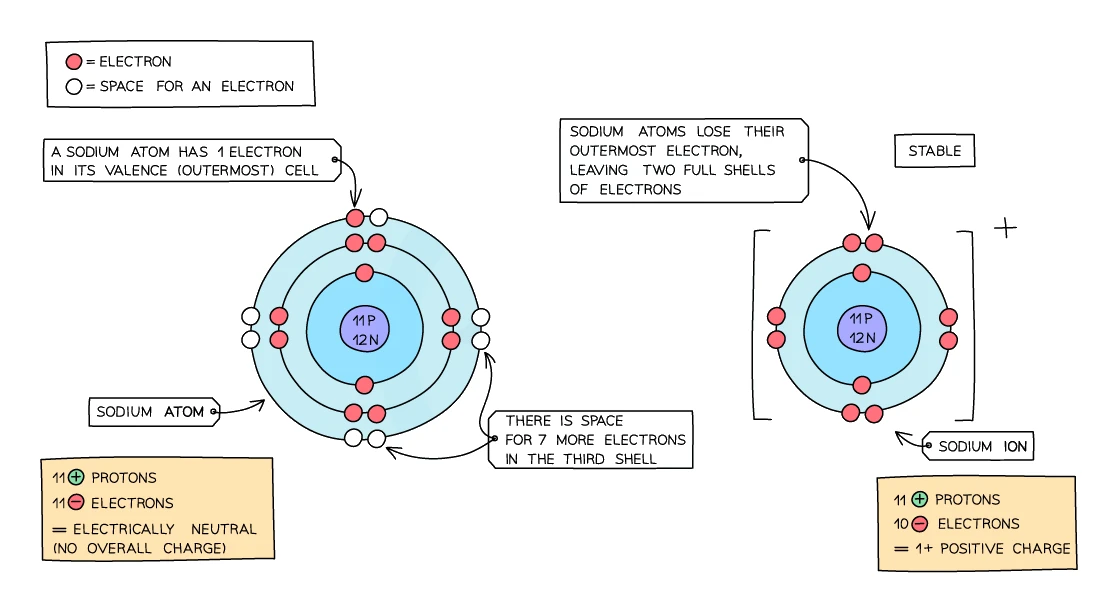
- A cation is a positive ion, formed when an atom loses electrons (it now has fewer electrons than protons)
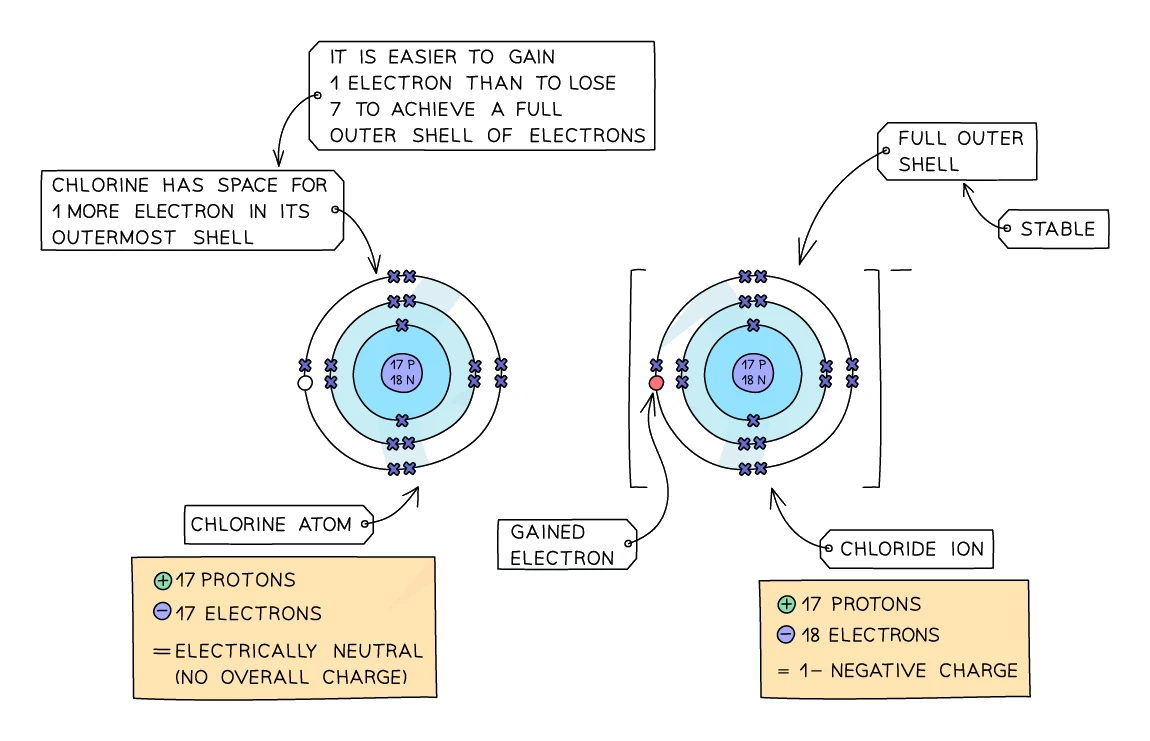
- An anion is a negative ion, formed when an atom gains electrons (it now has more electrons than protons)
- The driving force in every case is to reach a full outer shell — the stable electron arrangement of a noble gas
- Metals (1–3 outer electrons) lose those few electrons to form cations
- Non-metals (5–7 outer electrons) gain electrons to form anions
- Group 4 elements rarely form simple ions (losing or gaining 4 electrons costs too much energy)
- Group 0 noble gases already have full outer shells and so do not form ions
Common exam question
Describing electron transfer when ions form
Question: Describe, in terms of electrons or electronic configurations, what happens when a metal and a non-metal form an ionic compound such as sodium oxide or magnesium chloride (2–3 marks).
Asked in 5 of the 23 papers. One mark is for the metal atom losing electrons and one for the non-metal atom gaining them; saying that two electrons transfer from the magnesium atom to the sulfur atom earns both. The third mark is for the numbers, matched to the formula: each sodium atom loses one electron and the oxygen atom gains two, or magnesium loses two and each of two chlorine atoms gains one. One scheme lets both ions' configurations (2,8) earn it instead; when the ions' charges are also asked for, they are the third mark.
Any mention of sharing electrons scores zero in two schemes, and "chloride gains an electron" is not credited: the chlorine atom gains, the chloride ion is the result.
Predicting ion charges from group number
| Group | Outer electrons | Ion charge |
|---|---|---|
| 1 | 1 | 1+ |
| 2 | 2 | 2+ |
| 3 | 3 | 3+ |
| 5 | 5 | 3− |
| 6 | 6 | 2− |
| 7 | 7 | 1− |
Common exam question
Giving the charge on an ion
Question: Give the charge on the ion formed from an atom whose electronic configuration is drawn, on a named ion such as bromide, or on the metal ion in a compound such as PbO (1 mark, usually multiple choice).
Asked in 4 of the 23 papers. Count the outer electrons: one, two or three means a metal that loses them, so 1+, 2+ or 3+; five, six or seven means a non-metal that gains, so 3−, 2− or 1−. An "-ide" name is that non-metal's simple ion, so bromide is 1− and sulfide is 2−.
For a metal ion inside a compound, balance the partner: oxide is 2−, so the lead ion in PbO is 2+. Write the size then the sign, as in 2+; one scheme also accepts the sign first. Two more papers give proton and electron numbers instead: the charge is protons minus electrons, so a 2+ ion has two electrons fewer than its atom.
2. Common ions
The charges of a fixed set of common ions must be learnt by heart.
Positive ions (cations)
| Ion | Charge | Example |
|---|---|---|
| Group 1 metal | 1+ | Li⁺, Na⁺, K⁺ |
| Group 2 metal | 2+ | Mg²⁺, Ca²⁺ |
| Group 3 metal | 3+ | Al³⁺ |
| Silver | 1+ | Ag⁺ |
| Copper(II) | 2+ | Cu²⁺ |
| Iron(II) | 2+ | Fe²⁺ |
| Iron(III) | 3+ | Fe³⁺ |
| Lead(II) | 2+ | Pb²⁺ |
| Zinc | 2+ | Zn²⁺ |
| Hydrogen | 1+ | H⁺ |
| Ammonium | 1+ | NH₄⁺ |
Negative ions (anions)
| Ion | Charge | Example |
|---|---|---|
| Group 5 non-metal | 3− | N³⁻ |
| Group 6 non-metal | 2− | O²⁻, S²⁻ |
| Group 7 non-metal | 1− | F⁻, Cl⁻, Br⁻, I⁻ |
| Hydroxide | 1− | OH⁻ |
| Nitrate | 1− | NO₃⁻ |
| Carbonate | 2− | CO₃²⁻ |
| Sulfate | 2− | SO₄²⁻ |
- Polyatomic (NH₄⁺, OH⁻, NO₃⁻, CO₃²⁻, SO₄²⁻) are clusters of atoms that carry their charge as a single unit. Treat them as one piece in any formula you build
Common exam question
Giving the formula of each ion in a compound
Question: Give the formula of each ion in a named compound such as calcium nitrate, lead(II) nitrate or copper(II) sulfate (1–2 marks).
Asked in 4 of the 23 papers. Each ion needs its symbol with the full charge as a superscript, sign included: Ca²⁺ and NO₃⁻. A Roman numeral tells you the metal's charge, so lead(II) is Pb²⁺ and copper(II) is Cu²⁺. A polyatomic ion keeps its charge on the whole group, SO₄²⁻ rather than SO₄⁻, and a double salt such as KAl(SO₄)₂ splits into three ions, K⁺, Al³⁺ and SO₄²⁻, whose charges add up to zero. Writing a charge as a subscript, or a symbol in the wrong case, is capped at one mark in one scheme; writing the sign before the number, as in Al⁺³, is accepted.
3. Formula of an ionic compound
- An ionic compound is electrically neutral overall. The total positive charge from the cations exactly cancels the total negative charge from the anions
- Two equivalent methods for working out the formula: direct comparison and swap-and-drop
Direct comparison
- Pick the smallest whole-number ratio of cations to anions that makes the total charge balance to zero
- Iron(II) sulfate: Fe²⁺ has +2, SO₄²⁻ has −2; (+2) + (−2) = 0, so 1 Fe²⁺ pairs with 1 SO₄²⁻
- Formula: FeSO₄
Swap-and-drop
- Faster when the cation and anion have different charge sizes
- Procedure:
- Write the two ions side by side, with their charge numbers as superscripts
- Swap each ion's charge size to become the subscript of the other ion
- Drop the +/− signs; drop any subscript of 1 (it is always implied)
- Simplify the subscripts if they share a common factor
- Examples:
- Copper(II) chloride: Cu²⁺ and Cl⁻ → swap gives Cu₁Cl₂ → drop the 1 → CuCl₂
- Iron(III) chloride: Fe³⁺ and Cl⁻ → swap gives Fe₁Cl₃ → FeCl₃
- Aluminium oxide: Al³⁺ and O²⁻ → swap gives Al₂O₃ (no common factor)
- Calcium sulfide: Ca²⁺ and S²⁻ → swap gives Ca₂S₂ → simplify by 2 → CaS
Brackets for polyatomic ions
- Whenever a polyatomic ion is multiplied (subscript ≥ 2), put the polyatomic ion in brackets before applying the subscript:
- Magnesium hydroxide: Mg²⁺ and OH⁻ → Mg(OH)₂
- Aluminium nitrate: Al³⁺ and NO₃⁻ → Al(NO₃)₃
- Ammonium sulfate: NH₄⁺ and SO₄²⁻ → (NH₄)₂SO₄
Naming ionic compounds
- The metal (or the ammonium ion) keeps its name in full
- The non-metal usually changes its ending to -ide:
- chlorine → chloride
- oxygen → oxide
- sulfur → sulfide
- nitrogen → nitride
- For metals that can form more than one cation (Fe, Cu, Pb), include the charge in Roman numerals: iron(II), iron(III), copper(II), lead(II)
- Polyatomic anions keep their proper name: nitrate, carbonate, sulfate, hydroxide
Common exam question
Completing an ionic formula table
Question: Complete a table of ions with the missing formulae of the compounds they form, then name one compound, or give the formula of a named ionic compound (1 mark per formula, plus 1 for the name).
Asked in 3 of the 23 papers. Swap the charge sizes into subscripts and cancel any common factor: Al³⁺ with Cl⁻ gives AlCl₃, Zn²⁺ with SO₄²⁻ gives ZnSO₄, and a multiplied polyatomic ion keeps its brackets. The schemes accept reversed symbols (ClNa) and ion notation (Na⁺Cl⁻), one rejects a wrong charge on an ion, and all penalise wrong case or wrong sub- or superscripts only once across the table. For the name, one scheme insists on correct spelling; another allows "sulphate". The standalone form (give the formula of sodium sulfide) is set in 3 of the 23 papers: Na₂S; ion notation or a reversed formula is accepted, an invented symbol such as "Fl" is rejected.
A rarer variant gives one ion's charge and asks why the formula is Ca₃P₂: give the other ion's charge, P³⁻, and state that three 2+ charges balance two 3− charges; any mention of sharing scores zero.
4. Dot-and-cross diagrams for ionic bonds
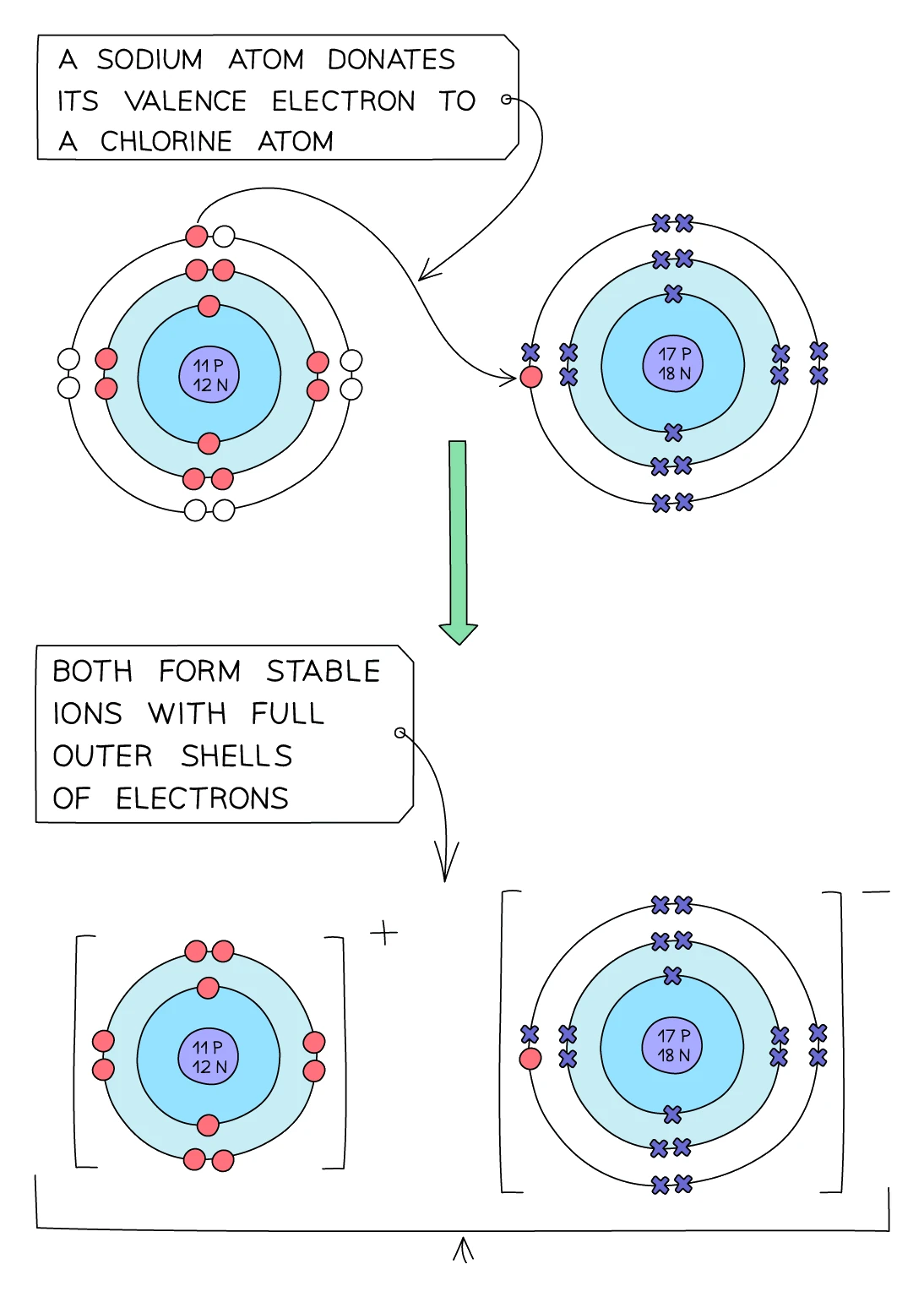
- A dot-and-cross diagram shows the transfer of electrons when atoms become ions and an ionic bond forms
- Conventions to follow:
- Use dots for one atom's electrons and crosses for the other atom's electrons
- Show only the outer-shell electrons (Edexcel does not require inner shells)
- Place each finished ion inside square brackets with its charge written as a superscript at the top-right, outside the brackets
- Any transferred electron keeps the symbol of its original atom (so a cross from chlorine onto the sodium ion is still drawn as a cross)
Sodium chloride: Na⁺ and Cl⁻
- Sodium (Group 1) has 1 outer electron and loses it
- Chlorine (Group 7) has 7 outer electrons and gains 1 to make 8
- One electron transfers from Na to Cl
- The Na atom becomes Na⁺ (configuration 2,8); the Cl atom becomes Cl⁻ (configuration 2,8,8)
- Formula: NaCl
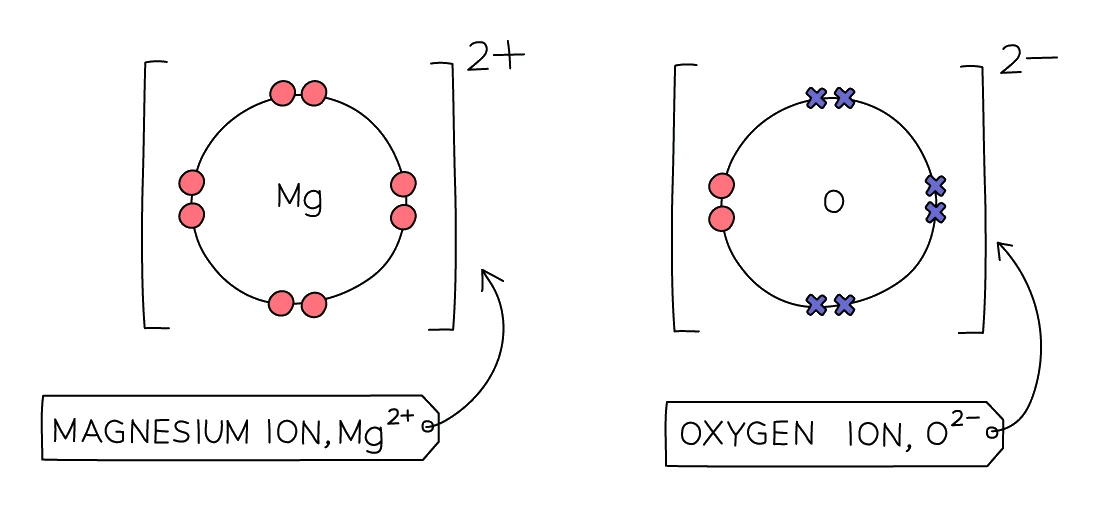
Magnesium oxide: Mg²⁺ and O²⁻
- Magnesium (Group 2) has 2 outer electrons and loses both
- Oxygen (Group 6) has 6 outer electrons and gains 2 to make 8
- Two electrons transfer from Mg to O
- The Mg atom becomes Mg²⁺; the O atom becomes O²⁻
- Formula: MgO
What goes in, what stays out
- Only the outer shell of each atom is drawn (inner shells are omitted)
- The transferred electrons still belong to their original atom and so are drawn as their original symbol on the new ion
- Square brackets and charge superscripts go around each finished , not around the starting atoms
Exam tip
Draw every shell of an ion, not just the outer one
A dot-and-cross diagram needs only the outer shells, but when a question asks you to draw the electronic configuration of a metal ion and a non-metal ion (3 marks), it wants every shell: the scheme that set it capped a diagram showing only the outer electrons at one mark for the two ions together. The third mark is the charge on each ion, so label them, 2+ and 1−. Dots, crosses or any mixture are accepted. The reverse also holds: when asked to describe the changes in words, one scheme gives both marks for correct diagrams of the ions' configurations, so a clear labelled diagram is never wasted.
5. Structure and properties of ionic compounds
The giant ionic lattice
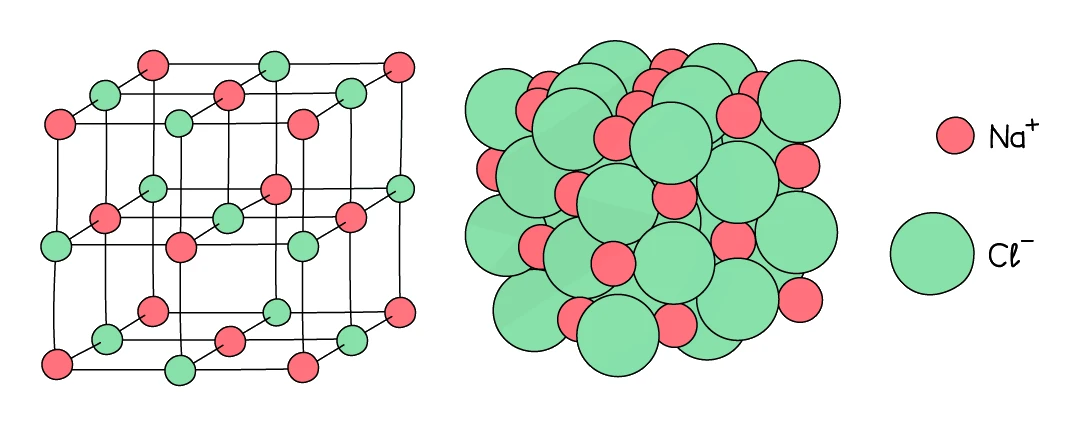
- In the solid state, the cations and anions arrange themselves into a regular, repeating three-dimensional pattern with positive and negative alternating in every direction
- This is called a
- Each ion is surrounded by ions of the opposite charge as its nearest neighbours
- The whole solid is one continuous structure containing many millions of alternating ions
Ionic bonding as electrostatic attraction
- An ionic bond is the electrostatic attraction between oppositely charged ions
- The forces act in all directions and extend throughout the entire lattice
- These forces are very strong
Exam tip
Defining ionic bonding
If you are asked what the term ionic bonding means (2 marks), give the two halves: electrostatic attraction, and between oppositely charged ions (positive and negative ions, or cations and anions, are accepted). Electron transfer is not needed: the definition is about the force holding the ions together, not how they formed. Any wording that implies covalent bonding loses the second mark. The same two phrases are the core of every mark scheme for an ionic compound's high melting point, so learn them as one unit.
High melting and boiling points
- Ionic compounds have high melting and boiling points
- Reason: melting or boiling the solid requires overcoming the many strong electrostatic forces between every pair of opposite ions in the lattice. That takes a lot of thermal energy
- The greater the charges on the ions, the stronger the attraction and the higher the melting point
- Magnesium oxide (Mg²⁺ and O²⁻, both 2-charge) melts at about 2852 °C
- Sodium chloride (Na⁺ and Cl⁻, both 1-charge) melts at about 801 °C
Common exam question
Explaining the high melting point of an ionic compound
Question: Explain, referring to structure and bonding, why an ionic compound has a high melting point, or a much higher one than a simple molecular substance (3–5 marks).
Asked in 7 of the 23 papers. Give the giant ionic lattice (a mark in five of the seven schemes), strong electrostatic forces of attraction ("strong ionic bonds" is accepted; "strong" is not optional) between oppositely charged ions, and a lot of energy needed to overcome the forces or break the ionic bonds. Say "a lot of", not "more": the schemes ignore "more energy" except in a comparison, where the extra marks are that the other substance is simple molecular with weak intermolecular forces needing much less energy. "Weak forces between bonds" is rejected, and so is breaking covalent bonds.
Two schemes give zero overall if covalent bonds, intermolecular forces or molecules appear in the ionic explanation; the others withhold some or all ionic marks for that slip.
Electrical conductivity
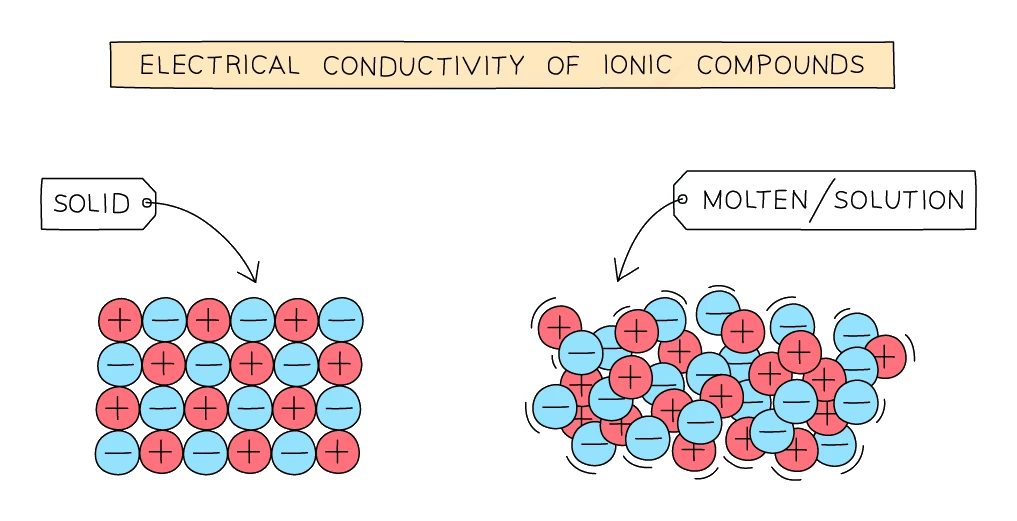
- An electric current is a flow of charged particles
- In an ionic compound the ions are the charge carriers (not free electrons)
- Solid ionic compound: poor conductor. The ions are locked in fixed positions in the lattice and cannot move
- Molten or dissolved in water (aqueous): good conductor. The ions are free to move and carry charge
Common exam question
Why ionic compounds conduct only when molten or dissolved
Question: Explain why an ionic compound conducts electricity when molten or in solution but not when solid, or why a molten electrolyte or a salt solution conducts (1–4 marks).
Asked in 7 of the 23 papers, often in an electrolysis question. In the solid the ions are held in fixed positions in the lattice and cannot move; when molten or dissolved the ions are free to move. Both halves must say ions: two schemes give zero to an answer with electrons moving, two more reject electrons for the ion mark, and "can move" is credited only once ions have been named. For a solid alone, one scheme also credits no delocalised electrons. A metal, by contrast, conducts through delocalised electrons; an insoluble ionic solid in water does not conduct for two reasons, each a mark: its ions are still held in place, and water is covalent so it does not conduct either.
In a properties table, conduction only when molten plus a high melting point identifies the ionic substance ("giant" alone earns nothing for the structure).
Solubility in water
- Many ionic compounds are soluble in water
- Water's polar molecules pull the ions out of the lattice and surround them in solution
- e.g. NaCl, KNO₃ and Na₂SO₄ all dissolve readily in water
Brittleness
- Ionic crystals are
- A sharp blow can shift one layer of ions sideways across the next, bringing ions of the same charge next to one another. They repel, and the crystal cracks along that plane