1. The Group 7 halogens
What the halogens are
- Group 7 contains the halogens: fluorine, chlorine, bromine, iodine and astatine
- They are reactive non-metals, all toxic, and many are coloured
- Each halogen atom has seven electrons in its outermost shell, which gives the group its family resemblance
- Halogens exist as diatomic molecules (F2, Cl2, Br2, I2) — a pair of atoms held together by one single covalent bond, sharing a pair of electrons
Physical state and appearance at room temperature
| Halogen | State at room temperature | Colour | Note |
|---|---|---|---|
| Fluorine, F2 | Gas | Pale yellow | Most reactive of all elements |
| Chlorine, Cl2 | Gas | Pale yellow-green | Dense, pungent |
| Bromine, Br2 | Liquid | Red-brown | Volatile; gives orange-brown vapour |
| Iodine, I2 | Solid | Dark grey, shiny crystals | Sublimes on warming to a violet vapour |
- The colour deepens as you go down the group (pale yellow → yellow-green → red-brown → dark grey/violet)
Common exam question
State and colour of a halogen at room temperature
Question: Which halogen is a liquid, or a solid, at room temperature; what colour is solid iodine; which halogen is palest; or complete a table of the halogens' states and colours (1–2 marks).
Asked in 6 of the 23 papers: as multiple choice, a table to complete, or a one-line request for the element that is liquid at room temperature (mercury is accepted there as well as bromine). Learn the set as one pattern that darkens down the group: fluorine is a pale yellow gas and the palest halogen (pale green is also credited), chlorine a green gas, bromine the only liquid and red-brown, iodine a grey solid, and astatine, below iodine, a solid as well. The fact asked most often is that bromine is the liquid. Iodine's colour comes next, and the wrong options offered for it were brown, black and purple: purple is the colour of its vapour, not of the solid. When iodine is not among the options for the solid halogen, choose astatine.
Trend in melting and boiling points
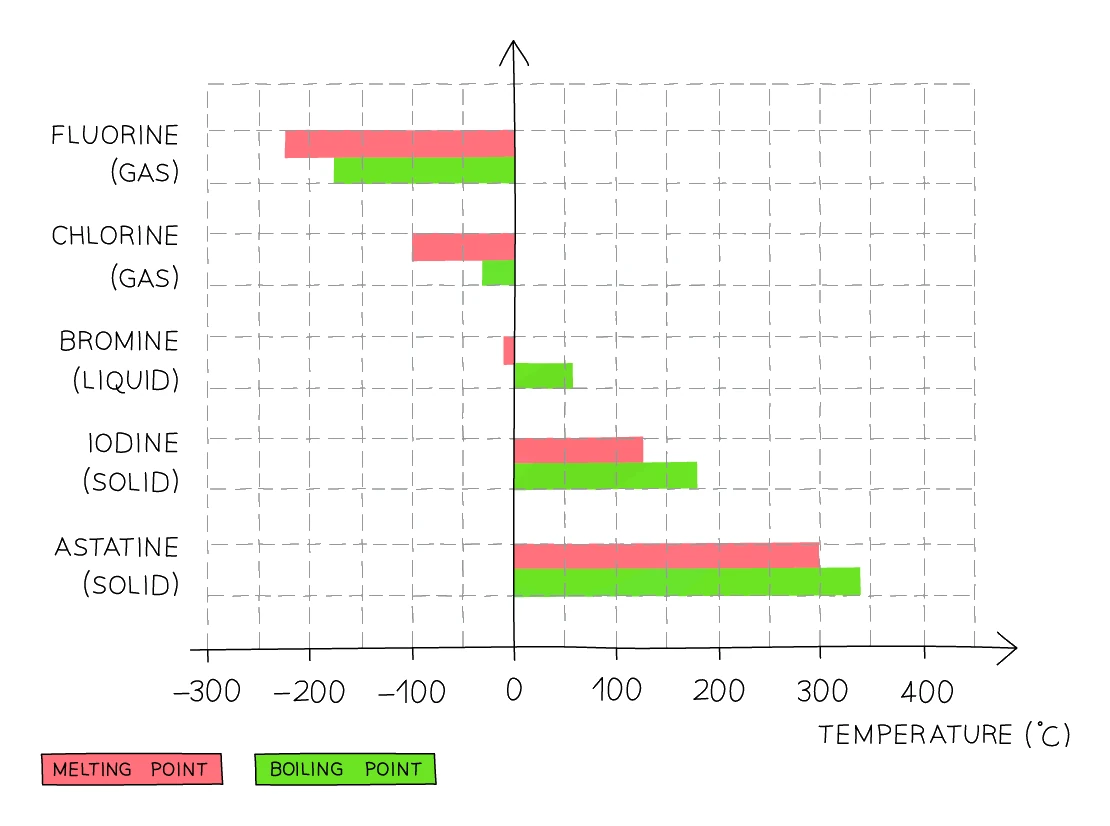
- Both the melting point and the boiling point increase steadily down the group
- F2 boils at −188 °C, Cl2 at −34 °C, Br2 at 59 °C, I2 at 184 °C
- The halogens are simple molecular structures, so it is the intermolecular forces between molecules that are overcome on melting or boiling — not the strong covalent bond inside each molecule
- As the molecules get larger going down the group, the intermolecular forces become stronger and more energy is needed to overcome them — so the melting and boiling points rise
Common exam question
Explaining the trend in boiling points down Group 7
Question: Use a table of boiling points to explain the trend down the group, or choose why a halogen boils at a higher temperature than other gases (1–3 marks).
Set in 2 of the 23 papers, once as a 3-mark explanation and once as multiple choice. The credited chain has four links, of which three are needed: the boiling points increase down the group; because the forces between the molecules get stronger; as the molecules get bigger, with more mass, more electrons and more shells; so more energy is needed to pull the molecules apart. Mention breaking covalent or ionic bonds anywhere and every mark after the first is lost, because the bond inside each molecule stays intact when a halogen boils. In the multiple-choice version the right option is the strongest attraction between molecules; "covalent bonds between molecules" and "covalent bonds between atoms" are both wrong.
2. Reactions of the halogens
Halogens with metals: metal halides
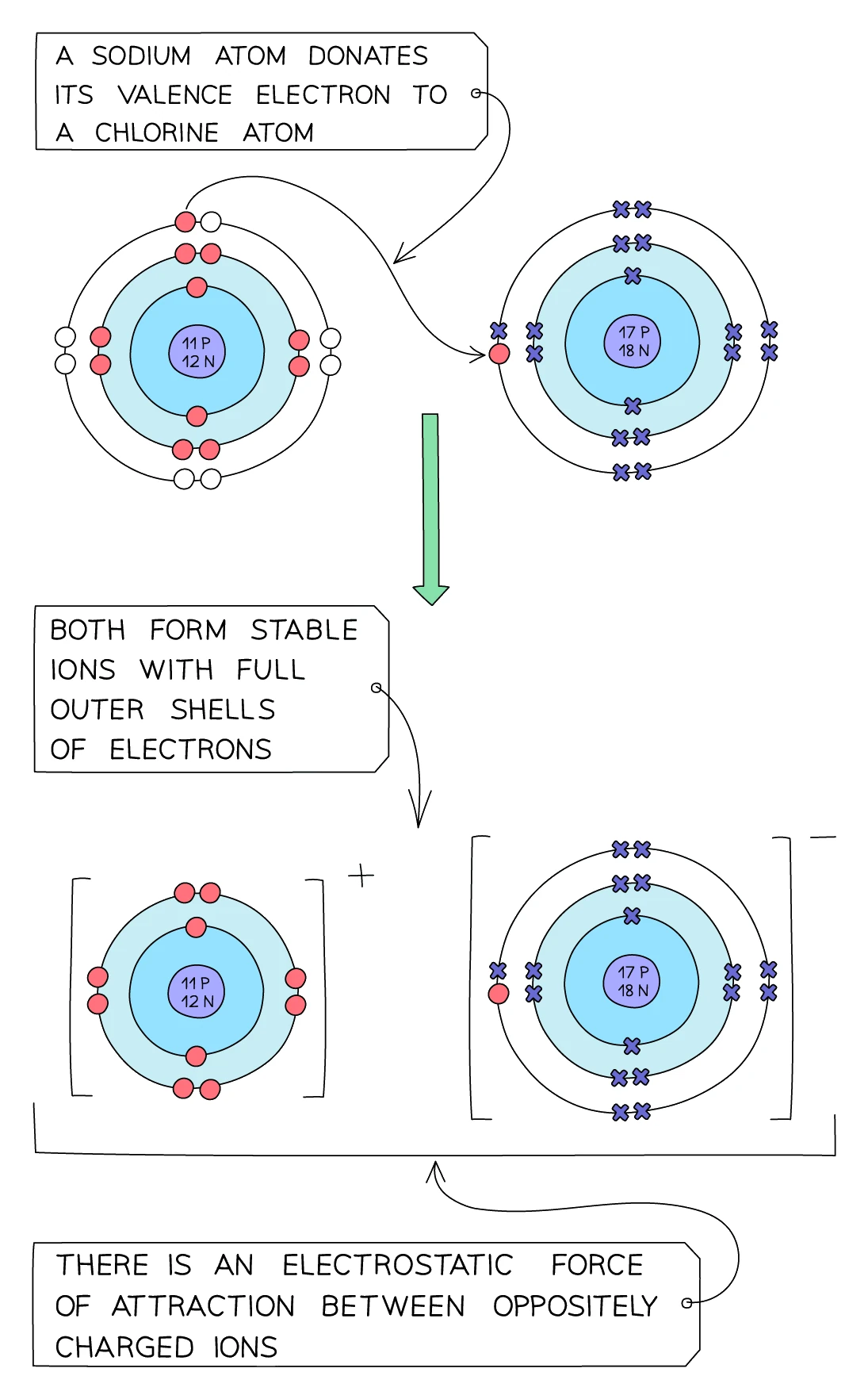
- Halogens react with many metals to form ionic metal halide salts
- Each halogen atom gains one electron to form a with a 1− charge (F−, Cl−, Br−, I−)
- The formula of the metal halide depends on the charge on the metal ion:
- Group 1 metals form M+ ions, giving compounds like NaCl
- 2 Na(s) + Cl2(g) → 2 NaCl(s)
- Group 2 metals form M2+ ions, giving compounds like CaBr2
- Ca(s) + Br2(l) → CaBr2(s)
- Iron forms FeX3 with chlorine and bromine
- 2 Fe(s) + 3 Cl2(g) → 2 FeCl3(s)
- Group 1 metals form M+ ions, giving compounds like NaCl
- Reactivity falls down the group, so the same metal reacts more slowly with bromine or iodine than with chlorine
Common exam question
Formula or equation for a metal halide
Question: Write the equation for a Group 1 metal reacting with chlorine, or give the formula of the compound a metal forms with fluorine (1 mark).
Set in 2 of the 23 papers. Work from the charges: every halide ion is 1−, so a Group 1 metal ion pairs with one halide ion (2Li + Cl₂ → 2LiCl) and a Group 2 metal ion with two (MgF₂). Multiples and fractions of the balanced equation are allowed and state symbols are ignored even when wrong, but any charge written on the metal or on the halogen molecule loses the mark: the reactants are a neutral element and a neutral molecule, not ions.
Halogens with non-metals: hydrogen halides
- With non-metal partners, the halogens form simple molecular covalent compounds
- With hydrogen, every halogen gives a hydrogen halide:
- H2(g) + F2(g) → 2 HF(g) (very vigorous, even in the dark and cold)
- H2(g) + Cl2(g) → 2 HCl(g) (needs UV light or heat)
- H2(g) + Br2(g) → 2 HBr(g) (slower, needs heat)
- H2(g) + I2(g) → 2 HI(g) (slow, partial reaction)
- The vigour of the reaction falls down the group — the same pattern as for the metals
Displacement reactions of the halogens
- A displacement reaction happens when a more reactive halogen pushes a less reactive halogen out of an aqueous solution of its halide salt
- The reactivity order in Group 7 is: chlorine > bromine > iodine
- Chlorine in water (pale green) displaces both bromine and iodine:
- Cl2(aq) + 2 KBr(aq) → 2 KCl(aq) + Br2(aq) — solution turns orange
- Cl2(aq) + 2 KI(aq) → 2 KCl(aq) + I2(aq) — solution turns brown
- Bromine in water (orange) displaces iodine:
- Br2(aq) + 2 KI(aq) → 2 KBr(aq) + I2(aq) — solution turns brown
- Iodine cannot displace either chlorine or bromine because it is the least reactive
- These reactions are sometimes called single replacement reactions
| Add → | Cl2(aq) | Br2(aq) | I2(aq) |
|---|---|---|---|
| KCl(aq) | — | No reaction | No reaction |
| KBr(aq) | Solution turns orange (Br2 formed) | — | No reaction |
| KI(aq) | Solution turns brown (I2 formed) | Solution turns brown (I2 formed) | — |
Common exam question
Using displacement reactions to show the reactivity order
Question: Explain how mixing halogen and halide solutions, or a table of which pairs react, shows the halogens' order of reactivity, with observations (3–6 marks).
Asked in 4 of the 23 papers. Each pair earns three marks: the observation, what was displaced, the conclusion. Chlorine or bromine added to an iodide solution turns it brown (red-brown and orange-brown also score) because iodine is displaced, so the added halogen is more reactive. Bromine with a chloride solution gives no reaction, so chlorine is the more reactive. With two or more pairs, close with chlorine > bromine > iodine. When the question is a table of which pairs react, the three marks are instead what chlorine displaces, what bromine displaces, and the overall order. Asked how to compare two halogens, the first mark is for mixing them.
Every scheme penalises muddled endings, usually once: the element is chlorine or iodine, the ion is chloride or iodide, so chlorine displaces iodine, or reacts with iodide ions to form iodine. "A displacement reaction occurs" earns nothing for that mark; an equation with iodine as a product does.
Common exam question
Describing the test for chlorine
Question: Describe a test for chlorine gas, or name the gas that bleaches damp litmus paper (1–2 marks).
Asked in 3 of the 23 papers, twice as a 2-mark description and once in reverse. One mark is for holding damp blue litmus paper in the gas (universal indicator paper is also allowed), the other for the paper being bleached, turning white. Saying it turns red and is then bleached is accepted, and one scheme ignores whether you test the gas or its solution. Red litmus that turns blue and then bleaches scores the first mark only.
3. Reactivity and electron configuration
Each halogen has seven outer electrons
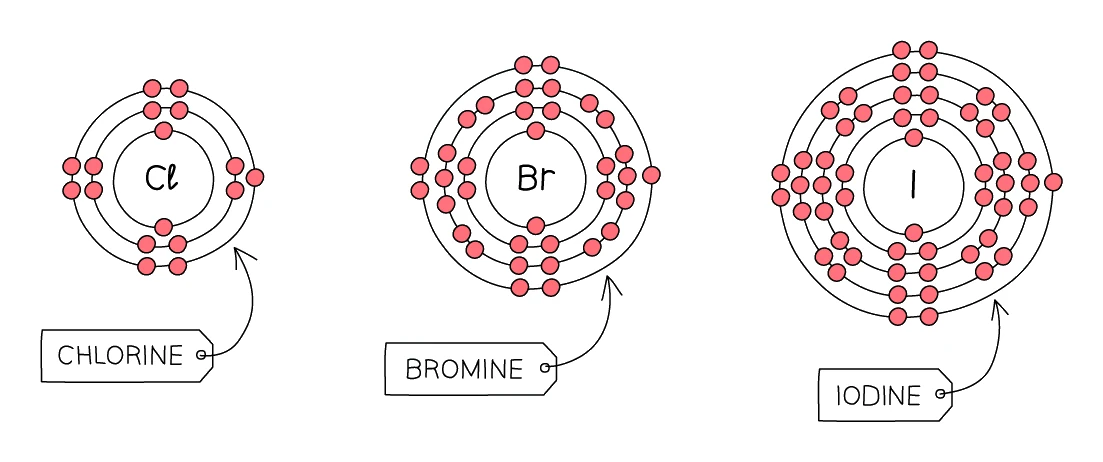
- Fluorine (proton number 9): 2, 7
- Chlorine (proton number 17): 2, 8, 7
- Bromine (proton number 35): 2, 8, 18, 7
- A halogen reacts by gaining one electron to complete its outer shell, which then has the noble gas configuration of the following group 0 element
- That captured electron makes the atom a 1−
Why reactivity decreases down Group 7
- An extra electron shell is added at each step down the group
- The outer shell therefore sits further from the positive nucleus
- The pull from the nucleus on an incoming electron is weaker the larger the atom (more distance, plus shielding by the inner shells)
- The atom finds it harder to grab a passing electron and complete its outer shell, so it reacts less readily
- Fluorine sits at the top with the smallest atom, the strongest pull, and is therefore the most reactive halogen; iodine sits much lower and is the least reactive of the four common halogens
Exam tip
Explaining reactivity through the electron a halogen gains
Explaining why one halogen is more reactive than another from electronic configurations is marked as a chain of four linked ideas that runs through the electron the atom gains. State which halogen is more reactive (or that reactivity falls down the group); say its outer shell sits nearer the nucleus because it has fewer shells, or a smaller atomic radius; say an incoming electron is therefore attracted more strongly, with less shielding an accepted alternative; and finish with that halogen accepting an electron more readily. Halogens gain an electron, so never borrow the Group 1 argument about losing one.