1. The Group 1 alkali metals
What Group 1 is
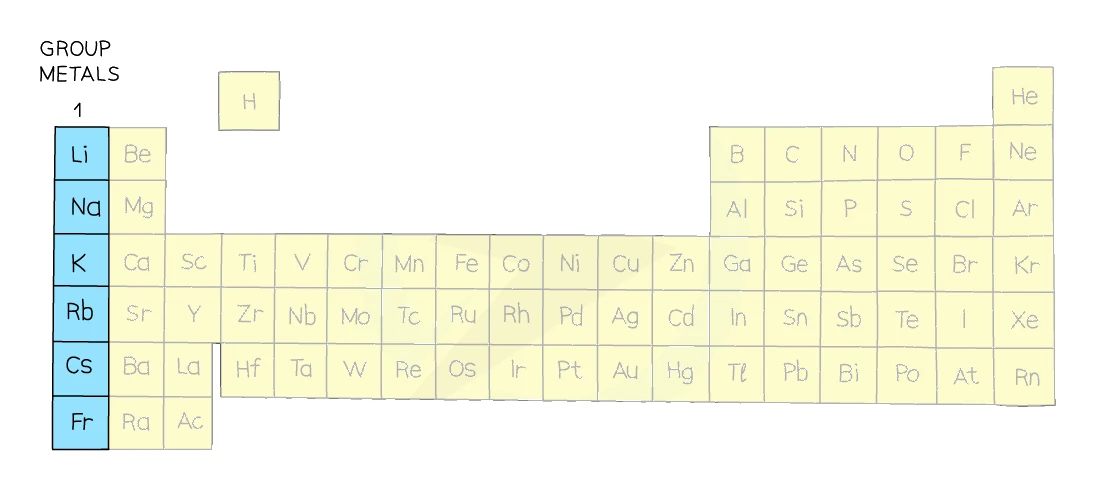
- Group 1 is the leftmost vertical group on the periodic table
- Its elements are the alkali metals: lithium, sodium, potassium, rubidium, caesium and francium
- They are called the alkali metals because they react with water to form alkaline solutions (pH > 7)
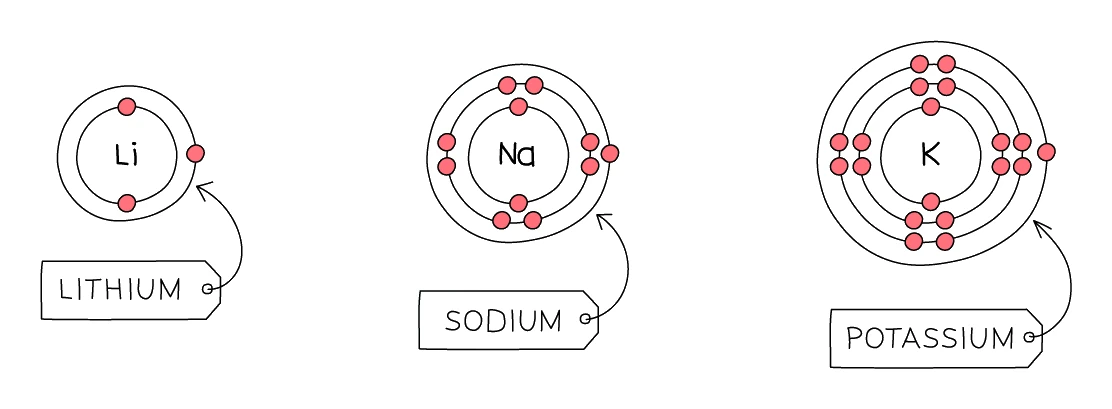
- Each atom has one electron in its outermost shell, which is why all six elements share a family resemblance in their chemistry
Physical properties shared by all Group 1 metals
- All six are soft enough to be cut with a knife
- A freshly cut surface is shiny and silvery
- They have relatively low densities — the top three (Li, Na, K) actually float on water
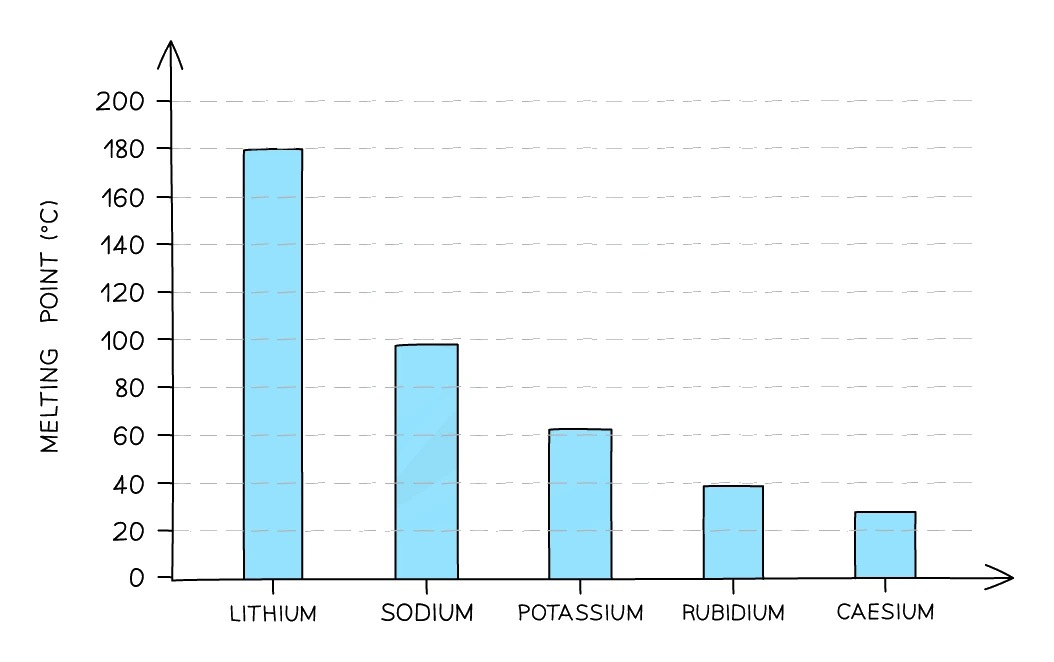
- They have low melting points compared with most other metals
- They are stored under oil to keep them away from air and moisture
General reaction with water
- Every Group 1 metal reacts with cold water to give the corresponding and hydrogen gas
2 M(s) + 2 H2O(l) → 2 MOH(aq) + H2(g)
- The hydroxide dissolves to give a colourless alkaline solution (lithium hydroxide, sodium hydroxide, potassium hydroxide and so on)
- The hydrogen gas can be tested by holding a lit splint over the bubbles — it gives the characteristic squeaky pop
Common exam question
Explaining the indicator colour after the reaction
Question: Universal indicator, phenolphthalein or methyl orange is in the water an alkali metal reacts with, or is added afterwards. Give, or explain, the final colour (1–2 marks).
Asked in 5 of the 23 papers. One mark is for the colour and one for the reason, which has two halves: the solution is alkaline because hydroxide ions (the metal hydroxide) have formed. Write both halves, because in one scheme "alkaline" only duplicates the colour mark and the second mark is reserved for the hydroxide ions.
Universal indicator turns blue or purple (violet and lilac are accepted). Phenolphthalein turns pink, and red or purple is rejected. Methyl orange turns yellow. Saying that a metal oxide forms earns nothing.
2. Trends down the group
Reactions with water become more vigorous down the group
- All Group 1 + water reactions give the same products, but the speed and energy of each reaction increase as you go down the group
| Metal | Word equation | Observations |
|---|---|---|
| Lithium | lithium + water → lithium hydroxide + hydrogen | Floats, fizzes steadily, moves slowly across the surface |
| Sodium | sodium + water → sodium hydroxide + hydrogen | Floats as a molten silvery ball, fizzes vigorously, darts about, can ignite to a yellow-orange flame |
| Potassium | potassium + water → potassium hydroxide + hydrogen | Reacts faster again, ignites at once and burns with a lilac flame above the water |
Common exam question
Observations when an alkali metal reacts with water
Question: A small piece of lithium, sodium or potassium is added to a trough of water. Give two observations, or two more besides those already described (2 marks).
Asked in 7 of the 23 papers, one mark per observation: it floats, it fizzes, it moves across the surface, it gets smaller, a white trail forms behind it, and sodium or potassium melts into a ball. Anything the stem has already given you (that it floats, that bubbles of hydrogen form) earns nothing again, and "hydrogen is produced" or "heat is given out" is not an observation.
Lithium does not melt, so "forms a ball" earns nothing for it, and one paper capped any lithium answer mentioning a flame at one mark; for sodium a flame is simply ignored. Potassium burns with a lilac flame: the flame, the melting and the faster reaction are the differences credited when potassium is compared with lithium or sodium. A wrong flame colour is rejected.
- Balanced symbol equations:
- 2 Li(s) + 2 H2O(l) → 2 LiOH(aq) + H2(g)
- 2 Na(s) + 2 H2O(l) → 2 NaOH(aq) + H2(g)
- 2 K(s) + 2 H2O(l) → 2 KOH(aq) + H2(g)
Worked example
Volume of hydrogen from a mass of sodium
A teacher drops 0.460 g of sodium into an excess of water. What volume of hydrogen, in cm3, forms at room temperature and pressure? (One mole of any gas occupies 24 000 cm3 at rtp; Ar of Na = 23.)
Solution:
- 2 Na(s) + 2 H2O(l) → 2 NaOH(aq) + H2(g), so 2 mol of sodium give 1 mol of hydrogen
- Moles of sodium = 0.460 ÷ 23 = 0.0200 mol
- Moles of hydrogen = 0.0200 ÷ 2 = 0.0100 mol
- Volume of hydrogen = 0.0100 × 24 000 = 240 cm3
This calculation has been set in 3 of the 23 papers, all on Paper 2, and it also runs in reverse (a volume of hydrogen to the mass of metal that made it). The halving is a mark on its own: leave it out, or double instead, and only that mark goes. A correct final answer with no working scores full marks, and rounding to one significant figure part-way through is penalised.
Reactions with oxygen become more vigorous down the group
- The alkali metals tarnish in air: a dull coating of metal oxide builds up on a freshly cut surface within seconds
- Tarnishing is faster the further down the group the metal sits — this is why the metals are stored under oil
- The general equation is 4 M(s) + O2(g) → 2 M2O(s):
- 4 Li(s) + O2(g) → 2 Li2O(s)
- 4 Na(s) + O2(g) → 2 Na2O(s)
- 4 K(s) + O2(g) → 2 K2O(s)
Physical trends down the group
- Softness increases: lithium can be cut with a knife with some effort, caesium with almost none
- Density rises overall down the group (Li 0.53 g cm−3, Na 0.97, K 0.86, Rb 1.53, Cs 1.93)
- Melting point falls down the group (Li 181 °C, Na 98 °C, K 63 °C, Rb 39 °C, Cs 29 °C)
Predicting properties of rubidium, caesium and francium
- Reactivity continues to increase, so the heavier alkali metals react with water explosively
- Rubidium should be a soft, silvery metal that is denser than potassium and melts below 63 °C
- Caesium is even softer, denser and lower-melting than rubidium
- Francium is radioactive and short-lived, but is predicted to be the most reactive Group 1 metal of all
3. Reactivity and electron configuration
Each alkali metal has one outer electron
- Lithium (proton number 3): 2, 1
- Sodium (proton number 11): 2, 8, 1
- Potassium (proton number 19): 2, 8, 8, 1
- The lone outer electron is the only thing the atom needs to lose in order to react
Common exam question
Why the alkali metals react in a similar way
Question: State, with reference to electronic configurations, why lithium, sodium and potassium have similar reactions with water (1 mark).
Set in 2 of the 23 papers. The mark is for the outer electron count: each atom has one electron in its outer shell, so they all have the same number of outer-shell (valence) electrons. That is the whole answer. The question says "electronic configurations", so being metals, or sitting in the same group, is not what it is asking for, and neither is a description of the reaction.
Forming 1+ ions
- When a Group 1 atom reacts, it loses its single outer electron to form a 1+ ion (Li+, Na+, K+, Rb+, Cs+)
- The shell below becomes the new outermost shell — it is already full, so the ion has the noble gas configuration of the previous group 0 element
Why reactivity increases down the group
- Going from lithium down to caesium, one extra electron shell is added at each step
- The outer electron therefore sits further from the nucleus
- The attraction between the outer electron and the positive nucleus is weaker (more distance, and inner shells partly shield the nuclear charge)
- Less energy is needed to remove the outer electron, so the atom loses it more easily
- An atom that loses its outer electron more readily reacts more readily — so the metals get more reactive as you descend the group
Common exam question
Explaining why reactivity increases down Group 1
Question: Explain why potassium is more reactive than lithium, or why lithium is less reactive than sodium, referring to atomic structure (3 marks).
Asked in 4 of the 23 papers, always on Paper 2. Three linked steps earn the marks. A potassium atom is larger, with more shells, so its outer electron is further from the nucleus (or write out both configurations); that outer electron is therefore less strongly attracted to the nucleus; so it is lost more easily and the metal is more reactive. The reverse argument for lithium scores the same.
Name the outer electron (or outer-shell electron) at every step: one recent scheme docks a mark if it is never named and another for writing "electrons" in the plural. Shielding by inner shells is accepted wording for a step, not a substitute for the others, and "lithium has fewer outer shells" is rejected because every atom has one outer shell.