1. Composition of air
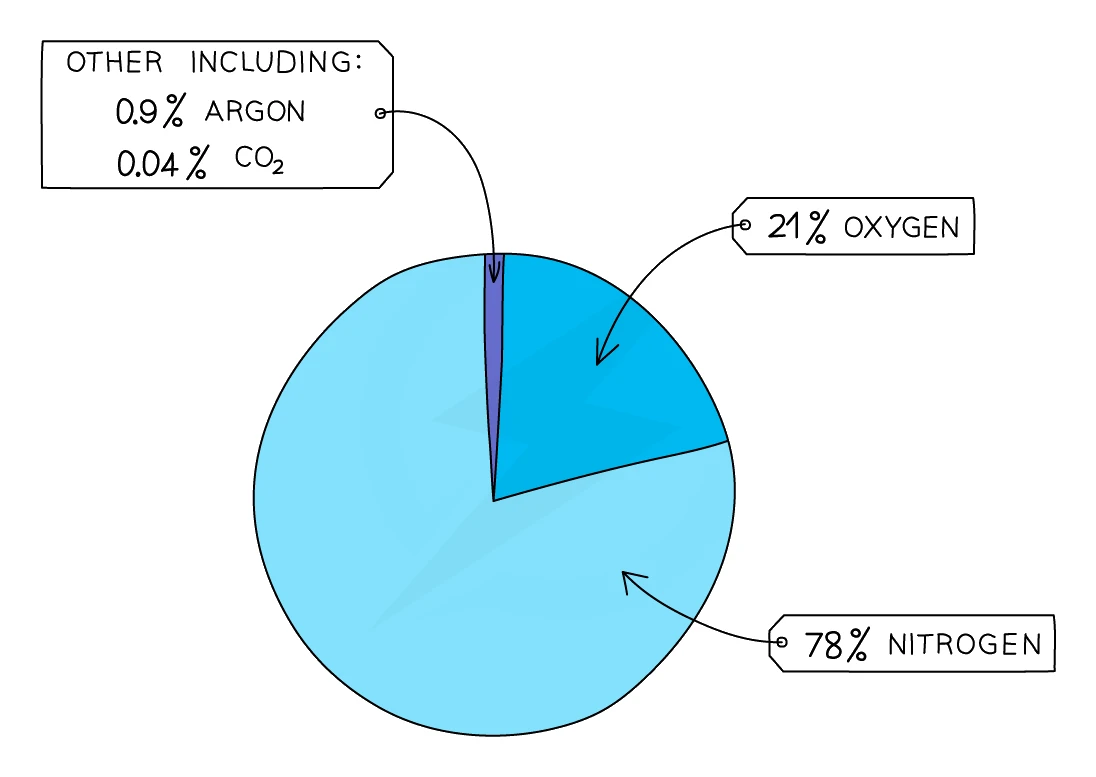
Approximate proportions
- Dry air is a mixture, not a compound
- It is made up of:
- Nitrogen, N2 — about four-fifths of the air, roughly 78–80%
- Oxygen, O2 — about one-fifth, roughly 20–21%
- Argon and other noble gases — about 1% in total
- Carbon dioxide, CO2 — about 0.04% (small but a key )
- Water vapour — a variable amount depending on humidity
- These proportions have stayed roughly constant for the last 200 million years; only the trace gases (especially CO2) have shifted noticeably over the last two centuries
Common exam question
Identifying a gas of the air from its percentage or property
Question: Name, or pick from a list, the gas that is most abundant in air, makes up about 1%, is the least reactive, is a greenhouse gas, or is not normally found in the atmosphere (1 mark each).
Asked in 9 of the 23 papers, sometimes as a pie chart or a table. About four-fifths (78–80%) of air is nitrogen and about one-fifth (21%) is oxygen. The noble gas at roughly 1% is argon, also the least reactive gas. Carbon dioxide (0.04%) has the lowest percentage of the gases usually listed, is the only compound among them and is the greenhouse gas (water vapour and methane are also accepted). The gas not normally present is hydrogen.
Write the name in full: N₂ is accepted but one scheme ignores a bare N. Argon exceeds carbon dioxide, so of those four the lowest percentage is carbon dioxide and the largest trace gas is argon. Air is a mixture, so it has no formula or relative formula mass.
2. Practical: finding the oxygen content of the air
Principle
- A reactive material is sealed inside a fixed volume of air and allowed to combine with the oxygen in that air
- The reacted oxygen leaves the gas phase, so the trapped gas volume shrinks
- The change in volume, divided by the starting volume, gives the percentage of oxygen
Method: iron in a burette
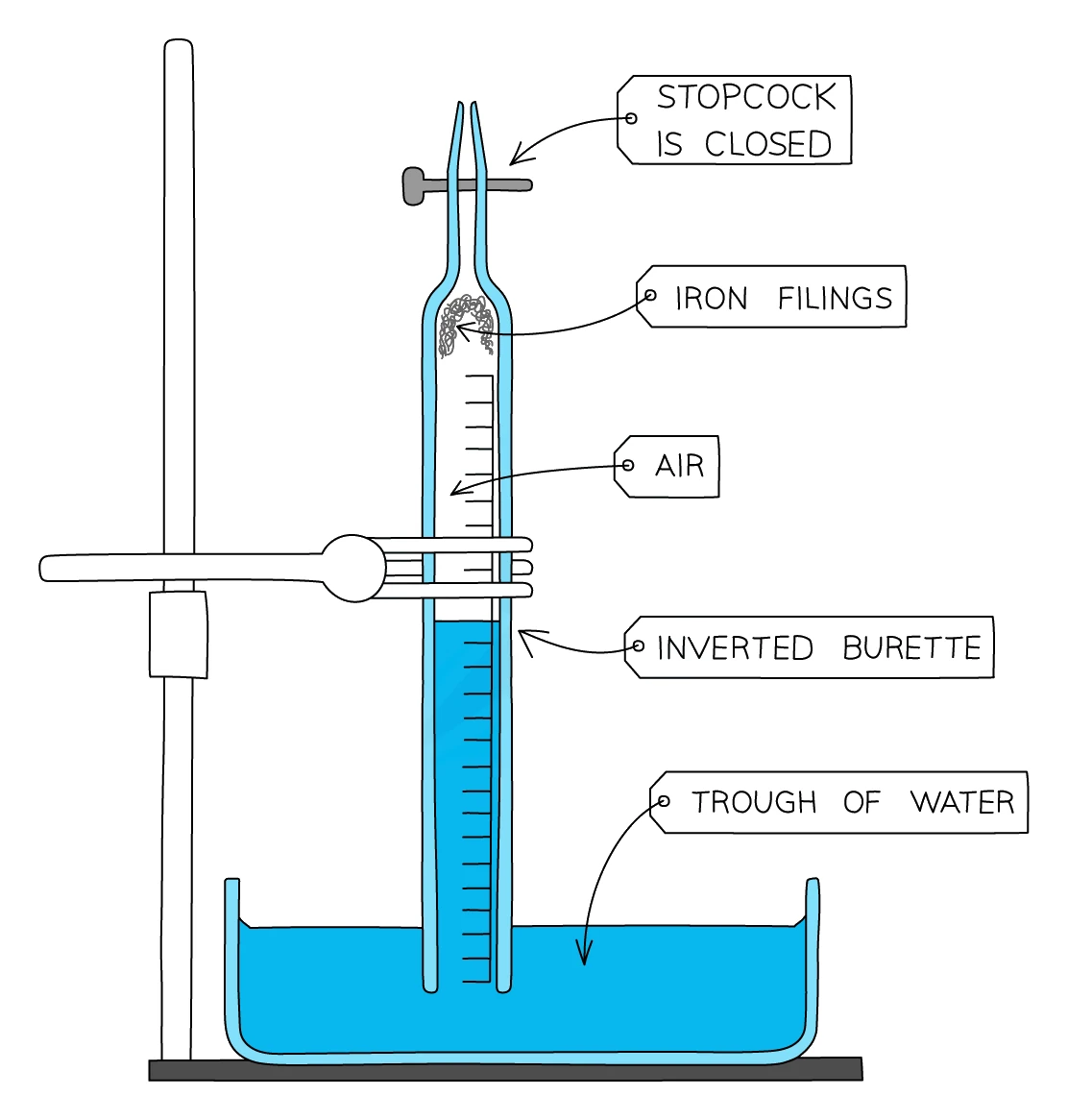
- Push damp iron wool into the closed end (the tap end) of an inverted burette, so the iron has plenty of contact with water and air
- Stand the burette mouth-down in a trough of water, with the tap closed at the top
- Read the water level inside the burette against the scale and write it down as the initial reading
- Leave the apparatus for several days while the iron slowly rusts, using up oxygen from the trapped air
- Once the water level stops rising, take a second reading against the same scale
Common exam question
Explaining the steps of the oxygen-in-air experiment
Question: Give a reason for a step, or state an observation, in an experiment to find the percentage of oxygen in air (1–2 marks per part).
Set in 6 of the 23 papers, with damp iron, hot copper between two syringes, or magnesium under a bell jar:
- Iron must be wet because rusting needs water; it turns brown as hydrated iron(III) oxide forms (write Fe₂O₃ when the formula is asked for; "iron oxide" alone is ignored). Powder rusts faster than lumps: larger surface area.
- Copper is heated because it does not react when cold, and turns black as copper(II) oxide forms (copper(I) oxide is rejected). Argon or neon is unreactive because its outer shell is full.
- Cool the gas before reading its volume, since gas volume changes with temperature; the readings stop changing once all the oxygen has reacted.
- Under the bell jar the water rises because the oxygen is used up, so the gas volume (or pressure) falls and water takes its place.
Sample calculation (worked through)
- Suppose the trapped air column measured 45.0 cm3 at the start, and 36.0 cm3 once rusting had stopped
- The volume of oxygen used up = 45.0 − 36.0 = 9.0 cm3
- Percentage of O2 in the original air = (9.0 ÷ 45.0) × 100 = 20.0%
- This is close to the accepted value near 21%; the small shortfall is because rusting is slow and some oxygen may remain unreacted
Common exam question
Calculating the percentage of oxygen from the volume change
Question: Use the starting and final volumes, or lengths of the gas column, to calculate the percentage of oxygen in the air (2–4 marks).
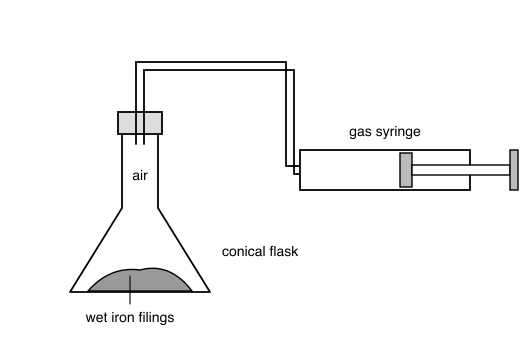
Set in 7 of the 23 papers. One mark is for the volume of oxygen used (start minus end) and the next for dividing it by the total starting volume and multiplying by 100. With a flask joined to a gas syringe, the total is flask plus syringe; dividing by the flask alone loses a mark. A correct answer scores full marks without working, except in a "show that" question, where the working must be written out.
Giving the percentage of gas left over instead of the oxygen earns only the first mark. Round correctly: a scheme rejects 17.8 or 17.85 where the value is 17.86. One paper reversed it, asking for the gas left from a known volume of air: 79% of the start (80% allowed); the oxygen volume alone scores 2 of 3.
Worked example
Percentage of oxygen with a flask and a gas syringe
The diagram shows the apparatus a student uses to measure how much of the air is oxygen. The flask and its connecting tube hold 240 cm³ of air, and the syringe reads 80 cm³ at the start. After a week the syringe reads 14 cm³ and stops changing. Work out the percentage of oxygen, by volume, in this sample of air, to three significant figures.
Solution:
- Volume of oxygen used = fall in the syringe reading = 80 − 14 = 66 cm³ (the flask's volume does not change)
- Total volume of air at the start = flask + syringe = 240 + 80 = 320 cm³
- Percentage of oxygen = 66 ÷ 320 × 100 = 20.625% = 20.6%
Common exam question
Why the measured percentage of oxygen is not 21%
Question: Give a reason why the percentage of oxygen calculated from the results is less than 21%, or may not be accurate (1 mark).
Set in 2 of the 23 papers, and the credited reason depends on the method. With damp iron left in a tube for a week, the answer is that not all the oxygen reacted: too little iron, or the reaction was incomplete or too slow. Water vapour in the gas column, or a change in temperature or pressure, is also allowed.
With hot copper and two syringes, where the gas is passed back and forth until the reading stops falling, "not all the oxygen reacted" is ignored. Give instead a leak in the apparatus, a temperature that differed between readings, or the gas not being cooled to room temperature before its volume was read.
Alternative material: burning phosphorus
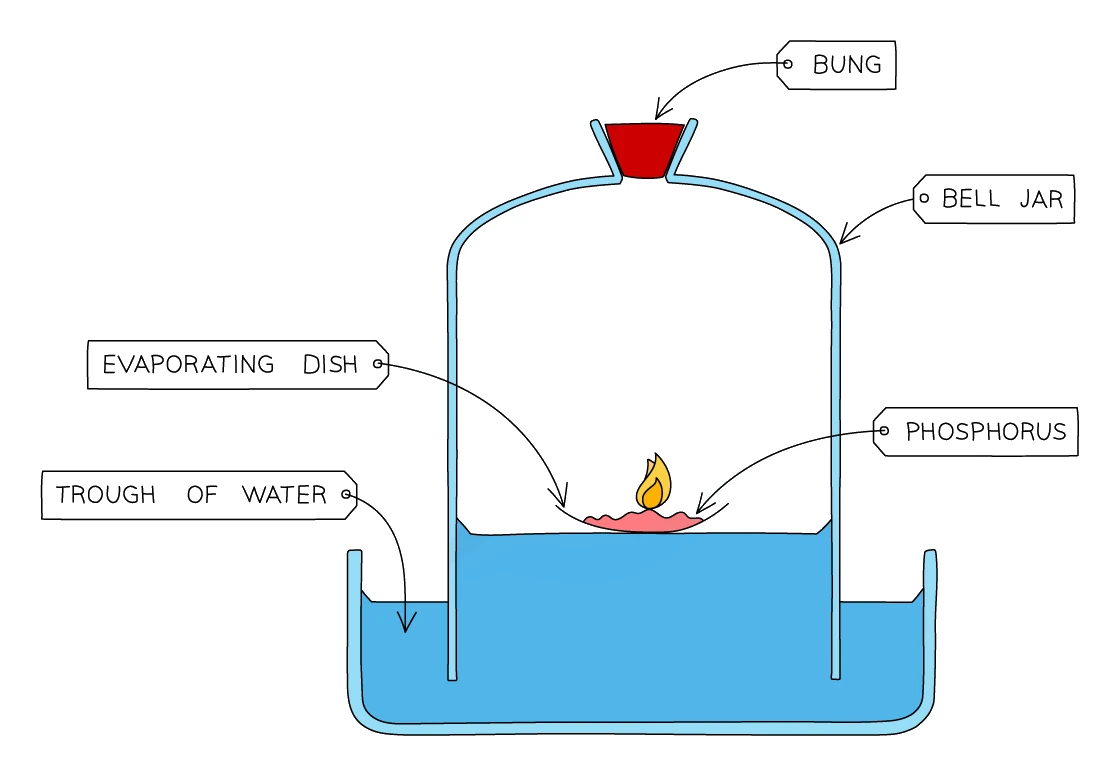
- Phosphorus burns readily in a sealed bell jar over water, consuming oxygen quickly rather than over days
- The water rises into the jar as the trapped gas contracts, by the same volume principle
- Phosphorus is toxic, so the iron-wool method is normally preferred for school work
3. Combustion
What combustion is
- Combustion is the reaction of a substance with oxygen, producing one or more oxides
- Every combustion reaction is exothermic — heat (and usually light) is released
- A combustion reaction is also classed as an oxidation reaction in the "addition of oxygen" sense
Three required combustion reactions
| Element burnt | Observations | Balanced equation |
|---|---|---|
| Magnesium | Intense white flame; fine white powder collects | 2 Mg(s) + O2(g) → 2 MgO(s) |
| Hydrogen | Burns quietly with a pale blue flame; a colourless liquid (water) condenses on a cool surface | 2 H2(g) + O2(g) → 2 H2O(l) |
| Sulfur | Burns with a pale blue flame; produces a colourless, choking gas | S(s) + O2(g) → SO2(g) |
- The magnesium product is an alkaline metal oxide
- The hydrogen product is water itself, the simplest non-metal oxide
- The sulfur product is sulfur dioxide, an acidic non-metal oxide and a major air pollutant linked to acid rain
Common exam question
Observations when magnesium or sulfur burns in oxygen
Question: State one or two observations when magnesium burns in oxygen or air, or give the appearance of the magnesium oxide formed (1–2 marks).
Asked in 4 of the 23 papers, and a fifth asks which metal burns with a bright white flame. The two observations are a bright white flame (or light) and a white solid, powder or ash left behind; white smoke or a grey powder is also allowed. "White precipitate" is rejected, because nothing is in solution. When only the appearance of the oxide is wanted, the flame earns nothing, so describe the solid.
Balance the equation as 2Mg + O₂ → 2MgO; one paper gave a second mark for the state symbols (s), (g) and (s). Sulfur was set once: it burns with a blue flame and gives a choking gas, and universal indicator added to that gas turns red, orange or yellow because sulfur dioxide forms an acidic solution.
4. Thermal decomposition of metal carbonates
What thermal decomposition is
- Thermal decomposition is a reaction in which a single compound breaks down into two or more simpler products when heated
- Metal carbonates from the lower half of the reactivity series break down readily on heating to give the metal oxide plus carbon dioxide
- General equation:
metal carbonate → metal oxide + carbon dioxide
- The carbon dioxide given off can be confirmed by bubbling it through limewater (calcium hydroxide solution), which turns milky/cloudy
Other examples
- ZnCO3(s) → ZnO(s) + CO2(g) (the white solid turns yellow when hot and back to white once cool)
- CaCO3(s) → CaO(s) + CO2(g) (the same reaction used industrially to make lime from limestone)
- Group 1 carbonates (Na2CO3, K2CO3) do not decompose at Bunsen-burner temperatures because their carbonates are very stable
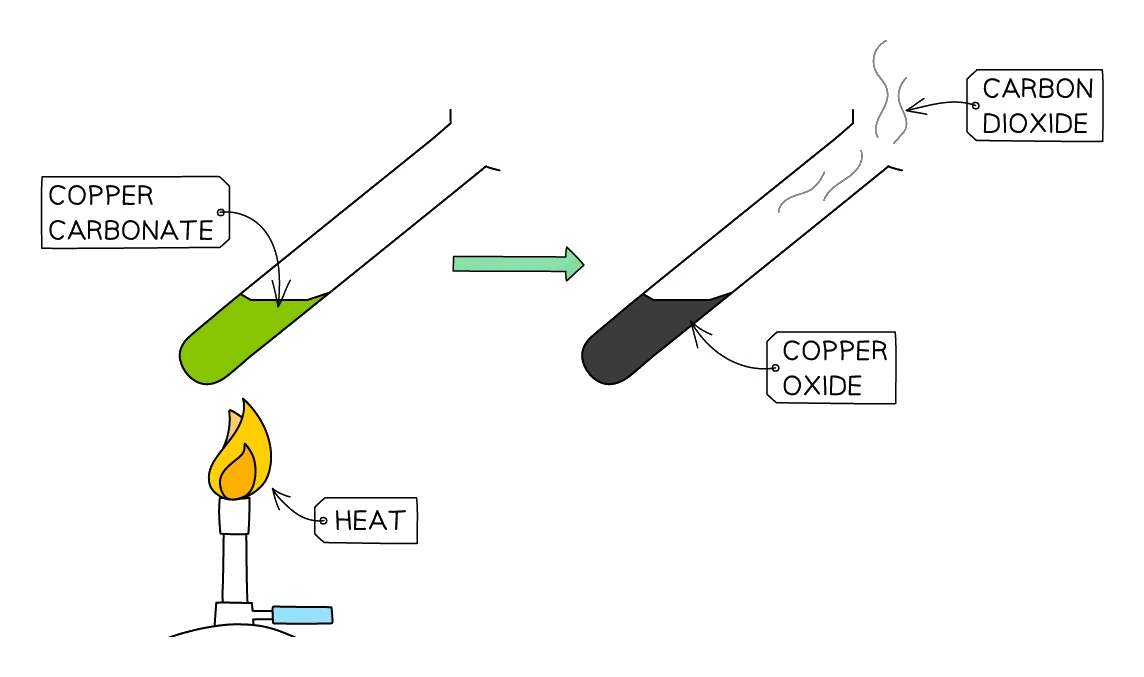
Common exam question
Thermal decomposition of copper(II) carbonate
Question: Name the type of reaction when copper(II) carbonate is heated, give the colour change, and give the chemical equation (1–2 marks per part).
Set in 3 of the 23 papers, twice as multiple choice. The reaction is thermal decomposition, the solid turns from green to black, and the equation is CuCO₃ → CuO + CO₂ (state symbols are not needed). When the colour change is worth two marks, one is for green and one for black, in that order. Copper(II) carbonate is green, not blue, and copper(II) oxide is black, not orange or white: the multiple-choice options offer both errors.
A fourth paper asked what the term thermal decomposition means: give both halves, a compound breaks down, by heating. "Elements" instead of a compound loses the first mark, and saying heat is given out loses the second. It also asked why a white, soluble solid cannot be copper(II) carbonate: green and insoluble.
5. The greenhouse effect
How the natural greenhouse effect works
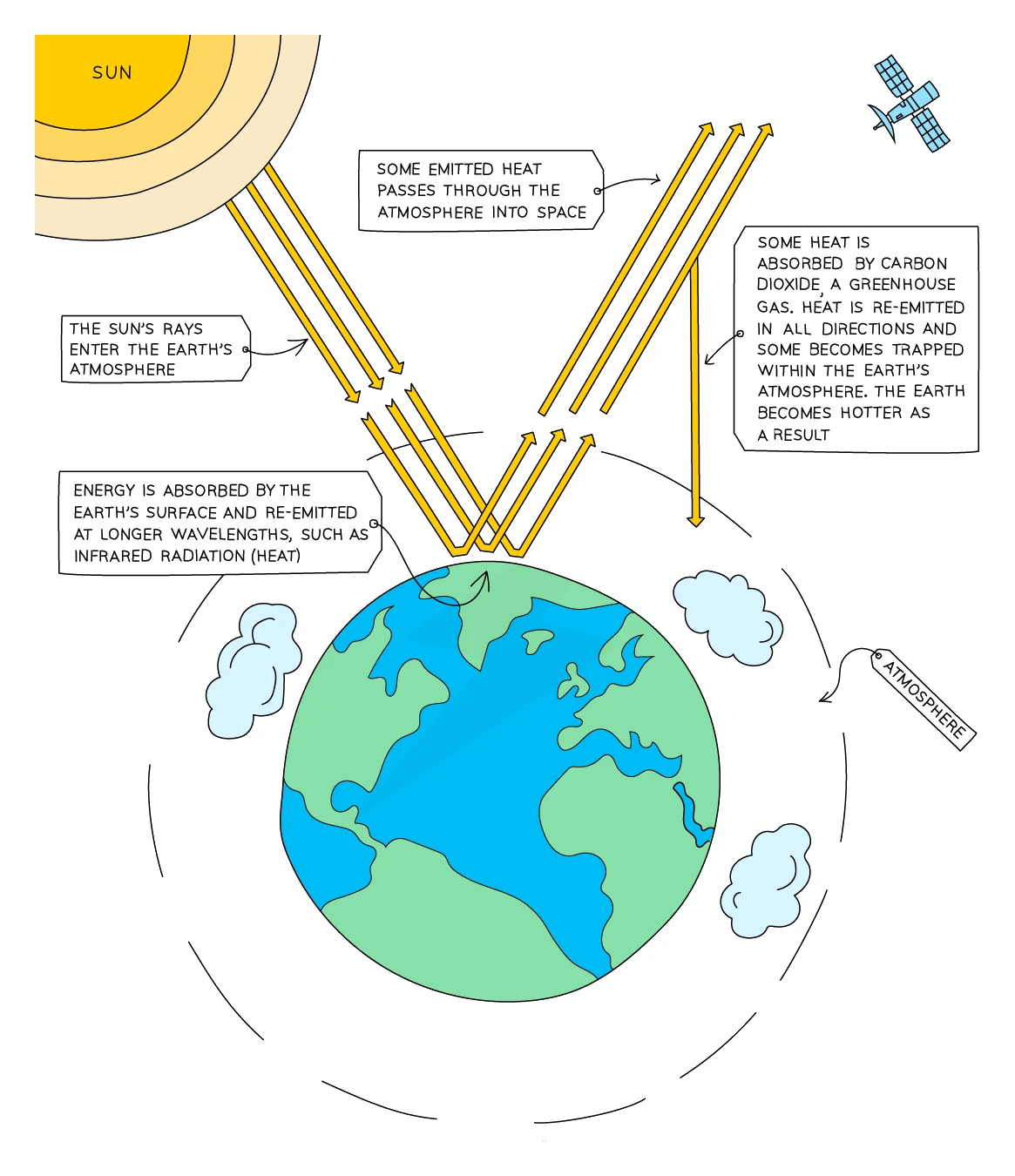
- Short-wavelength radiation from the Sun (visible and ultraviolet) passes through the atmosphere and warms the Earth's surface
- The warmed surface re-emits energy as infrared radiation with a longer wavelength
- Some of this outgoing infrared is absorbed by greenhouse gases in the atmosphere and re-radiated in all directions, including back down toward the surface
- The trapped energy keeps the average surface temperature at about +15 °C — without it, the planet would freeze
The main greenhouse gases
- Carbon dioxide, CO2
- Methane, CH4
- Water vapour, H2O
Sources of atmospheric carbon dioxide
- Burning fossil fuels (coal, oil, natural gas) and wood
- Heating limestone and other carbonate rocks during cement manufacture, releasing CO2 by thermal decomposition
- Natural weathering, where acids react with carbonate rocks
- Respiration: plants and animals exhale CO2 as a metabolic by-product
Enhanced greenhouse effect
- Human activity has raised CO2 and CH4 concentrations above their long-term natural values
- More greenhouse gas means more outgoing infrared is trapped, so the average surface temperature drifts upward — the enhanced
- This is the basis of the link between greenhouse gas emissions and global warming and
Common exam question
The problem caused by rising carbon dioxide
Question: Name, or explain, the environmental problem caused by an increasing amount of carbon dioxide in the atmosphere (1–2 marks).
Asked in 3 of the 23 papers, all on Paper 2, and two more ask only for the name of a greenhouse gas or the gas that affects global warming (carbon dioxide, or water vapour or methane). For one mark, global warming or climate change is enough; the greenhouse effect, oceans becoming more acidic, or an effect such as melting polar ice caps, flooding or wildfires is also accepted. For two marks, the first point must be that carbon dioxide is a greenhouse gas that traps heat (infrared radiation) in the atmosphere; the second is either global warming or climate change or a named consequence of it, such as melting ice caps, rising sea levels or flooding.
Mentioning the ozone layer is rejected and acid rain is ignored: neither is a greenhouse problem.