1. Element, compound or mixture
- Every chemical substance falls into one of three classes:
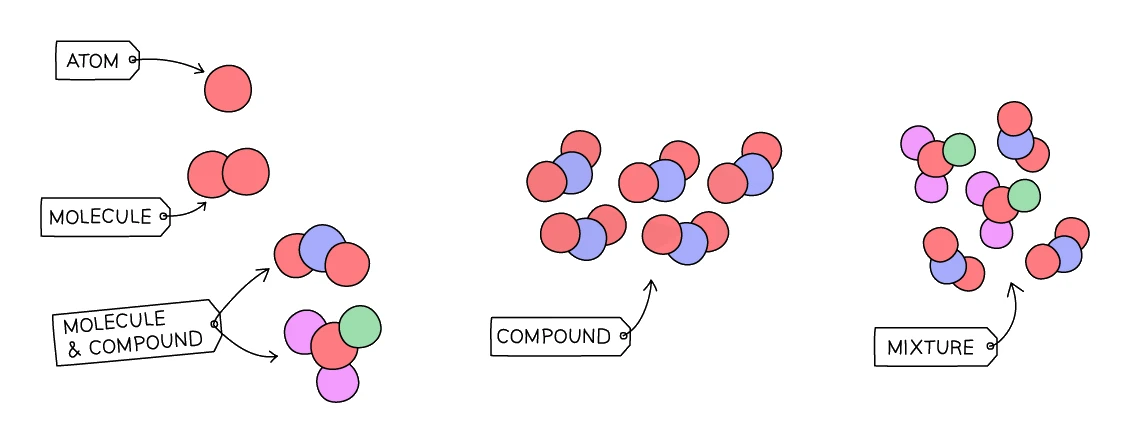
- Edexcel expects you to classify a substance from its name, formula, or particle diagram
Element
- Built entirely from atoms that all share the same proton number
- Each element has its own characteristic proton number (e.g. gold = 79, oxygen = 8)
- Cannot be reduced to anything simpler by ordinary chemical or physical methods
- 118 elements are known, all set out in the Periodic Table
- Examples: iron (Fe), copper (Cu), magnesium (Mg), oxygen (O₂), nitrogen (N₂), sulfur (S₈)
- Diatomic and polyatomic forms are still elements
- O₂ is an element (not a compound), because every atom in it is oxygen
Compound
- A pure substance formed when atoms of two or more different elements join in a fixed ratio through chemical bonds
- Has its own chemical properties, different from those of its elements
- Can only be broken back into its elements by another chemical reaction (not by physical means)
- Millions of different compounds exist
- Composition by mass is fixed
- Water is always H₂O, never H₃O or H₂O₂
- Sodium chloride is always one Na per one Cl
- Examples: water (H₂O), carbon dioxide (CO₂), calcium carbonate (CaCO₃), copper(II) sulfate (CuSO₄)
Mixture
- Two or more substances (any combination of elements and compounds) sharing the same space, with no chemical bonds between them
- Each component keeps its own chemical identity and properties
- Proportions can vary (a salt solution can be weak or strong)
- Components can be separated again by physical methods
- Examples:
- Air (mostly N₂ and O₂, plus Ar, CO₂, water vapour)
- Seawater (water + dissolved salts)
- Iron filings + sulfur powder
- Brass (copper + zinc)
Recognising the class from a formula
| What you see | Class | Examples |
|---|---|---|
| One element symbol only (optionally with subscript denoting a molecule of that element) | Element | Cu, O₂, S₈, P₄ |
| Two or more different element symbols bonded as one unit | Compound | H₂O, NaCl, CaCO₃, NH₃ |
| Two or more formulae written separately ("+", "and", or in a list) | Mixture | Fe + S; sand + water; air |
Common exam question
Explaining why a substance is a compound
Question: Explain why a substance shown as a molecule, a giant structure or a formula (hydrogen chloride, silicon dioxide) is a compound (2 marks).
Asked in 3 of the 23 papers, always for the same two marks: it contains two or more different elements ("different atoms" is accepted), and those atoms are chemically bonded or joined together. Naming the elements on its own is only the first mark.
Do not name a type of bonding unless you are certain of it. For silicon dioxide the second mark was refused to answers that said the atoms were held by intermolecular forces or by ionic bonds, whereas the plain phrase "chemically bonded together" always scores. The mirror questions are set as well: diamond is an element because it contains only one type of atom, and a box of particles represents a mixture because it contains two different substances (calling those particles compounds was rejected).
Common exam question
Counting the elements and atoms in a formula
Question: Give the number of different elements in a formula such as C₆H₁₂O₆ or Na₂SO₄·7H₂O, and then the total number of atoms in it (1 mark each).
The element count is asked in 6 of the 23 papers and the atom count in 7, sometimes as a multiple-choice item. For the elements, count the different capital-letter symbols, not the atoms: glucose has three elements even though it has 24 atoms. In a hydrated formula the water counts too, so Na₂SO₄·7H₂O has four elements: sodium, sulfur, oxygen and hydrogen (the wrong options offered were 3, 5 and 10). For the atoms, add every subscript, counting the water as many times as its coefficient says: Na₂SO₄·7H₂O has 2 + 1 + 4 + 21 = 28 atoms, and caffeine, C₈H₁₀N₄O₂, has 24.
2. Pure substances and mixtures
- In everyday English, "pure" usually means clean or natural
- In chemistry, a pure substance = a sample containing only one element or only one compound, with nothing else present
- "Pure" supermarket water is not chemically pure: it contains dissolved minerals, dissolved oxygen, sometimes fluoride
- Chemically pure water contains only H₂O molecules
Testing purity by melting and boiling behaviour
- : sharp, fixed melting point and boiling point
- Pure water melts at 0 °C, boils at 100 °C
- Pure NaCl melts at 801 °C
- or impure substance: melts over a range of temperatures, not at a single value
- Impurities lower the melting point and raise the boiling point
- Quality control for pharmaceuticals and foodstuffs routinely uses melting-point analysis
- A capillary tube of the sample is heated slowly in a melting-point apparatus
- Measured value is compared against the literature value
- Closer to the literature value, and narrower range = purer
Common exam question
Physical test to show that a liquid is pure
Question: Describe a physical test to show that a colourless liquid is pure water, or that a liquid collected by distillation is pure (2 marks).
Asked in 7 of the 23 papers, usually after a question has made or collected the liquid. The first mark is for measuring the boiling point (or the freezing point; "boil it" is accepted), the second for the value: 100 °C for boiling, 0 °C for freezing. The value must match the property, so never pair the boiling point with 0 °C. "Evaporate it" was rejected as the test.
For a liquid other than water (ethanol from a distillation) the second mark is instead that a pure substance boils at one fixed temperature, not over a range, and its known boiling point (78 °C for ethanol) scores too; a melting-point answer earns nothing there. The chemical test for water (anhydrous copper(II) sulfate turning blue) shows that water is present, not that it is pure, so it is not the answer here.
3. Separation techniques
| Mixture | Best method |
|---|---|
| Insoluble solid + liquid | Filtration |
| Soluble solid + liquid (want the solid back as crystals) | Crystallisation |
| Soluble solid + liquid (want the liquid back pure) | Simple distillation |
| Two or more miscible liquids of different b.p. | Fractional distillation |
| Coloured substances dissolved in a single solvent | Paper chromatography |
Common exam question
Choosing the separation technique for a mixture
Question: Choose from a box, or name, the technique that gives a named substance from a mixture: sand from seawater, water from copper(II) sulfate solution, gasoline from crude oil, the dyes in an ink (1 mark each).
Asked in 10 of the 23 papers, as a word box, a table, a multiple-choice item or a labelled diagram. The matches are fixed: insoluble solid from a liquid, filtration; dissolved solid back as crystals, crystallisation; solvent back from a solution, simple distillation; liquids with different boiling points (ethanol and water, crude oil), fractional distillation; dyes, chromatography.
Write the full name: bare "distillation" was rejected in two mark schemes and accepted in only one, and each distillation was rejected for the other's job ("fractional" for recovering the solvent ethanol from a solution of a solid, "simple" for separating ethanol from water). A gap-fill version wants the steps that take a soluble solid away from an insoluble one: dissolve, filter, evaporate some of the water, crystallise.
Filtration
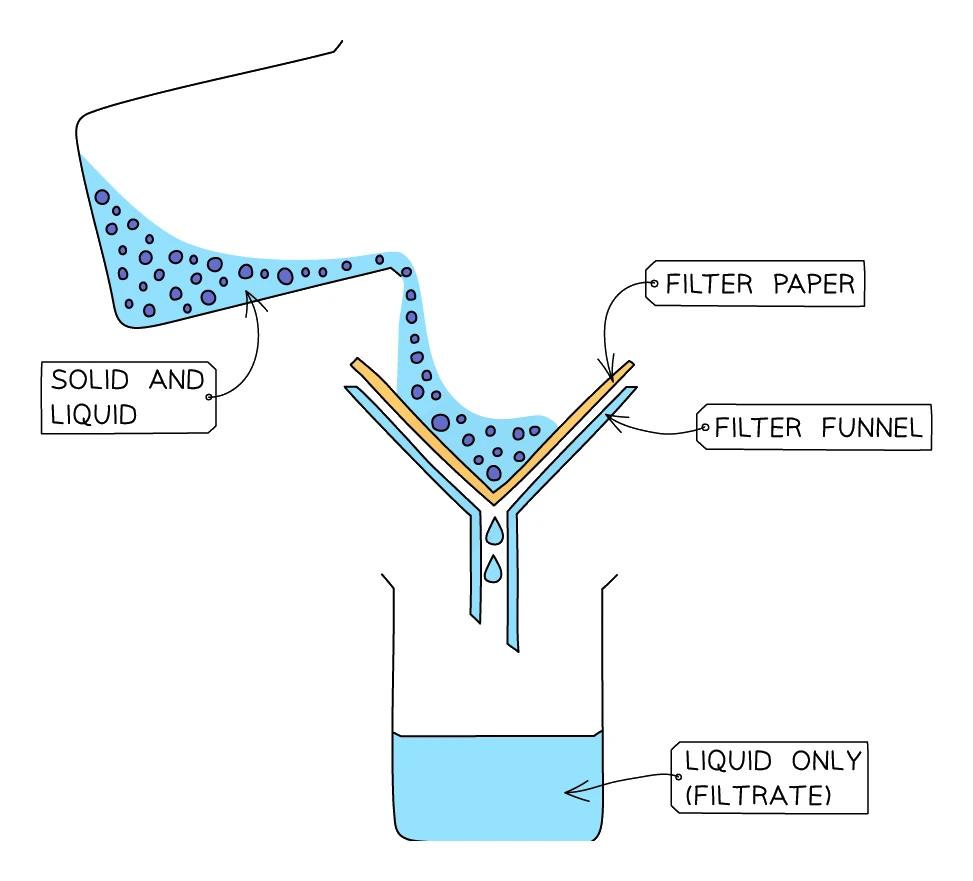
- Separates an solid from a liquid (e.g. sand from water)
- Apparatus:
- Folded filter paper in a filter funnel
- Funnel resting on the rim of a beaker (or held in a clamp above it)
- The mixture is poured into the funnel; the paper traps solid particles
- Residue = solid caught on the paper
- Filtrate = liquid that passes through into the beaker
- Centrifugation is an alternative for very fine particles (more common in biology than in chemistry)
Crystallisation
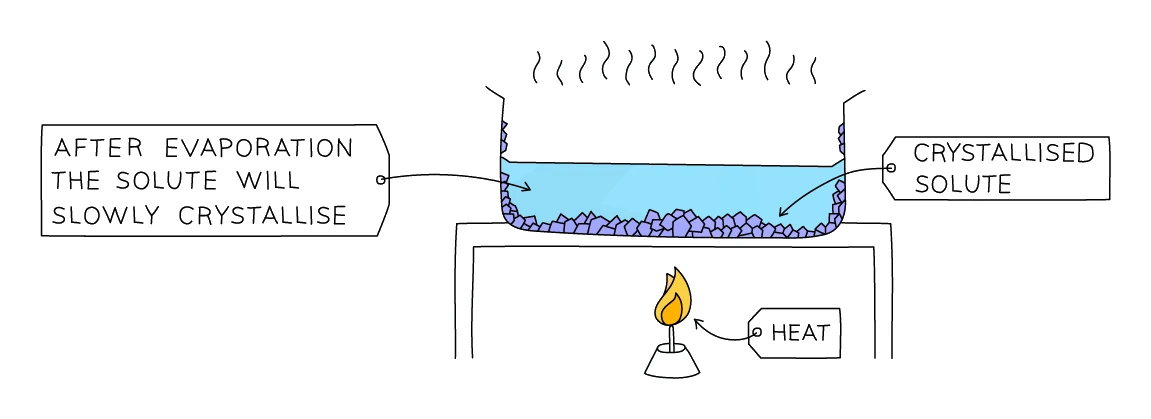
- Pulls a solid back out of its solution as well-formed crystals
- Works because the solubility of most solids falls sharply on cooling
- Procedure:
- Heat the solution gently to evaporate some solvent and concentrate it
- To test for saturation, touch the surface with a chilled, clean glass rod. If crystals form on the rod, the solution is saturated
- Stop heating; cool slowly (slow cooling = larger, better-formed crystals)
- Filter off the crystals; wash with a small volume of cold distilled water to rinse off impurities; pat dry between filter papers
- Standard method for harvesting:
- Hydrated copper(II) sulfate (CuSO₄·5H₂O) from CuSO₄ solution
- Industrially: sugar, alum, potash
Common exam question
Obtaining pure, dry crystals from a solution
Question: Describe how to obtain pure, dry crystals of a salt from its solution (4–5 marks).
Set in 8 of the 23 papers, and four points recur in every scheme. Heat the solution so that some of the water evaporates and it becomes saturated (crystals first appear, or form on a glass rod). Leave it to cool so crystals form. Filter or pour off the remaining liquid. Dry the crystals between filter papers, in a warm oven or in a desiccator.
Heating until all the water has gone is heating to dryness, which the schemes cap at one or two marks of the four or five; two schemes rejected a hot oven or a Bunsen flame for drying. Washing earns nothing, and washing after drying loses the drying mark. When the solution was made with an excess of solid, filtering that excess off first is the fifth mark; when it came from a titration, repeating it without the indicator is.
Simple distillation
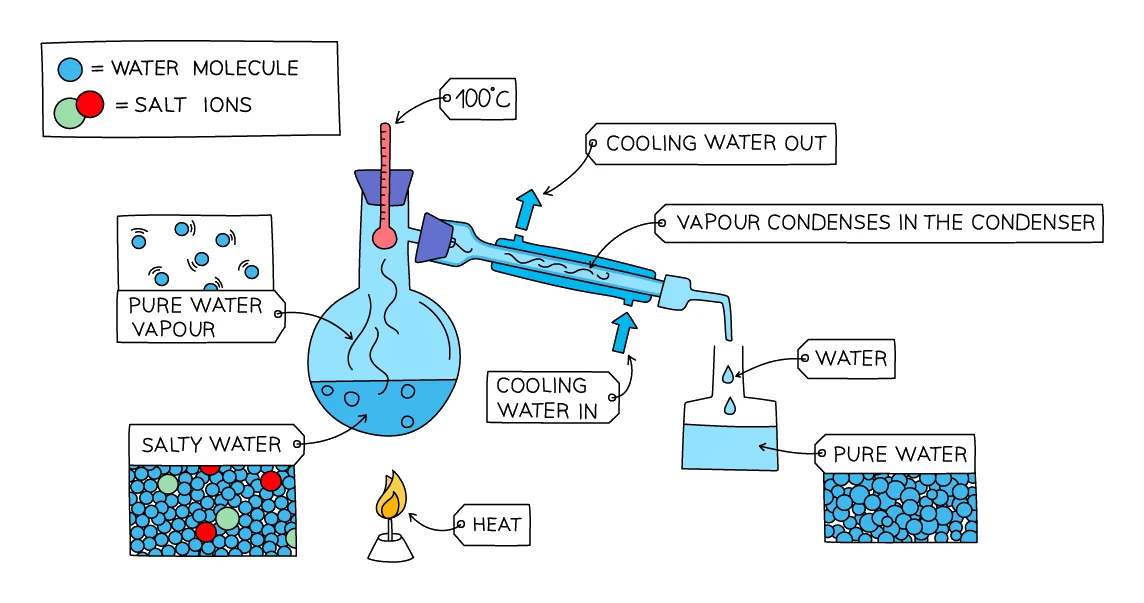
- Separates a liquid from a dissolved (e.g. pure water from salt water)
- Also isolates a single pure liquid from a mixture whose other components boil much higher
- How it works:
- The solution is heated in a round-bottomed flask
- The volatile component vaporises and rises out of the flask
- The vapour passes into a water-jacketed condenser and is cooled back into liquid form
- The pure liquid is collected in a beaker; the solute stays behind in the flask
Common exam question
Labelling and explaining the distillation apparatus
Question: Name the pieces of apparatus labelled on a distillation diagram, or explain what happens to the vapour in the condenser and why water flows through it (2–3 marks).
Set in 3 of the 23 papers. The labels wanted are the thermometer above the flask (at the top of the column, since the printed apparatus was a fractional distillation), the Liebig condenser ("condenser" is enough) and the beaker collecting the distillate, one mark each. The condenser question is two linked marks: the cold water cools the vapour (first mark), so it condenses back to a liquid (second mark). Water flows in and out continuously to keep the condenser cold, and saying only that it cools the vapour, without the condensing, is one mark of the two.
Fractional distillation
- Separates two or more liquids with different boiling points
- Example: ethanol (b.p. 78 °C) and water (b.p. 100 °C)
- Industrial example: crude oil into petrol, kerosene, diesel etc. (see Topic 11)
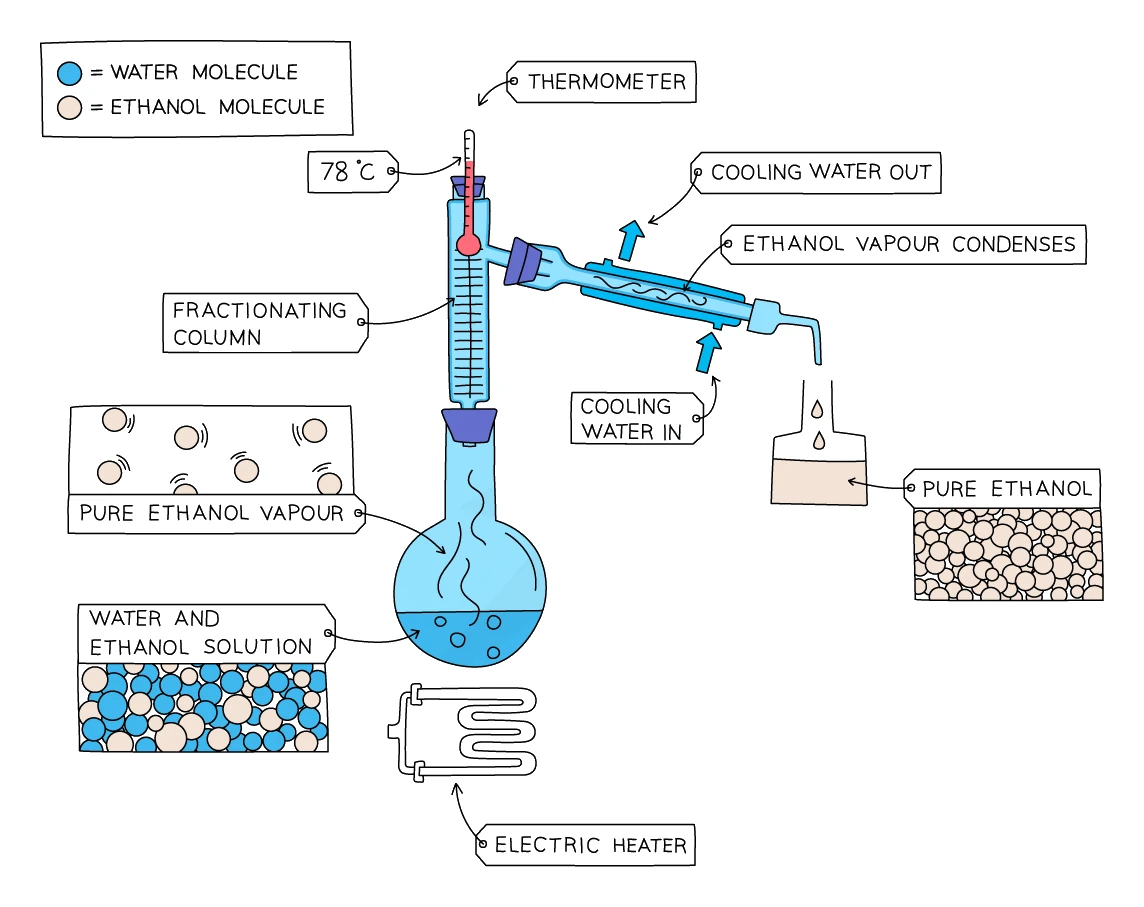
- Apparatus is simple distillation plus a vertical fractionating column between the flask and the condenser
- Column packed with glass beads (or fitted with plates)
- Provides a large surface area for repeated condensation and re-evaporation
- Each cycle enriches the rising vapour in the lower-boiling component
- Procedure (ethanol/water):
- Heat the flask; thermometer at the top of the column reads 78 °C when ethanol vapour reaches it
- Pure (or nearly pure) ethanol distils over; thermometer holds at 78 °C
- When the ethanol is exhausted, the temperature rises towards 100 °C as water starts to come over; stop collecting, or switch flasks
Paper chromatography
- Separates dissolved substances whose solubilities in a single chosen solvent differ from one another
- Typical targets: ink dyes, food colourings, plant pigments
- Procedure:
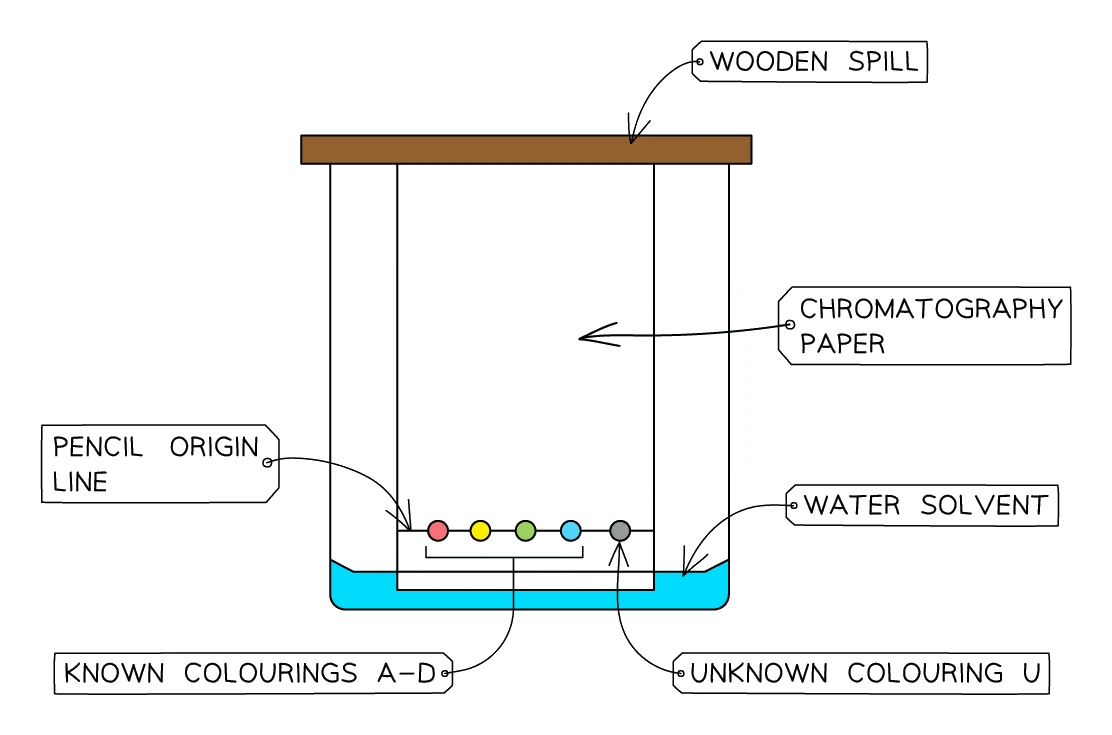
- Draw a horizontal baseline in pencil about 1–2 cm from one short edge of the chromatography paper
- Pencil graphite is insoluble; pen ink would itself run up the paper
- With a fine capillary tube, place one small spot of each sample on the baseline (fresh tube per sample)
- Stand the paper in a covered beaker with a shallow layer of solvent
- Solvent level must be below the baseline
- The solvent climbs the paper by capillary action, carrying dissolved substances with it
- More soluble in the solvent → travels further
- Less soluble (sticks to paper) → travels less
- When the solvent front is near the top, lift out the paper, mark the solvent front in pencil, and let it dry
- Draw a horizontal baseline in pencil about 1–2 cm from one short edge of the chromatography paper
4. Interpreting chromatograms
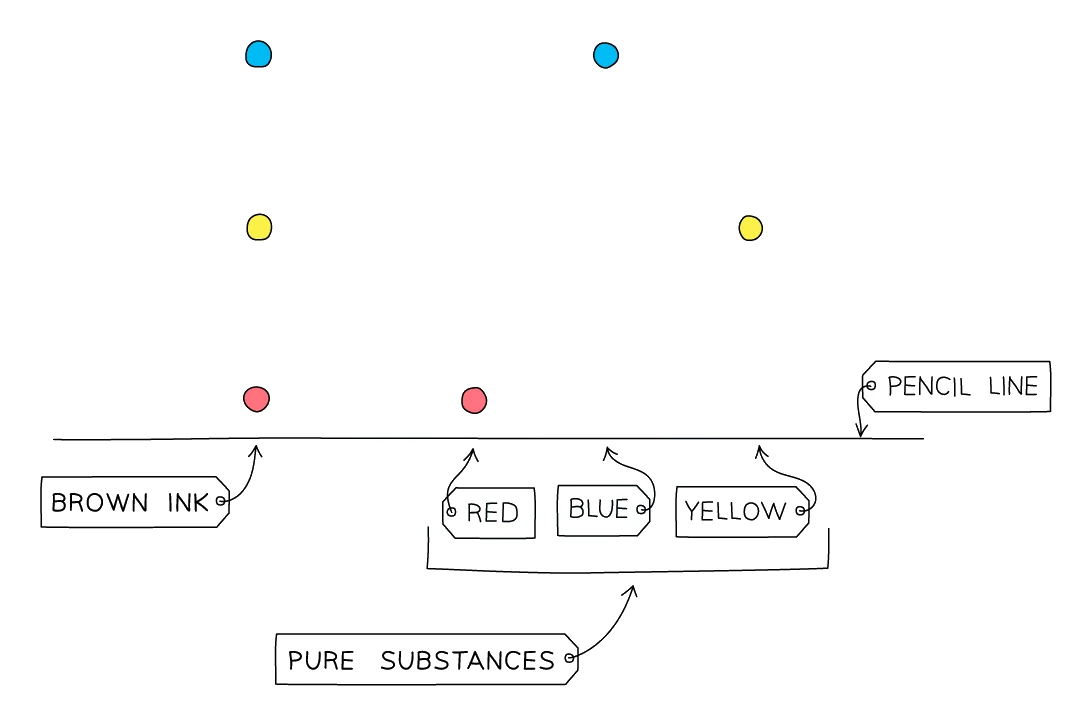
- A chromatogram is read by comparing the spots of an unknown sample against spots from known reference substances
- → a single spot in its lane
- Impure substance → two or more spots in the same lane
- Two samples of the same substance → produce identical chromatograms (same number of spots at the same heights)
- A separates on the paper, with each of its constituent substances showing up as a distinct spot in the lane
- Standard practice is to run known reference samples alongside the unknown in adjacent lanes
- The references give you fixed positions to compare against
- Any spot in the unknown lane that sits at the same height as a reference spot is the same substance
Common exam question
Reading a chromatogram
Question: Use a chromatogram, or a table of Rf values, to say which colourings share a dye, how many dyes one contains, which dye is insoluble, or why one travels furthest (1–2 marks per part).
Asked in 7 of the 23 papers. Two colourings share a dye when they have spots at the same height (same distance, same Rf value); a colouring has as many dyes as spots in its lane; a spot still on the start line (Rf of 0) is a dye insoluble in the solvent; the dye that travels furthest is the most soluble in it.
In a two-mark "explain which" part the reason mark depends on the right pair or lane, so identify first. Give the reason as solubility: "it moves further up the paper" only restates the chromatogram and was ignored. One spot proves a single dye only if it has moved; one still on the line could be several insoluble dyes.
Rf values
- Rf (retention factor) is used to identify a component quantitatively
- Defined by:
- Distance moved by the substance is measured from the baseline up to the centre of the spot
- Distance moved by the solvent is measured from the baseline up to the front
- Properties:
- Has no units (it's a ratio)
- Always less than 1 (a spot can't travel further than the solvent that carries it)
- Constant for a given solute, solvent and paper at a given temperature
- Changes if you change the solvent or the paper
Common exam question
Measuring and calculating an Rf value
Question: Calculate the Rf value of a dye from a chromatogram, or describe how to find it (2–3 marks).
Set in 5 of the 23 papers. Measure both distances from the start line, not the paper's bottom edge: to the centre of the spot and to the solvent front. The readings are the first mark (one each in one paper); dividing the spot's distance by the solvent's is the next. Readings are accepted within a couple of millimetres, and a wrong one written down still earns the division mark by follow-through.
Rf is always less than 1: the inverted fraction scored one mark of three. Round correctly: the last mark was withheld for a wrongly rounded value, and when two significant figures are asked for, the unrounded 0.808 still earns the working marks but only 0.81 earns the last. One paper instead listed two students' Rf values and asked which was impossible: the one above 1, as a spot cannot pass the solvent front.
Worked example
Calculating an Rf value from a chromatogram
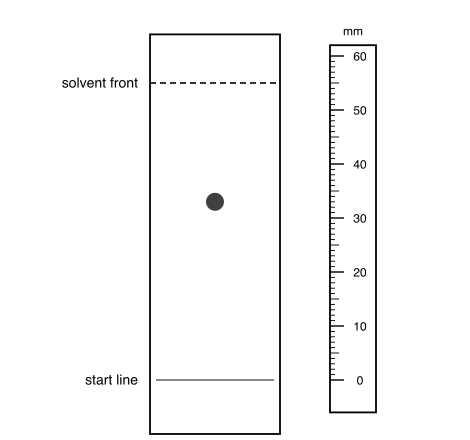
The diagram shows a chromatogram of a single dye, with a millimetre ruler laid beside it so that its zero is on the start line. Use the ruler to work out the dye's Rf value, to two significant figures.
Solution:
- Take both readings from the start line: the spot's centre is at 33 mm and the solvent front at 55 mm
- Rf = how far the dye moved ÷ how far the solvent moved = 33 ÷ 55
- Rf = 0.6 exactly, written to two significant figures as 0.60 (no units: it is a ratio, and always less than 1)
5. Practical: paper chromatography of food colourings
Aim
- Use paper chromatography to separate the components of a mixed food colouring
- Identify the components by comparing Rf values and spot positions against known reference colourings
Apparatus
- 250 cm³ beaker (with a watch glass or piece of clingfilm as a lid)
- Strip of chromatography paper sized to fit inside the beaker
- Five fine capillary tubes (one fresh tube per colouring)
- Four reference food colourings labelled A–D
- One mixed food colouring of unknown composition labelled U
- Wooden spill (or any pencil long enough to span the beaker mouth)
- Paper clip
- Ruler and a sharp pencil
Method
- Draw a horizontal baseline in pencil about 2 cm in from one short edge of the paper
- Using a fresh capillary tube for each colouring, place a small spot of each of A, B, C, D and U on the baseline, evenly spaced
- Keep every spot under about 3 mm wide
- Label each spot beneath in pencil
- Add water to the beaker so it forms a shallow pool no deeper than 1 cm
- Clip the top of the paper to the wooden spill and lay the spill across the beaker mouth so the paper hangs vertically, spotted end down
- Lower the paper into the beaker so its lower edge dips into the water, with the baseline staying above the water level
- Cover the beaker (watch glass or clingfilm) to keep the air inside saturated with solvent vapour
- Let the solvent climb the paper undisturbed until it has risen roughly three-quarters of the paper's length, and always before the front meets the top edge
- Lift the paper out, immediately mark the solvent front in pencil, and let the paper dry flat
- Measure (in mm) two distances: baseline → solvent front, and baseline → each spot's centre
- Calculate Rf for every spot in lanes A–D and U
- Identify the unknown. A spot in U with the same Rf, and at the same height, as a reference spot is the same substance
Results — suggested table
| Lane | Distance moved by spot / mm | Distance moved by solvent / mm | Rf value |
|---|---|---|---|
| A | |||
| B | |||
| C | |||
| D | |||
| U (spot 1) | |||
| U (spot 2) |
Sources of error
- Baseline drawn in pen, not pencil. Pen ink itself runs up the paper and contaminates every lane. Always use pencil for baseline and labels
- Sample spots too large. Bands smear during migration and the spot centre is hard to pin down. Use a fresh capillary tube per colouring and keep each spot small
- above the baseline. Samples dissolve straight into the solvent pool, so no migration occurs. Always check the solvent level before lowering the paper
- Solvent reaches the top edge of the paper. Once the front has gone off the paper, you cannot tell how far it travelled, so no Rf is calculable. Lift the paper out well before the front gets there
- Beaker left uncovered. Solvent evaporates from the paper, slowing the run and shifting the spot positions. Cover the beaker to keep the inside saturated with vapour
Common exam question
Describing or explaining the chromatography set-up
Question: Describe how to carry out paper chromatography, or explain its set-up: the pencil line, spots above the solvent, or mistakes in a diagram (1–5 marks).
Set in 6 of the 23 papers. Each step described is a mark: start line in pencil near the bottom; a spot of each sample on the line; shallow solvent in the beaker; paper in with the line above the solvent; leave until the solvent has nearly reached the top; mark the solvent front; dry. A labelled diagram can earn every mark.
The reasons are the same facts reversed: pencil is insoluble, so it does not run; spots above the solvent do not dissolve into it, so they travel up the paper. For each mistake give it and its consequence: an ink line runs and contaminates results; solvent above the line washes the sample off. Two runs compare fairly only with the same solvent and paper; solvent volume, temperature and time are ignored.