1. Fractional distillation of crude oil
What crude oil is
- (petroleum) is a thick black mixture of many different hydrocarbons formed over millions of years from the remains of ancient marine organisms
- It is a finite resource — the supply cannot be replaced on a human timescale
- In its raw state crude oil is not directly useful; it has to be separated into groups of hydrocarbons with similar properties, called
Fractional distillation
- Fractional distillation is the industrial process used to separate crude oil into its fractions
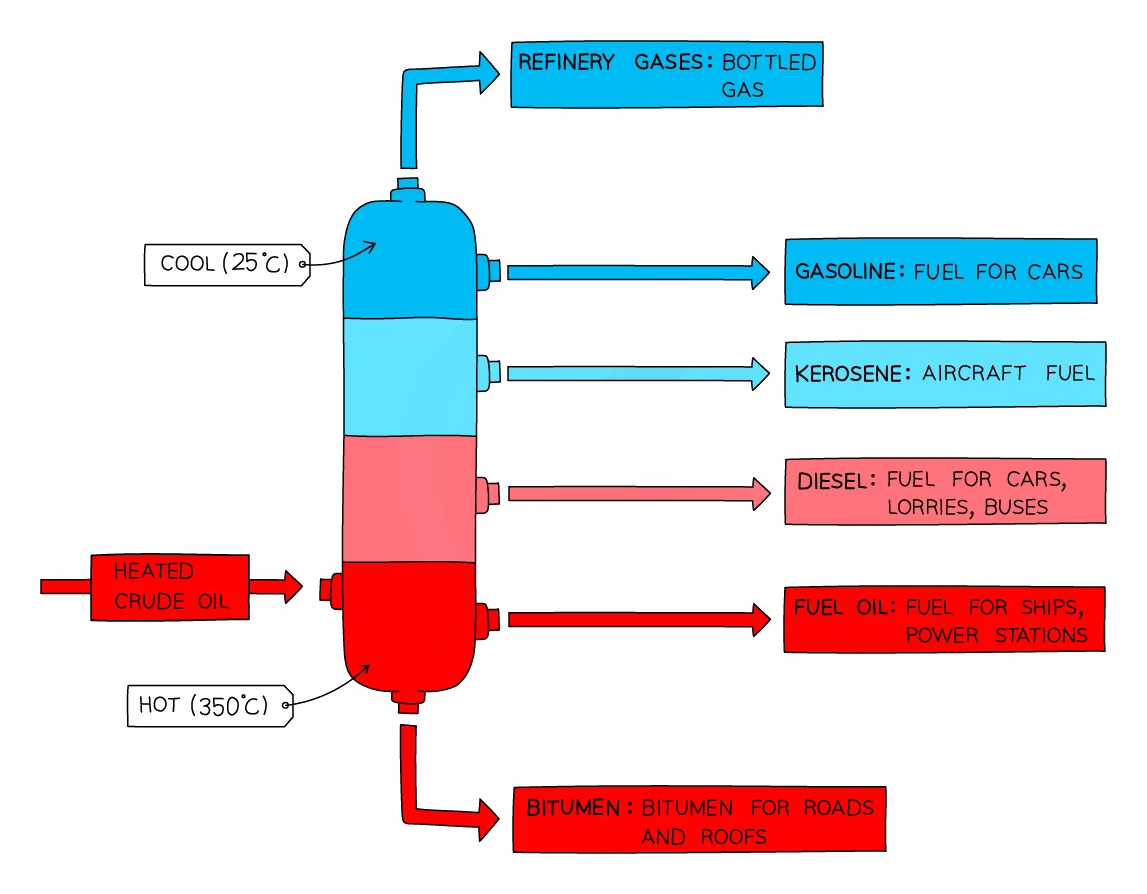
- It is carried out in a tall in which the temperature falls continuously from the bottom (very hot, about 350 °C) to the top (cooler, about 25 °C) — a vertical temperature gradient
- The process step-by-step:
- Crude oil is heated until it vaporises
- The hot vapours enter the column near the bottom
- As the vapours rise, they cool steadily
- Each hydrocarbon condenses back to liquid when its temperature reaches its own boiling point — long-chain hydrocarbons condense first, near the hot bottom; short-chain hydrocarbons condense further up, where it is cooler
- The condensed liquids are tapped off at different levels of the column as separate fractions
Common exam question
Describing how fractional distillation separates crude oil
Question: Describe how fractional distillation separates crude oil into fractions (4 marks), or state what happens to the crude oil in the heater (1 mark).
Set as a four-mark description in 4 of the 23 papers (five marks once, naming the fraction wanted). Each mark is a separate step: the crude oil is heated until it vaporises; the vapours rise through the column; the column is hottest at the bottom and coolest at the top; and each vapour condenses at the height where the temperature falls below its boiling point, so fractions collect at different levels. The five-mark version credited any five of six points: those four steps, naming fractional distillation, or saying that shorter chains have lower boiling points and rise higher.
The first step is also asked alone for one mark in 3 papers: write heated, which is credited every time. "Vaporised" scored on those one-mark questions but was ignored in a fill-in passage that had already said the oil forms a vapour, and "evaporated" was ignored on two papers and allowed on one, so avoid both; "burned" and "melted" are rejected. Melting points and density earn nothing.
Main fractions and what each one is used for
| Fraction | Chain length (C atoms) | Approximate boiling range / °C | Main use |
|---|---|---|---|
| Refinery gas | 1–4 | < 25 | Bottled gas; domestic heating and cooking |
| Gasoline (petrol) | 4–12 | 40–100 | Fuel for cars |
| Kerosene (paraffin) | 12–16 | 150–240 | Fuel for jet aircraft |
| Diesel (gas oil) | 14–18 | 220–300 | Fuel for lorries, trains, some cars |
| Fuel oil | 19–25 | 250–320 | Fuel for ships and power stations |
| Bitumen | > 70 | > 350 | Surfacing roads and roofs |
Common exam question
Naming a fraction from the column and giving its use
Question: Name a lettered fraction on a diagram of the column, or give one use for a named fraction such as bitumen or kerosene (1 mark each).
Asked in 5 of the 23 papers. Learn the order from the top of the column down: refinery gases, gasoline, kerosene, diesel, fuel oil, bitumen. The uses credited are specific: refinery gases for heating and cooking (bottled gas), kerosene as aircraft fuel, fuel oil as fuel for ships, and bitumen for surfacing roads and roofing. Petrol is accepted for gasoline and paraffin for kerosene, and gasoline is the fraction most likely to contain a molecule with six carbon atoms.
Two papers also asked why refinery gases leave at the top: they have the lowest boiling points, so they are the most volatile and pass out of the top without condensing. Say boiling point, not melting point, which is rejected, and not low density, which is ignored.
How properties change down the column
- As chain length increases:
- Boiling point rises — bigger molecules have stronger intermolecular forces to overcome
- rises — the liquid flows less readily (bitumen is tar-thick; petrol is runny)
- falls — bigger molecules evaporate less readily
- Colour darkens — the heaviest fractions are deep brown to black
- Flammability falls — long-chain hydrocarbons are harder to ignite
Exam tip
Why a heavier fraction has a higher boiling point
When a question asks why one fraction boils at a higher temperature than another, in terms of the forces between its molecules, three linked points earn the three marks: the heavier fraction has longer molecules; longer molecules have stronger intermolecular forces, meaning forces between molecules; so it takes more energy to overcome those forces and separate the molecules. Two wordings cost marks. "Forces between atoms" is rejected for the second point, and any mention of breaking covalent bonds loses both the second and the third: the bonds inside each molecule stay intact when a hydrocarbon boils.
2. Combustion of fuels
What a fuel is
- A fuel is a substance that releases heat when burned
- All combustion reactions are exothermic, and combustion is the most common way of releasing the energy stored in hydrocarbons
- All hydrocarbon combustion gives carbon-containing oxide products plus water; which oxides form depends on how much oxygen is available
Exam tip
A fuel is defined by two things
If you are asked to define a fuel (2 marks), give both halves of the definition: a fuel is a substance that is burned and that releases heat energy when it burns. Each half is a separate mark, so "something that burns" on its own earns only one of the two. "Combusts" and "catches fire" are accepted for burning, and "thermal energy" for heat.
Complete combustion
- Complete combustion happens when there is plenty of oxygen around the burning fuel
- The only products are carbon dioxide and water
- General word equation:
hydrocarbon + oxygen → carbon dioxide + water
- Worked equation for butane (C4H10), the fuel in a camping stove:
2 C4H10(g) + 13 O2(g) → 8 CO2(g) + 10 H2O(l)
- Complete combustion releases the maximum energy per gram of fuel because every carbon atom finishes as CO2
Incomplete combustion
- happens whenever the oxygen supply is restricted — a blocked vent, a clogged burner, or a poorly tuned engine all cause it
- The products may include any of: water, carbon monoxide (CO), unburnt carbon (soot) and unburnt hydrocarbons
- A characteristic clue: a smoky yellow flame instead of the clean blue flame of complete combustion
- Worked equation for propane with restricted oxygen:
2 C3H8(g) + 7 O2(g) → 6 CO(g) + 8 H2O(l)
- Less energy is released per gram of fuel because the carbon has not been fully oxidised
- Soot (unburnt carbon) blackens the underside of saucepans and the inside of chimneys
Common exam question
Products of incomplete combustion and why they form
Question: Identify the solid or the poisonous gas formed when a hydrocarbon burns in a limited supply of air, or give the reason incomplete combustion happens (1 mark each).
Asked in some form in 6 of the 23 papers. Name carbon monoxide and carbon, the black soot that collects on a cold surface above the flame; water forms too. The reason is always not enough oxygen (a limited air supply) for every carbon atom to become carbon dioxide. In a table asking for the toxic gas from incomplete combustion, the answer is carbon monoxide, never carbon dioxide.
Two papers asked you to complete an equation for incomplete combustion with the products given. Balance carbon and hydrogen first, count the oxygen atoms on the right, take away any oxygen already in the fuel (an alcohol has one), then halve to get the oxygen molecules: for hexane, C₆H₁₄ + 6O₂ → 5CO + C + 7H₂O. Add state symbols when asked; they can be a separate mark.
Why carbon monoxide is so dangerous
- Carbon monoxide is a particularly hazardous product of incomplete combustion because it is:
- Colourless
- Odourless
- Tasteless
- A person breathing CO has no warning until the symptoms (headache, dizziness, nausea, drowsiness) begin
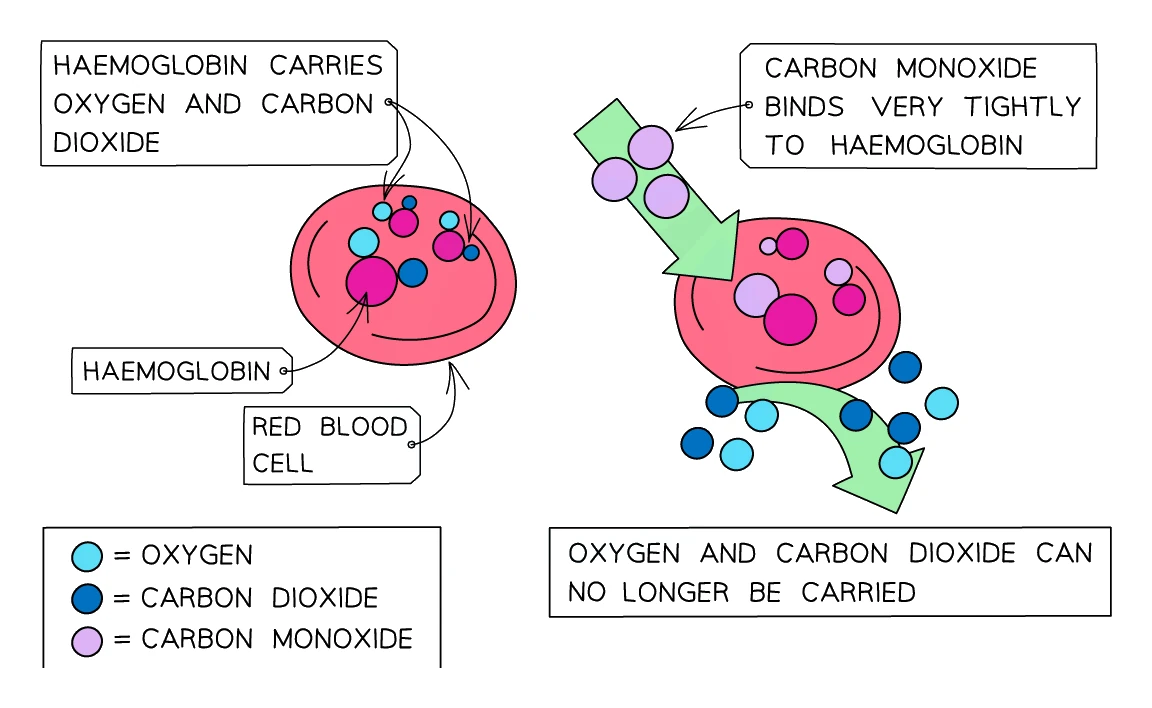
- Once in the bloodstream, CO binds tightly and almost irreversibly to the oxygen-carrying molecules in the red blood cells
- This reduces the capacity of the blood to carry oxygen to the body's tissues
- Severe CO poisoning starves vital organs of oxygen and can cause unconsciousness and death
- This is why gas heaters and boilers must be ventilated and serviced — a faulty burner can produce CO without any visible smoke
Common exam question
Why carbon monoxide is poisonous
Question: State why carbon monoxide is poisonous, or explain why a gas formed by incomplete combustion is a problem for humans (1–2 marks).
Asked in 6 of the 23 papers. The credited idea is that carbon monoxide reduces the blood's ability to carry oxygen around the body. In the two-mark version the first mark is for naming carbon monoxide as the gas and the second, which depends on the first, is for that effect; two schemes also accepted soot causing breathing problems as the pair. Saying that it binds to haemoglobin (forming carboxyhaemoglobin) is accepted but not required by the syllabus. "It is harmful" is ignored, and "it is toxic" only repeats the question when you were asked why it is poisonous, so always finish with the effect on oxygen in the blood.
3. Pollutant gases and acid rain
Sulfur dioxide from sulfur impurities in fuels
- Crude oil contains a small percentage of sulfur compounds; when fossil fuels are burned, the sulfur is oxidised to sulfur dioxide:
S(s) + O2(g) → SO2(g)
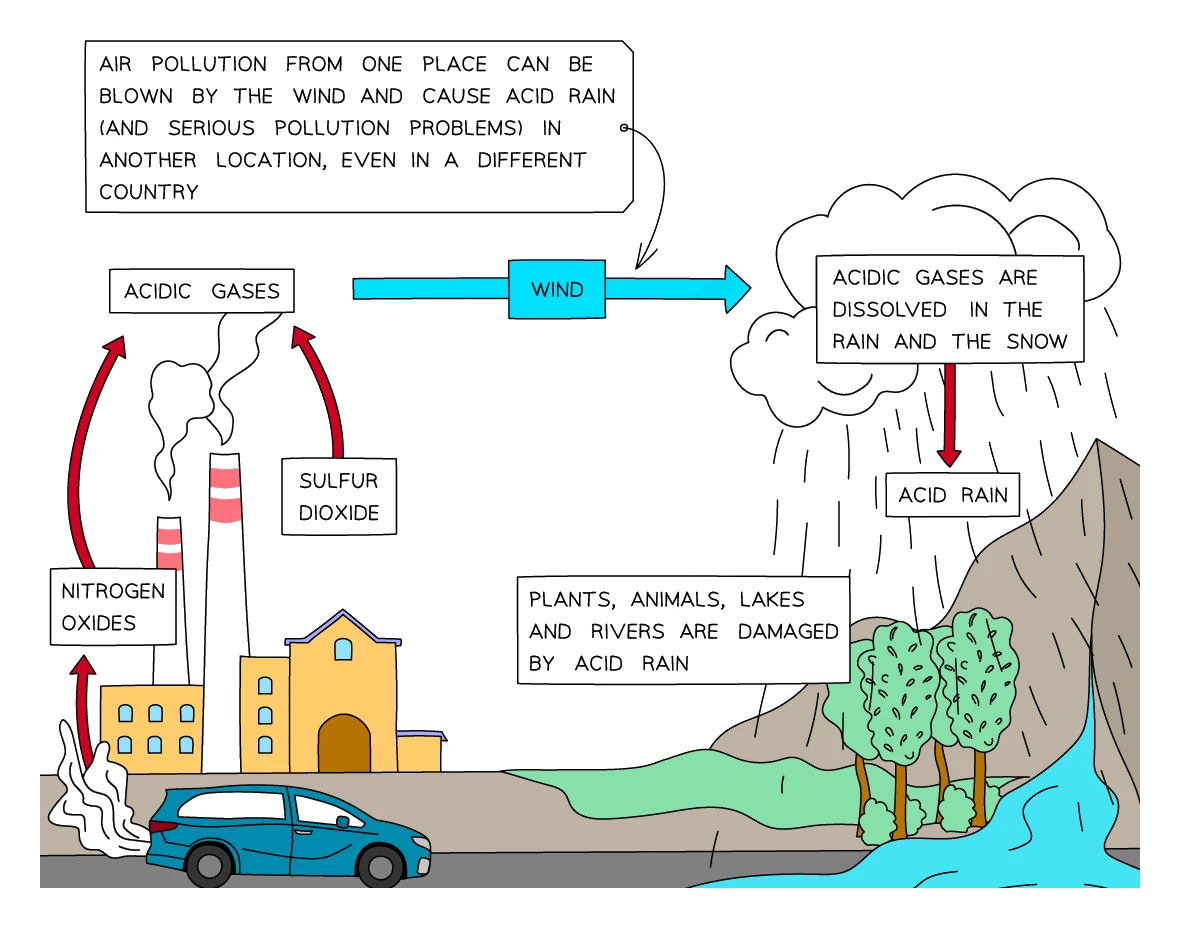
- SO2 escapes into the atmosphere through the chimneys of power stations and the exhausts of unfiltered vehicles
- Many modern power stations now use flue-gas desulfurisation with limestone or calcium hydroxide to scrub SO2 out before the gas reaches the atmosphere
Nitrogen oxides from hot engines
- The air drawn into a car engine, a jet engine, or an industrial blast furnace is mostly nitrogen and oxygen
- At the high temperatures inside these engines, the normally unreactive N2 and O2 react to form nitrogen monoxide (NO) and nitrogen dioxide (NO2), collectively called (NOx)
- Modern petrol cars carry a in the exhaust system that converts NOx and CO back to N2 and CO2 before they leave the tailpipe
Acid rain
- Both SO2 and NOx dissolve in rain droplets high in the atmosphere
- SO2 reacts with water (and more oxygen) to give sulfuric acid:
2 SO2(g) + O2(g) + 2 H2O(l) → 2 H2SO4(aq)
- NO2 reacts with water and oxygen to give nitric acid:
4 NO2(g) + 2 H2O(l) + O2(g) → 4 HNO3(aq)
- The mixture of acids falls as , with a pH typically of 4–5 (rainwater unaffected by pollution sits around pH 5.6, due only to dissolved CO2)
Effects of acid rain
- Acidifies lakes and rivers, killing fish and aquatic invertebrates
- Damages tree leaves and dissolves nutrients out of soil — large areas of forest decline
- Corrodes metal structures (bridges, railings) and dissolves carbonate building materials (limestone, marble) — historic statues lose facial detail over decades
Common exam question
Explaining how burning fuels causes acid rain
Question: Explain how an impurity in a fuel, or the air in a car engine, leads to acid rain (3 marks), or name the environmental problem sulfur dioxide causes (1 mark).
In 8 of the 23 papers, with the three-mark explanation in 3. Fuel impurity: the fuel contains sulfur; burning oxidises it to sulfur dioxide; this dissolves in or reacts with water and falls as acid rain. Engine: nitrogen and oxygen from the air react at the high temperature inside it, forming oxides of nitrogen, which dissolve in water to give nitric acid. Nitrogen as the fuel impurity is rejected, as is petrol containing nitrogen.
Carbon dioxide, carbon monoxide and global warming are ignored, so keep to the chain; write "dissolves in" rather than "mixes with" (also ignored). Asked to name the problem, "acid rain" alone scores; asked for an effect, give one (fish killed, limestone corroded), not climate change (ignored) or the ozone layer (rejected).
4. Cracking
Why cracking is needed
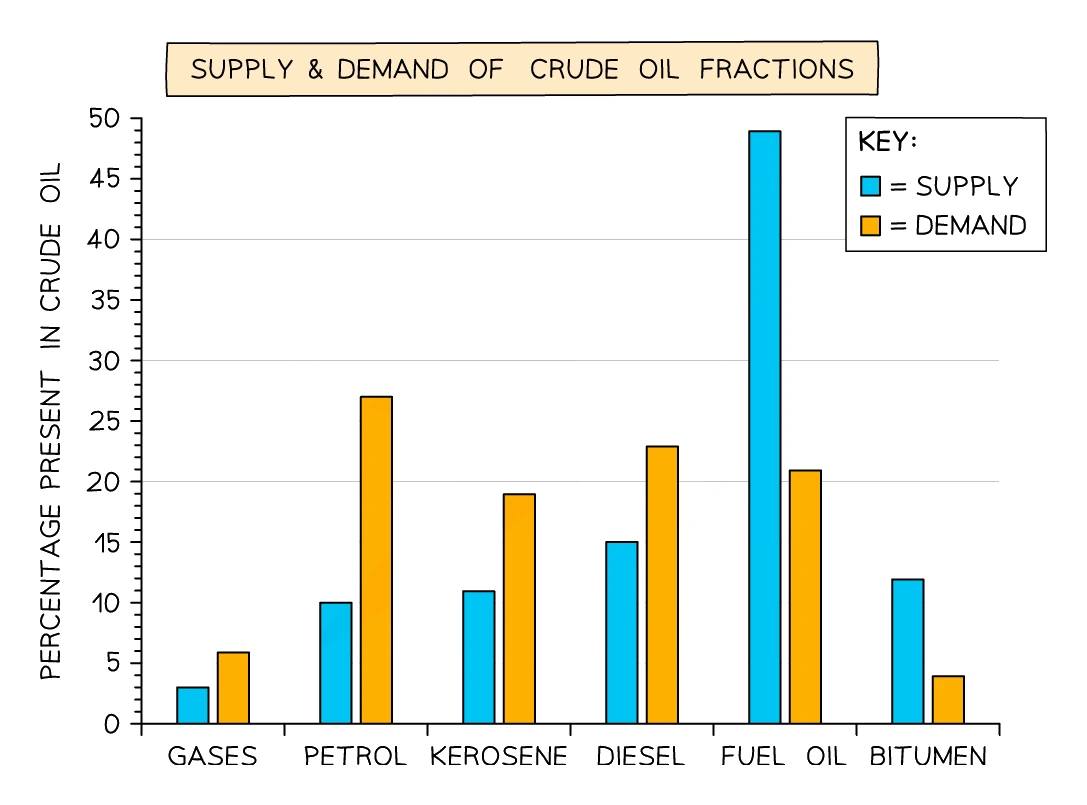
- The fractions from crude oil do not match consumer demand
- Demand is highest for short-chain fractions — petrol, kerosene, diesel — because these are the easiest fuels to burn in vehicles
- Supply from raw crude is heaviest in long-chain fractions — fuel oil, bitumen — which have fewer high-value uses
- balances this imbalance by breaking long-chain hydrocarbons down into shorter, more useful ones
Common exam question
Why cracking is needed and why its products are useful
Question: Explain why cracking is an important process in the oil industry, or why shorter-chain alkanes are more useful than longer ones, or describe what is meant by cracking (2–4 marks).
Asked in 7 of the 23 papers. The marks are separate points, so give as many as the total needs: distillation gives more long-chain hydrocarbons than industry can use, while short chains are in higher demand; cracking converts long-chain alkanes to shorter ones; the shorter alkanes are more flammable, so more useful as fuels such as petrol; cracking also produces alkenes; and alkenes are used to make polymers (or alcohols). The polymer mark depends on having said alkenes.
Alkenes are not fuels: that use was ignored on one paper and rejected on another. When the question is what cracking means, the two marks are for breaking down long-chain hydrocarbons and for forming shorter chains; "polymers" is rejected there and describing it as a separation is ignored.
What cracking is
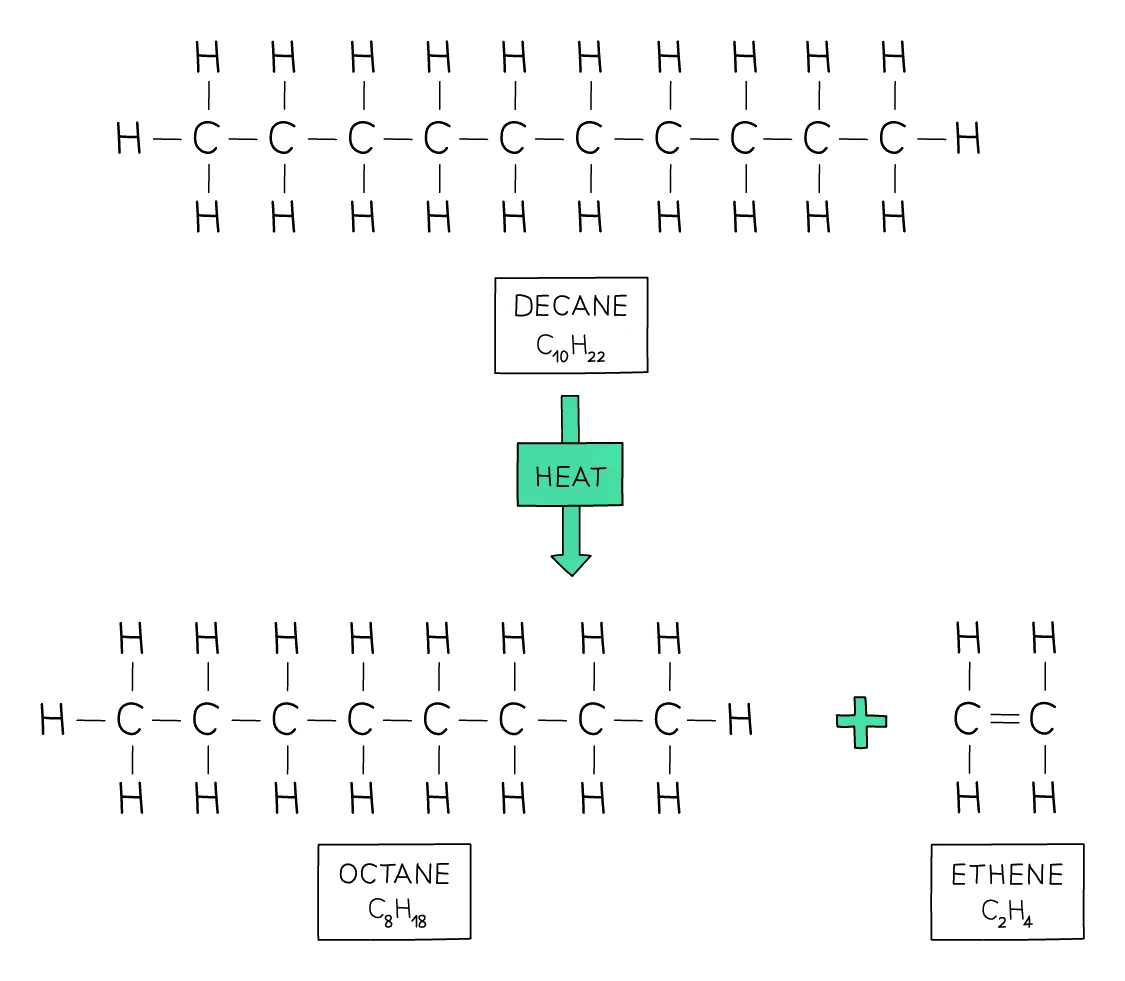
- Cracking is the breaking of long-chain alkanes into smaller hydrocarbon molecules
- Every cracking reaction produces:
- A shorter-chain alkane (still saturated, useful as fuel)
- One or more alkenes (unsaturated, useful as feedstock for plastics, alcohols, detergents)
- The process is endothermic — energy has to be put in to break the C–C single bonds in the long chain
Worked example
Completing a cracking equation
Undecane, C₁₁H₂₄, is cracked into one molecule of hexane, C₆H₁₄, plus two alkenes that are not the same. Write the completed equation.
C₁₁H₂₄ → C₆H₁₄ + … + …
Solution:
- Count what the alkane leaves behind: carbon 11 − 6 = 5 atoms and hydrogen 24 − 14 = 10 atoms, so the two alkenes together are C₅H₁₀
- Every alkene has the general formula CₙH₂ₙ, so split the five carbons between two different alkenes: C₂H₄ (ethene) and C₃H₆ (propene) is the only pair
- Check the balance: carbon 6 + 2 + 3 = 11, hydrogen 14 + 4 + 6 = 24
- C₁₁H₂₄ → C₆H₁₄ + C₂H₄ + C₃H₆
Writing the whole leftover as a single alkene, C₅H₁₀, balances but ignores the "two different alkenes" instruction, and scored only one of the two marks when it was tried. A correctly written alkene formula in an equation that does not balance also earns one mark.
Conditions for catalytic cracking
- The long-chain alkane vapour is heated to about 600–700 °C
- The hot vapour passes over a hot powdered catalyst, usually aluminium oxide (Al2O3) or zeolite
- Some C–C bonds break at random points along the chain; the resulting fragments leave as a blend of shorter alkanes plus one or more alkene molecules
Common exam question
Conditions for catalytic cracking
Question: Give the catalyst and the temperature used in catalytic cracking (2 marks).
Asked in 5 of the 23 papers, once for the catalyst alone. One mark is for the catalyst, silica or alumina: silicon dioxide, aluminium oxide, SiO₂, Al₂O₃, aluminosilicates and zeolites are all accepted. The other is for the temperature, and any value or range inside 600–700 °C scores. Pressure is not part of the answer and is ignored, and when the question says "conditions" it wants both.
Uses of the alkene products
- Ethene is polymerised industrially to make poly(ethene) — the plastic used in carrier bags, drink bottles and pipes
- Ethene also reacts with water to make ethanol for industrial solvent use
- Propene from cracking is polymerised to poly(propene), used in food containers and ropes
Alkanes versus alkenes — a useful contrast
- Alkanes are saturated — every carbon–carbon bond is a single bond
- Alkenes are unsaturated — they have at least one carbon–carbon double bond (C=C)
- The alkene's C=C double bond is the functional group that makes it useful for further reactions, including polymerisation (see topic 24 Alkenes)