1. Formation of covalent bonds
What a covalent bond is
- A forms when two non-metal atoms share a pair of electrons
- Each atom contributes one electron to the shared pair
- The shared pair counts toward each atom's outer shell, so both atoms end up with a full (noble-gas) outer shell
- Covalent bonds are very strong
Bonding and non-bonding electrons
- The two shared electrons in a bond are the bonding electrons (or a bonding pair)
- Outer-shell electrons that are not part of any bond are non-bonding electrons or
What holds a covalent bond together
- The shared pair of electrons (negative) sits between the two nuclei (positive)
- Both nuclei are electrostatically attracted to the same shared pair
- That mutual pull on the same electrons is what holds the atoms together
Common exam question
Describing the forces in a covalent bond
Question: Describe the forces of attraction in a covalent bond, or say, in terms of electrostatic attractions, what a covalent bond is (2 marks).
Asked in 8 of the 23 papers, always on Paper 1. One mark is for the shared pair of electrons and the other for the electrostatic attraction between that pair and the two nuclei. Write "nuclei", plural: the schemes insist on it and a bare "nucleus" is rejected. Name the electrons as well as the nuclei, because two of the schemes give the nuclei mark only once electrons have been mentioned, and an answer that only says the atoms share electrons earns at most one mark.
Keep intermolecular forces out of it: they act between molecules, not inside a bond, and one scheme takes both marks away for mentioning them. The same two points answer a question about the forces holding the atoms together in a named molecule such as propene.
Notation: a line for each bond
- A single covalent bond is drawn as a short straight line between two atom symbols:
- H–H means a single bond between two hydrogen atoms
- A double bond is drawn as two lines:
- O=O means a double bond
- A triple bond is drawn as three lines:
- N≡N means a triple bond
Covalent vs ionic — the key difference
- In a covalent bond, electrons are shared. No atom permanently gains or loses an electron, and no ions form
- In an ionic bond (Topic 6), electrons are transferred from one atom to another, and oppositely charged ions form
Two kinds of covalent substance
- Every covalent substance falls into one of two structural classes:
- Simple molecular — small, discrete molecules (H₂O, O₂, CO₂); covered in section 3
- Giant covalent (also called macromolecules) — many millions of atoms covalently bonded into one continuous lattice (diamond, graphite); covered in section 4
Common exam question
Spotting a giant covalent substance in a properties table
Question: From a table of melting points and whether each substance conducts electricity when solid and when molten, say which substance could be diamond or is giant covalent, or fill in its type of bonding and structure (1 mark per item).
Asked in 3 of the 23 papers, once from a word box rather than a table. The giant covalent substance is the one with a very high melting point that does not conduct electricity as a solid or when molten (graphite is the exception: giant covalent, yet it conducts as a solid). Every other row fails one test: a metal conducts when solid, an ionic compound conducts only when molten (or dissolved), and a simple molecular substance never conducts but has a low melting point.
When the table asks for names, give both words: bonding "covalent", structure "giant covalent" (giant molecular, giant covalent lattice and macromolecular are all accepted). The ionic row wants "giant ionic lattice", and "giant" on its own is ignored there.
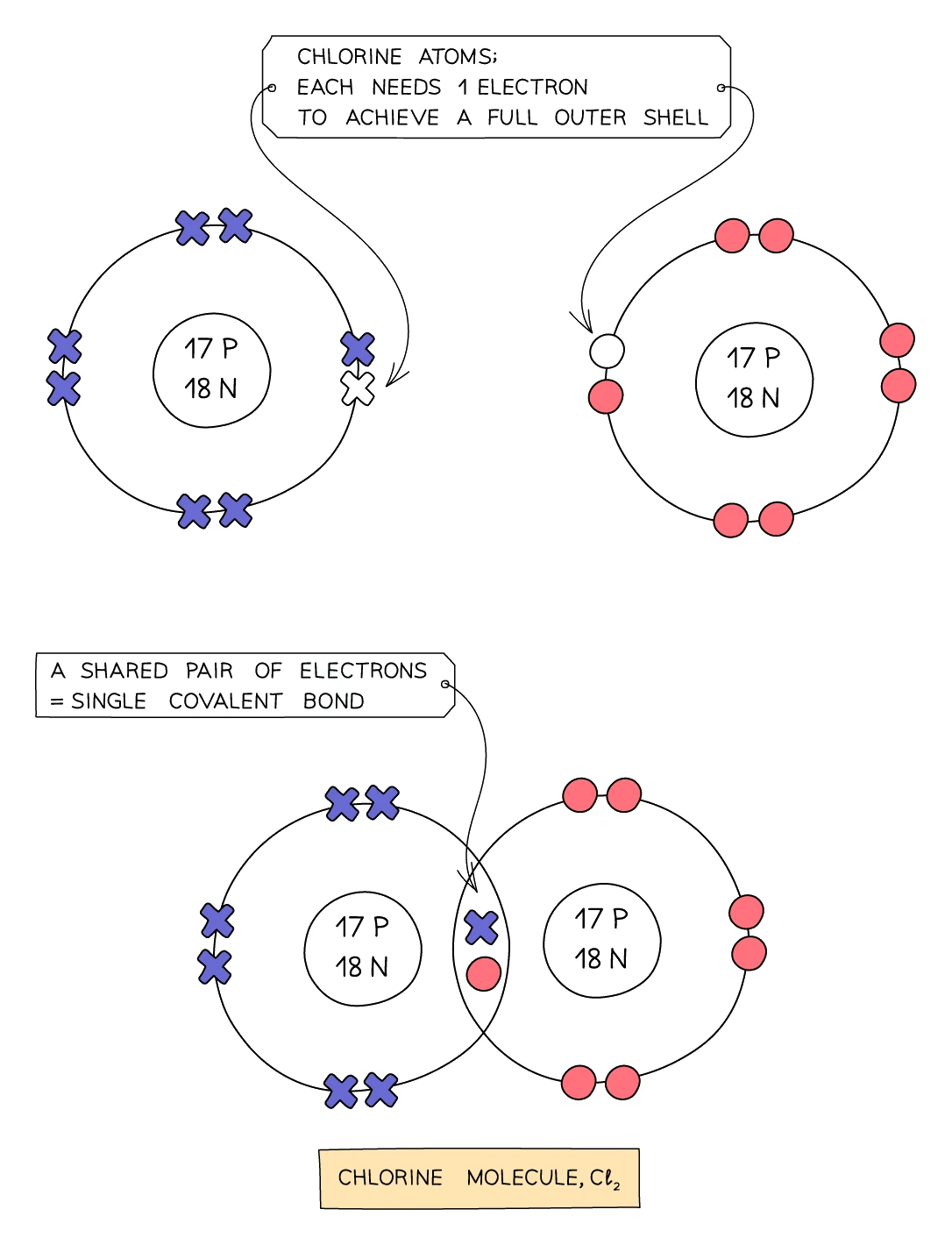
2. Dot-and-cross diagrams for simple molecules
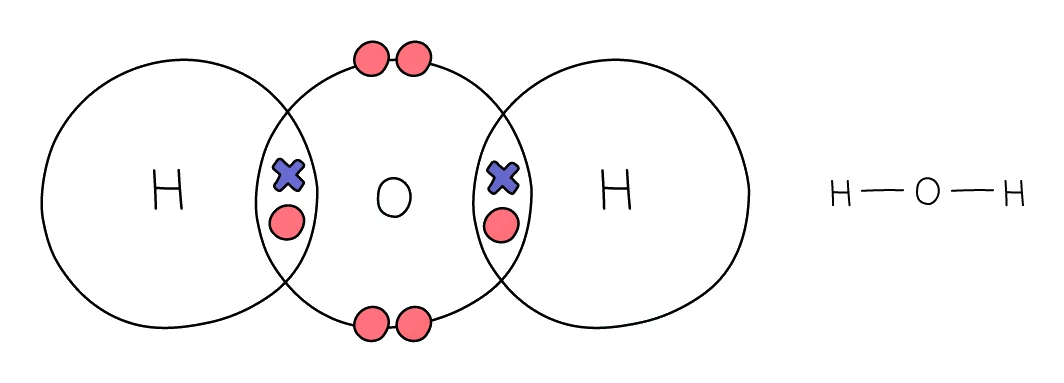
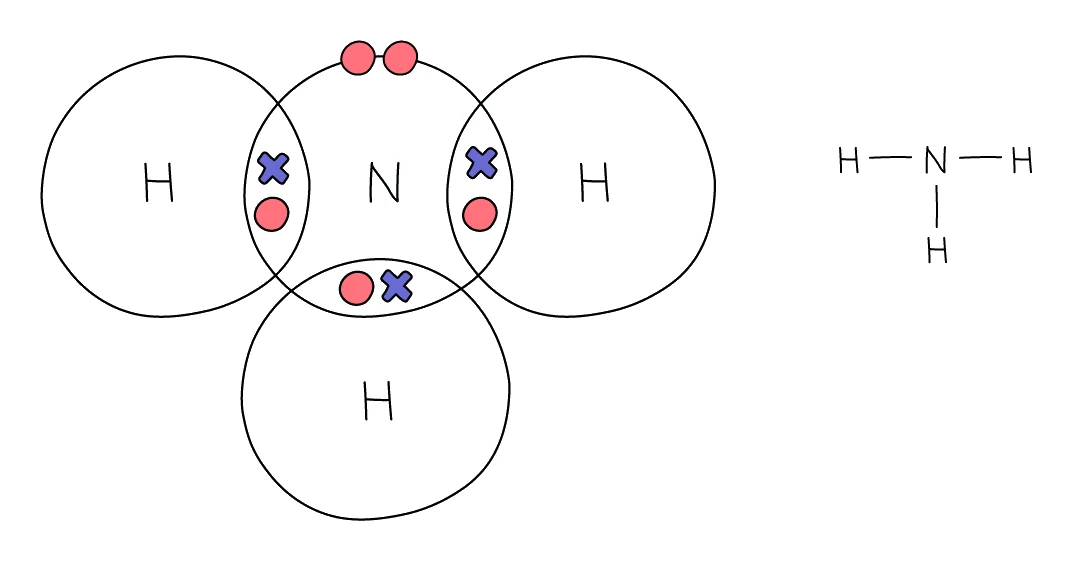
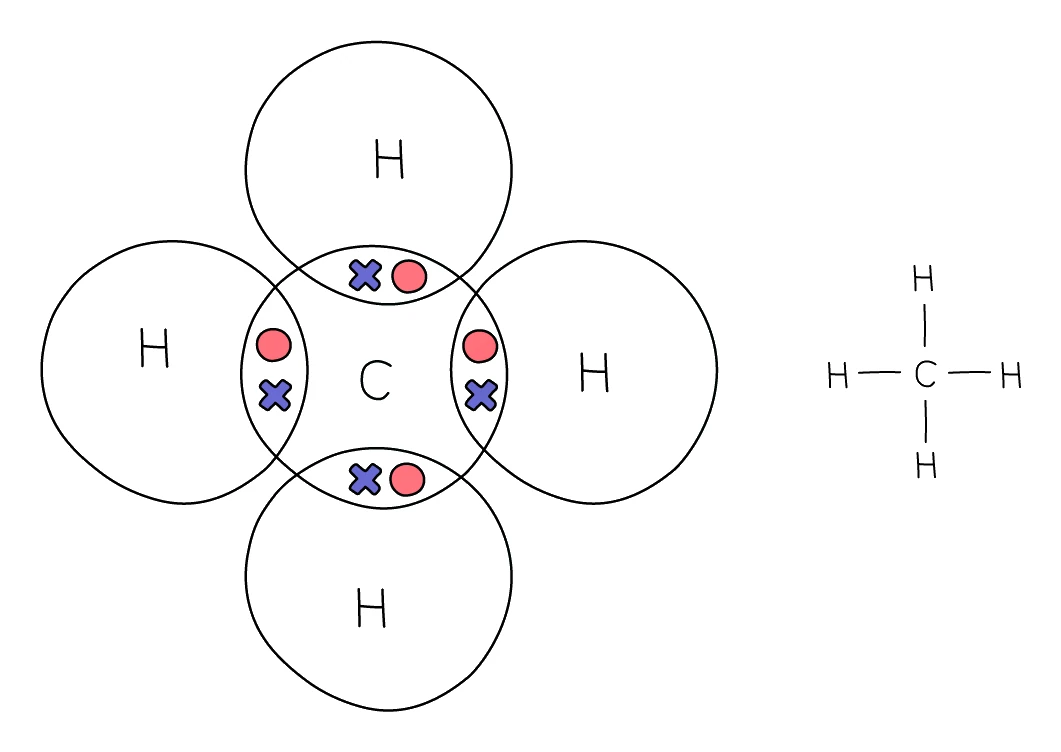
- A dot-and-cross diagram shows which atom each shared electron originally came from
- Conventions to follow:
- Use dots for one element's electrons and crosses for the other element's
- Show only the outer-shell electrons (Edexcel does not require inner shells)
- The two electrons of a shared pair sit in the overlap region between the atoms — one dot + one cross for each shared pair
- Lone pairs sit on the outside of the atom, away from the bond
- Edexcel Section 1.7 expects dot-and-cross diagrams for: H₂, Cl₂, HCl, O₂, N₂, H₂O, NH₃, CH₄ and CO₂
Diatomic molecules
| Molecule | Bond type | Shared electrons | Outer-shell arrangement |
|---|---|---|---|
| H₂ | single | 2 (1 pair) | each H has 2 (full 1st shell) |
| Cl₂ | single | 2 (1 pair) | each Cl has 8; 3 lone pairs each |
| HCl | single | 2 (1 pair) | H has 2; Cl has 8 with 3 lone pairs |
| O₂ | double | 4 (2 pairs) | each O has 8; 2 lone pairs each |
| N₂ | triple | 6 (3 pairs) | each N has 8; 1 lone pair each |
Polyatomic molecules
| Molecule | Central atom | Bonds | Shape | Lone pairs |
|---|---|---|---|---|
| H₂O | O | 2 single (O–H) | bent | 2 on O |
| NH₃ | N | 3 single (N–H) | trigonal pyramidal | 1 on N |
| CH₄ | C | 4 single (C–H) | tetrahedral | 0 |
| CO₂ | C | 2 double (O=C=O) | linear | 2 on each O |
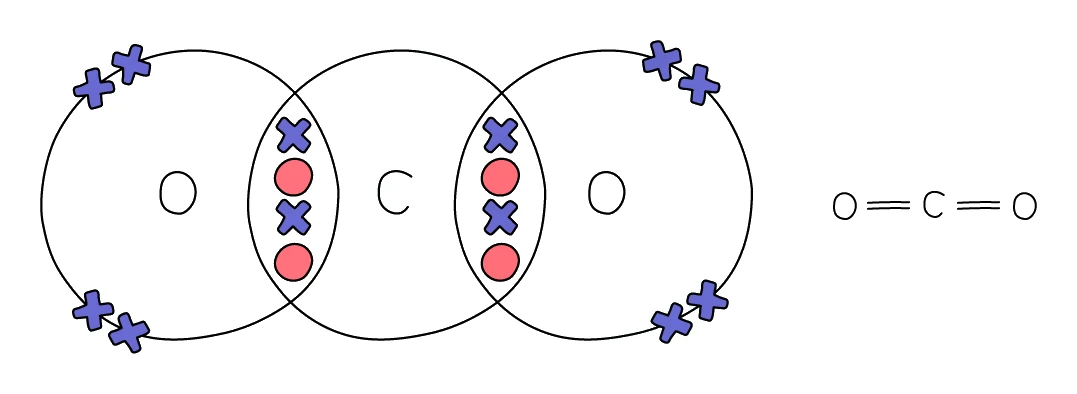
Counting electrons in a bond
- One covalent bond = one shared pair = 2 electrons
- One double bond = 4 electrons shared (two pairs)
- One triple bond = 6 electrons shared (three pairs)
- e.g. in O₂, the two oxygen atoms share 4 electrons in total through a double bond
Common exam question
Completing a dot-and-cross diagram
Question: Draw, or complete, a dot-and-cross diagram of the outer-shell electrons in a small molecule (2 marks, occasionally 1 or 3).
Asked in 11 of the 23 papers; in 6 of them the molecule is not one of the nine on the syllabus list (ethene, propene, hydrazine, hydrogen peroxide, methanoic acid, silicon hydride). Give each atom its outer electrons, one shared pair per single bond (two for a double bond), then place the leftovers as lone pairs: none on hydrogen or carbon, one pair on nitrogen, two on oxygen, three on a halogen.
The first mark is usually for the bonding pairs and the second, which depends on it, for the rest of the molecule including the lone pairs. Any mix of dots and crosses is accepted. Extra electrons are the usual loss: non-bonding electrons drawn on carbon or hydrogen are rejected, and one scheme caps a diagram with any spare electrons at one mark.
3. Simple molecular structures
Bonding inside vs forces between molecules
- A simple molecular substance is built from many small discrete molecules (e.g. H₂O, O₂, CO₂, HCl, NH₃, CH₄)
- Inside each molecule, the atoms are held by strong
- Between neighbouring molecules, there are weak
- When the substance melts or boils, only the weak intermolecular forces are overcome; the strong covalent bonds inside the molecules stay intact
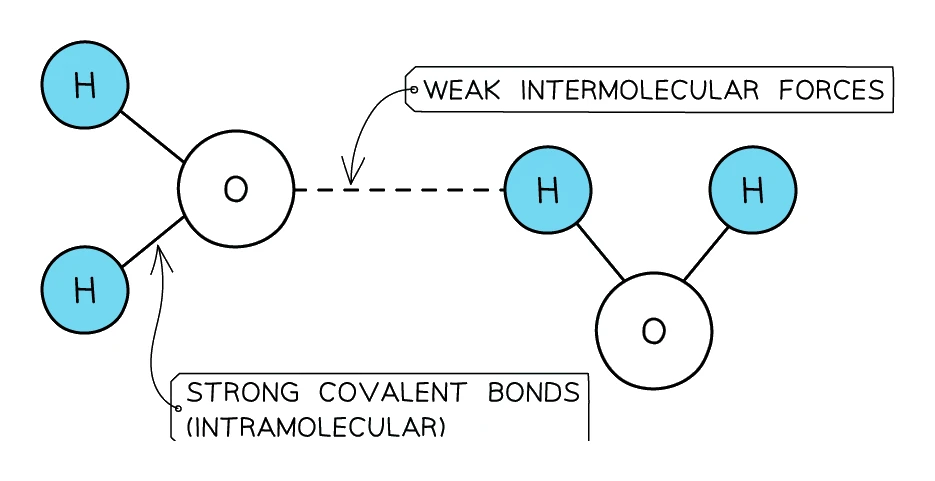
Low melting and boiling points
- Simple molecular substances generally have low melting and boiling points because:
- The intermolecular forces are weak
- Only a small amount of thermal energy is needed to overcome them
- Most simple molecular substances are gases or liquids at room temperature; only a few exist as soft solids with low melting points
Common exam question
Why a simple molecular substance has a low melting point
Question: Explain why a simple molecular substance has a low melting or boiling point, alone or as half of a comparison with a giant covalent or ionic substance (2 marks alone, 4–6 in a comparison).
The molecular half is credited in 8 of the 23 papers. Three points earn it: the substance has a simple molecular structure; the forces between its molecules are weak; so little energy is needed to overcome them. A comparison carries one more mark for the sentence joining the halves: breaking the strong covalent (or ionic) bonds of the giant structure takes far more energy than overcoming the weak forces between molecules.
Two wordings lose both molecular marks: "weak covalent bonds" or "the covalent bonds break", and "intermolecular forces between atoms". The covalent bonds stay intact; the forces are between whole molecules. One scheme also ignores a bare "less energy", so say what the energy does: overcome the forces between the molecules.
Trend: larger molecules, higher melting and boiling points
- As the relative molecular mass of the molecule increases, melting and boiling points increase too
- A bigger molecule has more electrons, so the intermolecular forces between molecules are stronger and need more thermal energy to overcome
- e.g. in the alkane family (Topic 16), methane is a gas, hexane is a liquid, and the waxy long-chain alkanes are soft solids. The trend follows molecular size
Common exam question
Why a larger molecule has a higher boiling point
Question: Explain, in terms of intermolecular forces, why one simple molecular substance has a higher boiling point than another, or explain a trend in boiling points down a group or along a homologous series (2–3 marks).
Asked in 4 of the 23 papers, once as a multiple-choice item. The chain of marks is the same each time: the larger molecule (greater relative molecular mass, longer chain, more electrons) has stronger intermolecular forces, so more energy is needed to overcome them and separate the molecules. If the question gives data, state the trend first, then the forces, then the energy.
Any mention of breaking covalent bonds forfeits the explanation marks. One scheme spells out why: covalent bonds are not broken when a substance boils, and they do not act between molecules. "Intermolecular forces between atoms" is rejected for the same reason.
Electrical conductivity
- Simple molecular substances do not conduct electricity in any state (solid, liquid or gas)
- Reason: there are no free charge carriers. No mobile ions and no delocalised electrons
- This is why plastics, rubber, wax and most solid sugars are good electrical insulators — the plastic coating around household wiring is a covalent polymer for exactly this reason
4. Giant covalent structures
What they are
- A (also called a macromolecule) contains a vast number of non-metal atoms joined by strong covalent bonds in one continuous lattice
- Two classic examples, both built from carbon only:
- Diamond and graphite are of carbon: different forms of the same element with different bonding arrangements
Why all giant covalent structures have high melting points
- There are many strong running throughout the lattice
- Melting or vaporising the solid requires breaking very large numbers of these bonds
- That takes a great deal of thermal energy, so the melting point is high
Common exam question
Why a giant covalent substance has a high melting point
Question: Explain why diamond, graphite or silicon dioxide has a high melting point, on its own or compared with a simple molecular substance (3 marks alone, 4–6 in a comparison).
Asked in 5 of the 23 papers. Three linked points: the substance has a giant covalent structure; it contains many strong covalent bonds, which must be broken; and a large amount of energy is needed to break them. Write "giant covalent structure": one scheme credits a bare "giant structure" only when the covalent-bonds mark is also earned. In a comparison the final mark is for saying that breaking these bonds takes far more energy than overcoming the weak forces between the other substance's molecules.
One slip costs the bond and energy marks in four of the five schemes and halves the total in the fifth: mentioning intermolecular forces (one scheme adds ions) in the giant covalent substance. It has no molecules, so there are no intermolecular forces to overcome; the covalent bonds themselves break.
Diamond
- Each carbon atom forms 4 single to four other carbon atoms
- The result is a rigid 3D tetrahedral network extending throughout the crystal
- Every outer electron on every carbon is locked into a covalent bond → no free electrons
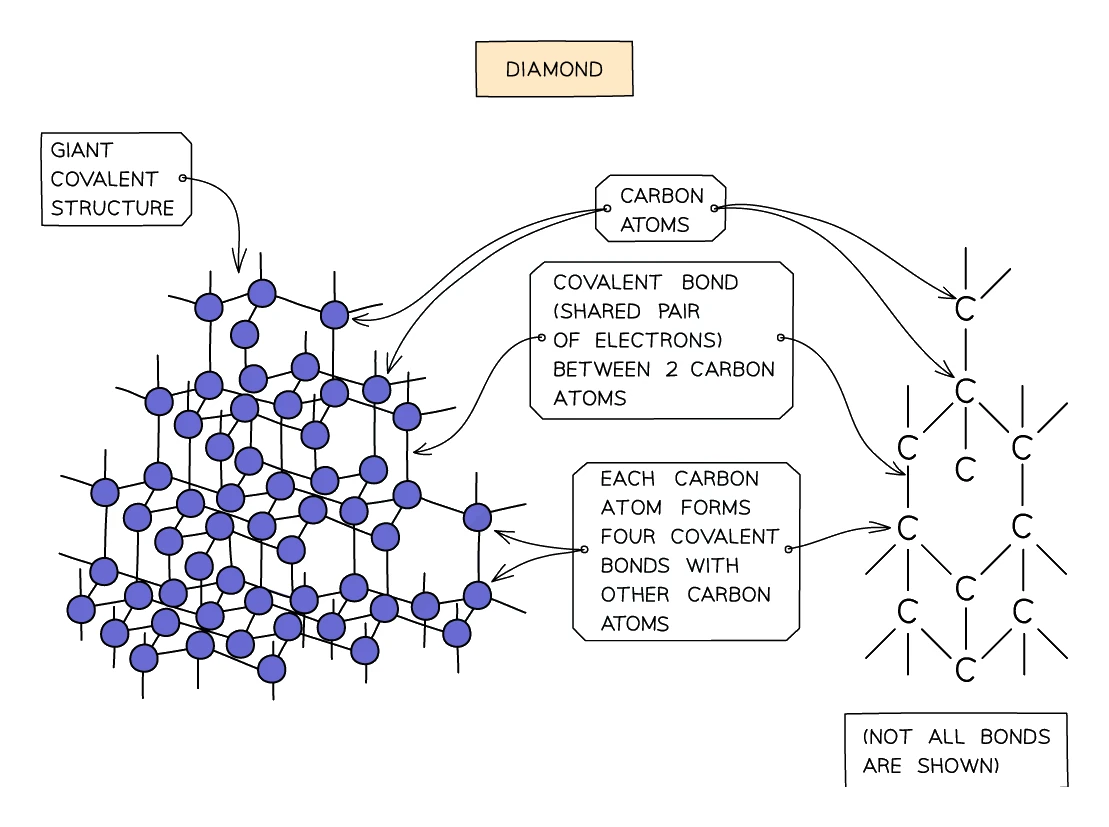
Properties of :
- Very hard: the rigid 3D network of strong covalent bonds resists deformation. Diamond is used in cutting tools, drill bits and saw edges where extreme hardness matters
- High melting point: the many strong covalent bonds running through the lattice need a large amount of energy to break
- Does not conduct electricity: every outer electron is locked in a covalent bond, so there are no free electrons or ions to move and carry charge
Graphite
- Each carbon atom forms only 3 single covalent bonds with three other carbon atoms
- These bonded atoms arrange themselves into flat layers of hexagons (sometimes called sheets)
- Each carbon has 4 outer electrons in total; 3 are used in bonds and the 4th is a that can move freely along the layer
- The hexagonal layers stack on top of each other, held together only by weak forces between the layers, not by covalent bonds
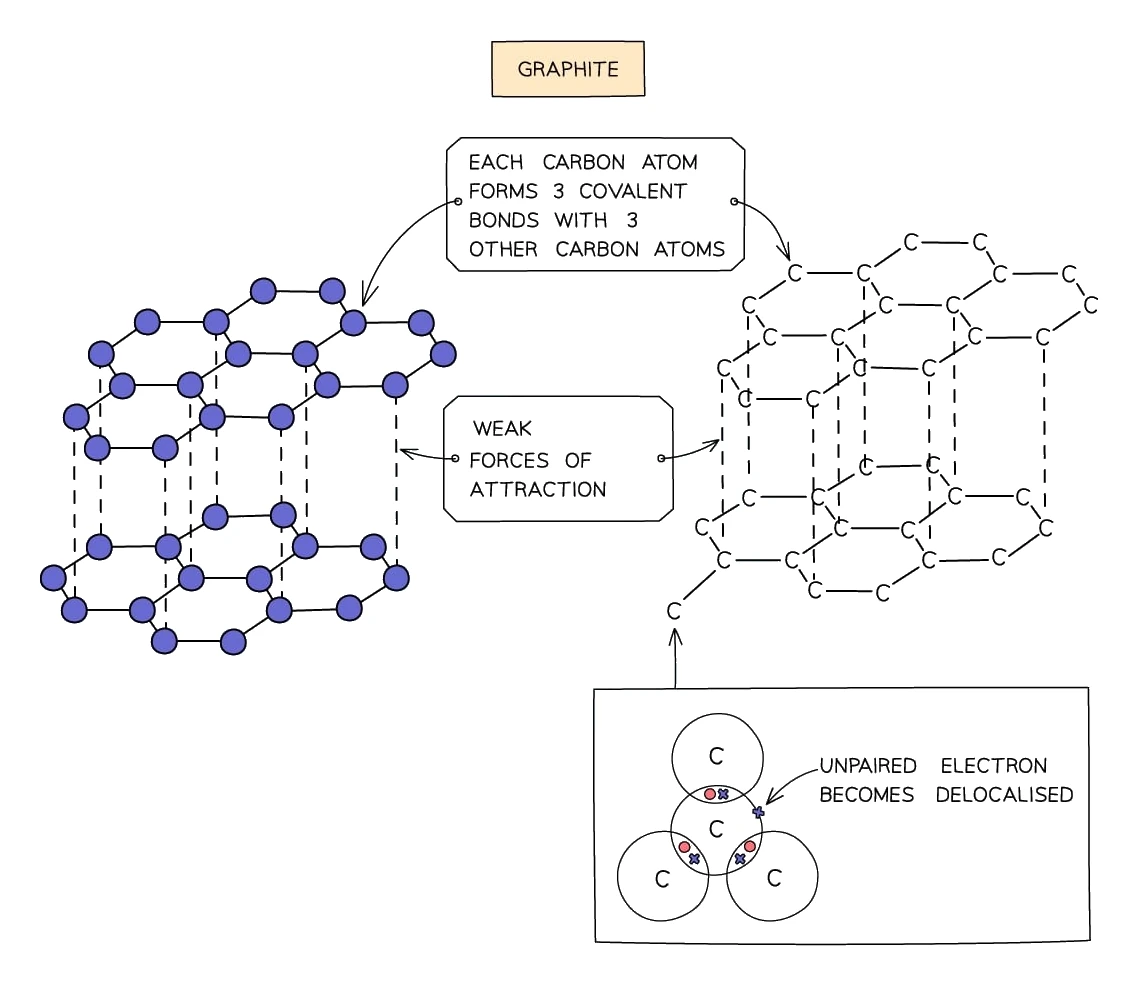
Properties of :
- Soft and slippery: the weak forces between layers let the layers slide easily over each other. Graphite is used as a dry lubricant and as the writing "lead" in pencils
- Conducts electricity (and heat): the delocalised electrons can move along the layers and carry charge. Graphite is one of the very few non-metals that conducts electricity well
- High melting point: within each layer the covalent bonds are strong, and a great deal of energy is needed to break enough of them for the structure to fall apart
Common exam question
Why diamond is hard but graphite is soft
Question: Explain why diamond is hard but graphite is soft, sometimes inside a longer comparison of the two structures (2–4 marks).
Asked in 4 of the 23 papers. For diamond: a rigid three-dimensional (tetrahedral) lattice in which every carbon is bonded to four others, plus, in the 4-mark version, a second mark for those bonds needing a lot of energy to break. For graphite: it is made of layers, and the layers can slide over one another; the sliding mark depends on having said "layers". The softness marks come from the layers, not from the covalent bonds within them.
Do not mention intermolecular forces in diamond: the schemes reject the diamond marks if you do. For the forces between graphite's layers, write "weak forces between the layers". Graphite has no molecules, so "intermolecular forces" here is ignored by two schemes and rejected by two others.
Why diamond doesn't conduct but graphite does
- An electric current is a flow of mobile charged particles
- In , every carbon uses all 4 of its outer electrons in covalent bonds. There are no free electrons available to move, so diamond is an electrical insulator
- In , every carbon uses only 3 of its 4 outer electrons in bonds. The 4th is delocalised and can move freely along the layer, carrying charge along with it. Graphite therefore conducts electricity
Common exam question
Why graphite conducts electricity
Question: Explain why graphite conducts electricity, or why it is a good conductor of electricity (2 marks).
Set as a 2-mark part in 3 of the 23 papers and inside a longer graphite question in 2 more. The two marks: graphite has delocalised electrons (each carbon bonds to only three others, leaving one electron per atom), and those electrons can move through the structure. Two of the three schemes make the second mark depend on the first, so name the electrons before you say what moves.
Three wordings matter. "Free electrons" and "sea of electrons" are ignored, so write "delocalised". "They carry the charge" or "carry the current" is also ignored: the credited idea is that the electrons move or flow. And any mention of ions in graphite, or of atoms moving, scores zero for the whole part. In the longer versions, "each carbon forms three covalent bonds" and "one delocalised electron per carbon" are separate marks.