1. Tests for gases
Why these five gases matter
- Many cation, anion and water tests release a gas that then has to be identified
- You are expected to recognise the test, the positive result, and the name of the gas in each case
- The five gases assessed are ammonia, carbon dioxide, chlorine, hydrogen and oxygen
| Gas | Test | Positive result |
|---|---|---|
| Ammonia, NH3 | Hold a piece of damp red litmus paper at the mouth of the tube | The paper turns blue |
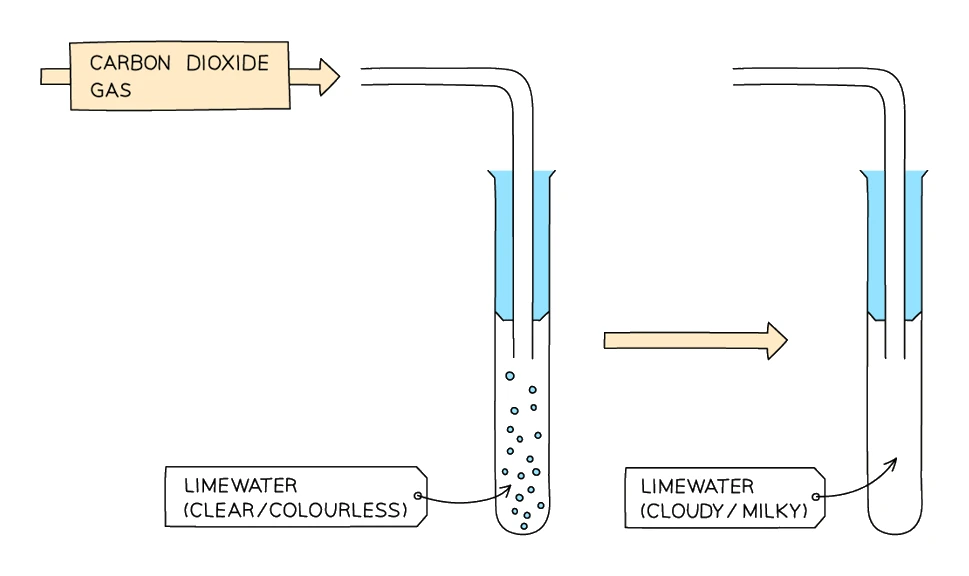
| Carbon dioxide, CO2 | Bubble the gas through limewater (Ca(OH)2(aq)) | The limewater turns milky (cloudy white) |
| Chlorine, Cl2 | Hold a piece of damp blue litmus paper at the mouth of the tube | The paper turns red and is then bleached white |
| Hydrogen, H2 | Hold a lit splint at the mouth of the tube | A loud squeaky pop sound (hydrogen burns rapidly with the oxygen in the air) |
| Oxygen, O2 | Hold a glowing splint inside the mouth of the tube | The splint relights |
Things to be careful about
- For ammonia: keep the litmus paper just at the mouth of the tube and clear of the inner walls, so any alkali residue on the glass does not give a false positive
- For carbon dioxide: a burning splint does go out in CO2, but it also goes out in nitrogen and many other gases, so the splint test is not a valid identification — only the limewater test is accepted
- For chlorine: the paper goes red first because chlorine reacts with the moisture to form an acid, then bleaches as the chlorine attacks the dye; do the test in a fume cupboard because chlorine is toxic
- For hydrogen vs oxygen: a ligHted splint identifies Hydrogen; a glOwing splint identifies Oxygen — the H and O hidden inside each word avoid the common mix-up
- For oxygen: a "much brighter glow" usually counts as a positive result, but in an exam stick to the textbook answer "relights the glowing splint"
Common exam question
Describing the test for chlorine
Question: Describe a test for chlorine gas, or name the gas that bleaches damp litmus paper (1–2 marks).
Set in 3 of the 23 papers, twice as a two-mark test to describe and once as a one-mark name-the-gas. One mark is for holding damp blue litmus paper in the gas (universal indicator paper is accepted too) and one for the paper being bleached, or turning white; saying it turns red first and is then bleached is also credited. In one scheme the second mark depends on the first, so name the paper.
Do not start from red litmus paper. One mark scheme scored an answer built on red litmus (turning blue, then bleaching) at one mark only. Blue paper, then bleached: that is the whole answer.
Common exam question
Giving the test for hydrogen or for oxygen
Question: Give the test for hydrogen, or give the test for oxygen (1 mark).
One of these one-mark tests appears in 9 of the 23 papers (hydrogen in 5, oxygen in 5, with one paper asking both), usually tacked onto an electrolysis, a metal-and-acid reaction or the decomposition of hydrogen peroxide. Hydrogen: a lighted splint gives a squeaky pop. Oxygen: a glowing splint relights.
The single mark needs both the splint and the result, and the state of the splint is what the examiners check. Three mark schemes reject a glowing splint for hydrogen outright, and two ignore "burns with a squeaky pop" on its own because it never mentions the lighted splint. Lit for hydrogen, glowing for oxygen.
2. Flame tests for metal cations
Why use a flame test
- Some metal cations look identical in solution and give similar hydroxide precipitates, so a flame test is used: the cation is recognised from the colour it gives to a hot Bunsen flame
- The test is quick, qualitative, and works on solids or solutions of the metal salt
Carrying out the test
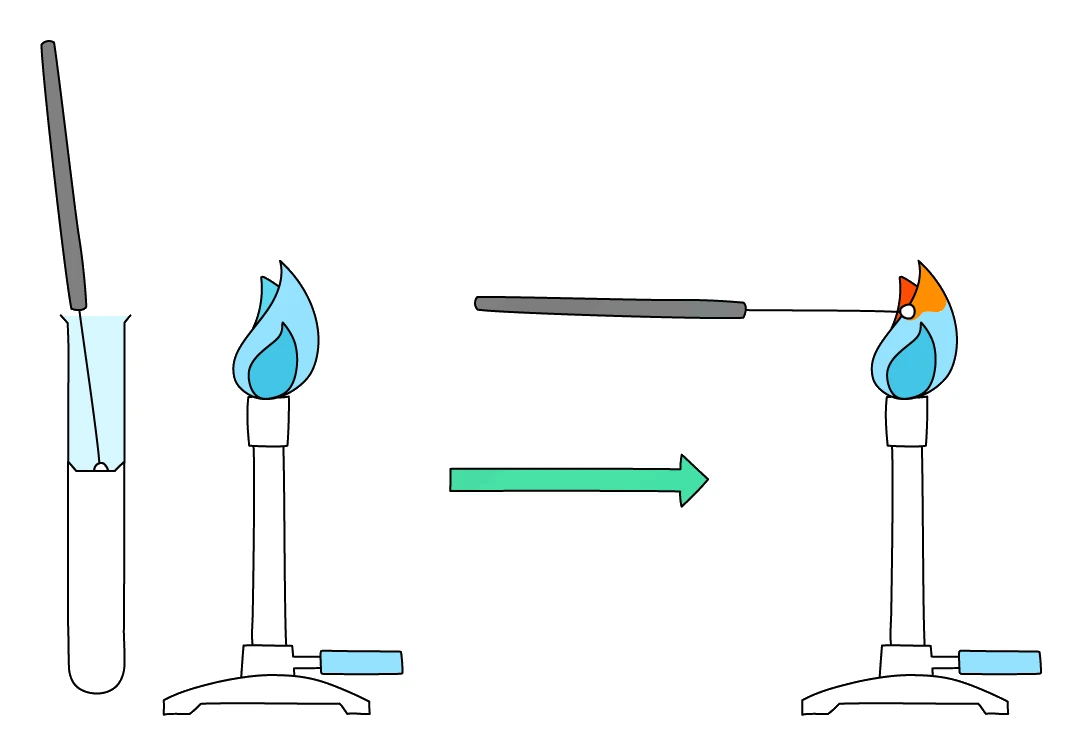
- Dip the loop of a clean nichrome or platinum wire into dilute hydrochloric acid
- Hold the wet loop in the hottest part of a roaring Bunsen flame until any residual colour burns off — this cleans the loop of any previous sample
- Touch the cleaned wet loop into the solid or solution being tested so that a small amount sticks to it
- Place the loaded loop at the edge of the roaring blue Bunsen flame and watch the colour
- Cleaning between tests matters because two different ions on the same loop give a mixed flame in which one colour can mask the other
Flame colours to memorise
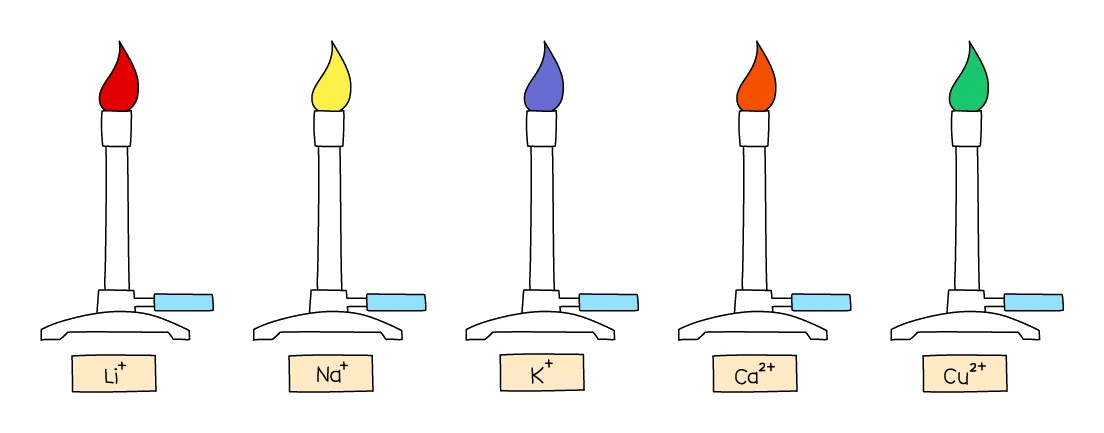
| Cation | Flame colour |
|---|---|
| Lithium, Li⁺ | Crimson red |
| Sodium, Na⁺ | Yellow / golden-orange |
| Potassium, K⁺ | Lilac (pale purple) |
| Calcium, Ca²⁺ | Orange-red (brick red) |
| Copper(II), Cu²⁺ | Blue-green |
- The flame must be blue (air-hole open) so the burner's own colour does not mask the result
Common exam question
Using a flame test to identify a metal ion
Question: Give a test to show that a compound contains sodium ions, or state the flame colour of a named metal ion (1–2 marks, or part of a longer identification).
A flame test earns marks in 8 of the 23 papers, and one more paper gives a lilac flame as a result to interpret. The first mark is for saying flame test (a description of the method is accepted instead), the second for the colour: sodium yellow (orange allowed), lithium red (crimson accepted; brick-red rejected in two schemes), potassium lilac, calcium orange-red (orange or brick-red allowed here) and copper(II) blue-green (green allowed). In three schemes the colour mark needs the flame test, or at least a flame, to have been mentioned, so name the test.
Cleaning the wire has been asked once, for two marks: dipping it in acid and heating it removes any other ions or impurities left on the wire, so that they cannot mask or change the colour of the flame.
3. Tests for cations with sodium hydroxide
The general idea
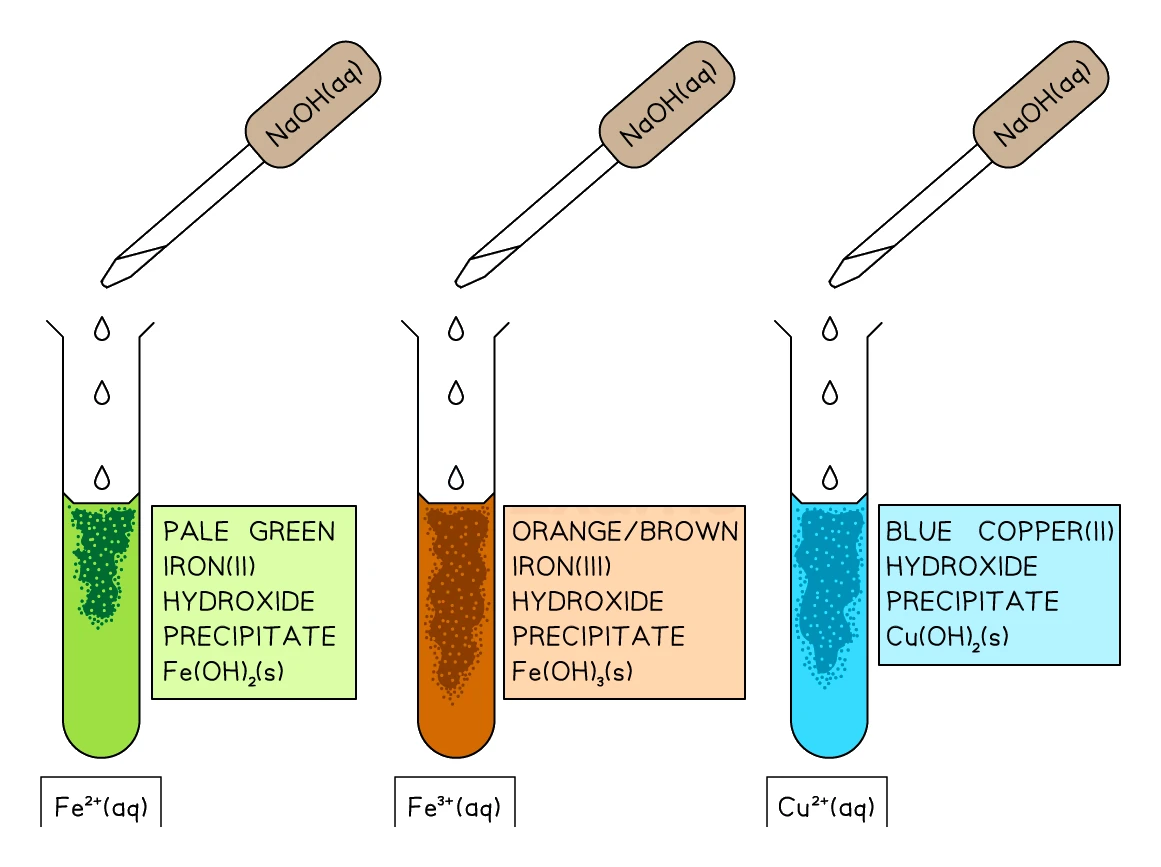
- Aqueous sodium hydroxide is dripped into a solution of the unknown cation
- If the metal hydroxide is insoluble, it appears as a coloured that identifies the metal
- The colour of the precipitate is the diagnostic feature
Iron(II), iron(III) and copper(II)
| Cation | Ionic equation | Precipitate colour |
|---|---|---|
| Fe²⁺ (iron(II)) | Fe²⁺(aq) + 2 OH⁻(aq) → Fe(OH)2(s) | Pale green |
| Fe³⁺ (iron(III)) | Fe³⁺(aq) + 3 OH⁻(aq) → Fe(OH)3(s) | Orange-brown (rust colour) |
| Cu²⁺ (copper(II)) | Cu²⁺(aq) + 2 OH⁻(aq) → Cu(OH)2(s) | Light blue |
- "Blue precipitate" is the credited answer for copper(II); "light" or "pale" in front of it is ignored, so it neither gains nor loses the mark
- Adding excess NaOH does not redissolve any of these three precipitates, which is why a few drops are enough
Common exam question
Identifying Fe²⁺, Fe³⁺ or Cu²⁺ with sodium hydroxide
Question: Describe a chemical test to show that a solution contains copper(II) ions, or to tell iron(II) from iron(III) (2 marks, or part of a 6-mark identification).
Set in 3 of the 23 papers. The first mark is for adding sodium hydroxide solution (potassium hydroxide or aqueous ammonia is accepted), the second for the precipitate colour: green for iron(II), brown for iron(III) (red-brown and orange-brown allowed), blue for copper(II). The colour mark depends on a correct alkali having been named, and one scheme gives no reagent mark if an incorrect reagent is added alongside it.
"Pale" or "dark" in front of blue is ignored, so "blue precipitate" is enough for copper. For iron(II) write green precipitate: "green sludge" and "sluggish green" are ignored and earn nothing on their own. When two solutions are to be told apart, add the alkali to both and give the colour that identifies the one asked about; what you say about the other is ignored, unless you call that one green as well.
Ammonium ion, NH4+
- Add aqueous sodium hydroxide to the unknown sample and warm the mixture gently
- If ammonium ions are present, ammonia gas is released:
NH4+(aq) + OH⁻(aq) → NH3(g) + H2O(l)
- Identify the gas with damp red litmus paper held at the mouth of the tube: the paper turns blue, confirming ammonia and therefore ammonium ions
- Keep the test specifically clear in your answers: NH4+ is the ion in solution; NH3 is the gas released
Common exam question
Describing the test for ammonium ions
Question: Describe a test to show that a solution contains ammonium ions (3 marks).
Set in 3 of the 23 papers, always for three marks: add sodium hydroxide solution and warm it (the warming is not itself marked), hold damp red litmus paper in the gas given off (moist universal indicator paper is also accepted), and the paper turns blue (blue or purple for universal indicator). In one scheme the second and third marks depend on the first; in another the colour mark stands on its own as long as it is clearly the ammonia gas being tested.
The trap is where the paper goes. All three schemes refuse the colour mark if the paper is put into the solution itself, and two refuse the litmus-test mark as well. Hold it at the mouth of the tube, in the gas, and make that explicit.
4. Tests for anions
Carbonate ion, CO32−
- Add a few drops of dilute acid (HCl or HNO3) to the solid or solution
- (fizzing) is seen as carbon dioxide is released:
CO32−(aq) + 2 H⁺(aq) → CO2(g) + H2O(l)
- Confirm the gas is carbon dioxide by passing it through limewater — the turns milky as insoluble calcium carbonate forms:
CO2(g) + Ca(OH)2(aq) → CaCO3(s) + H2O(l)
- The exam-mark wording is "bubble the gas through limewater; if carbonate is present the limewater turns milky" — saying only "limewater turns milky" is the result, not the test
Common exam question
Testing for carbonate ions with acid and limewater
Question: Describe a test to show that a solution or solid contains carbonate ions, or describe the test for carbon dioxide (2–3 marks, or part of a longer identification).
Set in 6 of the 23 papers. A carbonate carries three marks: add a dilute acid (any named acid is accepted), bubble the gas through limewater, and the limewater turns milky (cloudy, or a white precipitate). When only the gas test is asked, the acid mark drops out. Each mark depends on the previous one: no limewater mark without an acid, no milky mark without limewater named.
Two habits lose marks: limewater put into the solution, not the gas, scores nothing for those steps in two schemes, and extra reagents such as silver nitrate are rejected. One paper asked why it goes cloudy (carbon dioxide forms insoluble calcium carbonate) and one asked for the apparatus: a delivery tube into a tube of labelled limewater, with no bung.
Halide ions, Cl⁻ / Br⁻ / I⁻
- Acidify the sample first with a few drops of dilute nitric acid — this destroys any carbonate impurity that would otherwise give a false-positive precipitate
- Add a few drops of solution, AgNO3(aq)
- A silver halide precipitate forms whose colour identifies the halide:
| Halide | Equation (with KX representing the metal halide) | Precipitate colour |
|---|---|---|
| Chloride, Cl⁻ | KCl(aq) + AgNO3(aq) → AgCl(s) + KNO3(aq) | White |
| Bromide, Br⁻ | KBr(aq) + AgNO3(aq) → AgBr(s) + KNO3(aq) | Cream |
| Iodide, I⁻ | KI(aq) + AgNO3(aq) → AgI(s) + KNO3(aq) | Yellow |
- Use nitric acid (not hydrochloric) for the acidification step — HCl introduces chloride ions and would give a false positive
- Memorise the colour order: white → cream → yellow as the halide moves down the group
Common exam question
Testing for chloride, bromide or iodide ions
Question: Describe a chemical test to show that a solution contains chloride, bromide or iodide ions, or state the colour of the silver halide precipitate (1–2 marks, or part of a longer identification).
Set in 6 of the 23 papers. The reagent mark is for silver nitrate solution; the observation mark is for the precipitate colour, white for chloride, cream for bromide and yellow for iodide, and it depends on silver nitrate having been named. Adding dilute nitric acid first earns nothing extra in three schemes, but one paper made it a mark of its own and another wrote it into the reagent mark, so always include it.
Four schemes reject hydrochloric or sulfuric acid as the acid (hydrochloric acid adds the very ion you are testing for), and one rejects any extra incorrect reagent. Use a fresh sample when the halide test follows another test on the same solution.
Sulfate ion, SO42−
- Acidify the sample with dilute hydrochloric acid — this removes any carbonate impurity that would otherwise precipitate as BaCO3 and confuse the result
- Add a few drops of solution, BaCl2(aq) (barium nitrate also works)
- A white of barium sulfate forms if sulfate ions are present:
Ba²⁺(aq) + SO42−(aq) → BaSO4(s)
- Why the acid is added first: a carbonate would otherwise form BaCO3 (also white) and give a false positive. Any named acid other than sulfuric will do (hydrochloric or nitric), since only sulfuric acid would add the very ion being tested for
Exam tip
Sulfate test: any named acid except sulfuric
Set once to describe and once to interpret (a lilac flame plus a white precipitate with acidified barium chloride identified potassium sulfate). The reagent mark is for acidified barium chloride (barium nitrate is accepted); the white precipitate mark is credited only when the barium salt has been named. Any named acid is allowed for the acidifying step except sulfuric acid, which brings its own sulfate ions, and any extra incorrect reagent is rejected. When naming a salt from results give both ions: the cation or the sulfate alone earns one mark of the two.
Common exam question
Planning a series of tests to identify a salt
Question: Describe tests to show that an unknown is a named salt, or to identify which of several listed compounds a solution contains (5–6 marks).
Set in 6 of the 23 papers, the biggest marks on this topic. Each ion needs a reagent (or the flame test) and the observation that identifies it, one mark each, and most observation marks depend on the right reagent having been named, so always name it. Cation first (flame colour, or the sodium hydroxide precipitate), then the anion (acid and limewater; silver nitrate; barium chloride). Give a positive test for every ion named in the candidates, even after two tests have told the salts apart: on the four-salts question the sixth mark was the barium chloride test for the sulfate.
Marks go missing in the same places. A gas must be tested as a gas: limewater or litmus paper put straight into the solution earns nothing for those steps. Extra reagents are rejected, so do not scatter acids around. And link each result to the ion it shows ("a cream precipitate means bromide"), as the mark schemes do.
5. Tests for water
Chemical test: anhydrous copper(II) sulfate
- Anhydrous copper(II) sulfate is a fine white powder
- A drop of any sample suspected to contain water is added to the white powder
- If water is present, the powder turns blue as it absorbs water and becomes hydrated:
CuSO4(s) + 5 H2O(l) → CuSO4·5H2O(s)
- The colour change from white to blue is the positive result for water
- This test confirms water is present but does not say whether it is pure
Physical test: boiling point
- Pure water boils at exactly 100 °C at standard atmospheric pressure
- Heat the sample gently in a boiling tube with a thermometer in the liquid; record the temperature when the liquid is steadily boiling
- If the boiling point is 100 °C, the sample is pure water
- A dissolved solute pushes the boiling temperature higher than 100 °C and pulls the freezing temperature below 0 °C, so any reading away from those textbook values is evidence of an impurity
- (Anhydrous copper(II) sulfate is the chemical test for the presence of water; a boiling point of 100 °C tests for purity. Both tests are normally needed to confirm "pure water".)
Common exam question
Testing for water and for its purity
Question: Describe a chemical test to show that a liquid contains water, and a physical test to show that it is pure water (2 marks each).
The chemical test is set in 3 of the 23 papers and the physical test in 6, often as consecutive parts of one question. Chemical test: add anhydrous copper(II) sulfate (white copper sulfate is accepted) and it turns from white to blue; anhydrous cobalt chloride turning from blue to pink is accepted in two schemes. The colour mark depends on the reagent being named, and one scheme caps the answer at one mark if the starting colour is wrong.
Physical test: measure the boiling point, which is 100 °C for pure water (freezing at 0 °C is accepted). The value must match the property measured, and "evaporate it" is rejected in two schemes. The chemical test only shows water is present, so it earns nothing when purity is asked.