1. The carboxylic acids
What a carboxylic acid is
- Carboxylic acids are a homologous series of organic compounds containing the carboxyl functional group, −COOH
- The carboxyl group is what makes these compounds acidic — it is the proton-donor end of the molecule (compare with acids in topic 16)
- Common examples include vinegar (an aqueous solution of ethanoic acid, about 5% by volume), the methanoic acid in nettle stings, and the long-chain fatty acids that make up animal and plant fats
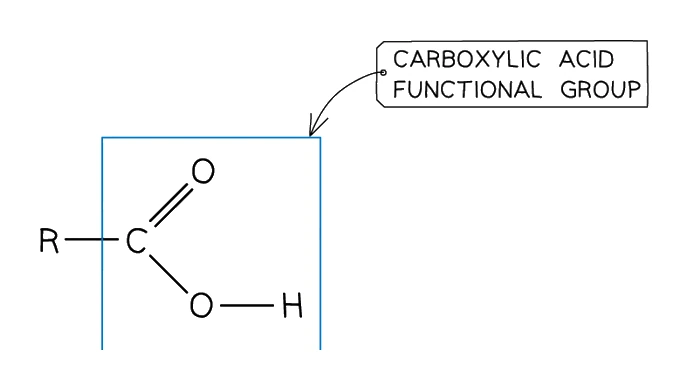
The carboxyl group up close
- The −COOH group consists of:
- A central carbon
- A C=O double bond to one oxygen
- A single bond to a separate O−H group
- The whole group is written as −COOH for short, or drawn out as −C(=O)−O−H when every bond is shown
- The hydrogen of the O−H is the acidic hydrogen — it is the proton released into solution that gives a carboxylic acid its acid character
Common exam question
Circling the carboxylic acid functional group
Question: Draw a circle around the functional group in the displayed formula of ethanoic acid, or around the carboxylic acid group in a larger molecule that also contains an ester group (1 mark).
Asked in 2 of the 23 papers. Circle the whole −COOH unit: the carbon, its C=O oxygen, the second oxygen and the hydrogen on it. Ring one group in one molecule only: when the acid is drawn in an equation beside an alcohol, also ringing the alcohol's O−H is rejected, and so is ringing more than one group. The carbon chain next to the group stays outside the circle.
When the molecule also contains an ester link, tell the two apart by the hydrogen: the ester's carbon and oxygens continue to another carbon atom, while the acid group ends in O−H. Circle the group that ends in O−H.
General formula
- The general formula of the carboxylic acid series is:
CnH2n+1COOH
- where n counts only the carbons sitting in the alkyl chain bonded to the −COOH group — it does not count the carbon already inside the carboxyl group itself
- A molecule with n alkyl carbons therefore has (n + 1) carbon atoms in total, including the one in the −COOH
- Special case: when n = 0, the alkyl chain is just a single hydrogen atom and the formula reduces to HCOOH (methanoic acid). This is the smallest member of the series
Naming carboxylic acids
- The name follows the standard stem-plus-ending convention from topic 21, with the ending "-anoic acid":
- 1 carbon → methan- + oic acid →
- 2 carbons → ethan- + oic acid →
- 3 carbons → propan- + oic acid → propanoic acid
- 4 carbons → butan- + oic acid → butanoic acid
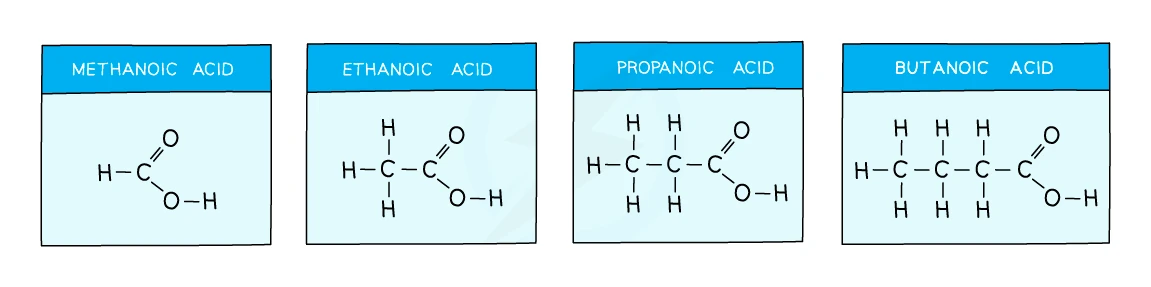
The first four carboxylic acids
The four shortest members of the series, all liquids at room temperature with sharp, vinegar-like smells:
| n | Name | Molecular formula | Found in |
|---|---|---|---|
| 1 | Methanoic acid | HCOOH | Ant and bee stings |
| 2 | Ethanoic acid | CH3COOH | Vinegar |
| 3 | Propanoic acid | C2H5COOH | Used as a food preservative |
| 4 | Butanoic acid | C3H7COOH | Rancid butter |
Every formula in this table contains the −COOH group. That group is what gives the molecules their acidic behaviour: in water the O–H end releases a hydrogen ion (H+), leaving a negatively-charged carboxylate ion behind.
Common exam question
Naming a carboxylic acid and drawing its displayed formula
Question: Complete a table for an acid whose structural formula is shown: give its name, say what type of formula CH2O is and draw its displayed formula; or draw the displayed formula of the acid that made a given ester (1–3 marks).
Asked in 3 of the 23 papers: twice as a displayed formula, and once as a structural formula for any compound C2H4O2, where CH3COOH is the expected answer (methyl methanoate also scored). Draw every bond, especially the O−H of the carboxyl group: one scheme requires that bond and another rejects a formula that leaves "−OH" undrawn. For the name, count every carbon including the one in −COOH: CH3COOH is ethanoic acid (acetic acid is also accepted). The table also prints CH2O and wants its type named: it is the empirical formula, the simplest whole-number ratio, half of C2H4O2.
To recover the acid from an ester, split it at the single C−O bond of the ester link: the fragment with the C=O is the acid, and it gets its O−H back, so methyl propanoate came from propanoic acid. Copy its carbon chain exactly as drawn, branches included.
2. Reactions of carboxylic acids
- Carboxylic acids behave like the inorganic acids met in topic 16: they donate a proton (the H of the O–H) into solution, and they react with the same partners — metals, bases and carbonates — to give a salt as one of the products
Naming the salts
- A salt formed from a carboxylic acid ends in "-anoate" instead of "-anoic acid"
- The pattern:
- Methanoic acid → methanoate salts (HCOO−)
- Ethanoic acid → ethanoate salts (CH3COO−)
- Propanoic acid → propanoate salts (CH3CH2COO−)
- Butanoic acid → butanoate salts (CH3CH2CH2COO−)
- The cation (sodium, potassium, calcium, ammonium, etc.) is named first, exactly as for inorganic salts
Reaction with reactive metals
- Carboxylic acids react with metals above hydrogen in the reactivity series to give a salt plus hydrogen gas:
carboxylic acid + metal → metal carboxylate + hydrogen
- Worked example: ethanoic acid with magnesium ribbon
2 CH3COOH(aq) + Mg(s) → (CH3COO)2Mg(aq) + H2(g)
- The acid loses its acidic hydrogens to form the magnesium ethanoate salt
- The gas given off can be tested with a lit splint — the characteristic squeaky pop confirms hydrogen
Common exam question
Observations with a reactive metal or a carbonate
Question: Give two observations that could be made when ethanoic acid reacts with magnesium, or state what you would observe when methanoic acid is added to sodium carbonate solution (1–2 marks).
Asked in 2 of the 23 papers. The first mark is effervescence (fizzing, bubbles). Both schemes ignore "a gas is given off", so describe the fizzing rather than the gas. The second observation with magnesium is that the metal gets smaller or disappears (dissolves is allowed). With a carbonate, the carbonate disappearing or dissolving is also allowed as the single observation.
Two marks need two different things you can see: the fizzing, then what happens to the solid.
Reaction with metal carbonates
- Carboxylic acids react with carbonates to give a salt plus water plus carbon dioxide gas:
carboxylic acid + metal carbonate → metal carboxylate + water + carbon dioxide
- Worked example: propanoic acid with sodium carbonate
2 CH3CH2COOH(aq) + Na2CO3(s) → 2 CH3CH2COONa(aq) + H2O(l) + CO2(g)
- Worked example: methanoic acid with calcium carbonate
2 HCOOH(aq) + CaCO3(s) → (HCOO)2Ca(aq) + H2O(l) + CO2(g)
- Visible features:
- as carbon dioxide bubbles off
- The carbonate dissolves into the acid solution
- Confirming the gas: bubble it through limewater — the limewater turns milky, confirming CO2
Common exam question
Completing the equation with a metal or a carbonate
Question: Complete the symbol equation for ethanoic acid reacting with magnesium, or for methanoic acid reacting with sodium carbonate (2 marks).
Set in 2 of the 23 papers. Write the acid with its alkyl group first and −COOH last. For the magnesium reaction the first mark is for 2CH3COOH + Mg on the left (the molecular formula C2H4O2 is allowed, but a scrambled CH4COO is rejected) and the second is for H2 on the right. For a carbonate, one mark is for carbon dioxide and water, which stands even if their coefficients are wrong, and the other is for the salt written as 2HCOONa, since the question already prints two acid molecules. NaHCOO is allowed but NaCOOH is rejected: the sodium replaces the hydrogen on the oxygen, so the hydrogen left is the one on the carbon, whereas NaCOOH still shows the acid's O−H.
In the magnesium scheme multiples and fractions are allowed and state symbols are ignored even when wrong, so spend the time on the formulae rather than on (aq) and (g).
Exam tip
Testing for a carboxylic acid without an indicator
When a question rules out an indicator and asks for a chemical test for ethanoic acid in a mixture (2 marks), name the reagent before the observation. The first mark is for adding a carbonate (no name needed) or a named metal such as magnesium or zinc: "add a metal" loses the first mark, and a group 1 metal is rejected. The second mark is the effervescence, which only scores once you have said what you added: "add a metal; it fizzes" still earns one mark, but fizzing with nothing added scores zero. A gas test (a lighted splint pops for hydrogen, limewater turns milky for carbon dioxide) is accepted in place of the fizzing.
Reaction with metal hydroxides (neutralisation)
- Like any acid, a carboxylic acid is neutralised by a metal hydroxide to give a salt plus water:
carboxylic acid + metal hydroxide → metal carboxylate + water
- Worked example: ethanoic acid with sodium hydroxide
CH3COOH(aq) + NaOH(aq) → CH3COONa(aq) + H2O(l)
- Sodium ethanoate (the salt) is fully soluble in water; the reaction is the same as for the inorganic acid–alkali reactions in topic 15
Why carboxylic acids are classed as weak acids
- An aqueous carboxylic acid only partially dissociates — most of the acid molecules sit in solution as the un-dissociated −COOH form, with only a small fraction releasing H+
- This makes carboxylic acids weak acids — a 1 mol dm−3 ethanoic acid solution has a pH of about 2.4, well above the pH 0–1 of a 1 mol dm−3 strong acid like HCl
- All the reactions in this section still happen — they are simply slower than the equivalent reactions of HCl or H2SO4 at the same concentration