1. The alkenes
What an alkene is
- Alkenes are a family of hydrocarbons that contain at least one , written as C=C and drawn as two parallel lines between two adjacent carbons
- The C=C double bond is the alkenes' functional group — the feature that fixes their chemistry and tells them apart from alkanes
- A molecule with a C=C double bond is described as unsaturated: the two carbons of the double bond are not joined to as many hydrogens as they possibly could be. Open the double bond and each carbon could accept one extra atom
Common exam question
Explaining why a compound is an unsaturated hydrocarbon
Question: Explain why ethene, or a compound whose displayed formula is given, is described as an unsaturated hydrocarbon (1–3 marks).
Asked in 4 of the 23 papers, usually for three marks that go to three separate ideas: the molecule contains a carbon–carbon double bond (the unsaturated part); it is made of carbon and hydrogen atoms; and it contains those two elements only (the hydrocarbon part). The "only" mark is given only once carbon and hydrogen are named, so write both.
Write "carbon and hydrogen atoms", never "carbon and hydrogen molecules": the mark schemes reject the word molecules every time. A compound with two or three C=C bonds still earns the double-bond mark for saying it contains a double bond. When the question asks only why ethene is unsaturated, for one mark, the double bond is the whole answer.
General formula
- The general formula of the alkene series (with one C=C double bond) is:
CnH2n
- where n is the number of carbon atoms (n ≥ 2; methene does not exist because one carbon cannot form a double bond with itself)
- Compare with alkanes (CnH2n+2): an alkene has two fewer hydrogen atoms than its alkane of the same chain length, because two of the bonds that would have held hydrogens now sit between the two C=C carbons
Common exam question
Using the general formula of the alkenes
Question: State why every alkene in the CₙH₂ₙ series has the empirical formula CH₂, explain why straight-chain alkenes share one empirical formula while alkanes do not, say why a given compound does or does not fit CₙH₂ₙ, or pick out the saturated compound that fits it (1–3 marks).
Asked in 5 of the 23 papers. The credited idea is that an alkene has two hydrogen atoms for every carbon atom, which is what CₙH₂ₙ says; writing the general formula earns the same mark, and in the three-mark version so does quoting two members such as C₂H₄ and C₃H₆. For the three-mark version add that the ratio therefore always simplifies to CH₂, then show that the alkane formula CₙH₂ₙ₊₂ does not: C₂H₆ simplifies to CH₃ but C₄H₁₀ to C₂H₅.
The formula alone does not prove an alkene. A saturated ring compound fits CₙH₂ₙ with no double bond, and a molecule with more than one C=C has fewer hydrogens than CₙH₂ₙ predicts, so it does not follow the general formula.
The first four alkenes
The smallest four members of the series are the ones tested most often:
| n | Name | Molecular formula | State at room temperature |
|---|---|---|---|
| 2 | Ethene | C2H4 | Gas |
| 3 | Propene | C3H6 | Gas |
| 4 | Butene | C4H8 | Gas |
| 5 | Pentene | C5H10 | Liquid |
The naming pattern is the same as the alkanes (eth-, prop-, but-, pent- for the carbon count) but the ending changes to -ene to signal the presence of a C=C double bond.
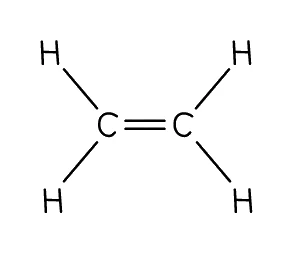
Naming alkenes with the C=C position
- For ethene and propene the C=C can only sit in one place, so no number is needed
- From butene onward, the position of the C=C must be shown with a number — counting from whichever end gives the lowest possible number
- But-1-ene: C=C between carbons 1 and 2 (CH2=CH−CH2−CH3)
- But-2-ene: C=C between carbons 2 and 3 (CH3−CH=CH−CH3)
- A 5-carbon chain therefore gives two main alkenes — pent-1-ene and pent-2-ene — depending on where the double bond sits
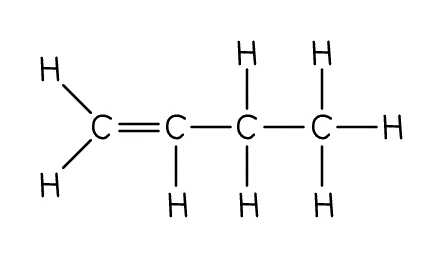
Common exam question
Drawing and naming alkenes and the isomers of C₄H₈
Question: Draw the displayed formula of propene, draw the other alkene isomers with the molecular formula C₄H₈, name a drawn alkene or give its structural formula, or explain why two C₄H₈ compounds are isomers (1–2 marks).
Set in 5 of the 23 papers: propene alone in two, the C₄H₈ isomers in two, and one on the structural formula of but-1-ene and why it and a C₄H₈ ring are isomers. A displayed formula shows every bond, with the C=C as two lines; one scheme let a methyl group stand as CH₃, another insisted on every bond, so draw them all. The alkene isomers of C₄H₈ are but-1-ene, but-2-ene and the branched methylpropene, a propene skeleton with a CH₃ on the middle carbon. But-2-ene with its CH₃ groups on the same side of the C=C and with them on opposite sides counted as different isomers. A four-carbon ring has the formula C₄H₈ but is not an alkene, and it is rejected.
If asked why two alkenes are isomers, the two marks are the same molecular formula and different structural or displayed formulae; "same general formula" is not accepted for the first.
Why alkenes are reactive
- The C=C double bond can break open: one of the two bonds between the carbons breaks, leaving a single bond between them and two spare bonds (one on each carbon) free to accept incoming atoms
- Each carbon now ends with four single bonds, which is the most stable arrangement for carbon
- This is why alkenes undergo (section 2) so readily, while alkanes — with all single bonds already in place — do not
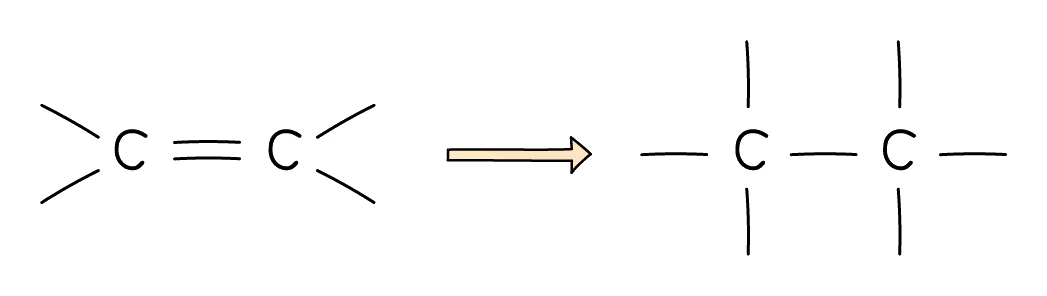
2. Addition reactions and the bromine water test
What an addition reaction is
- An addition reaction combines a small molecule with the C=C of an alkene to give one larger product molecule and nothing else
- Each atom of the small molecule attaches to one of the two C=C carbons; the C=C double bond becomes a C–C single bond
- Several useful addition reactions to know:
- With hydrogen (over a nickel catalyst, 150 °C) to make the corresponding alkane (the basis of hardening vegetable oils into margarine)
- With steam (catalysed by phosphoric acid, 300 °C, 60 atm) to make an alcohol (industrial route to ethanol from ethene — see topic 25)
- With halogens to make a dihalogenoalkane
Common exam question
The reaction of an alkene with bromine
Question: Name the type of reaction when an alkene reacts with bromine (or chlorine), or describe the differences between the reactions of ethene and ethane with bromine (1–5 marks).
Asked in 4 of the 23 papers: three times as a one-mark multiple choice whose answer is addition, once as a five-mark comparison. The comparison is marked as seven separate points, any five of which score: ethene reacts by addition and forms dibromoethane as the only product; ethane needs ultraviolet light, reacts by substitution, and gives bromoethane together with hydrogen bromide; which bond breaks (the C=C in ethene, or a C–H in ethane) is a single further point. The condition and the three product points can be earned from equations instead of sentences.
Colour changes earned nothing in that comparison, because it asks about the reactions rather than the test. Keep ultraviolet light on the ethane side only: an alkene adds bromine with no light needed.
The bromine water test for unsaturation
- Bromine water is an orange solution of bromine dissolved in water
- It is the standard laboratory test for distinguishing an alkene from an alkane:
- Shake a sample of the unknown hydrocarbon with bromine water in a test tube
- If the orange colour decolourises (turns colourless), a C=C double bond is present — the substance is an
- If the orange colour stays the same, no C=C is present — the substance is an (saturated)
- Why it works:
- With an alkene, bromine atoms add across the C=C to make a colourless dihalogenoalkane in solution — the free Br2 is consumed by the reaction, and the orange colour disappears
- With an alkane, there is no C=C for the bromine to react with, so the bromine stays dissolved and the solution remains orange
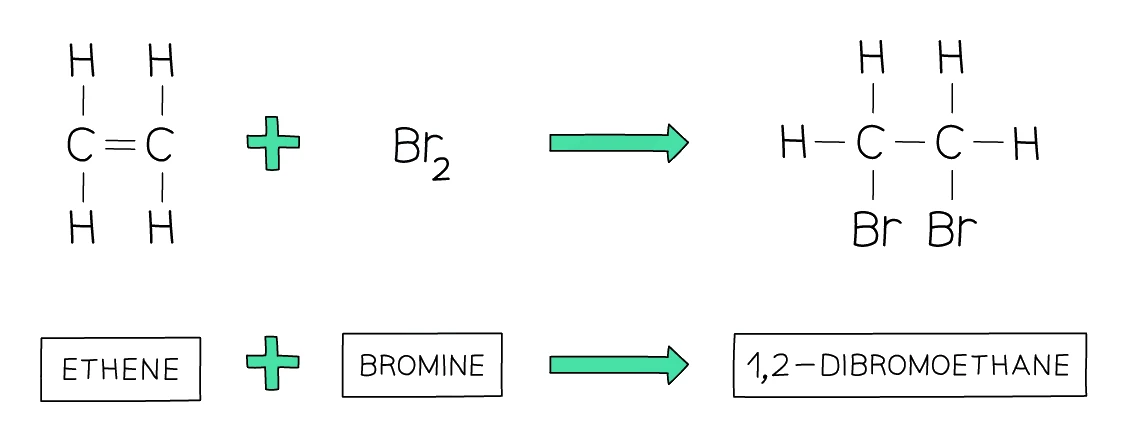
Common exam question
The bromine water test for an alkene
Question: Describe a test to show that a hydrocarbon is unsaturated, give the colour change when ethene meets bromine water, or state what is seen with ethane and with ethene (1–2 marks).
Asked in 6 of the 23 papers. For the test, the first mark is for adding bromine water (bromine solution or aqueous bromine also count; "bromine" alone is rejected) and the second is for the result: the bromine water turns from orange to colourless, or is decolourised. The colour-change mark counts only once you have named bromine, so "add bromine" still loses the first mark and a test with no bromine in it scores nothing. With an alkane the observation is that it stays orange; "no reaction" is not an observation and is ignored.
"Clear" is ignored, "changes colour" scores nothing on its own, and any final colour other than colourless is rejected. Start from orange or yellow: the one-mark colour-change question did not accept red or red-brown. Never say the test needs ultraviolet light; that is the alkane reaction, and mentioning it loses the result mark.
Why this test matters
- Bromine water (an aqueous bromine solution) is safer to handle and easier to see colour-change with than liquid bromine itself
- The test is the simplest way to identify whether a hydrocarbon contains a C=C double bond — i.e. whether it is unsaturated
- The same test will give a positive result for any alkene of any chain length, because the C=C is the reactive functional group rather than the chain length being the key feature