1. The alcohols
What an alcohol is
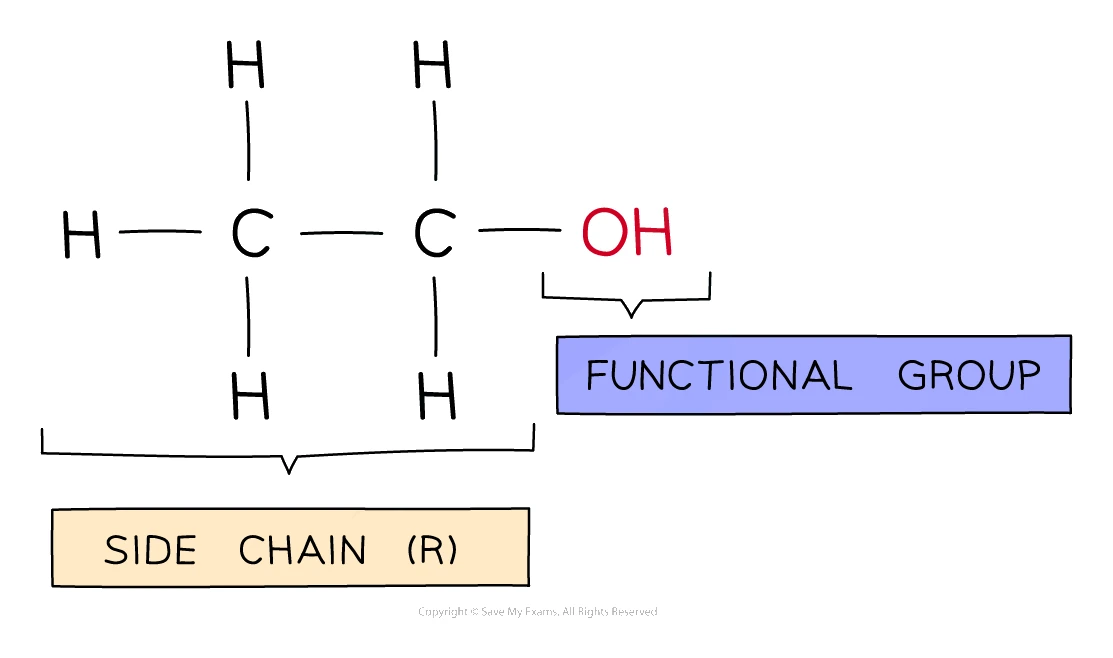
- Alcohols are a homologous series of organic compounds that contain the hydroxyl functional group, −OH
- The hydroxyl group is what fixes the chemistry of every alcohol — it can be oxidised, react with carboxylic acids to form esters, and is responsible for the alcohol being a polar molecule that dissolves in water
- The short alcohols are colourless liquids at room temperature; they mix fully with water and the resulting solution is neutral on the pH scale
- Methanol, ethanol, propanol and butanol — the first four members of the series — are all used either as fuels or as solvents
- General formula of the alcohol homologous series:
CnH2n+1OH
- The naming rule is the standard stem-plus-ending convention from topic 21: replace the final "-e" of the parent alkane with "-ol"
- meth-an-e + -ol → methanol
- eth-an-e + -ol → ethanol
- prop-an-e + -ol → propanol (numbered as propan-1-ol or propan-2-ol when the position of −OH matters)
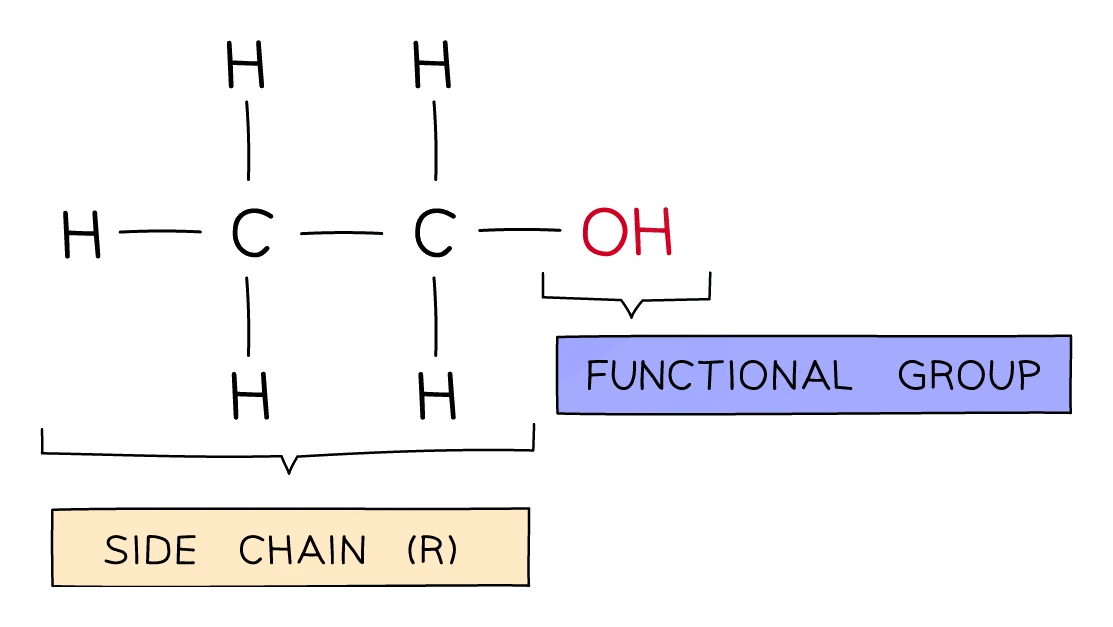
The first four alcohols
The members of the series most commonly tested:
| n | Name | Formula | State at room temperature |
|---|---|---|---|
| 1 | Methanol | CH3OH | Liquid |
| 2 | Ethanol | C2H5OH | Liquid |
| 3 | Propan-1-ol | C3H7OH | Liquid |
| 4 | Butan-1-ol | C4H9OH | Liquid |
All four are liquids at room temperature, unlike the smaller alkanes which are gases. The extra −OH group lets each molecule form with its neighbours, which raises the boiling point well above the equivalent-length alkane.
Exam tip
Which formula of ethanol a question wants
The table above writes each alcohol with its −OH group shown, the way equations do. A question that asks for the molecular formula wants the atoms counted instead: ethanol is C₂H₆O, and when a paper asked for it the scheme rejected C₂H₅OH. CH₃CH₂OH is a structural formula, which is the answer when a multiple-choice question asks what kind of formula it is; a displayed formula is the one that draws every bond.
Position of the −OH on longer alcohols
- For propanol and onwards, the hydroxyl group can sit on different carbons in the chain; a number between the stem and the "-ol" shows which carbon
- Propan-1-ol has the −OH on carbon 1 (the end of the chain): CH3CH2CH2OH
- Propan-2-ol has the −OH on carbon 2 (the middle): CH3CH(OH)CH3
- In exam answers, "propanol" and "butanol" without a number always mean the propan-1-ol and butan-1-ol isomers
Common exam question
Naming an alcohol and drawing its displayed formula
Question: Name the alcohol whose structural or displayed formula is shown, or draw the displayed formula of propanol (1 mark each).
Asked in 3 of the 23 papers, and the alcohol was propanol each time. When the formula puts the OH on an end carbon, as in CH₃CH₂CH₂OH, the name is propan-1-ol; plain "propanol" is accepted, but "propan-2-ol" is rejected because that would put the OH on the middle carbon.
For the drawing, the mark depends on the bond between O and H being drawn: a chain that ends in an "–OH" written as a group scores nothing. When the question says only "propanol", a correct drawing of either isomer is accepted.
2. Oxidation of ethanol
Ethanol — the alcohol in alcoholic drinks — can be oxidised in three ways. Complete combustion converts every carbon atom all the way to carbon dioxide, whereas the other two routes attack the hydroxyl carbon in particular, turning it into a carbonyl (C=O) carbon.
(a) Combustion of ethanol
- Ethanol burns in a plentiful supply of oxygen with an almost invisible pale-blue flame, giving carbon dioxide and water:
C2H5OH(l) + 3 O2(g) → 2 CO2(g) + 3 H2O(l)
- The reaction is strongly exothermic, which is why ethanol is used as a fuel — for laboratory spirit burners, in cooking burners (methylated spirit), and as an additive to motor fuel (E10 petrol)
- A common mistake when balancing this equation is forgetting that ethanol already contains one oxygen atom of its own
(b) Aerobic oxidation by bacteria
- Bacteria in the genus Acetobacter can use atmospheric oxygen to oxidise ethanol to (the acid in vinegar):
ethanol + oxygen → ethanoic acid + water
C2H5OH(aq) + O2(g) → CH3COOH(aq) + H2O(l)
- A bottle of wine left uncorked on the kitchen counter for a few days develops a sharp vinegary taste because of exactly this microbial oxidation
- The same reaction is the industrial route to vinegar — wine or cider is left open to Acetobacter-rich air on purpose to sour it
(c) Oxidation with potassium dichromate
- In the school lab, ethanol is oxidised by heating it with (VI) solution (orange K2Cr2O7 in dilute H2SO4) — the dichromate provides the oxygen
- The reaction is written as:
CH3CH2OH(l) + 2[O] → CH3COOH(aq) + H2O(l)
- The square-bracketed [O] is shorthand for "an atom of oxygen supplied by the oxidising agent"
- Observation: the orange potassium dichromate solution turns green as the dichromate ion is reduced to chromium(III) (Cr3+) while the ethanol is oxidised
- The orange-to-green colour change is the test result: a positive result for an alcohol being oxidised
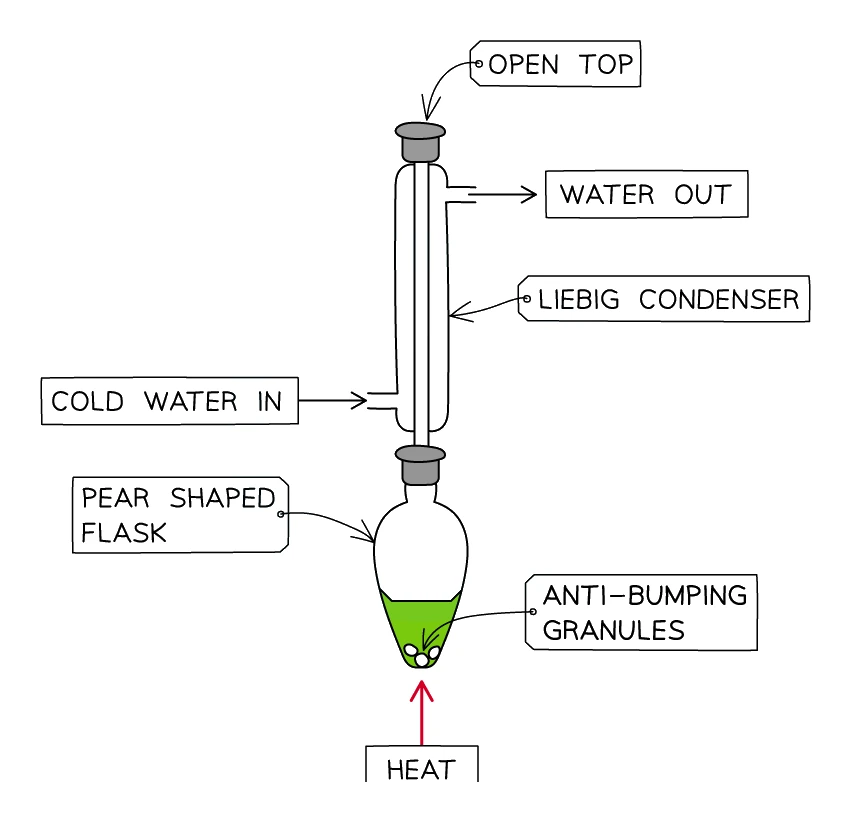
- Apparatus: the ethanol–dichromate mixture is heated under (with a vertical condenser fitted to the flask) so that volatile ethanol and ethanoic acid do not escape as they boil over
Exam tip
Both reagents for oxidising ethanol in the laboratory
Asked for the two reagents that oxidise ethanol to a carboxylic acid, name both, because each is a separate mark: potassium dichromate(VI) and dilute sulfuric acid, in either order. Sodium dichromate(VI) or the formula K₂Cr₂O₇ earns the first mark and the (VI) is not essential; concentrated sulfuric acid or H₂SO₄ earns the second. "Potassium dichromate" on its own stops at one mark. The colour change is orange to green, as dichromate(VI) ions are reduced to chromium(III) ions while the ethanol is oxidised, and the multiple-choice version lists the reverse order as a distractor.
3. Manufacture of ethanol
Ethanol is made on an industrial scale by two completely different routes; one is fast and continuous, the other slow and batch-based. Both are important in different parts of the world.
Route A — Hydration of ethene
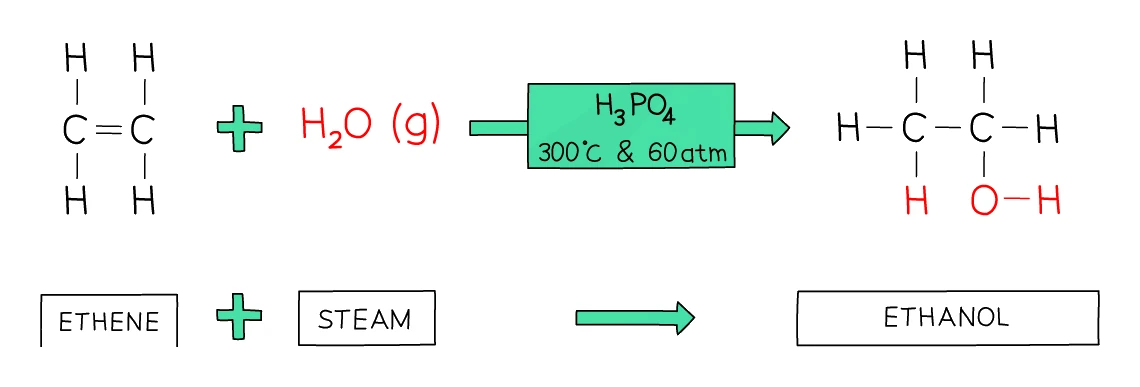
- Ethene from cracking is reacted with water (as steam) in the presence of a catalyst:
C2H4(g) + H2O(g) → C2H5OH(g)
- An addition reaction across the C=C: H and OH from a water molecule attach to the two carbons of the double bond, leaving an ethanol molecule
- Conditions:
- Temperature about 300 °C
- Pressure about 60–70 atm
- Catalyst: concentrated phosphoric acid, H3PO4
- The reaction does not finish in a single pass: the gas mixture leaving the reactor still contains some ethene along with the ethanol and the water. The unreacted ethene condenses at a much lower temperature (boiling point −104 °C) than the other two and is separated off and pumped back into the reactor; the ethanol-and-water mixture is then split by fractional distillation
- Hydration is a continuous industrial process — feedstock flows in, products flow out, around the clock
- The route depends on having a cheap supply of ethene from cracking oil, so it dominates ethanol manufacture in oil-rich countries
Common exam question
Conditions for the hydration of ethene
Question: State the temperature and pressure used when ethene reacts with steam to make ethanol, or complete a table of the conditions for both manufacturing routes (1 mark per condition).
Set in 2 of the 23 papers. The credited conditions are 300 °C, a pressure of 60 to 70 atmospheres and a phosphoric acid catalyst (H₃PO₄ is accepted). Learn 300 °C and 60 to 70 atm as they stand, with their units. The one scheme that asked for the temperature took anything from 250 to 350 °C, and both took any pressure from 60 to 70 atm, but those margins are no reason to write anything else. In the table version the fermentation temperature, 30 °C, is wanted alongside, so learn the two sets of conditions as a pair.
Route B — Fermentation of sugar
- Glucose or sucrose (in fruit juice, sugar-cane syrup or molasses) is dissolved in water with and left to react in the absence of air:
C6H12O6(aq) → 2 C2H5OH(aq) + 2 CO2(g)
- The yeast contains enzymes that catalyse the breakdown of glucose into ethanol and carbon dioxide
- Conditions:
- Temperature kept at about 25–35 °C (optimum near 30 °C)
- Below 25 °C the enzymes work too slowly
- Above 35 °C the enzymes start to (lose their shape and stop functioning)
- No oxygen — fermentation is an anaerobic process. If air is allowed in, Acetobacter would oxidise the ethanol to vinegar (see section 2 part b)
- Temperature kept at about 25–35 °C (optimum near 30 °C)
- The yeast keeps fermenting until the ethanol concentration reaches around 14–15%, at which point the alcohol kills the yeast and the reaction stops
- The fermented mixture is then fractionally distilled to give purer ethanol (up to about 96%)
- Fermentation is a batch process — each fermenter is filled, run, drained and refilled separately
- The route depends only on plant material (a renewable source), so it dominates ethanol manufacture in countries with large agricultural surpluses such as Brazil
Common exam question
Writing the equation for fermentation
Question: Write the word equation for the fermentation of glucose, or complete the balanced symbol equation (1–2 marks).
Asked in 3 of the 23 papers. The word equation is glucose → ethanol + carbon dioxide; yeast supplies the enzymes that catalyse it, so it is not a reactant, and it is ignored if you add it. The symbol equation is C₆H₁₂O₆ → 2C₂H₅OH + 2CO₂. When it carries two marks the first is for both product formulae and the second for the balancing, which normally depends on the formulae being right; the one exception the scheme makes is C₂H₆O for ethanol, which loses the formula mark but can still be balanced for the second. So give ethanol as C₂H₅OH or CH₃CH₂OH. State symbols are ignored even when they are wrong, and multiples of the equation are allowed.
Common exam question
Conditions needed for fermentation
Question: State two conditions needed for fermentation, or give the substance that must be added (1–2 marks).
Asked in 3 of the 23 papers, once as a table to complete. The credited conditions are 30 °C, yeast (the source of the enzymes) and the absence of air; which two score depends on what the stem already gives. If it says the fermentation is done without air, "anaerobic" is ignored and the marks are for the temperature and the yeast; if yeast was asked for in an earlier part, they are for the temperature and the absence of air or oxygen.
Give the temperature as a number: "room temperature" is ignored. The tolerance around 30 °C varies (20 to 40 °C in two schemes, 30 to 40 °C in a third), so write 30 °C: every value from 30 to 40 °C scored in all three, but a lower one, such as the 25 °C at the bottom of the range above, would have failed the third. Write "yeast" rather than "zymase": one scheme allows zymase, another ignores it.
Common exam question
Why fermentation is done in the absence of air
Question: Explain why the fermentation of glucose has to be done without any air present (2 marks).
Set in 2 of the 23 papers, for two marks. The first mark is for oxygen in the air reacting with (oxidising) the ethanol; the second is for naming the product, ethanoic acid. "Vinegar" is accepted for the second mark in both schemes, but "carboxylic acid" was allowed in one year and ignored in the other, so name the acid itself. The alternative pair of marks is that fermentation is anaerobic, so with air present ethanol would not be made and only carbon dioxide and water would form.
Comparison
| Feature | Hydration of ethene | Fermentation of sugar |
|---|---|---|
| Raw material | Ethene from cracking crude oil (non-renewable) | Glucose from plants (renewable) |
| Mode | Continuous, fast | Batch, slow (takes days) |
| Conditions | 300 °C, 60–70 atm, H3PO4 catalyst | 25–35 °C, yeast enzymes, no oxygen |
| Energy cost | High (heating, compressing) | Low |
| Purity of product | Very high after a single fractional distillation | Limited by enzyme denaturing; mixture is dilute and needs more separation work |
| Sustainability | Dependent on finite oil reserves | Renewable as long as crops can be grown |
Exam tip
Explaining an advantage and a disadvantage of fermentation
Asked to explain one advantage and one disadvantage of fermentation over hydration for four marks, treat each as two linked marks: the difference, then its consequence. Advantages that score are the renewable raw material (sugar from plants) against ethene from finite crude oil, or the lower temperature or pressure, so less energy is needed; "cheaper" or "less costly" on its own is ignored. Disadvantages are that fermentation is slower, or a batch process while hydration is continuous, so it is less efficient; or that its ethanol is impure and has to be purified. A comment about yield is ignored.