1. Indicators and the pH scale
What an indicator is
- An indicator is a substance that changes colour to show whether a solution is acidic, neutral or alkaline
- A two-colour shows one colour in acid and a different colour in alkali — its colour flips sharply at the of an acid–alkali reaction
- A universal indicator is a mixture of several indicators that goes through a continuous range of colours, giving a rough numerical pH rather than a single switch
Common two-colour indicators
- Phenolphthalein — stays colourless in acid; flips to a clear pink in alkali
- Methyl orange — looks red while the solution is acidic; turns yellow once the solution becomes alkaline
- Litmus — red in acid, blue in alkali; supplied either as a solution or as red and blue paper strips for testing drops of liquid or moist gases
- Phenolphthalein and methyl orange give sharp colour changes and are the indicators used in (see section 3)
- Litmus solution gives a less sharp change than the other two, passing through a purple band rather than a single clean transition, although the mark schemes do accept litmus solution as a titration indicator
Common exam question
Choosing a titration indicator and its colour
Question: Name a suitable indicator for an acid–alkali titration and give its colour, or its colour change, in the flask (1–2 marks).
Asked in 5 of the 23 papers. Methyl orange, phenolphthalein or litmus solution all score; universal indicator is rejected, so is litmus paper, and the abbreviation "pp" is ignored, so spell phenolphthalein out. The colour follows what the flask holds. Methyl orange is yellow in alkali (orange accepted) and red in acid (pink accepted; yellow to orange or to pink is allowed for the change); phenolphthalein is pink in alkali and colourless in acid; litmus is blue in alkali (purple accepted) and red in acid. When alkali is run into acid the final colour is the alkaline one, and when acid is run into alkali methyl orange goes from yellow to red, which must be given in that order.
When name and colour are both asked, the colour mark depends on the name: a colour alone scores nothing, a name alone scores one.
The pH number line
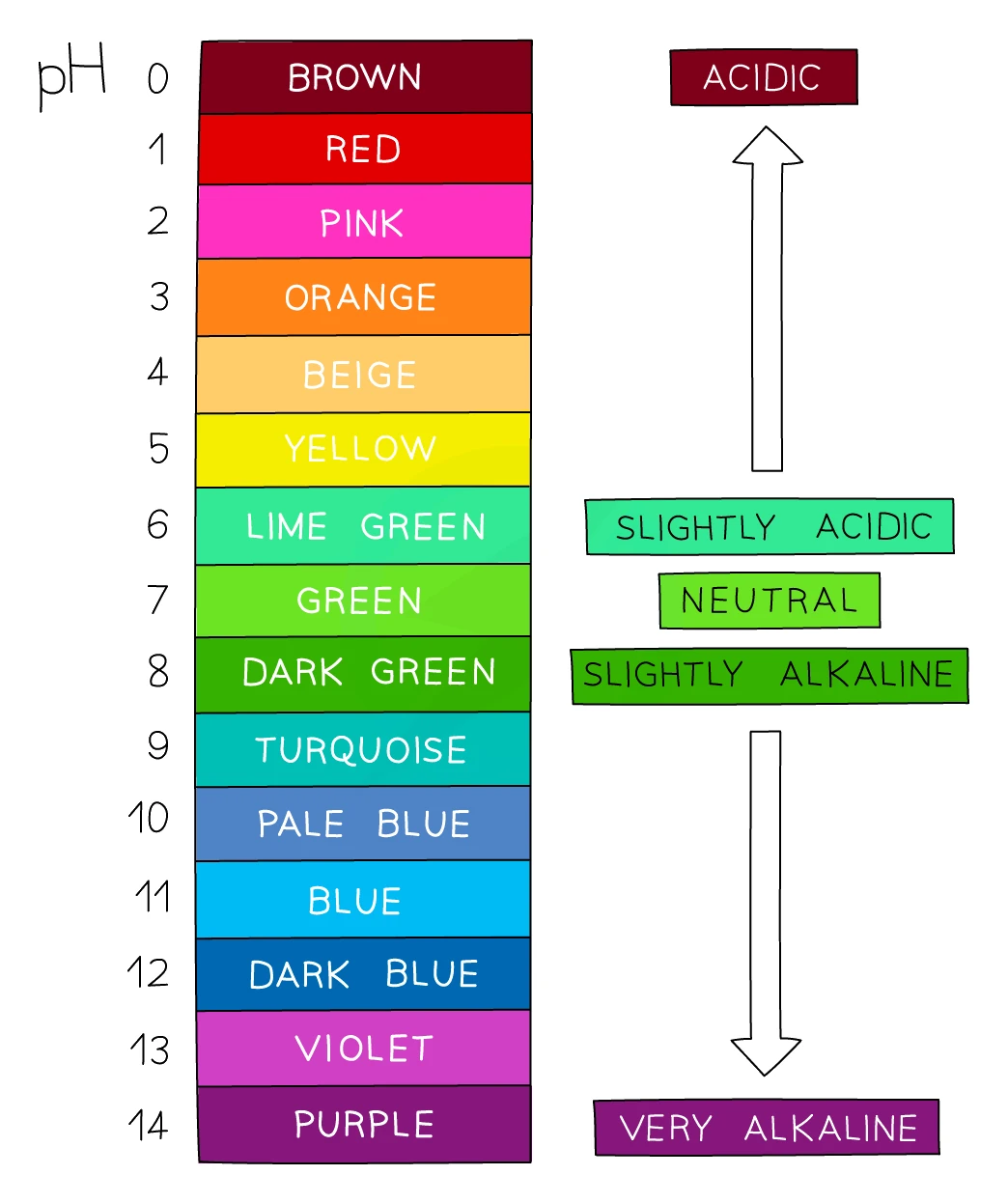
- The pH scale is a number scale that runs from 0 (most acidic) to 14 (most alkaline)
- pH = 7 is (pure water at room temperature)
- The scale measures the concentration of H+ ions in solution; the more H+ ions, the lower the pH
- Rough guide:
| pH range | What it describes | Examples |
|---|---|---|
| 0–3 | Strong acid | Hydrochloric, sulfuric and nitric acid in the lab; stomach acid |
| 4–6 | Weak acid | Lemon juice, vinegar, rainwater |
| 7 | Neutral | Pure water, sodium chloride solution |
| 8–10 | Weak alkali | Sodium hydrogencarbonate solution, soap |
| 11–14 | Strong alkali | Sodium hydroxide, potassium hydroxide, oven cleaner |
Common exam question
Giving a pH value
Question: Give the pH of a neutral solution, or a pH value that fits a weakly acidic or weakly alkaline solution (1 mark each).
Asked in 2 of the 23 papers, both times in question 1. Neutral is exactly 7. For a weakly acidic solution any value from 4 up to, but not including, 7 is accepted, so a safe choice is 5. A solution of pH 9 is weakly alkaline, not strongly alkaline: the strong ends of the scale are 0 to 3 and 11 to 14.
Using universal indicator
- A few drops of universal indicator are added to the solution under test
- The resulting colour is matched against a printed chart that maps each colour band to a pH value
- Universal indicator gives only an estimate; the exact colours vary between brands, so the supplied chart must be used
- Because the change is gradual, universal indicator is not suitable for titrations — the end-point would be impossible to pin down
Common exam question
Explaining the colour of an indicator in a solution
Question: Give the colour of an indicator in an acidic or an alkaline solution, or give or explain its final colour in the solution formed by a reaction such as a Group 1 metal in water or sulfur dioxide dissolving (1–2 marks).
Asked in 9 of the 23 papers. The first mark is the colour: universal indicator turns blue or purple in an alkali and red, orange or yellow in an acid; phenolphthalein turns pink (red and purple are rejected); methyl orange turns yellow in alkali; litmus turns red in acid (pink accepted, red-orange rejected). The second mark is the reason, and it is about the ions: an alkaline solution has formed because hydroxide ions, OH⁻, are present, or an acidic one because it contains hydrogen ions, H⁺. Naming the alkali made, such as sodium hydroxide, is also accepted. The indicator's colour before the reaction is ignored, so do not spend words on it.
Common exam question
Why universal indicator is not used in a titration
Question: Give a reason why universal indicator is not suitable for a titration, or explain why a named indicator should replace it (1–2 marks).
Asked in 3 of the 23 papers. One statement earns the single mark: universal indicator gives no sharp colour change, so there is no clear end-point, or it changes colour gradually over a range of pH values, giving a range of colours. Either scores on its own. When a faulty method is given and you are asked to improve it, the pair is worth two marks: name the replacement (methyl orange, phenolphthalein or litmus) and give the reason, that it gives a sharp colour change, or has just two colours, one in acid and one in alkali.
2. Acids, alkalis and neutralisation
What makes a solution acidic or alkaline
- An acid is a substance that releases hydrogen ions, H+, into aqueous solution
- Hydrochloric acid: HCl(aq) → H+(aq) + Cl−(aq)
- Sulfuric acid: H2SO4(aq) → 2 H+(aq) + SO42−(aq)
- Nitric acid: HNO3(aq) → H+(aq) + NO3−(aq)
- An alkali is a soluble base that releases hydroxide ions, OH−, into aqueous solution
- Sodium hydroxide: NaOH(aq) → Na+(aq) + OH−(aq)
- Potassium hydroxide: KOH(aq) → K+(aq) + OH−(aq)
- Aqueous ammonia: NH3(aq) + H2O(l) ⇌ NH4+(aq) + OH−(aq)
Neutralisation
- A reaction is the reaction between an acid and a base (or an alkali) that produces a and water
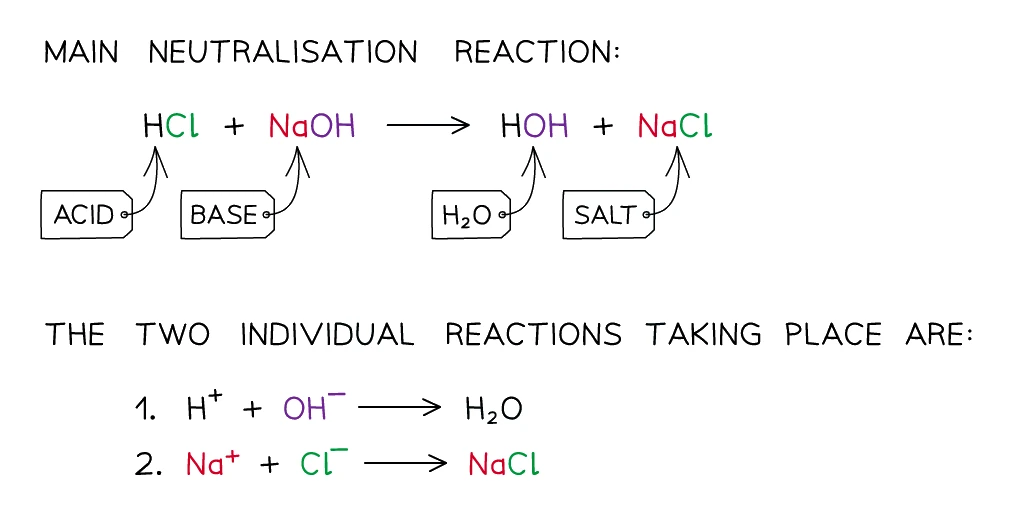
- For an alkali, the central chemistry is that H+ ions from the acid combine with OH− ions from the alkali to form water:
H+(aq) + OH−(aq) → H2O(l)
- This is the net ionic equation for every acid–alkali neutralisation; the spectator ions (e.g. Na+ and Cl−) move from reactants to products unchanged
- Example: hydrochloric acid neutralised by sodium hydroxide
- Full equation: HCl(aq) + NaOH(aq) → NaCl(aq) + H2O(l)
- Net ionic equation: as above
- Example: sulfuric acid neutralised by potassium hydroxide
- H2SO4(aq) + 2 KOH(aq) → K2SO4(aq) + 2 H2O(l)
Not every acid reaction is a neutralisation
- A metal reacting with an acid gives a salt and hydrogen gas, not water, so it does not count as a neutralisation (see topic 13 section 1)
- Neutralisation specifically requires that water be produced alongside the salt — so it is the acid + base / alkali / metal carbonate type reactions that qualify
A practical use: treating acidic soil
- Many crops grow poorly when the soil pH drops below 7
- Farmers spread bases such as crushed limestone (calcium carbonate) or quicklime (calcium oxide) on acidic soil
- These bases neutralise the soil acidity and raise the pH back into the range crops tolerate
3. Acid–alkali titrations
What a titration is and what it tells you
- A titration is a quantitative procedure used to find how much of one solution exactly reacts with a measured volume of another
- For acid–alkali titrations, the question usually asked is: what volume of acid (of known concentration) neutralises a fixed volume of alkali (of unknown or known concentration)?
- From the titration result you can work out the moles that reacted, the concentration of the unknown solution, or the volume of acid needed in a salt preparation
Method (acid in burette, alkali in flask)
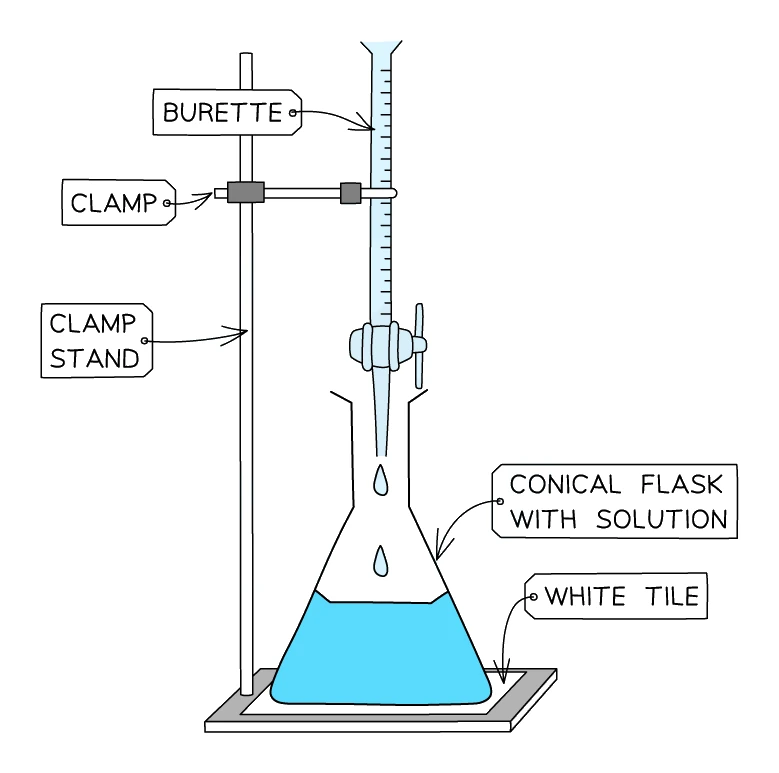
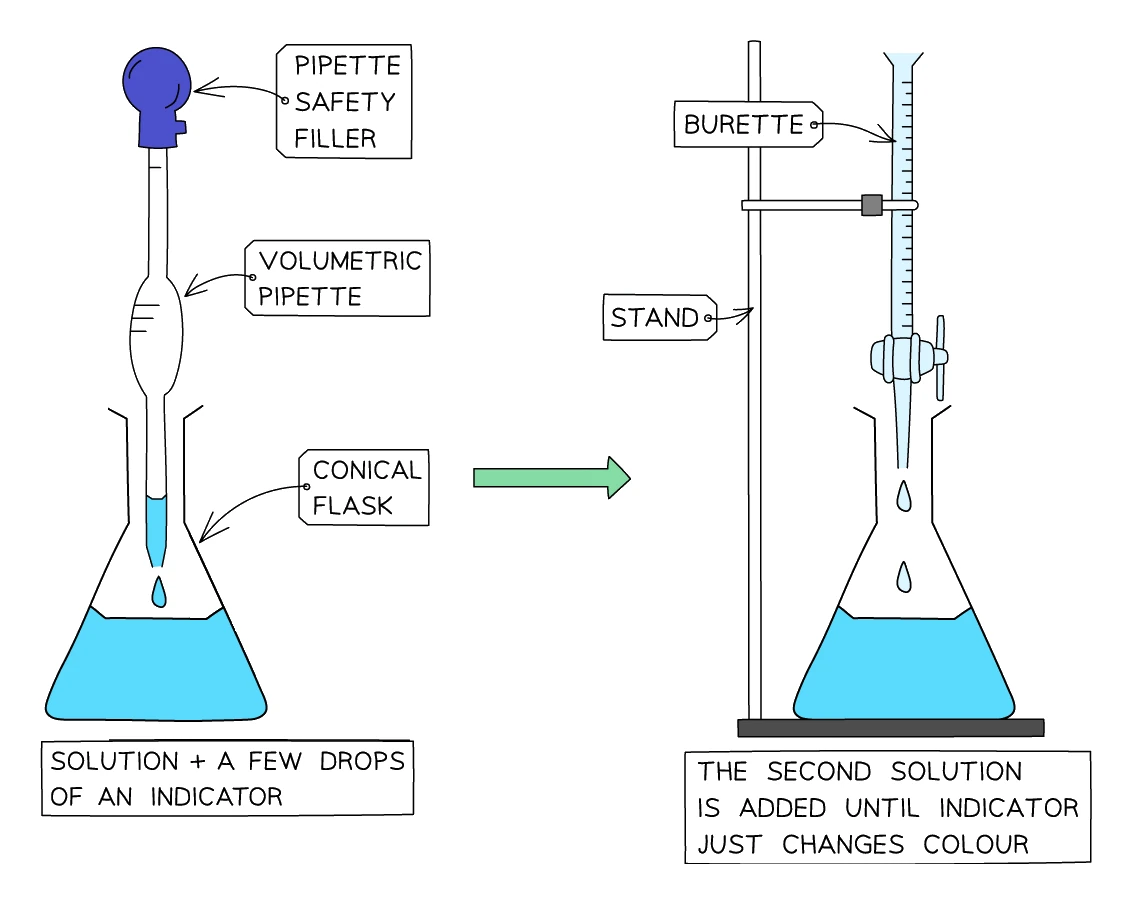
- Pipette a fixed, known volume (e.g. 25.0 cm3) of the alkali into a clean conical flask, using a pipette and pipette filler
- Add 2–3 drops of a suitable indicator (phenolphthalein or methyl orange) to the alkali
- Fill the with the acid; record the initial reading by lining up the bottom of the meniscus with the scale, reading to the nearest 0.05 cm3
- Position the conical flask directly under the burette tip, sitting it on a white tile so any colour change shows up clearly against the pale background
- Do one rough run first — open the tap and let the acid run in steadily, swirling the flask, and close the tap as soon as the indicator changes colour. Record the rough titre
- For each accurate run, deliver the acid quickly to about 1 cm3 short of the rough titre, then add it drop by drop with swirling between each addition, stopping the moment the indicator flips colour
- Record the final reading to the nearest 0.05 cm3; the titre is the final reading minus the initial reading
- Repeat until two titres agree to within 0.1 cm3 — these are concordant results — and take their mean as the answer
Common exam question
Naming the titration apparatus
Question: Name the apparatus used to measure 25.0 cm³ of the alkali into the flask, identify the two pieces of apparatus in a diagram, or say why a pipette is better than a measuring cylinder (1–2 marks).
Asked in 6 of the 23 papers, all on Paper 2. The fixed volume is measured with a (volumetric) pipette and the other solution is added from the burette. A measuring cylinder is rejected, and so is a dropping pipette. In a diagram, the burette is the long graduated tube with a tap and 0 at the top of its scale, the pipette has a bulb with a single line, and a measuring cylinder's scale rises from the bottom and it stands on a base. The pipette is preferred because its volume is more precise; more accurate, or exactly 25.0 cm³, also score.
Common exam question
Describing the titration method
Question: Describe how the student should do the titration, or the further steps needed for an accurate result (5–6 marks).
Asked in 4 of the 23 papers, always on Paper 2, one mark per step, so give more steps than the total. Pipette 25.0 cm³ of whichever solution the question puts in the conical flask (usually the alkali) and add a few drops of a named indicator (not universal indicator); the other solution goes in the burette, and one scheme rejects the alkali in the burette when the method has it in the flask. Rinse the burette with the solution whose volume you are finding, fill it, check the jet holds no air bubble and record the initial reading. Run it in while swirling, drop by drop near the end-point, and stop at the permanent colour change. Record the final reading and subtract; repeat until two titres agree within 0.2 cm³ and take their mean.
Rinse the flask between runs only with distilled water; rinsing it with the solution is rejected. When the question's own method has already added the indicator, indicator names and colour changes are ignored.
Sample results
| Run | Initial reading / cm³ | Final reading / cm³ | Titre / cm³ |
|---|---|---|---|
| Rough | 0.00 | 22.80 | 22.80 |
| 1 | 0.00 | 22.10 | 22.10 |
| 2 | 0.00 | 22.15 | 22.15 |
| 3 | 22.15 | 44.30 | 22.15 |
- Runs 1, 2 and 3 are within 0.1 cm3 of each other and are taken as concordant
- Mean titre = (22.10 + 22.15 + 22.15) ÷ 3 = 22.13 cm3
- The rough run is excluded from the mean — it is used only to find the end-point quickly so that the careful runs can be timed
Common exam question
White tile, swirling and concordant results
Question: State why the flask stands on a white tile, why it is swirled, or what concordant results are, or use a results table to find the mean titre (1–3 marks).
Asked in 4 of the 23 papers. The white tile makes the colour change easier to see at the end-point. Swirling mixes the solutions. Concordant results are titres within 0.2 cm³ of each other; 0.1 cm³ is also accepted, but a wider gap is rejected. When a table of runs is given, the mean is taken from the concordant titres only, leaving out the rough run and any outlier: picking the wrong titres costs the first mark, though the averaging can still earn follow-through. Burette readings and titres carry two decimal places, so 23.80 written as 23.8 loses its mark, and the titre is the end reading minus the start reading.
Common reasons accurate runs miss
- Filling the burette while a funnel is still in place — drops from the funnel after the start give a false initial reading
- Air bubble trapped in the burette's jet below the tap — the bubble dislodges during the run and the volume reading is off
- Reading the meniscus from above or below eye level — parallax error of up to 0.1 cm3
- Adding the acid too fast near the end-point — the indicator flips colour past the equivalence point and the titre is too large
Common exam question
Calculating a concentration or volume from a titration
Question: Use the titre, the other solution's volume and concentration and the equation to calculate the unknown concentration, the volume needed to neutralise it, or the amount in moles of one reactant (3–5 marks, sometimes split into parts).
Asked in 9 of the 23 papers, all on Paper 2. Three steps: moles of the solution you know fully, concentration × volume ÷ 1000; moles of the other reagent from the mole ratio in the equation; then divide by its volume in dm³ for a concentration, or by its concentration for a volume, then multiply by 1000 for cm³. A correct answer with no working scores full marks. Skipping or inverting the ratio costs exactly one mark, and an answer that is just one volume divided by the other, with no concentration used, scores nothing. One significant figure is penalised, and when the question fixes three the last mark is only for an answer rounded to three. A missing ÷ 1000 is penalised at most once, provided both volumes are treated the same way.
Worked example
Concentration of sulfuric acid from a titration
25.0 cm³ of sodium hydroxide solution of concentration 0.200 mol/dm³ is exactly neutralised by 22.40 cm³ of dilute sulfuric acid. Calculate the concentration of the sulfuric acid in mol/dm³, to three significant figures.
2NaOH + H₂SO₄ → Na₂SO₄ + 2H₂O
Solution:
- Moles of NaOH = concentration × volume in dm³ = 0.200 × (25.0 ÷ 1000) = 0.00500 mol
- The equation shows 2 mol of NaOH react with 1 mol of H₂SO₄, so moles of H₂SO₄ = 0.00500 ÷ 2 = 0.00250 mol
- Volume of acid in dm³ = 22.40 ÷ 1000 = 0.0224 dm³
- Concentration of H₂SO₄ = 0.00250 ÷ 0.0224 = 0.1116… = 0.112 mol/dm³
Missing the halving gives 0.223 mol/dm³, which loses only the ratio mark.