1. What photosynthesis is
Photosynthesis is the process by which green plants use light energy absorbed by to combine carbon dioxide and water into glucose, releasing oxygen as a by-product
Photosynthesis is what makes plants autotrophs: they manufacture their own food rather than eating it. This is also why plants sit at the base of every food chain. Almost all the energy flowing through living things on Earth started as sunlight captured by chlorophyll.
The two equations
The word equation:
carbon dioxide + water → glucose + oxygen
(in the presence of sunlight and chlorophyll)
The balanced symbol equation:
6 CO₂ + 6 H₂O → C₆H₁₂O₆ + 6 O₂
In plain English: six molecules of carbon dioxide combine with six molecules of water to produce one molecule of glucose and six molecules of oxygen. The reaction is endothermic: it absorbs light energy from the sun and stores it as chemical energy in the glucose.
Common exam question
Writing the balanced symbol equation for photosynthesis
Question: Give, or fill the gaps in, the balanced chemical symbol equation for photosynthesis (2 marks).
Asked in 4 of the 23 papers. The equation is 6CO₂ + 6H₂O → C₆H₁₂O₆ + 6O₂. When only the 6O₂ is printed, one mark is for the reactant side (6CO₂ and 6H₂O, in either order) and one for glucose, C₆H₁₂O₆. Otherwise the equation is marked as a whole: correct formulae with wrong balancing numbers still earn one of the two marks, so check that every coefficient is a 6. The word equation earns nothing in this question.
Compare this to aerobic respiration:
glucose + oxygen → carbon dioxide + water (releases energy)
The two equations look like mirror images: the reactants of one are the products of the other. That makes them a useful pair to learn together. They are not literally the reverse reaction, though. Photosynthesis and respiration happen by different pathways, using different enzymes, in different parts of the cell, so one is not simply the other run backwards.
What the plant does with the glucose
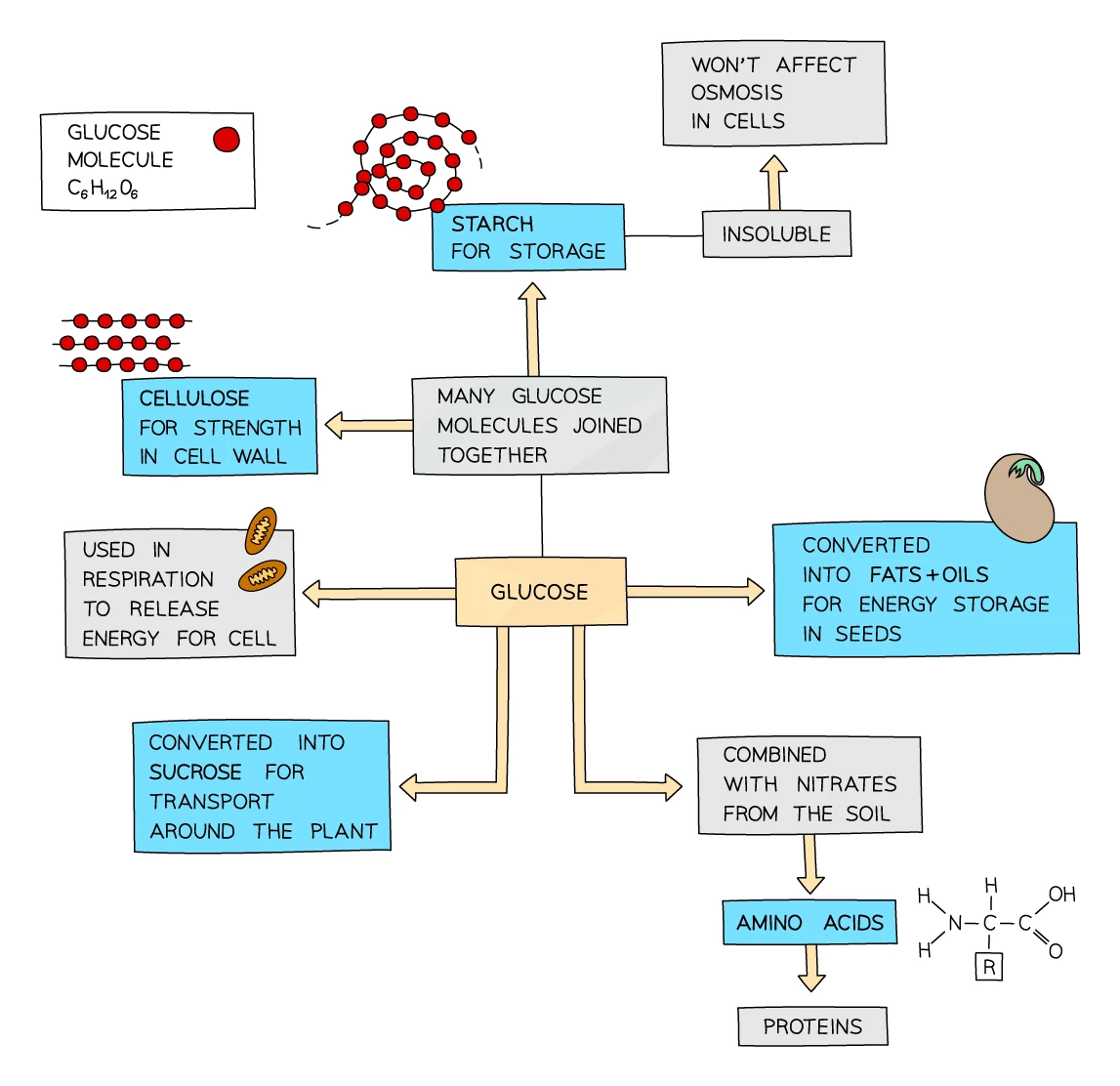
Glucose has many uses inside the plant:
- Respiration: glucose is broken down to release energy for the plant's own life processes (transport, growth, reproduction).
- Sucrose for transport: glucose is converted into sucrose, the soluble sugar in which food is transported around the plant through the phloem.
- Starch storage: glucose is converted into the polysaccharide and stored in roots, tubers and seeds. Starch is insoluble, so it does not affect the cell's water balance.
- Cellulose: glucose is built into long chains of cellulose for new cell walls as the plant grows.
- Lipids: glucose can be converted into lipids for energy-dense storage in seeds (think of the oil in sunflower seeds or nuts).
- Amino acids and proteins: when glucose is combined with nitrogen from nitrate ions absorbed by the roots, the plant builds amino acids, which are then joined to form proteins.
Common exam question
Explaining why less photosynthesis means slower growth
Question: Explain why a plant whose cells stop making chloroplasts grows more slowly, or why the plants in a growth experiment are kept in sunlight (2–3 marks).
Asked in 2 of the 23 papers, and the marks follow one chain with a link per mark. Less light energy is absorbed (fewer chloroplasts, less chlorophyll), so there is less photosynthesis, so less glucose is made. Then say what the glucose was needed for: starch and cellulose, amino acids and protein, or respiration to release energy (ATP) for growth. Write every link, because each is a separate mark. "Less energy produced" is ignored, so say less glucose for respiration and less energy for growth.
Raw materials, products, and what each needs
| Where it comes from | Where it goes | |
|---|---|---|
| Carbon dioxide (raw material) | The air, diffuses in through stomata | Used in photosynthesis |
| Water (raw material) | Absorbed from soil by root hair cells, carried up through the xylem | Used in photosynthesis |
| Light energy (not a raw material, but required) | Sunlight, absorbed by chlorophyll | Provides the energy for the reaction |
| Glucose (product) | Made in the chloroplasts | Stored as starch, used for respiration, converted to other molecules |
| Oxygen (product) | Made in the chloroplasts | Released into the air through stomata |
A quick exam note: light is not a raw material. The exam mark scheme only counts CO₂ and water as raw materials, because they are the substances that combine in the reaction. Light is the energy source.
2. Leaf structure and adaptations for photosynthesis
The leaf is the plant's solar panel. Its structure is finely tuned to absorb as much light as possible, get carbon dioxide to every photosynthesising cell, and ship water and glucose in and out.
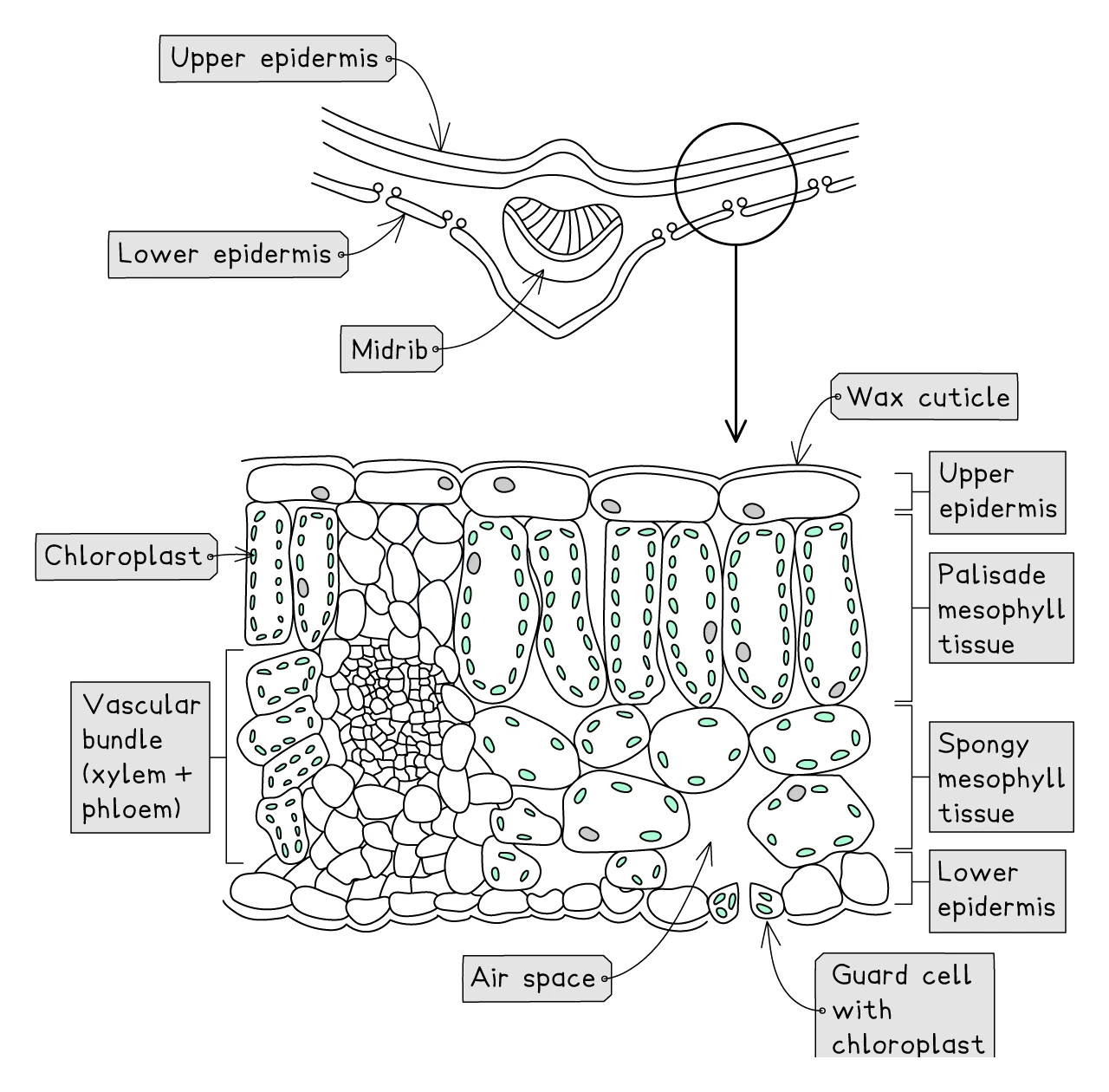
The layers of a leaf in cross-section
Going from the top surface of the leaf downwards:
| Layer | Structure | What it does |
|---|---|---|
| Waxy cuticle | A thin waterproof wax coating on the upper surface | Stops water evaporating away from the leaf; protects the leaf without blocking light because it is transparent |
| Upper epidermis | A single layer of flat, transparent cells with no chloroplasts | Lets light pass through to the layers below |
| Palisade mesophyll | Column-shaped cells packed tightly side by side, full of chloroplasts | The main site of photosynthesis. Positioned at the top of the leaf so they catch the most light |
| Spongy mesophyll | Loosely-packed cells with air spaces between them, fewer chloroplasts than palisade | Provides a large internal surface area for gas exchange (CO₂ in, O₂ out) |
| Lower epidermis | A single layer of cells, mostly transparent. Contains the guard cells | Forms the underside of the leaf and houses the stomata |
| Stomata (plural; stoma = singular) | Tiny pores between pairs of guard cells, mostly on the lower epidermis | Allow CO₂ in and O₂ out; also where water vapour leaves (transpiration) |
| Guard cells | Pairs of bean-shaped cells around each stoma | Change shape to open or close the stoma. Open in the day for gas exchange, closed at night to save water |
| Xylem | Hollow tubes inside the leaf veins | Bring water from the roots up to the photosynthesising cells |
| Phloem | Living tubes inside the leaf veins | Carry the manufactured sugars (mostly as sucrose) away to the rest of the plant |
Why the leaf is shaped the way it is
Almost every part of the leaf is an adaptation for fast photosynthesis. Specifically:
- Large flat surface area so the leaf intercepts as much light and absorbs as much CO₂ as possible.
- Thin (typically less than a millimetre) so CO₂ can diffuse quickly from the air spaces to every chloroplast, and so light can reach every layer easily.
- Transparent cuticle and upper epidermis so light passes through to the palisade cells without loss.
- Palisade cells at the top, packed with chloroplasts so the densest concentration of chloroplasts is exactly where the light is brightest.
- Air spaces in the so the inside of the leaf has a huge surface area for CO₂ and O₂ to diffuse across the cell membranes.
- on the lower epidermis so that gas exchange can happen but water loss is reduced (the underside of a leaf is shaded and cooler, so less evaporation).
- Network of veins carrying xylem and phloem, so water reaches every cell and sugar is shipped out promptly.
Exam tip
Match the adaptation to the layer the label points to
When a labelled leaf section asks how one part is adapted for photosynthesis, identify the layer first: tightly packed columns under the upper epidermis are palisade mesophyll, loose cells with gaps are spongy mesophyll. For the spongy layer the credited points were the air spaces between the cells, diffusion or gas exchange, carbon dioxide moving in and oxygen out, and xylem nearby to bring water; "chloroplasts" and "chlorophyll" were ignored for that part, and calling it palisade was rejected. Multiple-choice parts ask you to identify a labelled layer or cell (palisade, guard), so know the layers from the top down.
3. Limiting factors
A limiting factor is something whose shortage slows down a process. In photosynthesis, the rate is set by whichever of the necessary inputs is in the shortest supply at that moment. Provide more of that factor and the rate climbs; the moment a different factor runs short, that one becomes the new limiting factor.
The three main limiting factors are:
- Light intensity
- Carbon dioxide concentration
- Temperature
A fourth factor, availability (broadly, the number of chloroplasts in the leaf), can also limit the rate in specific situations.
Note: water is technically required for photosynthesis, but plants almost never run short of it for the reaction itself, because they lose far more water through transpiration than they use in photosynthesis. So water is not usually counted as a limiting factor.
Common exam question
Designing an investigation into a photosynthesis factor
Question: Design an investigation into how one factor (colour of light, carbon dioxide concentration, temperature or amount of sunlight) affects the rate of photosynthesis, crop yield or leaf size, with experimental details in full sentences (6 marks).
Set in 4 of the 23 papers, always the six-mark planning question, with the same seven points each time (any six score). Change the factor: at least two temperatures, three or more carbon dioxide concentrations, lamps of different colours, shaded and unshaded plots. Organism: plants of the same species, age, size and condition. Repeat and calculate a mean. Measure something specific, such as the volume of oxygen collected, bubbles counted, crop mass or number of fruits ("yield" alone was not enough; for leaf size, measure length, width or area), over a stated time. Then keep two other factors the same, one from temperature or light and one from mineral ions, pH, water or soil. One point per sentence, naming each variable precisely.
Light intensity
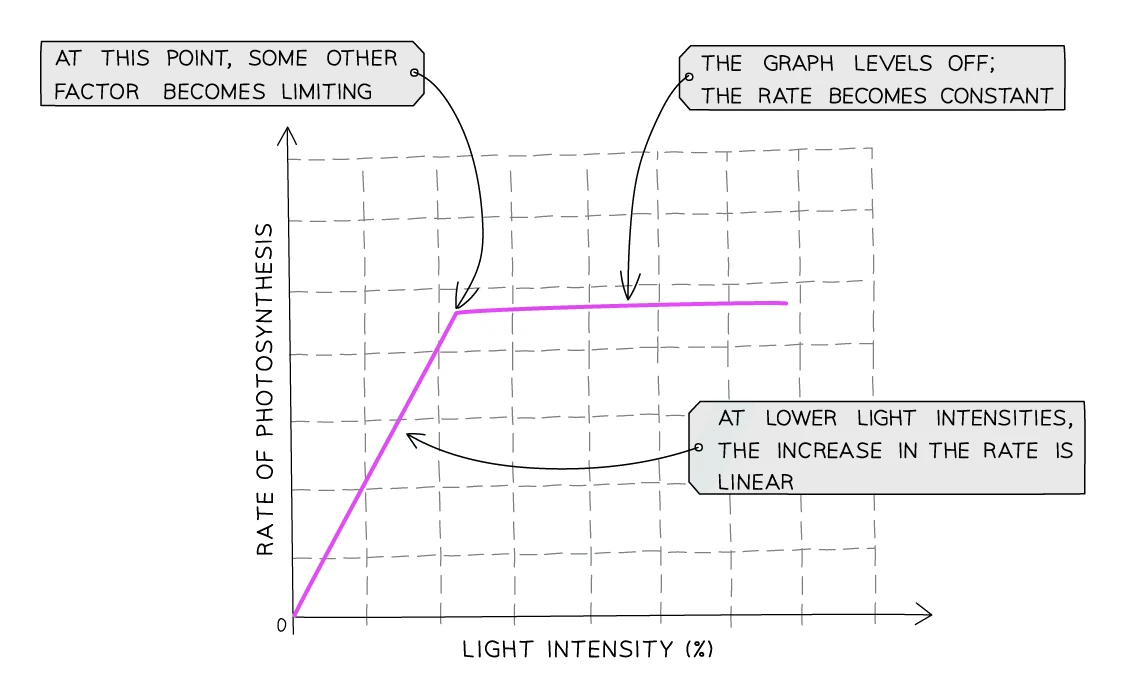
- The brighter the light, the more energy chlorophyll can absorb, so the faster photosynthesis can run.
- Plotting rate against light intensity gives a curve that rises steeply at first, then levels off when something else (CO₂ or temperature) becomes the bottleneck.
- In a greenhouse, growers fit artificial lights to keep the rate high in winter and at night.
Common exam question
Explaining the effect of lamp distance on the bubble count
Question: Explain the effect of moving the lamp further from the pondweed on the number of bubbles per minute, or describe the relationship between light intensity and the bubble count (3–4 marks).
Asked in 3 of the 23 papers. For the explanation, write the chain in order: as the distance increases the light intensity falls; less light energy is absorbed; so the rate of photosynthesis falls; so less oxygen is released and fewer bubbles appear. The trend is the first mark, and "less light" alone does not earn the second, so say light intensity or light energy. For "describe the relationship", give the trend (more bubbles as light intensity rises), the shape (steepest at low light intensities) and the levelling off at high intensities, one mark each. When two carbon dioxide concentrations are compared, the extra marks are for the plateau, covered in the limiting-factor question below.
Carbon dioxide concentration
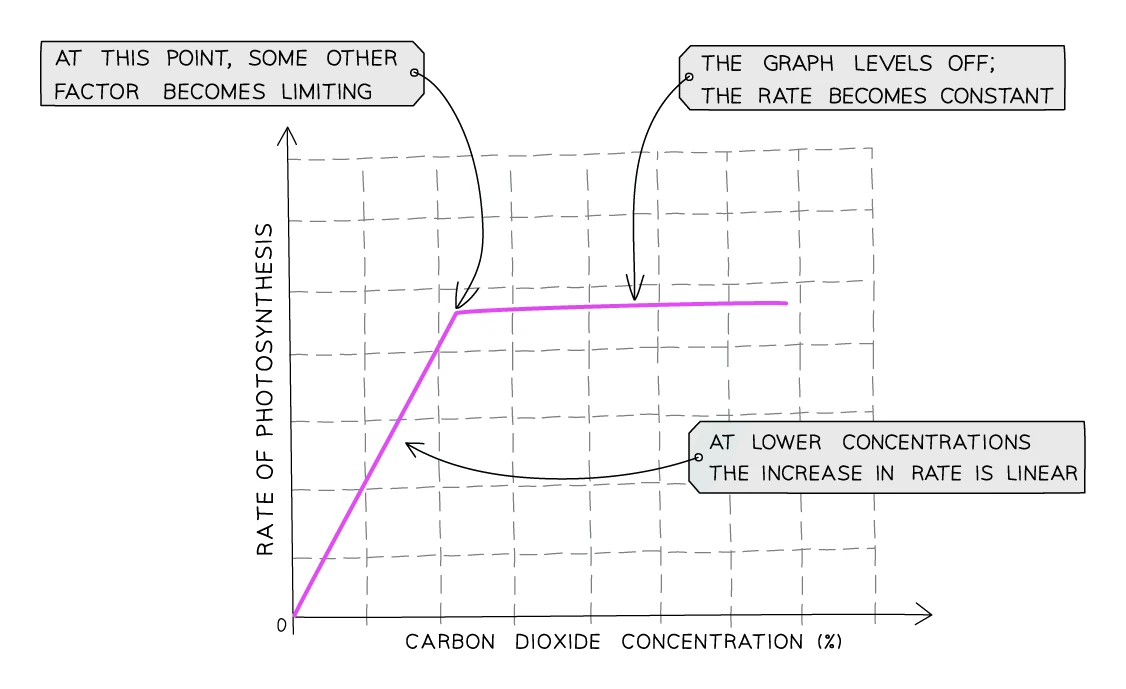
- Atmospheric air is only about 0.04 % CO₂, so CO₂ is often the bottleneck for plants growing in still air.
- Increasing the CO₂ around a plant boosts the rate of photosynthesis, until light or temperature catches up and becomes the new limit.
- Commercial greenhouses sometimes pump in extra CO₂ (often from burning fuel) to push the rate up further.
Temperature
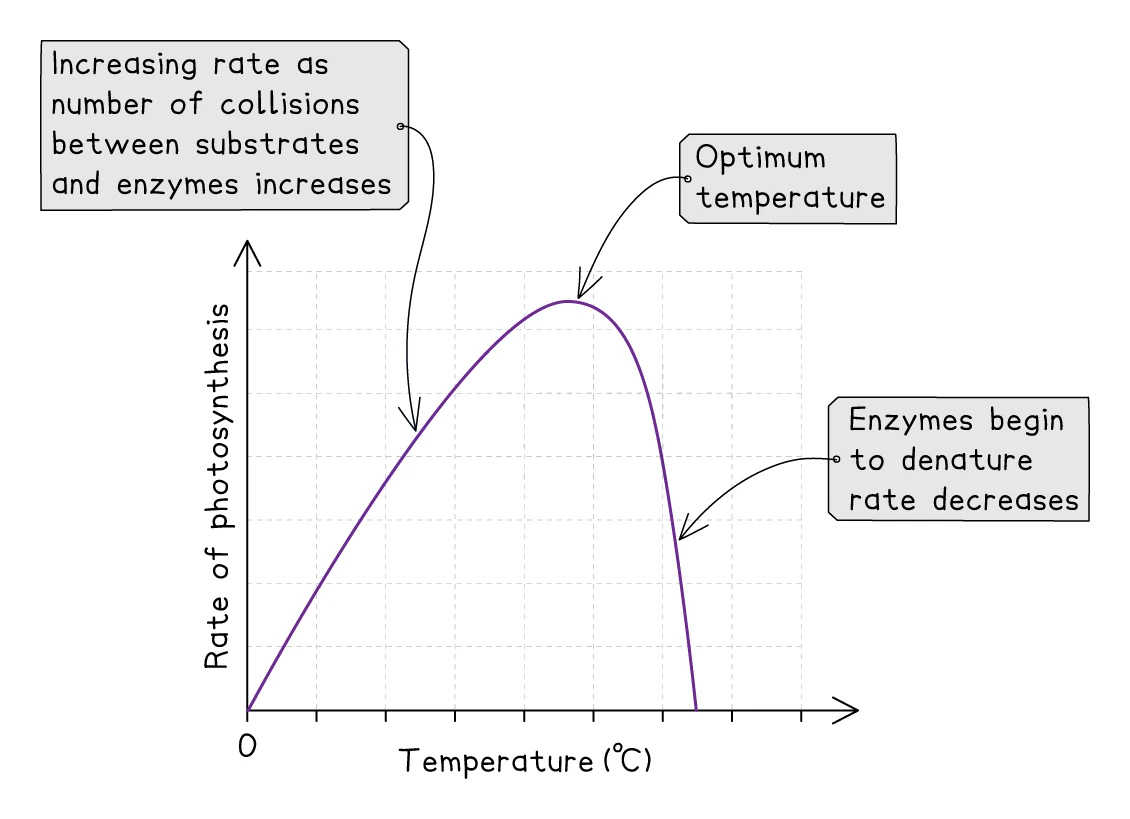
- All of the chemical reactions inside the chloroplast are controlled by enzymes.
- As temperature rises, the enzymes work faster (more kinetic energy, more successful collisions), so the rate of photosynthesis rises with temperature.
- Above an optimum of about 30–40 °C, the enzymes start to denature: their active sites change shape, and the rate crashes.
- This is why a graph of rate vs temperature for photosynthesis has the same peaked shape as for any enzyme-controlled process.
Common exam question
Explaining the effect of temperature on photosynthesis
Question: Explain the effect of increasing the temperature on the rate of photosynthesis, or on the time an indicator takes to change colour, from a graph or table (3 marks).
Asked in 3 of the 23 papers. First the trend: a higher temperature gives a faster rate of photosynthesis (in the indicator version, add that more carbon dioxide is removed, a separate mark). Second the enzyme reason: the molecules have more kinetic energy, so enzyme and substrate collide more often and more enzyme-substrate complexes form; "more enzyme activity" was accepted once too. A third mark can come from a limiting-factor point: at low temperatures temperature is the limiting factor; the rate levels off when light (at low light intensity) or carbon dioxide (at high) takes over; and extra carbon dioxide has little effect while temperature limits. No scheme gave a mark for denaturation, since no curve fell; keep it for a graph that drops after an optimum.
Chlorophyll availability
- The more chloroplasts a leaf has, the more light it can absorb and the higher the maximum rate of photosynthesis.
- Chlorophyll content can be reduced by:
- Loss of leaves (e.g. in autumn, or due to disease)
- Tobacco mosaic virus and other plant diseases that destroy chloroplasts
- Magnesium deficiency in the soil (magnesium is part of every chlorophyll molecule, so without enough magnesium, the plant cannot make enough chlorophyll)
- leaves, where some patches genuinely contain no chlorophyll at all
Reading a limiting-factor graph
A common exam question gives a graph that levels off at some maximum rate and asks what the limiting factor is:
- If the x-axis is the factor you are changing (e.g. light intensity), then in the section where the line is going up, light intensity is the limiting factor.
- In the section where the line has levelled off, the limiting factor is something else (one of the other two: CO₂, temperature, or chlorophyll). The exam expects you to name that other factor.
- A graph with two lines at different temperatures (or CO₂ levels) shows which factor matters most: the line with the higher plateau is the one with the better-supplied "other" factor.
Common exam question
Explaining why the rate of photosynthesis levels off
Question: Explain the shape of a graph (or the pattern in a table) of the rate of photosynthesis against light intensity, carbon dioxide concentration or temperature, especially where the rate stops rising (2–4 marks).
Asked in 6 of the 23 papers. Two ideas carry the plateau marks: the rate no longer changes as the factor on the x-axis increases, because it is no longer the limiting factor and another factor now limits the rate. Name that factor (carbon dioxide concentration, temperature or chlorophyll); naming it can earn both marks. "Light is the limiting factor" written about the flat part scores nothing: light limits the rate only on the rising part, and saying so there is credited. With two curves on one graph, the lower one levels off sooner because its other factor (carbon dioxide concentration, temperature or light intensity) is lower, and extra carbon dioxide has little effect while temperature is limiting.
4. Net gas exchange in a leaf
A leaf is doing two opposite things with the same two gases. Respiration is going on in every living cell all the time, day and night, taking in oxygen and giving out carbon dioxide. Photosynthesis only happens when there is light, taking in carbon dioxide and giving out oxygen. Both involve diffusion of CO₂ and O₂ through the stomata.
What you actually measure leaving or entering the leaf is the net exchange, the balance between the two processes. Because respiration is steady but photosynthesis rises and falls with light, the net direction of gas movement depends on the light intensity.
- In darkness, only respiration happens. The leaf takes in oxygen and gives out carbon dioxide, so there is a net release of CO₂.
- In bright light, photosynthesis runs much faster than respiration. The leaf uses up all its own respiratory CO₂ and more besides, so there is a net uptake of CO₂ and a net release of oxygen.
- At low light, around dawn and dusk, there is a point where photosynthesis and respiration run at exactly the same rate. The CO₂ released by respiration is used up by photosynthesis as fast as it is made, so there is no net exchange with the air.
Common exam question
Explaining net gas exchange in the light and in the dark
Question: Explain why a plant takes in oxygen (or turns the indicator yellow) in the dark, why the indicator turns purple in bright light, or why nothing changes at one light intensity (2–4 marks).
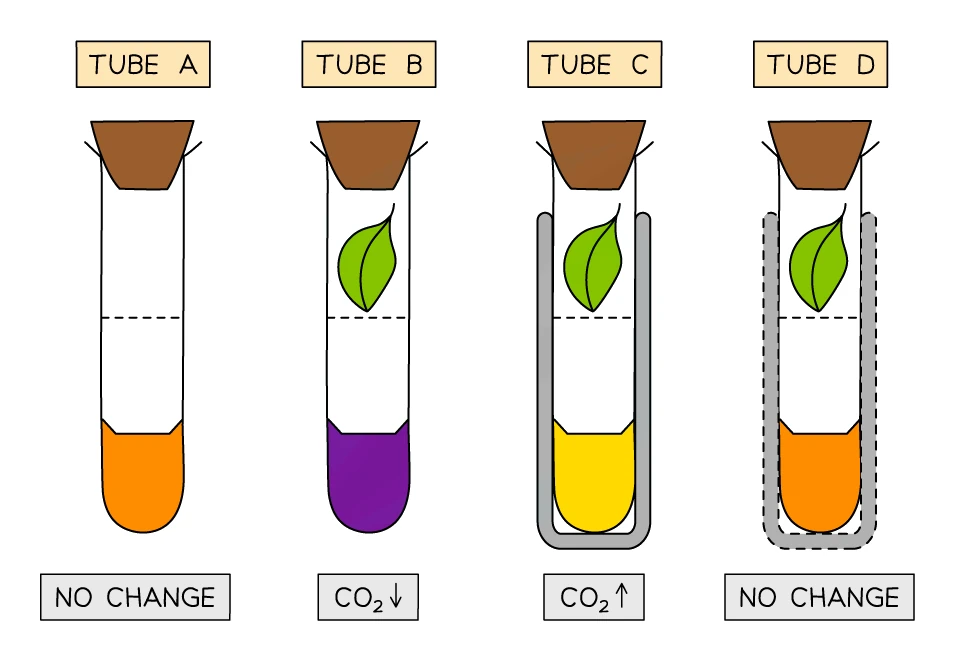
Asked in 3 of the 23 papers. In the dark or dim light respiration is faster than photosynthesis (or respiration but no photosynthesis), so more oxygen is taken in than released and carbon dioxide is released, turning the indicator yellow. In bright light photosynthesis is faster than respiration, so carbon dioxide is absorbed, turning the indicator red or purple. Where the two rates are equal (the compensation point) the carbon dioxide released equals that absorbed, so there is no net exchange: the indicator stays orange. Say "respiration is faster", not "respiration gets faster" (ignored) or "respiration starts when photosynthesis stops" (rejected): it runs all the time. A tube with no organism shows no change; one with only an animal gains carbon dioxide in light and dark.
Core practical: the effect of light on net gas exchange (hydrogencarbonate indicator)
Hydrogencarbonate indicator changes colour with the carbon dioxide concentration of the air or water around it:
| Colour | What it shows |
|---|---|
| Yellow | High CO₂ (more than the atmosphere) |
| Orange / red | Atmospheric CO₂ level (the starting colour) |
| Purple / magenta | Low CO₂ (less than the atmosphere) |
Method:
- Set up several sealed tubes, each containing the same volume of hydrogencarbonate indicator at its starting orange/red colour, with a leaf (or a fixed amount of pondweed or algae) inside.
- Expose the tubes to different light intensities: one in bright light, one in dim light, and one wrapped in foil so it gets no light at all.
- Set up a control tube with indicator but no leaf, to show the colour does not change on its own.
- Leave all the tubes for the same length of time, then compare the colours.
Results:
- The foil-covered (dark) tube turns yellow. Only respiration happens, so CO₂ builds up.
- The brightly-lit tube turns purple/magenta. Photosynthesis runs faster than respiration and removes CO₂ from the indicator.
- A dim-light tube can stay close to the starting orange/red colour, where photosynthesis and respiration roughly balance.
This links the colour change directly to the net gas exchange: more light shifts the balance towards net CO₂ uptake.
Common exam question
Setting up the hydrogencarbonate indicator experiment
Any question on setting up the hydrogencarbonate indicator experiment: how to compare gas exchange in light and dark, the dependent variable, a controlled variable with its reason, or the purpose of the tube with no leaf. Set in 4 of the 23 papers. The dependent variable is the colour of the indicator, not "gas exchange". Method marks: equal volumes of indicator in sealed tubes, the same mass of leaves or algae in each, one tube in light and one in dark, the same temperature and time, and a tube with no plant as a control, showing the colour change is due to the leaf. For a question about light intensity, vary it properly (lamp at different distances, layers of foil): one scheme ignored "light and dark" alone. Both method schemes also credited the expected colours. Controlled variables that score, each with a reason: volume and concentration of indicator (different volumes absorb different amounts of carbon dioxide; "amount" is ignored), tube size, time and light. When the water baths are at different temperatures, temperature is the independent variable ("heat" is ignored).
5. Mineral ions for plant growth
Photosynthesis makes glucose, but plants also need other elements to build amino acids, proteins, chlorophyll and nucleic acids. They obtain these as mineral ions dissolved in soil water, absorbed by root hair cells through active transport (because the soil normally has much lower ion concentrations than the cells).
Two mineral ions are particularly important and tested in exams:
Nitrate ions (NO₃⁻)
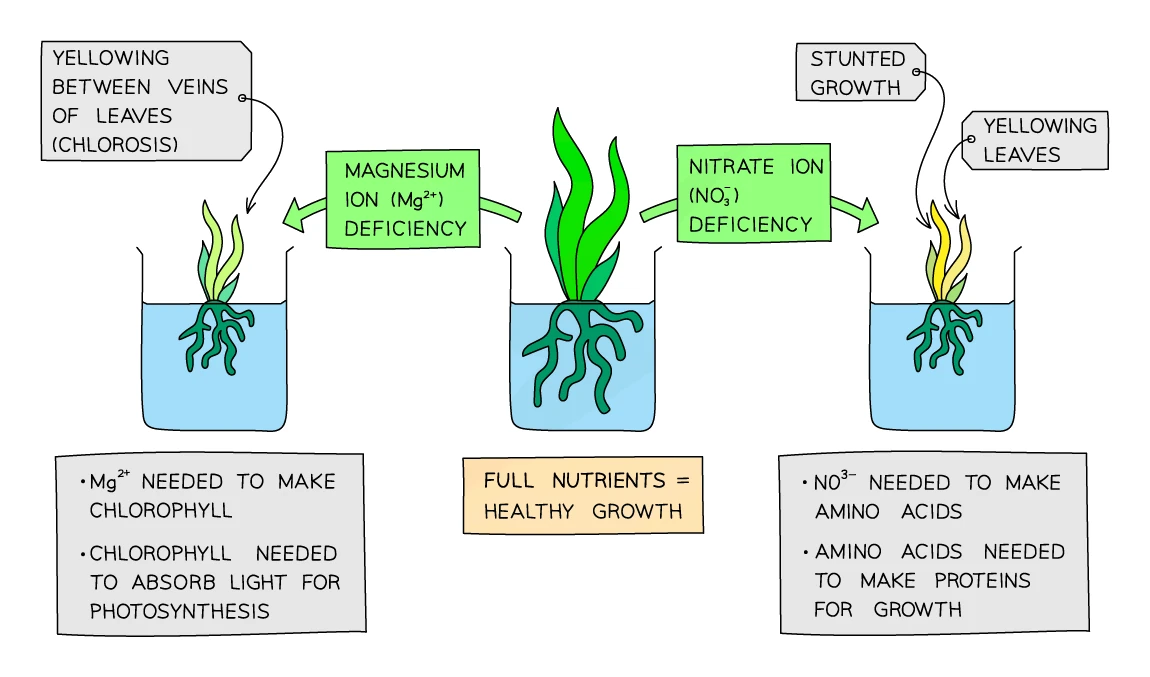
- Function: plants combine glucose with nitrogen from nitrate ions to build amino acids. The amino acids are then joined to form proteins, which are needed for growth, enzymes, and many other roles.
- Deficiency symptoms: stunted growth (without enough nitrogen, the plant cannot make new proteins to build new tissues) and yellowing of older leaves (the plant breaks down proteins in older leaves to recycle the nitrogen into new growth).
Magnesium ions (Mg²⁺)
- Function: magnesium is part of every molecule (right in the middle of the porphyrin ring). Without magnesium, the plant cannot make chlorophyll.
- Deficiency symptoms: yellow leaves (the technical term is ), often starting between the veins. Without chlorophyll the leaves cannot photosynthesise properly, so the plant grows slowly.
| Mineral ion | Used for | Deficiency symptom |
|---|---|---|
| Nitrate | Making amino acids and proteins | Stunted growth; older leaves yellow first |
| Magnesium | Making chlorophyll | Leaves turn yellow (chlorosis), especially between veins |
Farmers and gardeners add these (and other nutrients) to soil as fertiliser. Most commercial fertilisers are NPK (nitrogen as nitrate, phosphorus and potassium), often with added magnesium and trace elements.
Common exam question
Explaining why plants need nitrate and magnesium ions
Question: Explain how lacking a named mineral affects plant growth, describe the role of a named mineral ion, or explain the effect of the nitrate and magnesium ions in a fertiliser on growth (2–6 marks).
Asked in 6 of the 23 papers. Marks come in matched pairs, the ion then its job, and the function mark needs a correctly named ion ("nitrogen" is not one; write nitrate). Nitrate ions make amino acids, then proteins, for growth; without them a plant is stunted with small, pale or yellow leaves. Magnesium ions make chlorophyll (chloroplasts is accepted); without them the leaves turn yellow (chlorosis). In a fertiliser question extend each chain: more chlorophyll, more photosynthesis, more glucose, starch and cellulose; amino acids, then protein (including enzymes) for growth. With the ions left out, chlorophyll and protein earn one mark, only if nothing else scores. "For growth" alone scored in two schemes but not in two others, so name the molecule first.
6. Core practical: showing oxygen is produced
Principle
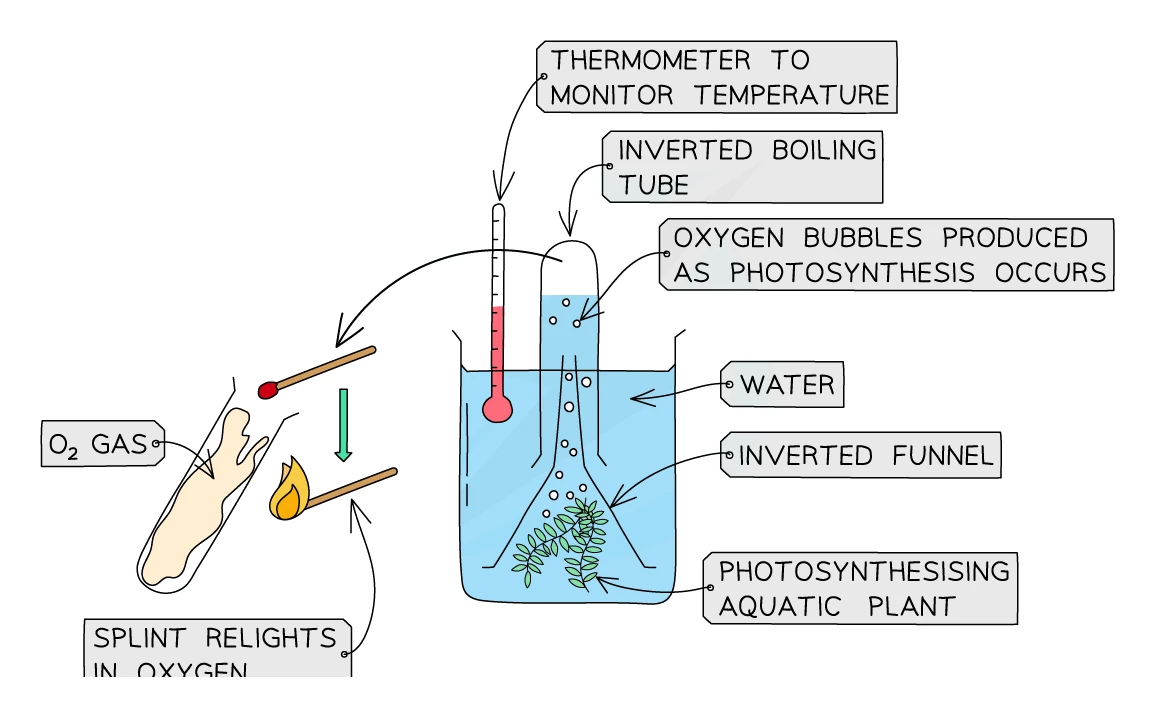
A water plant such as Elodea (Canadian pondweed) is placed underwater in bright light. As photosynthesis happens, oxygen is released from the cut end of the stem and rises through the water as visible bubbles. The bubbles can be collected and tested with a glowing splint.
Method
- Cut a fresh piece of pondweed and place it upside-down in a beaker of water.
- Cover the pondweed with an upturned glass funnel.
- Fill a boiling tube completely with water, place a thumb over the opening, invert it, and lower it over the stem of the funnel so that no air is trapped.
- Place the apparatus in bright light. Bubbles of oxygen rise up the funnel and collect at the top of the boiling tube, gradually displacing the water.
- After the boiling tube has filled with gas, remove it carefully (keeping the opening pointing downwards under the water) and quickly insert a glowing splint.
- The splint relights, confirming the gas is oxygen.
Measuring the rate of photosynthesis
- Counting the number of bubbles per minute at different light intensities (or distances from a lamp) gives a quick measure of the rate.
- More accurately, the volume of gas collected in a fixed time can be measured. This avoids the problem that bubble sizes can vary.
Exam tip
Method marks in the pondweed experiment
Control-variable questions want the variable and how you hold it, marked as a pair: temperature with a water bath, pH with a buffer; carbon dioxide concentration, the same bulb, background light and counting time are also accepted. To make the measurement more accurate, collect the gas and measure its volume in a measuring cylinder, syringe or burette over a set time instead of counting bubbles. For reliability: repeat, calculate a mean and identify or remove anomalies. In any explanation, tie the lamp distance to light intensity.
7. Core practical: testing a leaf for starch
Why test for starch?
Glucose made by photosynthesis is quickly used or converted into other molecules, so it does not build up enough in the leaf to be tested directly. , however, is stored in chloroplasts as the plant's main reserve. So testing a leaf for starch is the standard indirect way to show that photosynthesis has been happening.
Why de-starch the plant first?
If a leaf already contains starch from the previous day, that would mask the result of the experiment. To de-starch a plant:
- Place the plant in a dark cupboard for 24 to 48 hours.
- With no light, the plant cannot photosynthesise, so any existing starch in the leaves gets broken down and used up in respiration.
After de-starching, the leaves should give a negative starch test. Then the experiment can begin.
The iodine test for starch in a leaf
- Pluck the leaf and drop it into a beaker of just-boiled water for 30 seconds. This kills the cells and breaks down the cell walls so iodine can enter.
- Turn off the Bunsen burner. Transfer the leaf into a boiling tube of ethanol, and stand the tube in a beaker of hot water (water-bath heating, not direct flame) for about 5 to 10 minutes. Ethanol is highly flammable, so keep it well away from any naked flame. The hot ethanol dissolves the green chlorophyll out of the leaf, making colour changes easier to see.
- Dip the now-pale leaf in warm water to soften it (the ethanol made it brittle).
- Spread the leaf out on a white tile and cover it with iodine solution.
- Observe the colour. Areas where the leaf has been photosynthesising contain starch and will turn blue-black. Areas without starch stay yellow-brown.
Investigating the need for light
After de-starching:
- Cover part of one leaf (still attached to the plant) with aluminium foil or a piece of black card.
- Place the plant in bright light for several hours.
- Pick the leaf and test it for starch.
Result: the area that received light turns blue-black; the area covered by foil stays yellow-brown. This shows that light is needed for photosynthesis.
Investigating the need for carbon dioxide
After de-starching:
- Enclose one leaf inside a conical flask containing potassium hydroxide solution (KOH absorbs all the carbon dioxide from the air inside the flask). Seal the flask around the leaf stalk with cotton wool and tape so air cannot enter.
- Enclose another leaf inside an identical flask without KOH as a control.
- Place the plant in bright light for several hours.
- Test both leaves for starch.
Result: the leaf in the KOH flask stays yellow-brown (no CO₂, no photosynthesis, no starch). The control leaf turns blue-black. This shows that CO₂ is needed for photosynthesis.
Investigating the need for chlorophyll
Use a leaf (one that is patchy green and white). The white patches contain no .
- De-starch the plant.
- Place it in bright light for several hours.
- Remove the variegated leaf, sketch the pattern of green and white areas before testing.
- Test the leaf for starch.
Result: the green areas turn blue-black (chlorophyll was present, photosynthesis happened, starch was made). The white areas stay yellow-brown (no chlorophyll, no photosynthesis, no starch). This shows that chlorophyll is needed for photosynthesis.
Safety notes for the leaf-starch tests
- Ethanol is highly flammable. Heat it in a water bath, never directly over a Bunsen flame. Switch off the Bunsen before transferring the leaf into the ethanol.
- Iodine and potassium hydroxide are irritants. Wear safety goggles and wash off any splashes immediately.
- Hot water and hot apparatus. Handle with tongs; let glassware cool before putting it away.