MathematicsExam code: 0580
Set Notation and Venn Diagrams
Number
How the diagram is built
- A Venn diagram shows sets as circles inside a rectangle, where the rectangle is the universal set
- Overlapping circles share the elements that lie in both sets
- Anything belonging to no named set is written inside the rectangle but outside every circle
- This specification limits Venn diagrams to two or three sets
Regions and operations
- Each operation corresponds to a region of the diagram, which is what makes the notation easy to apply
- The union covers both circles entirely; the intersection covers only the overlap
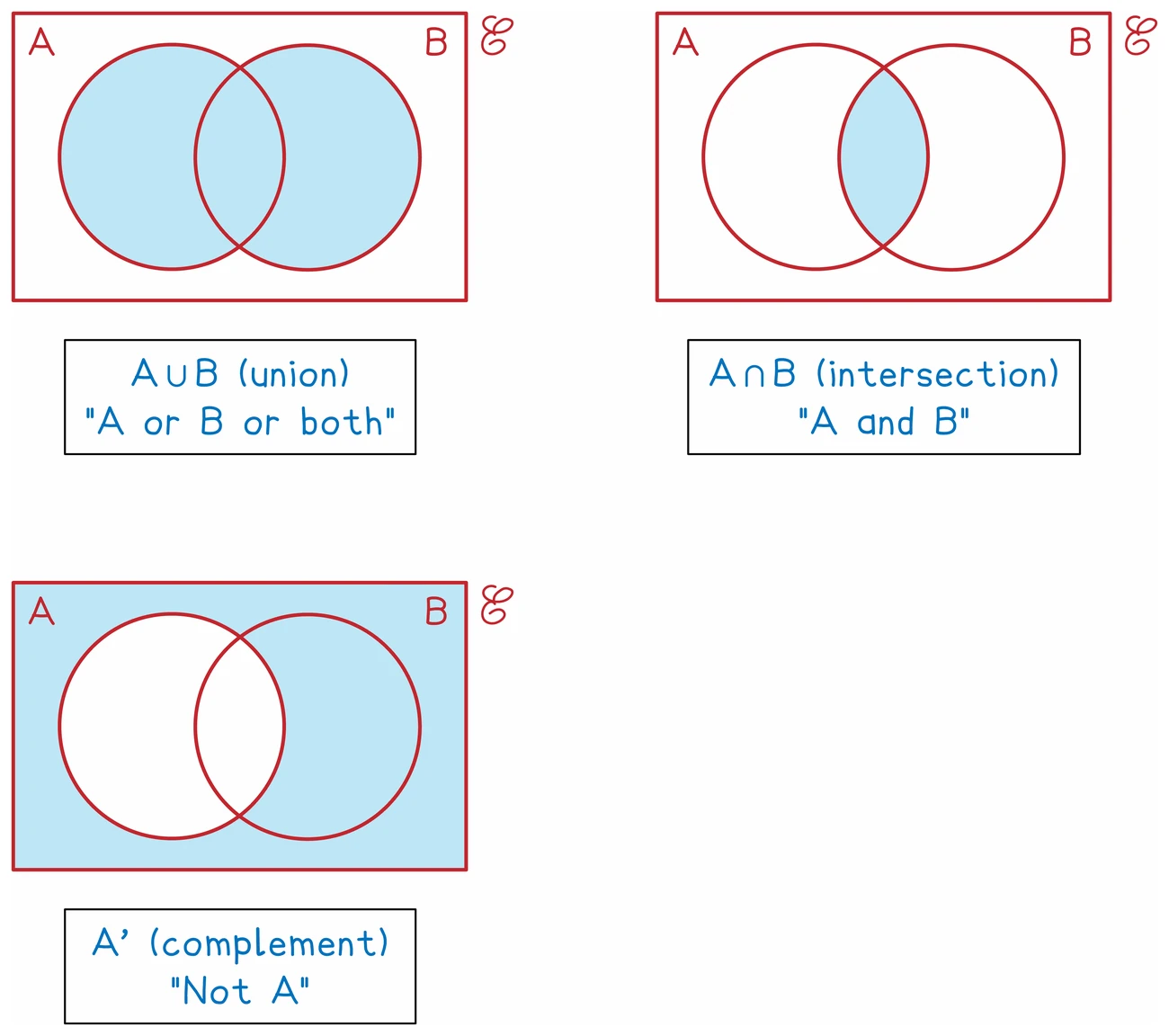
- A complement shades everything outside the named set but still inside the rectangle
- Combined expressions are read from the inside out, so (A ∪ B)′ means shade everything the union does not cover
Counting from a diagram
- n(A) counts every element inside circle A, including those in the overlap
- Elements in the overlap belong to both sets and are counted once in a union
Worked example
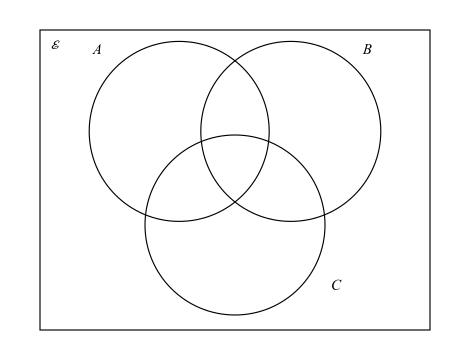
Placing elements in a three-set Venn diagram
ℰ = {x : x is an integer, 1 ⩽ x ⩽ 15}, A = {prime numbers}, B = {odd numbers} and C = {multiples of 3}. Complete the Venn diagram for A, B and C, then find n(A ∩ C ∩ B′).
Solution:
- List each set from ℰ first: A = {2, 3, 5, 7, 11, 13}, B = {1, 3, 5, 7, 9, 11, 13, 15} and C = {3, 6, 9, 12, 15}
- Fill the centre first: 3 is the only number in all three sets
- In A and B but not C: 5, 7, 11, 13
- In B and C but not A: 9, 15
- In A and C but not B: nothing, because 3 is the only prime that is a multiple of 3 and it is already in the centre
- A only: 2, the only even prime; B only: 1, which is odd but not prime; C only: 6, 12
- Outside all three circles: 4, 8, 10, 14
- Check the count: 1 + 4 + 2 + 0 + 1 + 1 + 2 + 4 = 15, so every element of ℰ is placed exactly once
- n(A ∩ C ∩ B′) counts the empty region, so n(A ∩ C ∩ B′) = 0, a number, not ∅
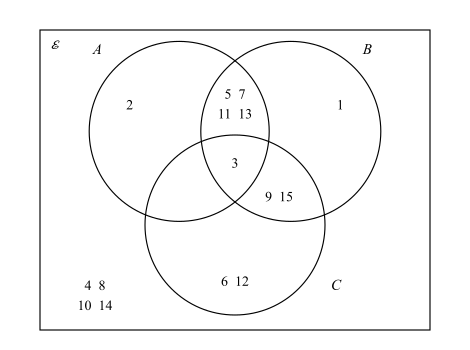
Worked example
Counting from a Venn diagram
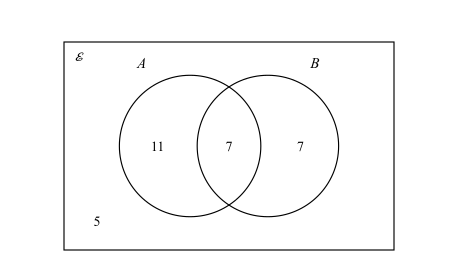
In a group of 30 students, 18 study art (A) and 14 study biology (B). 7 study both. Show this on a Venn diagram, then work out how many study neither.
Solution:
- Fill the overlap first, because the two given totals each already include it
- The intersection holds 7
- Art only = 18 − 7 = 11
- Biology only = 14 − 7 = 7
- Those three regions hold 11 + 7 + 7 = 25 students
- The universal set holds 30, so the region outside both circles holds 30 − 25 = 5
- Check by adding all four regions: 11 + 7 + 7 + 5 = 30
- Writing 18 in the art circle and 14 in the biology circle would count the 7 twice and total 39