MathematicsExam code: 0580
Sequences
Algebra and Sequences
Terms and positions
- A sequence is a list of numbers written in a fixed order and governed by a rule
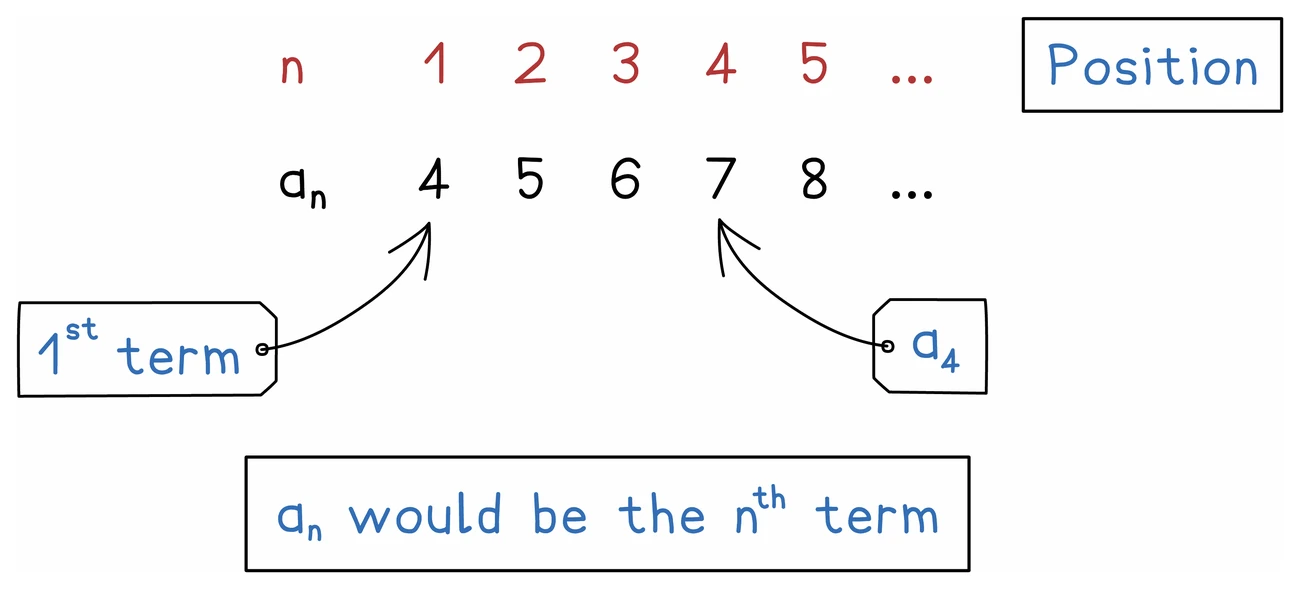
- Each number in the list is a term, and where it sits in the list is its position
- The letter n stands for the position, so n = 1 marks the first term, n = 2 the second, and so on
- Writing the position above each term before you start is the single most useful habit in this topic
- A sequence can also be described by a growing pattern of shapes, in which case counting the dots, sticks or squares in each picture produces the numbers
Two ways of describing a rule
- A term-to-term rule says what to do to one term to reach the next, such as add 9 each time or halve each time
- It is quick to use but only moves one step at a time, so reaching the 60th term means writing out 59 steps
- A position-to-term rule, usually called the nth term, is an expression in n that produces any term directly
- With nth term 6n − 1, substituting n = 1, 2, 3 gives 5, 11, 17, and substituting n = 100 gives 599 in one line
- With nth term n² − 2, the first three terms are −1, 2 and 7, and the 100th term is 9998
- A question asking for a specific far-off term is really asking you to find the nth term first
Subscript notation
- A sequence can be named with a letter, and its terms labelled by position using a subscript
- If a sequence is called T, then T₁ is its first term, T₅ its fifth, and Tₙ its nth
- Questions use this to link two sequences without writing either out, for example by defining a third sequence as Cₙ = Aₙ + Bₙ
- The subscript is a position label, never a multiplier
Worked example
Position, term and the two kinds of rule
A sequence begins 5, 8, 11, 14. Write down the term-to-term rule, find the nth term, and work out the 50th term.
Solution:
- Write the position numbers above the terms: 1, 2, 3, 4
- The gaps are 8 − 5 = 3, 11 − 8 = 3 and 14 − 11 = 3, so the gap is constant
- The term-to-term rule is "add 3", which needs the previous term to use it
- A constant gap of 3 means the nth term contains 3n
- 3n alone gives 3, 6, 9, 12, which is 2 short of every term
- The nth term is 3n + 2, which is a position-to-term rule
- The 50th term is 3 × 50 + 2 = 152, found without listing the terms in between
- Check on a term other than the first: n = 3 gives 11, which matches