MathematicsExam code: 0580
Rounding, Estimation and Bounds
Number
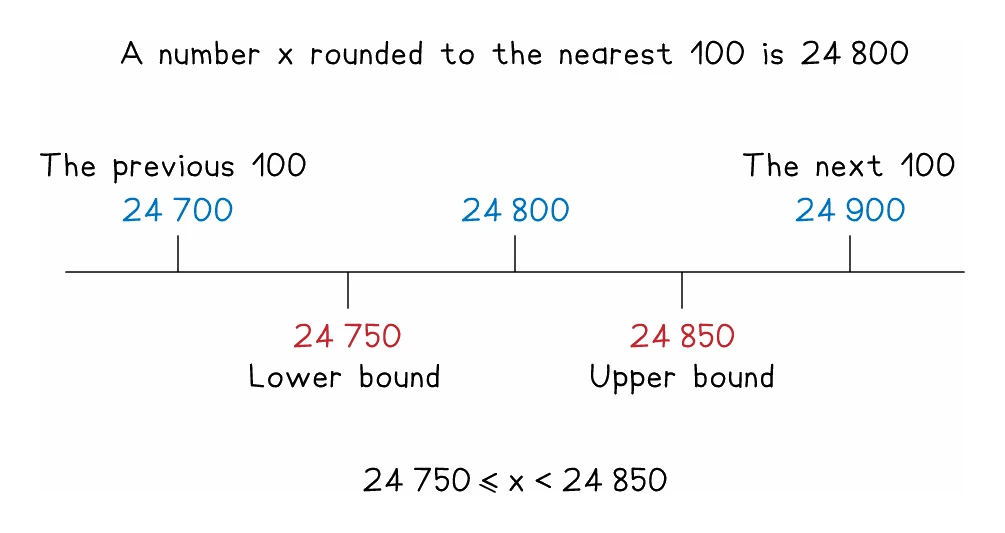
What the bounds are
- A rounded value stands for a range of true values, and the bounds are the ends of that range
- The lower bound is the smallest value that would still round to the figure given
- The upper bound is the value the true figure must stay below
- Both lie half a unit of accuracy away from the rounded value, so they are the midpoints between it and its neighbours
- A true value may sit exactly on the lower bound, but reaching the upper bound would round it the other way, so only one end of the range is inclusive
Finding them
- Halve the degree of accuracy the value was rounded to
- Subtract that half-unit for the lower bound and add it for the upper bound
- A mass of 6.4 kg given to one decimal place has a half-unit of 0.05
- The bounds are 6.35 ⩽ m < 6.45
Worked example
Writing down a pair of bounds
A length is 8.6 cm, correct to 1 decimal place. Write down its lower and upper bounds.
Solution:
- 1 decimal place means the value was rounded to the nearest 0.1
- Half of 0.1 is 0.05, so the true length is within 0.05 cm of 8.6
- Lower bound = 8.6 − 0.05 = 8.55 cm
- Upper bound = 8.6 + 0.05 = 8.65 cm
- The lower bound is included and the upper bound is not, so 8.55 ⩽ length < 8.65
- 8.65 itself would round up to 8.7, which is why it is excluded even though it is written as the upper bound