MathematicsExam code: 0580
Proportion
Algebra and Sequences
Recognising it
- In inverse proportion one quantity rises as the other falls, and it is their product that stays fixed
- Written in symbols, y ∝ 1 ÷ x, which becomes y = k ÷ x
- Doubling one quantity halves the other, and multiplying one by 3 divides the other by 3
- The graph is a curve that approaches each axis without ever touching it, quite unlike the straight line of direct proportion
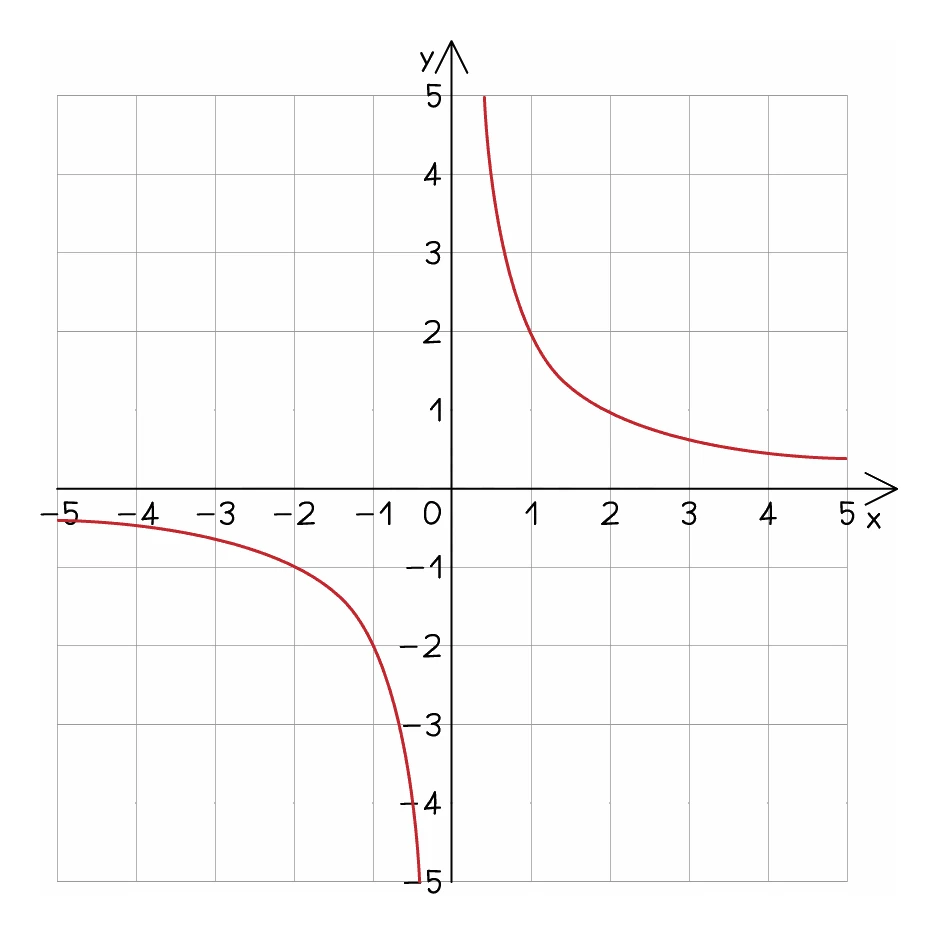
- Real contexts are usually a fixed total shared out: more workers means less time, more speed means less travelling time
Worked example
An inverse relationship
T is inversely proportional to n. When n = 5, T = 12. Find T when n = 8.
Solution:
- The statement gives the equation T = k ÷ n
- Substitute the given pair: 12 = k ÷ 5
- Multiply by 5: k = 60
- The finished equation is T = 60 ÷ n
- Substitute n = 8: T = 60 ÷ 8
- So T = 7.5