MathematicsExam code: 0580
Powers, Roots and Standard Form
Number
The required shape
- Standard form writes a number as a × 10ⁿ, where n is an integer and a satisfies 1 ⩽ a < 10
- The condition on a is what makes the form standard: exactly one non-zero digit sits before the decimal point
- The sign of n records the size of the number
- n is positive for numbers of 10 or more
- n is zero for numbers from 1 up to but not including 10
- n is negative for numbers between 0 and 1
Writing a number in standard form
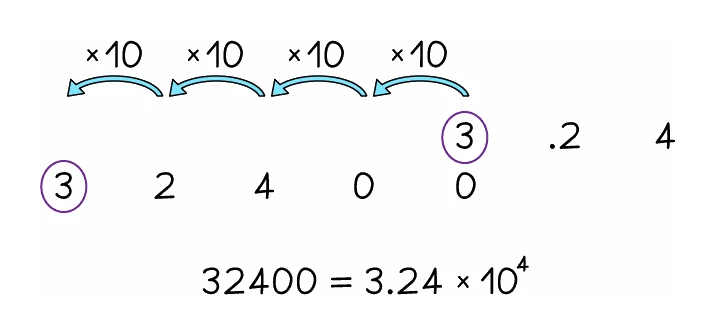
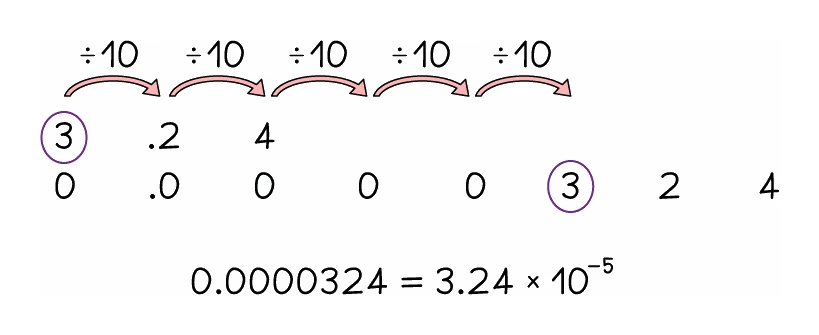
- Place the decimal point so that one non-zero digit lies in front of it, giving a
- Count how many places the digits moved: that count is n
- Moving the point left gives a positive index, moving it right gives a negative one
- 68 500 becomes 6.85 × 10⁴
- 0.00092 becomes 9.2 × 10⁻⁴
Worked example
Writing numbers in standard form
Write 62 700 000 and 0.000 47 in standard form.
Solution:
- Standard form is a × 10ⁿ with 1 ⩽ a < 10
- For 62 700 000, put the point after the first non-zero digit: 6.27
- Count how far the point moved: from after the last zero to after the 6 is 7 places left
- Moving left means a positive index, so 62 700 000 = 6.27 × 10⁷
- For 0.000 47, the first non-zero digit is 4, giving 4.7
- The point moved 4 places right, and moving right means a negative index
- 0.000 47 = 4.7 × 10⁻⁴
- Check each by counting back: 6.27 with the point moved 7 places right rebuilds 62 700 000