MathematicsExam code: 0580
Functions
Algebra and Sequences
What each word covers
- The domain is the collection of inputs a function is allowed to take
- The range is the collection of outputs those inputs produce
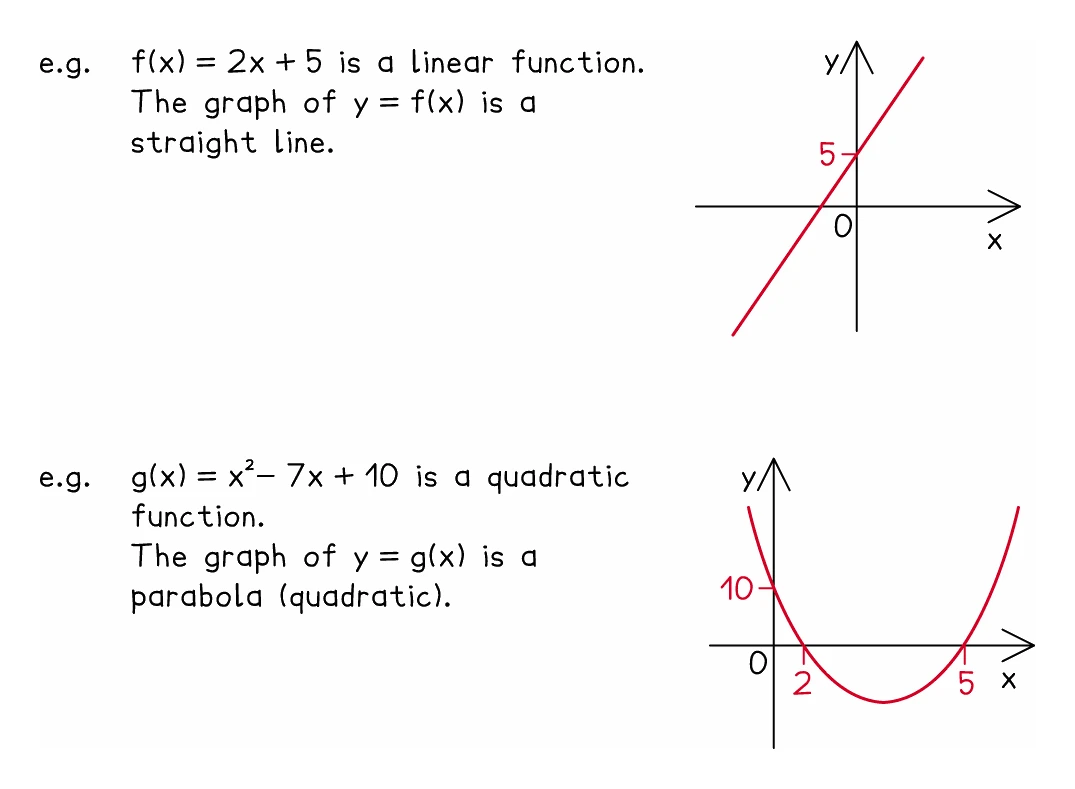
- A domain is always described in terms of x, and a range always in terms of f(x), so keep the two letters straight
- On this specification the domain is very often handed to you as a short list of numbers inside curly brackets, and the range is then simply the list of answers you get by substituting each one
- The outputs are listed in the same curly-bracket form, and getting most of them right still scores
Worked example
A range from a listed domain
g(x) = x² + 2 has domain {−3, 1, 4}. Find the range of g(x).
Solution:
- The domain is the set of inputs allowed, and the range is the set of outputs they produce
- The domain here is a short list, so the range is a short list too: substitute each value in turn
- g(−3) = (−3)² + 2: bracket the negative, then square it
- (−3)² = 9, so g(−3) = 9 + 2 = 11
- g(1) = 1² + 2 = 1 + 2 = 3
- g(4) = 4² + 2 = 16 + 2 = 18
- The range is {3, 11, 18}
- Give the outputs, not the inputs: {−3, 1, 4} is the domain and answers a different question
- Writing them in increasing order is conventional, and it also makes a missing value obvious
Domains given as an interval, and values that must be excluded
- Where the domain is an interval such as 1 ⩽ x < 5, substitute each end value to find where the outputs start and stop, provided the graph only rises or only falls across the interval (when a quadratic's turning point lies inside the interval, the turning-point value is one end of the range and the end value further from it is the other)
- Carry the ⩽ and < across carefully, remembering that a decreasing function swaps which end is included
- Some values can never be inputs, and the two reasons are dividing by zero and square rooting a negative
- h(x) = 5 ÷ (x − 6) excludes x = 6, because the bottom would be zero
- j(x) = √(x − 2) excludes everything below 2, because the inside would be negative
- To find an excluded value, set the bottom of the fraction equal to zero and solve
- A quick sketch of the graph settles most range questions faster than substituting does
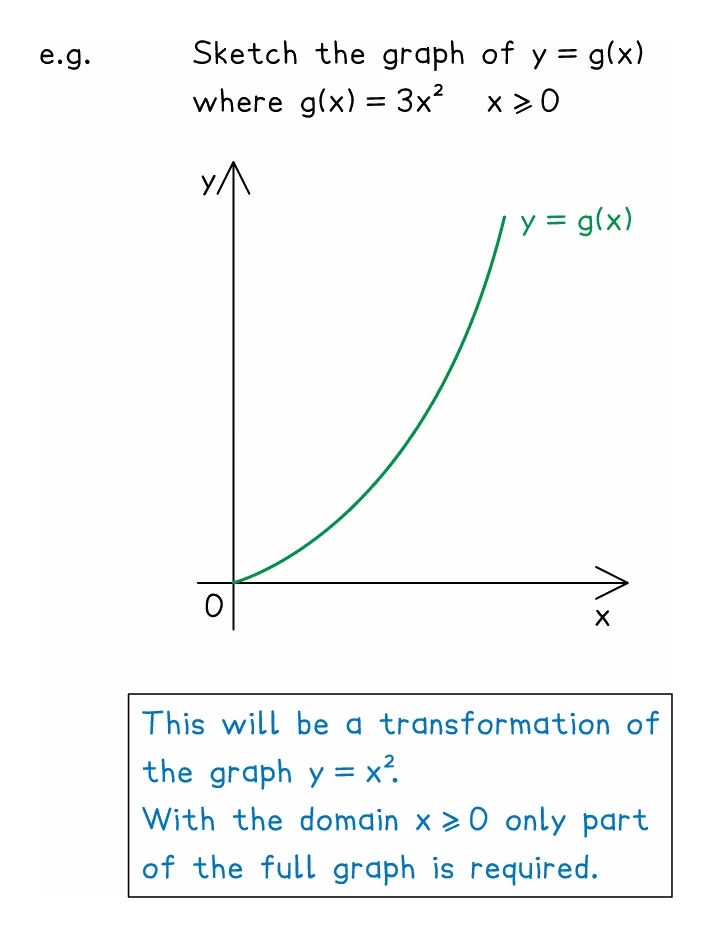
- Composite functions are the one exception here: this specification does not ask for their domains or ranges
Worked example
A range from an interval
f(x) = 4x − 7 has domain 1 ⩽ x < 5. Find the range of f(x).
Solution:
- With an interval there are too many inputs to list, so work from the ends
- The rule multiplies by 4, which is positive, so larger inputs give larger outputs and the order of the ends is preserved
- At the lower end: f(1) = 4 − 7 = −3
- At the upper end: f(5) = 20 − 7 = 13
- Each end keeps the symbol it had: 1 was included, so −3 is included; 5 was excluded, so 13 is excluded
- The range is −3 ⩽ f(x) < 13
- Write the range in terms of f(x), not x: −3 ⩽ x < 13 describes a set of inputs
- Had the rule multiplied by a negative number the ends would swap over, so the check is always to substitute both and see which output is larger