Forming and Solving Equations
Algebra and Sequences
Using the property of the shape
- A shape supplies the equation through one of its known properties
- The most useful are the perimeter as a sum of sides, the angle sum of a triangle being 180°, the angle sum of a quadrilateral being 360°, and the equal sides or angles of an isosceles triangle
- For a polygon with n sides, the interior angles sum to 180(n − 2)
- Mark the diagram with the expressions before forming the equation
Worked example
Perimeter of a rectangle
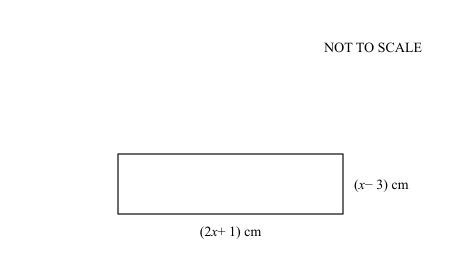
A rectangle has length (2x + 1) cm and width (x − 3) cm. Its perimeter is 38 cm. Find the length and the width.
Solution:
- The property of the shape supplies the equation, so name it before writing anything: a rectangle's perimeter is twice the length plus twice the width
- 2((2x + 1) + (x − 3)) = 38
- Simplify inside the bracket by collecting like terms: 2x + x = 3x, and 1 − 3 = −2
- 2(3x − 2) = 38
- Divide both sides by 2 rather than expanding, which keeps the numbers small: 3x − 2 = 19
- Add 2: 3x = 21, so x = 7
- x = 7 is not the answer: the question asks for two lengths
- Length = 2 × 7 + 1 = 15 cm, width = 7 − 3 = 4 cm
- Check against the perimeter given: 2(15 + 4) = 2 × 19 = 38 cm, and both sides are positive, which a length must be
Worked example
Showing that an area gives a quadratic
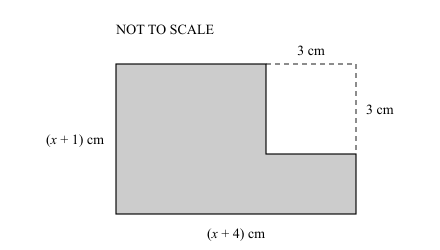
The diagram shows a rectangle (x + 4) cm long and (x + 1) cm wide. A square of side 3 cm has been cut from one corner, and the shaded area that is left is 31 cm². Show that x² + 5x − 36 = 0.
Solution:
- The area fact supplies the equation: the rectangle's area minus the square's area equals the shaded area
- Write it with the brackets still in place, before expanding anything: (x + 4)(x + 1) − 3² = 31
- Expand the brackets: x² + x + 4x + 4 − 9 = 31
- Collect like terms: x² + 5x − 5 = 31
- Subtract 31 from both sides: x² + 5x − 36 = 0, the equation printed in the question
- The working runs from your own equation to the printed one with every line shown, which is what the last mark needs
- As a check, x = 4 satisfies it (16 + 20 − 36 = 0) and gives an 8 cm by 5 cm rectangle with 40 − 9 = 31 cm² shaded
Exam tip
Write the equation down even if you cannot finish
The equation you form earns marks before you expand or simplify anything. In a "show that", the unsimplified line, such as (x + 4)(x + 1) − 3² = 31 above, is worth the first one or two marks; in a word problem the formed equation earns the first mark. Those marks stay even if you never reach the printed quadratic or the answer, so write the equation down even when you cannot see how to finish.