Mathematics (Core)Exam code: 0580
Volume and Surface Area
Lengths, Areas and Volumes
Joining and cutting
- A compound solid is two shapes joined, and a part of a solid is a piece cut from one, such as a hemisphere (half of a sphere)
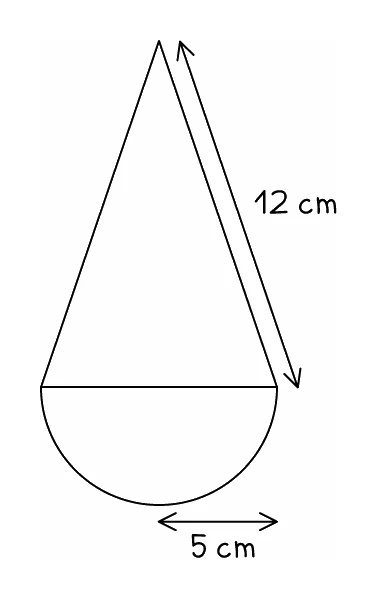
- Volumes simply add or subtract, so a cylinder with a hemisphere on top has the two volumes added
- Surface areas do not simply add, because the faces where the two solids meet are inside the finished solid and are no longer surfaces
- Work along the outside of the solid, listing each surface you would actually touch, then add only those
- Answers may be asked for in terms of π, so keep π symbolic throughout and collect at the end
Worked example
Surface area from a net
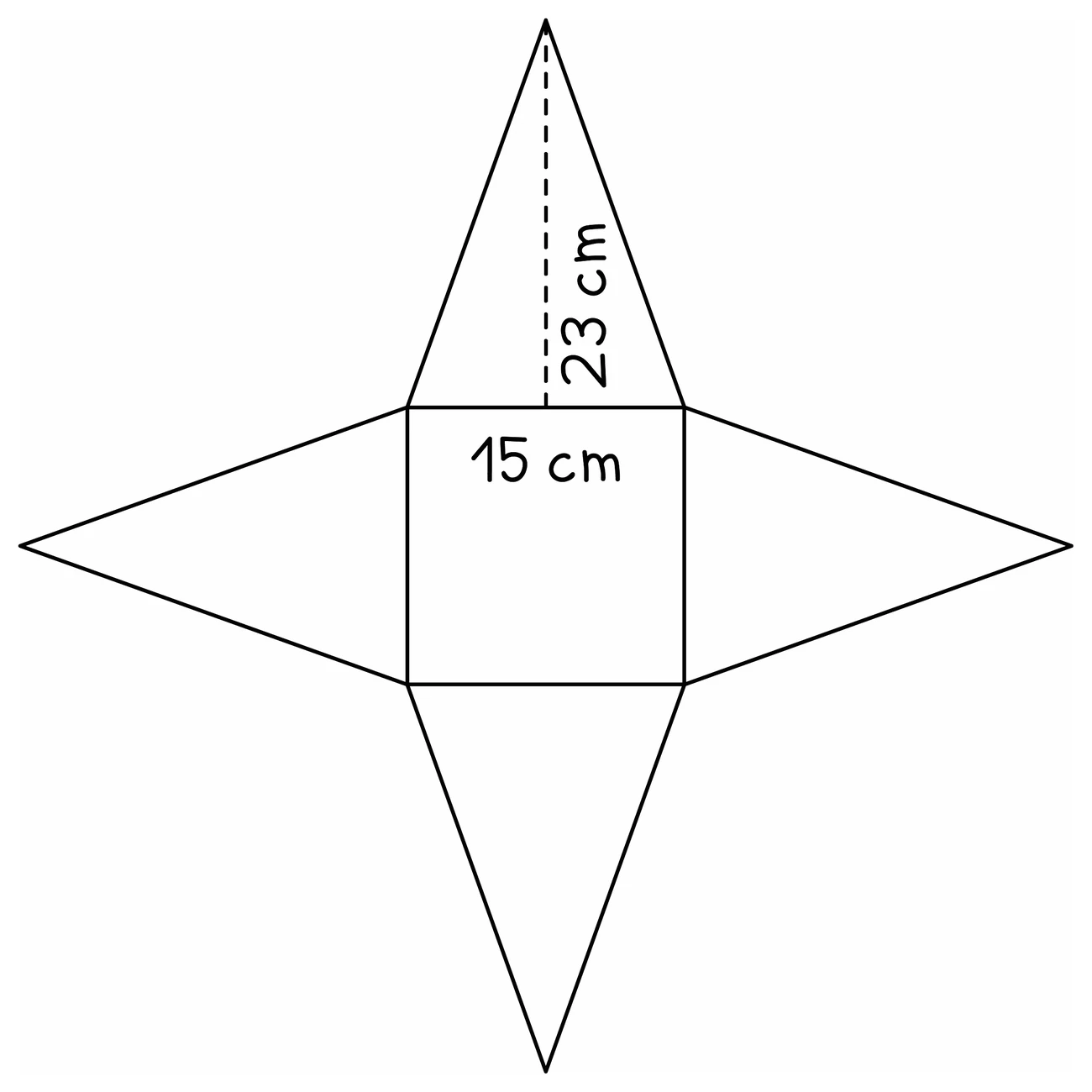
The net of a solid square-based pyramid is shown. Find its total surface area.
Solution:
- A net shows every face laid flat, so the surface area is just the total area of the shapes on it
- There is one square base and four identical triangles
- Square: 15 × 15 = 225 cm²
- Each triangle has base 15 cm and perpendicular height 23 cm
- One triangle: ½ × 15 × 23 = 172.5 cm²
- Four triangles: 4 × 172.5 = 690 cm²
- Total surface area = 225 + 690 = 915 cm²
- The 23 cm is the height of the triangle, not the height of the pyramid — the two are different lengths, joined by Pythagoras
- No formula for this is printed on the paper; it has to be built from the faces
Worked example
Surface area of a joined solid
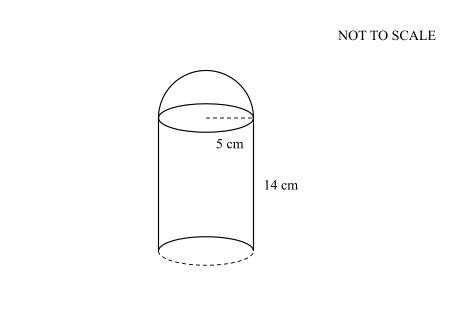
A solid is made by joining a hemisphere of radius 5 cm to the top of a cylinder of radius 5 cm and height 14 cm. Find its total surface area in terms of π.
Solution:
- Walk round the outside and list the surfaces that are actually on show
- The curved surface of the cylinder: 2π × 5 × 14 = 140π cm²
- The flat circular base of the cylinder: π × 5² = 25π cm²
- The curved surface of the hemisphere, which is half a sphere: ½ × 4π × 5² = 50π cm²
- The top circle of the cylinder is not counted, because the hemisphere sits on it and it is no longer on the outside
- Total = 140π + 25π + 50π
- Total surface area = 215π cm²
Worked example
Equal total surface areas
A solid cone has base radius 3 cm. A solid hemisphere has radius 5 cm. The two solids have the same total surface area. Find the sloping edge of the cone.
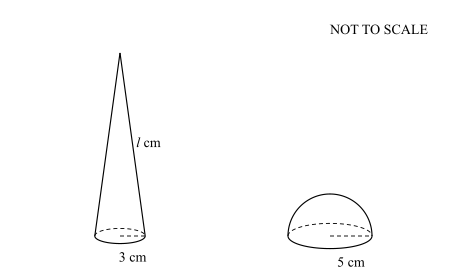
Solution:
- On its own, a solid hemisphere has two surfaces: half the surface of a sphere and a flat circle
- Hemisphere: ½ × 4π × 5² + π × 5² = 50π + 25π = 75π cm²
- The cone has a curved surface, πrl with l the sloping edge, and a circular base
- Cone: π × 3 × l + π × 3² = 3πl + 9π
- Set the totals equal and divide by π: 3l + 9 = 75
- 3l = 66, so l = 22 cm
- Check: 3π × 22 + 9π = 66π + 9π = 75π
- Both flat circles count here, because each one is on the outside of its solid, unlike the hidden join in the example above