Trigonometry
Pythagoras and Trigonometry
Sine, Cosine and Tangent
Labelling the triangle
- The three ratios connect an angle to two of the sides, and which sides they are depends on the angle chosen
- Pick the angle in question, call it θ, then label the sides from its point of view
- H, the hypotenuse, opposite the right angle and always the longest
- O, the side opposite θ
- A, the side next to θ
- H never moves, but O and A swap over if a different angle is chosen, so relabel whenever the angle changes
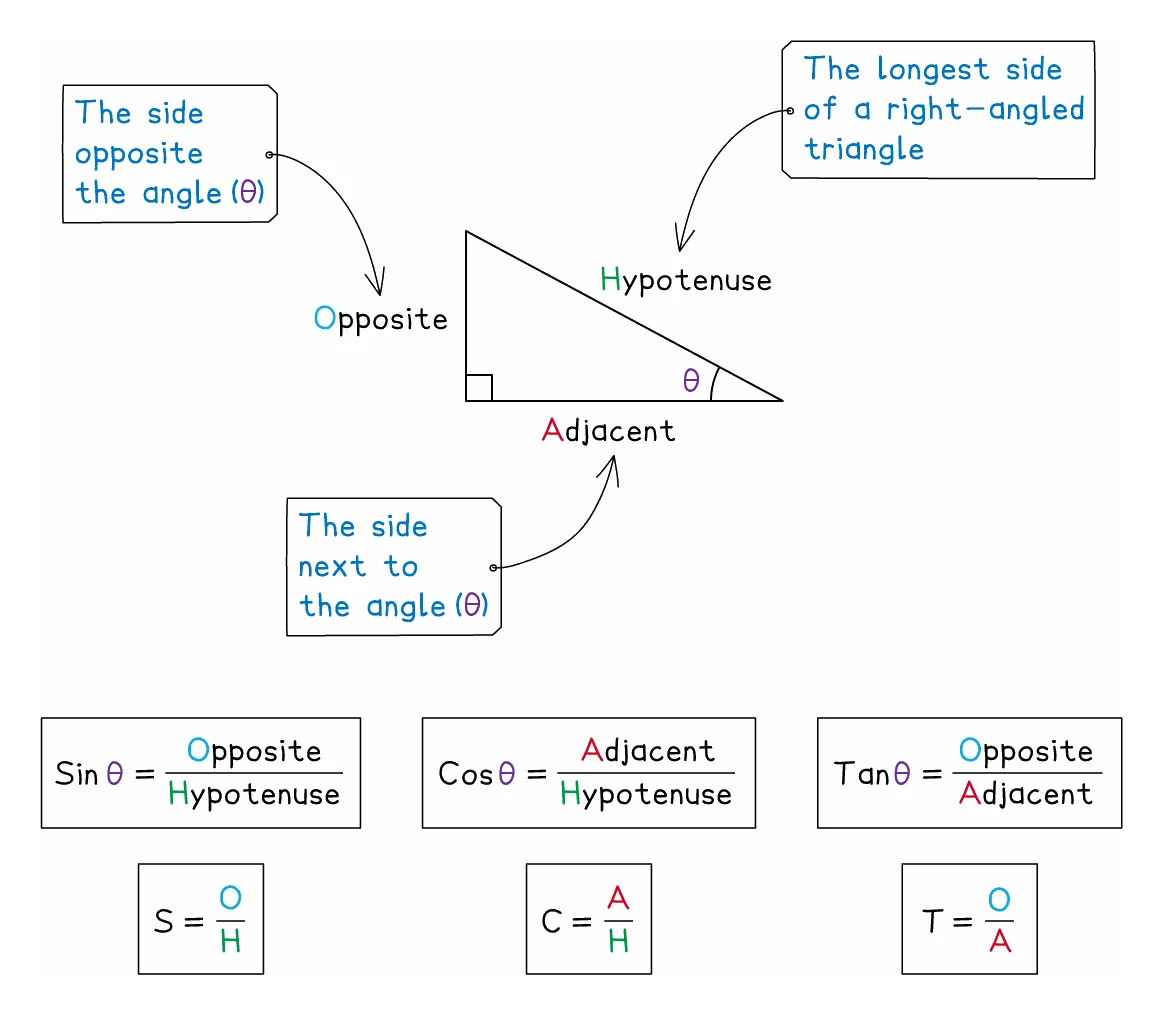
- SOHCAHTOA records the three ratios
- sin θ = O ÷ H
- cos θ = A ÷ H
- tan θ = O ÷ A
- Like Pythagoras, these work only in right-angled triangles
Finding a side
- Label the triangle, then note which letter belongs to the side you have and which to the side you are after
- Those two letters pick the ratio: A and H means cosine, O and A means tangent, and O and H means sine
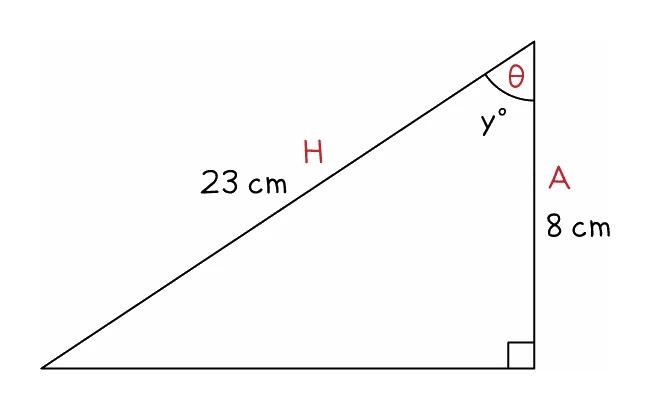
- Substitute, then rearrange to make the unknown the subject
- Round to three significant figures unless the question says otherwise
Worked example
Finding a side
Find the length x in the triangle below, correct to 3 significant figures.
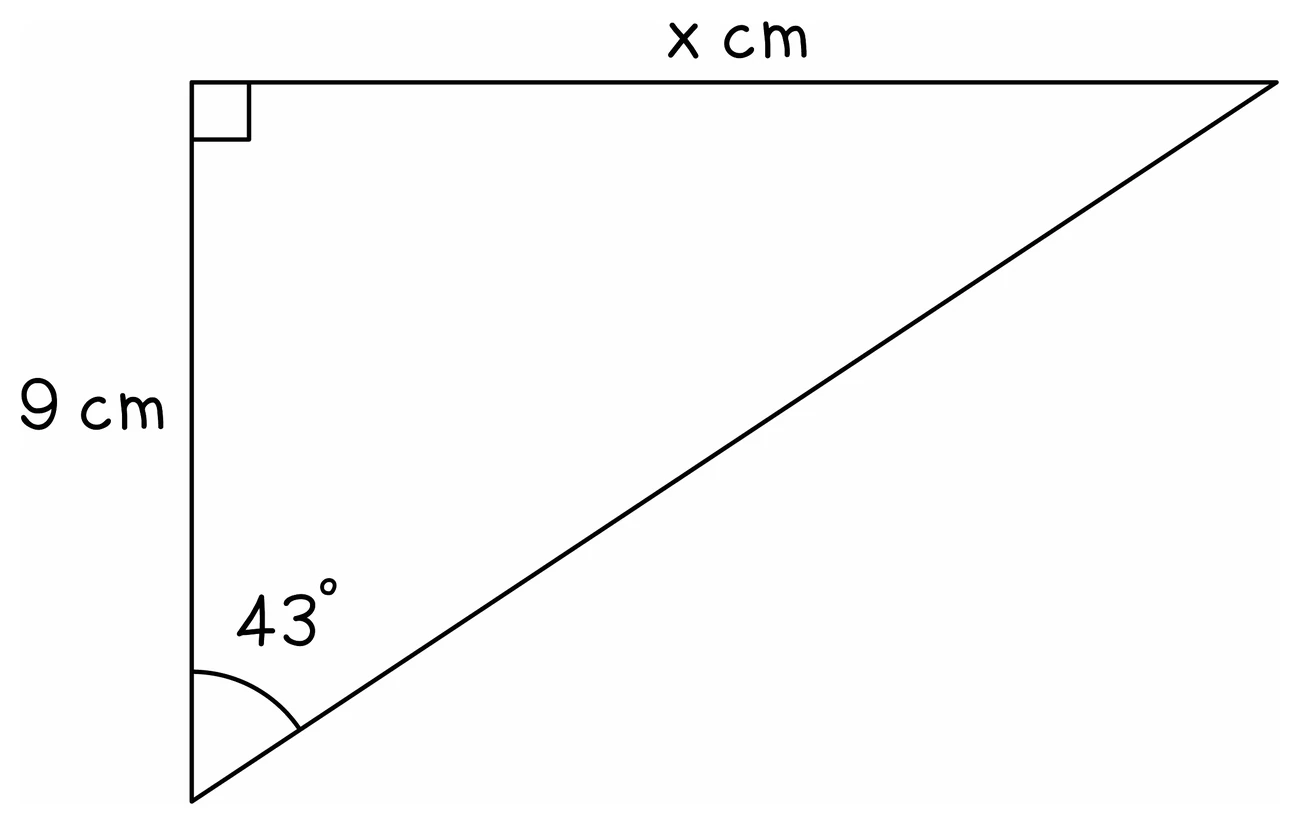
Solution:
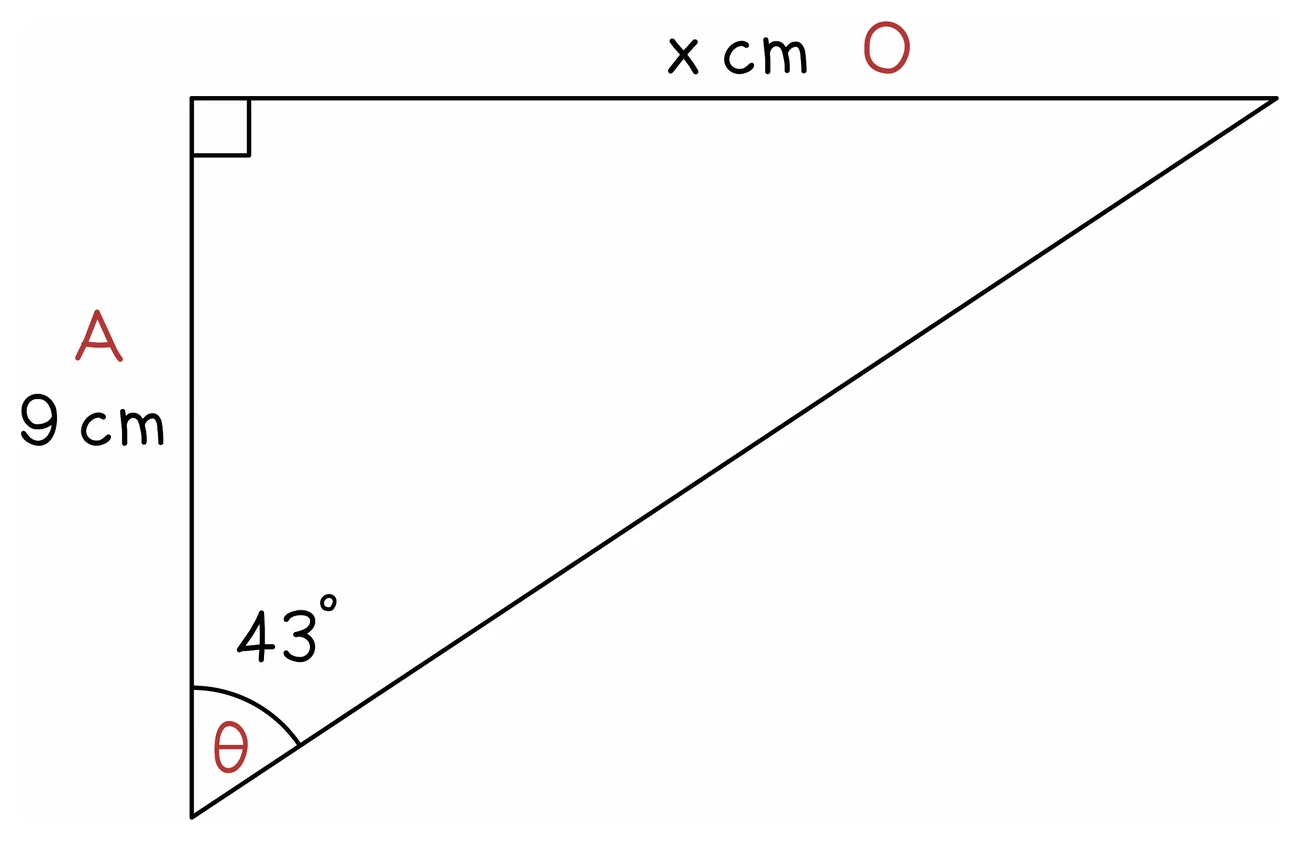
- Label the sides from the 43° angle, not from the right angle
- The 9 cm side runs from the 43° angle to the right angle, so it is the adjacent
- x is across the triangle from the 43° angle, so it is the opposite
- Opposite and adjacent together means tangent
- tan 43° = x ÷ 9
- Multiply both sides by 9: x = 9 × tan 43°
- x = 8.3926… = 8.39 cm to 3 significant figures
- Write the substituted line, x = 9 tan 43°, before evaluating: that is the method mark
- The hypotenuse is not involved at all here, so it needs no label
Exam tip
Write the first side down
When a side has to be found before the trigonometry, from a perimeter or from another triangle, write it on its own line and mark it on the diagram: that value earns marks by itself. The ratio is then marked on your value, so a line such as tan x = 9 ÷ w, with your value of w, still scores even if w was wrong. So always finish the question.
Worked example
Finding a side first
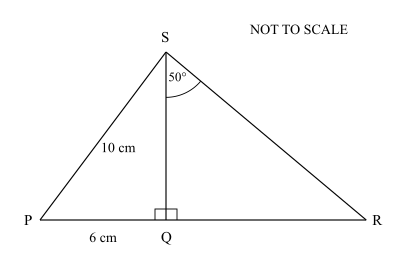
The diagram shows two right-angled triangles, PQS and RQS. P, Q and R lie on a straight line, and QS is perpendicular to PR. PS = 10 cm, PQ = 6 cm and angle QSR = 50°. Find QR, correct to 3 significant figures.
Solution:
- Triangle RQS has no known length yet, so find QS first, from triangle PQS
- In triangle PQS the right angle is at Q, so PS = 10 cm is the hypotenuse and QS is a shorter side: subtract
- QS² = 10² − 6² = 100 − 36 = 64
- QS = √64 = 8 cm, so write 8 cm on QS in the diagram
- In triangle RQS, label the sides from the 50° angle at S: QR is opposite and QS is adjacent, so use tangent
- tan 50° = QR ÷ 8
- QR = 8 × tan 50° = 9.5340… = 9.53 cm to 3 significant figures
Finding an angle
- Label the triangle and identify which two sides are known
- Write the ratio, which leaves the angle as the unknown
- Apply the inverse function, written sin⁻¹, cos⁻¹ or tan⁻¹, usually reached with the shift key
- The syllabus states that angle answers should be given correct to one decimal place, so use that unless told otherwise
- Check the calculator is in degrees before starting, since a wrong mode makes every answer wrong
Worked example
Finding an angle
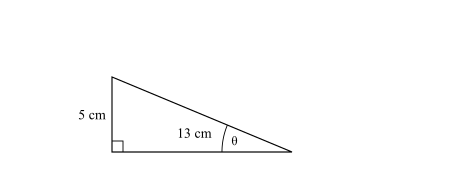
A right-angled triangle has hypotenuse 13 cm and the side opposite angle θ is 5 cm. Find θ, correct to 1 decimal place.
Solution:
- The known sides are O and H, which is SOH, so use sine
- sin θ = 5 ÷ 13
- Apply the inverse: θ = sin⁻¹(5 ÷ 13)
- θ = 22.61986…
- So θ = 22.6° to 1 decimal place
- Check: the third side is 12 by Pythagoras, and the smallest angle faces the shortest side