Prime Factors, HCF and LCM
Number
What each one means
- Where a single value divides two numbers exactly, it is a common factor of the pair, and 1 always qualifies
- The highest common factor, or HCF, is the largest such value
- A value sitting in both numbers' times tables is a common multiple
- Of the infinitely many such values, the smallest is the lowest common multiple, or LCM
- The HCF is what cancels a fraction to its simplest form; the LCM is what supplies a common denominator
Finding them by listing
- List every factor of both numbers, then take the largest value common to the two lists
- List the multiples of both, then take the smallest value common to the two lists
- Listing is quick for small numbers and unreliable for large ones
Finding them from prime factors
- Decompose both numbers into primes first
- Place the primes the two numbers share in the overlap of a Venn diagram, taking each shared prime only as many times as it appears in both
- Place the remaining primes in the outer region belonging to their own number
- Multiplying the overlap gives the HCF; multiplying everything in the whole diagram gives the LCM
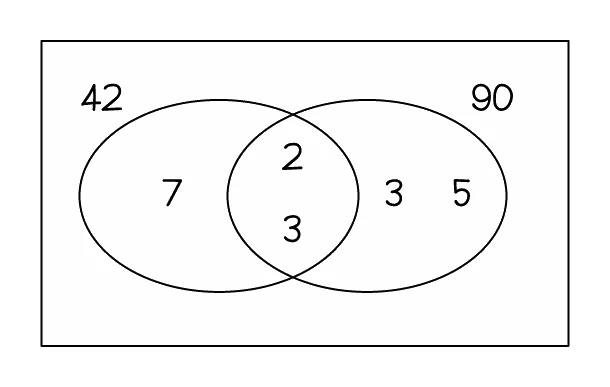
- Where no primes are shared, the overlap holds a 1 and the HCF is 1
Exam tip
Give the clock time
In a question about two buses or trains next leaving together, the LCM is the number of minutes until they next do. The schemes give two of the three marks for that number, in minutes or in hours and minutes; the last mark needs the clock time. Buses every 15 and 25 minutes that leave together at 09 10 next do so 75 minutes later, at 10 25.
Exam tip
Check the multiple is the lowest
A common multiple that is not the lowest earns just one mark. Multiplying the two numbers always gives a common multiple, but it is the lowest only when they share no prime factor: 12 × 18 = 216, yet the LCM is 36. Before you stop, divide your answer by each of its prime factors in turn; if a result is still a multiple of both numbers, go lower.
Worked example
Finding the HCF and LCM from prime factors
Find the highest common factor and the lowest common multiple of 60 and 144.
Solution:
- Decompose each into primes
- 60 = 2² × 3 × 5
- 144 = 2⁴ × 3²
- Both contain 2 and 3. Take the lower index of each for the shared part: 2² and 3
- HCF = 2² × 3 = 12
- For the LCM collect every prime occurring anywhere, each at its highest index: 2⁴, 3² and 5
- LCM = 16 × 9 × 5 = 720