Mathematics (Core)Exam code: 0580
Congruence and Similarity
Lengths, Areas and Volumes
Finding a missing length
- Pick a pair of sides whose lengths are both known, one from each shape, and divide one by the other to get the scale factor
- Multiply to move towards the larger shape and divide to move towards the smaller one
- Choosing the direction that goes small to large keeps the scale factor above 1, which many find easier to check
- Pair the sides correctly before dividing: corresponding sides sit between the same pair of equal angles
- Sanity check the answer, since a length on the larger shape must come out larger
Exam tip
Write the matching sides as two fractions
On a two-mark similar-shapes question, the first mark is for the matching sides written as an equation of two fractions with the lengths in place, such as x/6 = 7/4 for the example below, and it is earned even if solving the equation goes wrong. When the shapes are named, the letter order shows which sides match: if triangle ABC is similar to triangle PQR, AB matches PQ, BC matches QR and AC matches PR.
Worked example
A missing length on a similar shape
Two triangles are mathematically similar. A side of 4 cm on the smaller corresponds to 7 cm on the larger. Another side of the smaller is 6 cm. Find the corresponding side, x cm, on the larger.
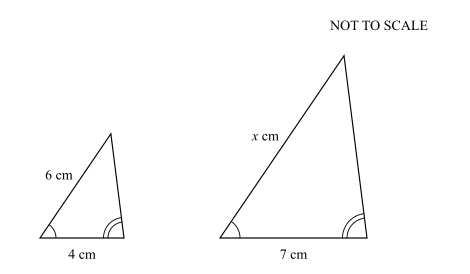
Solution:
- Take the scale factor from the pair of sides that are both known
- Scale factor = 7 ÷ 4 = 1.75
- The missing side is on the larger shape, so multiply
- x = 6 × 1.75 = 10.5, so the side is 10.5 cm
- Check: 10.5 ÷ 6 = 1.75, matching the scale factor from the first pair