Basic Angle Properties
Geometry
Using the shape's own properties
- Any triangle's three angles total 180°, and knowing two gives the third by subtraction
- An isosceles triangle has two equal angles, and they are the ones opposite the two equal sides
- With an apex angle of 34°, the two base angles are (180 − 34) ÷ 2 = 73° each
- An equilateral triangle has three angles of 60°
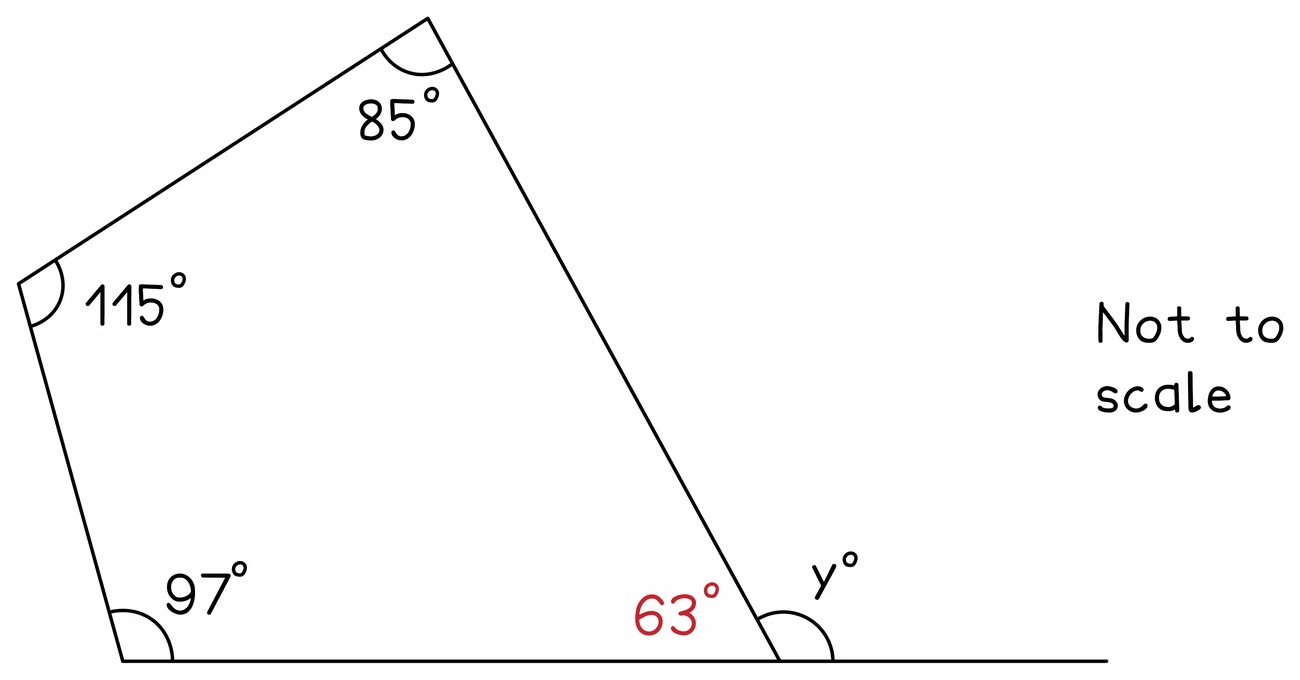
- Any quadrilateral's four angles total 360°
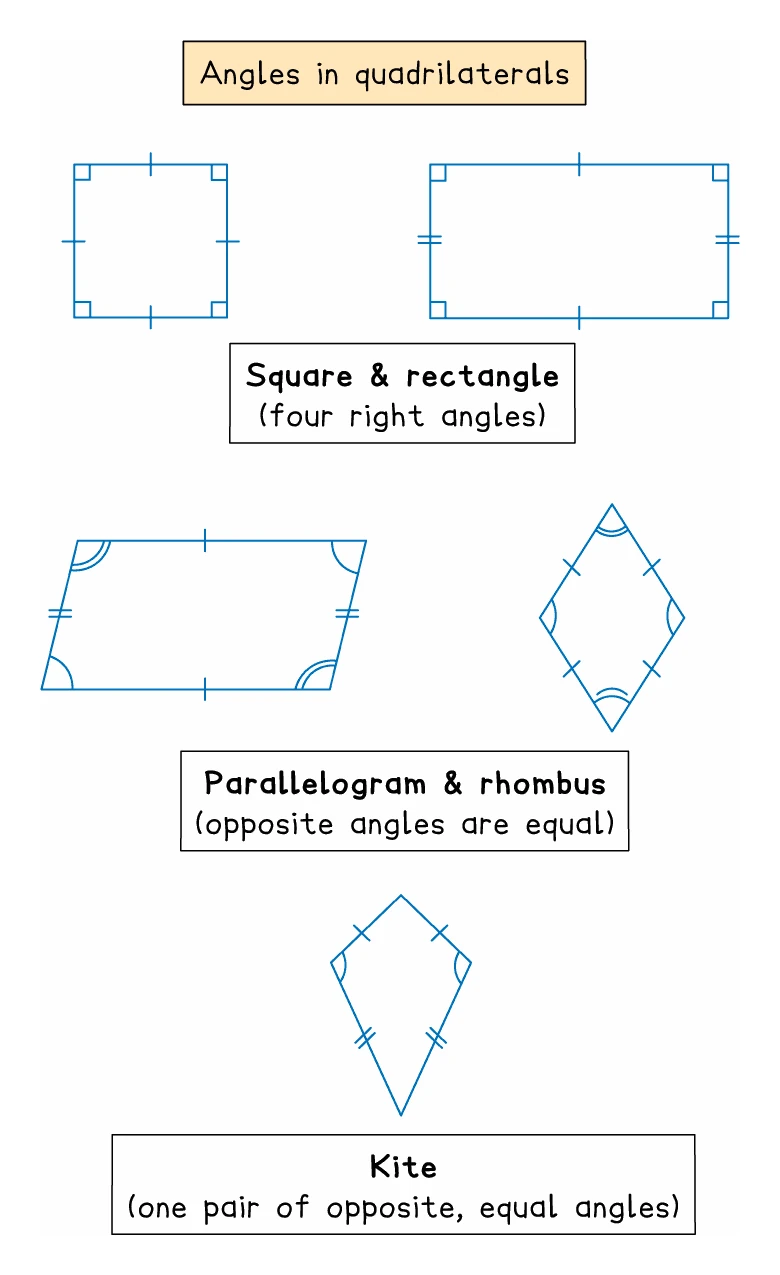
- Symmetry supplies extra equal angles: a parallelogram and a rhombus have equal opposite angles, and a kite has one pair of equal opposite angles
- A square or rectangle has four right angles
Exam tip
The reason scores separately
When a question asks for a geometrical reason, the angle and the reason earn separate marks, and a question asking for two reasons gives a mark for each, so a correct value on its own loses a mark. Write the fact in full, saying which angles and what is true of them: "angles on a straight line add to 180°", "the angles in a triangle add to 180°", "an isosceles triangle's base angles are equal".
Worked example
An isosceles triangle on a straight line
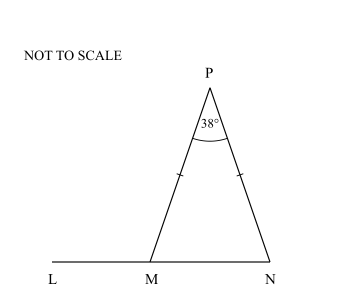
LMN is a straight line. In triangle MNP, PM = PN and angle MPN = 38°. Find angle LMP, giving a reason for each step.
Solution:
- PM = PN, so triangle MNP is isosceles, and its base angles PMN and PNM are equal
- The angles in a triangle add to 180°, so each base angle is (180 − 38) ÷ 2 = 71°
- Angle PMN = 71°, and L, M and N lie on one straight line
- Angles on a straight line add to 180°, so angle LMP = 180 − 71 = 109°
- Check: 71 + 71 + 38 = 180, and 109 + 71 = 180
Worked example
The fourth angle of a quadrilateral
Three angles of a quadrilateral are 88°, 124° and 97°. Find the fourth angle.
Solution:
- The four angles of any quadrilateral add to 360°
- Add the three given: 88 + 124 + 97 = 309
- Subtract from 360: 360 − 309 = 51
- The fourth angle is 51°