Unemployment: Types & Effects
Government and the Macroeconomy · 4 question types
The right policy depends on the type of unemployment. Using the wrong tool for the wrong type is a common slip. Broadly, cyclical unemployment calls for a demand-side response while the other three types call for supply-side labour-market policies.
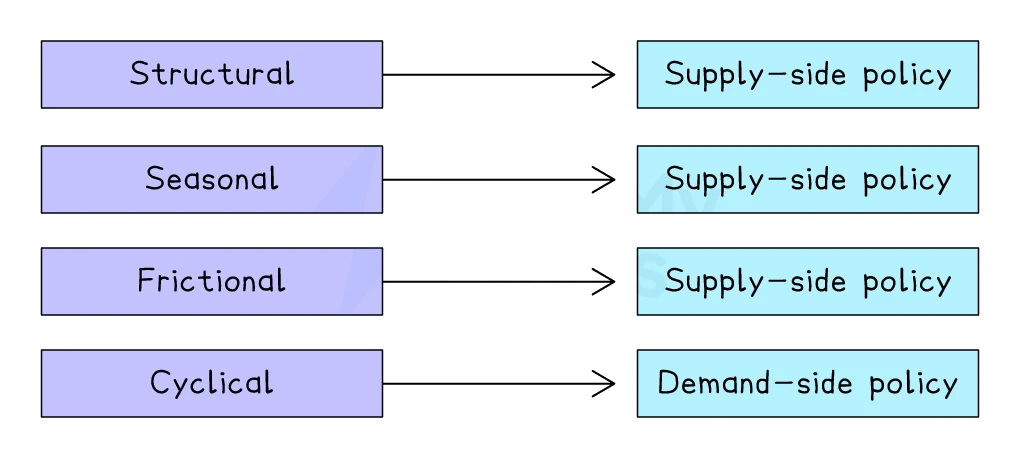
Cyclical unemployment: expansionary AD policy
Cyclical unemployment is a problem of too little demand. The response is to raise aggregate demand.
- Expansionary fiscal policy. Cut taxes and/or raise government spending. Both increase AD: households have more to spend, government injects money directly. Firms hire more workers to meet the higher demand.
- Expansionary monetary policy. Cut interest rates. Borrowing becomes cheaper, households spend more on credit-purchased goods (cars, homes), firms invest more. AD rises.
Both work over months to a year. The trade-off is that excessive stimulus can trigger inflation (topic 12's growth–inflation conflict).
Structural unemployment: supply-side policy
Structural unemployment is a problem of mismatched skills or declining industries. The response is to change the supply side of the labour market.
Main tools:
- Retraining programmes. Government-funded courses to teach unemployed workers new skills for growing industries.
- Subsidised apprenticeships. Firms get money to take on and train new workers, especially the previously unemployed.
- Education reform. Schools and colleges adjust the curriculum to match labour-market needs (more vocational pathways, more STEM).
- Regional aid. Tax incentives or grants for firms to set up in high-unemployment regions, or subsidies for workers to relocate to where the jobs are.
- Encouraging geographic mobility. Housing support, transport investment, easier credentials transfer between regions.
These policies take years to bear fruit; structural unemployment is not solved overnight.
Frictional unemployment: search-and-information policies
Frictional unemployment is a problem of job search taking time. The response is to speed up matching.
- Better job-information services. Online job portals, well-funded job centres, employer-matching services.
- Tighter benefit eligibility. Some governments shorten the period during which unemployment benefit can be claimed, to incentivise faster job search. (This has obvious downsides for vulnerable workers.)
- Job-search support. CV-writing classes, interview practice, career guidance.
Frictional unemployment can never be fully eliminated, but it can be kept very low with good information and incentives.
Seasonal unemployment: income smoothing
Seasonal unemployment is predictable and recurring. The response is usually to smooth incomes across seasons rather than to eliminate the unemployment.
- Income support during off-seasons.
- Encouraging off-season work for seasonal workers (e.g. ski instructors who work as climbing guides in summer).
- Subsidising employers to keep workers on the books year-round.