Unemployment: Types & Effects
Government and the Macroeconomy · 4 question types
Unemployment harms more than just the unemployed person. A 4-mark question rewards effects on multiple stakeholder groups.
Effects on the unemployed individual
- Loss of income. The most immediate effect. Living standards fall.
- Deskilling. Skills decay during long periods without work. The longer someone is unemployed, the harder it becomes to find a new job (a "scarring" effect).
- Mental and physical health. Long-term unemployment is associated with depression, anxiety, and poorer physical health.
- Social stigma. Unemployed people may face discrimination from employers and judgement from peers.
Effects on the government
- Higher welfare spending. Unemployment benefits, housing support and free school meals all rise when unemployment rises.
- Lower tax revenue. Less income tax (fewer wage-earners), less VAT (people on benefits spend less), less corporation tax (firms earn less).
- Larger budget deficit. Both directions push the government's books into deficit.
- More pressure for action. Voters dislike high unemployment, and political pressure for stimulus rises.
Effects on the wider economy
- Output below potential. Some of the economy's productive capacity sits idle. Real GDP is below what it could be.
- Lower aggregate demand. Unemployed people spend less, which feeds back into lower demand for firms' products.
- Lost productive capacity. Long-term unemployment causes permanent skill loss; the economy's future capacity is reduced.
- Higher inequality. Unemployment is concentrated among already-vulnerable groups (low-skilled workers, certain regions, ethnic minorities).
Effects on firms
Firms see a mix of harm and benefit:
- Harm: lower sales. Unemployed customers spend less, so firms in consumer-facing industries lose revenue.
- Benefit: cheaper labour. With more job seekers per vacancy, firms can hire at lower wages and put less effort into retention.
- Benefit: less wage pressure. Existing workers are less likely to demand pay rises because the threat of unemployment is real.
On balance the harm usually outweighs the benefit, which is why business groups generally support job-creation policies despite the cheap-labour upside.
The effects spread out across every stakeholder group at once, as this summary shows.
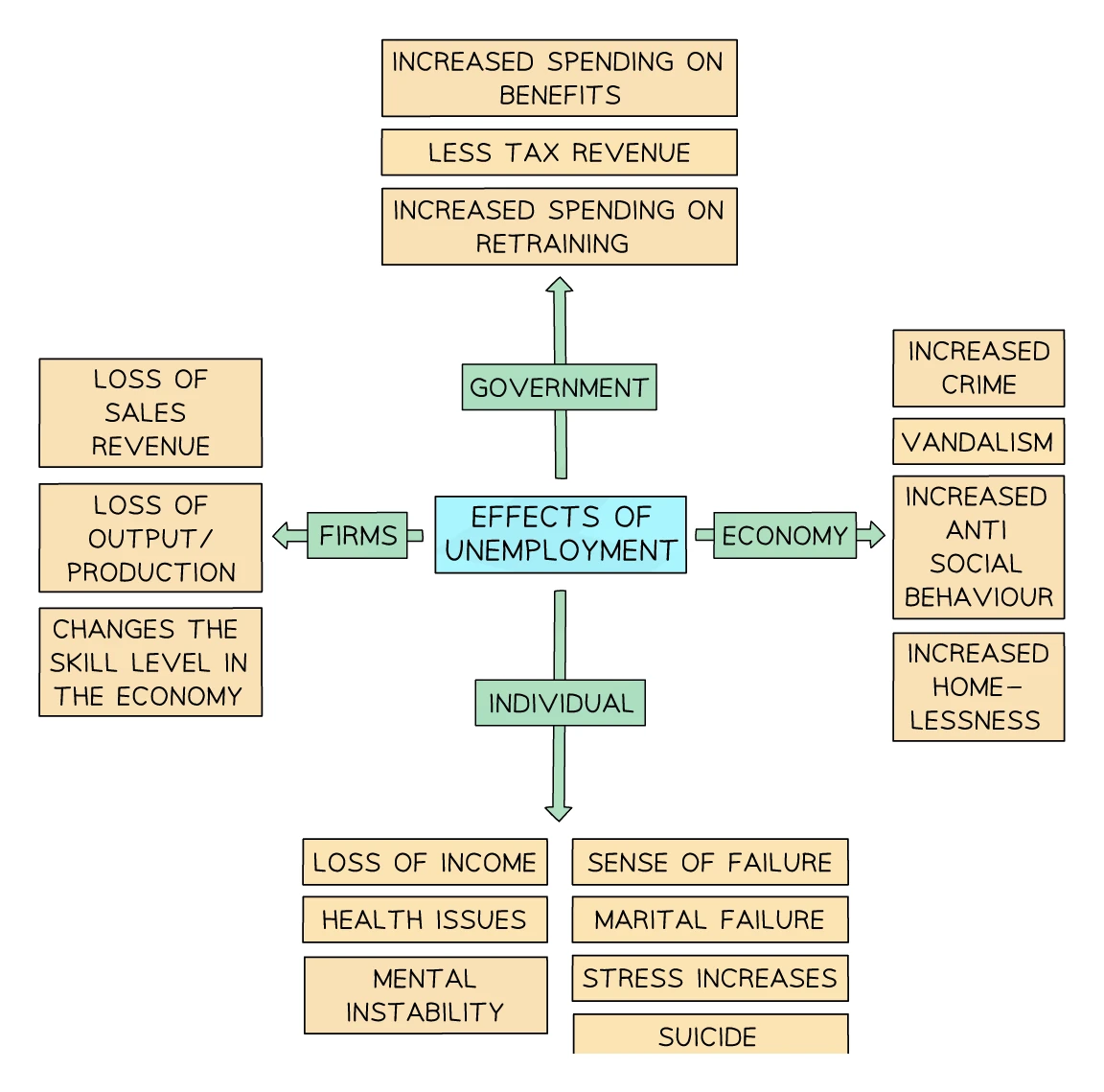
Consequences of unemployment for government and the economy
What comes up: "Discuss whether or not a government should try to prevent a rise in unemployment" (8 marks) or an Analyse question asking how unemployment harms an economy.
Write: Build a chain of reasoning across multiple stakeholders. For the government: higher unemployment raises welfare benefit spending (1) while simultaneously reducing tax revenue — fewer workers means less income tax, lower consumer spending means less VAT revenue (1) — pushing the government toward a budget deficit (1). For the wider economy: output falls below the economy's potential so real GDP is lower than it could be (1); unemployed workers spending less feeds back into lower aggregate demand (1); long-term unemployment causes skill loss, permanently reducing future productive capacity (1).
Watch out: A Discuss question requires both sides. The "why it might not" side might include: existing unemployment is already low, or efforts to cut unemployment risk triggering inflation (the trade-off between unemployment and inflation). A judgement line deciding which argument is stronger is needed for the top mark band.
The downward-spiral pattern
In a serious recession, the effects feed back into each other:
- AD falls → firms cut output → workers lose jobs.
- Unemployed workers spend less → AD falls further.
- Firms cut output again → more workers lose jobs.
The spiral is what makes a deep recession so hard to escape without policy intervention.