Types of Markets: Competition & Monopoly
Microeconomic Decision Makers · 2 question types
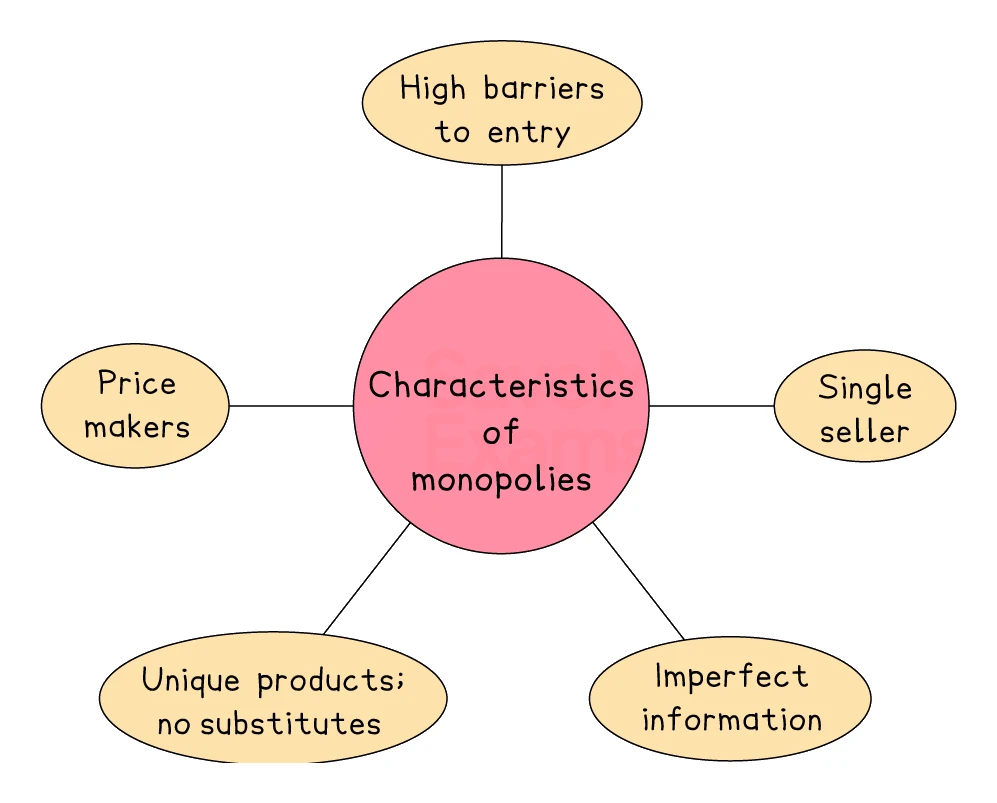
A monopoly is a market supplied by a single firm (or, more loosely, one firm with a dominant share). With no close competitor, the firm has the power to set its own price rather than accept a market price. Such a firm is sometimes called a price maker.
A monopoly often arises from that keep rivals out: control of an essential resource, very large set-up costs, patents, or legal protection.
Effect of one firm on price, quality, choice and profit
| Feature | Effect under monopoly |
|---|---|
| Price | Higher — with no competitor to undercut it, the firm can restrict supply and raise the price above the competitive level. |
| Quality | May be lower — with no competitive pressure, the firm has less incentive to improve. (It may also be high if the firm reinvests its profits.) |
| Choice | Narrower — a single supplier means consumers have little or no alternative. |
| Profit | Higher (supernormal) — protected from competition, the firm can earn large, lasting profits. |
Disadvantages of monopoly
- Higher prices and restricted supply. To maximise profit, the monopolist produces less and charges more than a competitive market would, so consumers are worse off and resources are misallocated.
- Less choice for consumers, who cannot switch to a rival.
- Weaker incentive to improve quality or cut costs, because no competitor threatens the firm's sales.
- Possible exploitation. The firm's market power can be used against the interests of consumers and, sometimes, of its suppliers.
Advantages of monopoly
A monopoly is not always harmful, and the syllabus expects you to see both sides.
- Economies of scale. A single large firm produces on a very large scale, so its average costs may be lower than those of many small firms — and some of that saving may be passed on as lower prices.
- Funds for research and innovation. High profits give the monopolist the money to invest in research, new technology and product development.
- Avoiding wasteful duplication. One firm avoids the duplicated networks and advertising of many competing firms — useful for a natural monopoly such as a water or rail network, where having one supplier of the infrastructure is the most efficient arrangement.
Explain how a monopoly affects consumers
What comes up: a 4-mark "Explain two ways in which a monopoly may affect consumers," or an analyse question on the effect of one firm dominating a market.
Write (identify + explain, twice): for example, (1) higher prices (1) because the single firm can restrict supply and faces no rival to undercut it (1); (2) less choice / lower quality (1) because there is no competitive pressure to vary or improve the product (1). Other creditable effects: large profit for the firm, or possibly lower prices if economies of scale are passed on.
Watch out: the question asks for the effect of having only one firm — keep each point linked to the absence of competition. A balanced answer can note that economies of scale might let a monopoly charge less, not more, in some cases.