Production Possibility Curves
Basic Economic Problem · 4 question types
A movement along the PPC is one thing. A shift of the whole PPC is something different and is caused by changes in the underlying resources or technology.
An of the entire PPC means the economy can now produce more of both goods at once. This is the textbook definition of of productive potential.
An of the entire PPC means the economy can now produce less of both goods. This is economic decline of productive potential.
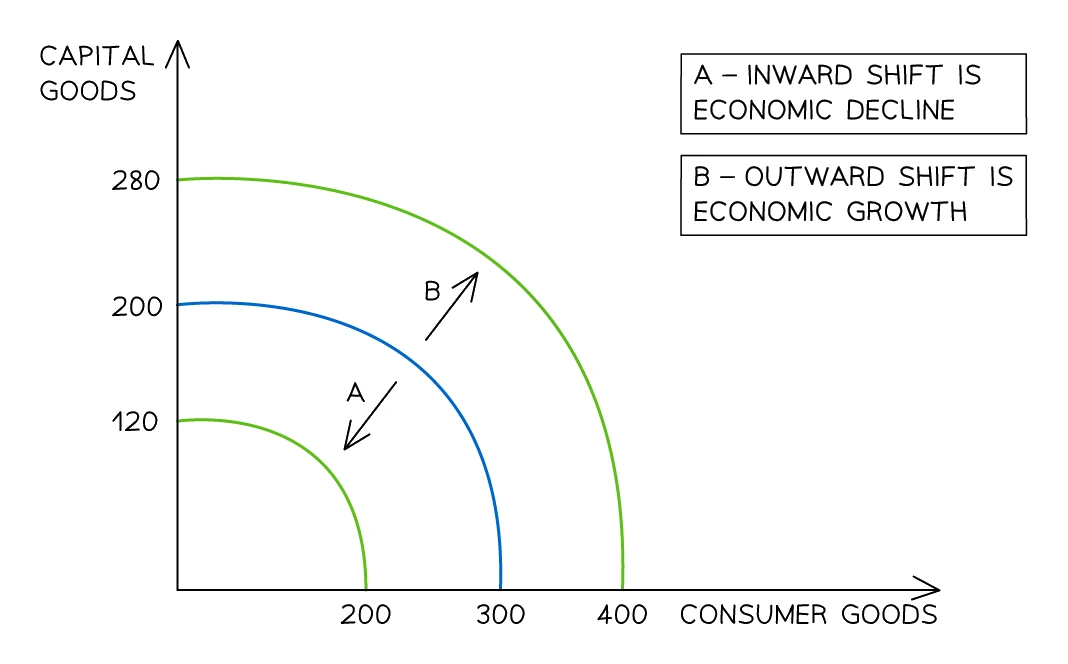
Causes of an outward shift (economic growth)
Anything that raises the quantity or quality of the factors of production, or improves the technology used to combine them.
| Cause | What changes |
|---|---|
| Net inward migration | Quantity of labour rises |
| Capital investment | More machinery, factories, infrastructure |
| Discovery of new natural resources | Quantity of land rises (new oil field, new mineral seam) |
| Improved education and training | Quality of labour rises (more skilled, more productive workers) |
| Better health of the workforce | Quality of labour rises (fewer days lost to illness) |
| New technology | Same resources produce more output per worker / per machine |
| Productivity-enhancing reforms | Better infrastructure, deregulation that frees up factor markets |
Causes of an inward shift (economic decline)
Anything that reduces the quantity or quality of factors.
| Cause | What changes |
|---|---|
| War | Capital destroyed; labour lost to combat or displacement |
| Natural disaster | Land or capital destroyed (earthquake, tsunami, flood) |
| Resource depletion | Land falls (oil fields run dry, fish stocks collapse) |
| Mass emigration / brain drain | Quantity and quality of labour falls |
| Pandemic | Labour quality and quantity fall short-term |
| Catastrophic policy failure | Capital and skilled labour fall (very high inflation, sanctions, civil collapse) |
A reliable real-world example for an outward shift: a country opens a major new copper deposit and begins extracting it. An example for an inward shift: a 2011 tsunami in Japan destroying coastal infrastructure and depressing the country's productive capacity for years.
Analyse, using a PPC diagram, the effect of [change] on an economy (5–6 marks)
What comes up: you are given a scenario (technological progress, disaster, migration) and asked to analyse its effect with a PPC diagram.
Write: draw and label both axes with two different outputs (1); draw an initial curve sloping downward to both axes (1); draw a second curve in the correct direction (1); mark the shift with an arrow or label the curves PPC1 and PPC2 (1). Then add written analysis: the change raises/reduces the quantity or quality of resources (or technology), increasing/decreasing productive capacity — the maximum the economy can produce (1).
Watch out: curves must touch (or nearly reach) both axes to earn the diagram marks. A curve floating in mid-air does not score. Label your axes — "output of good A" and "output of good B" are fine; unlabelled axes lose the first diagram mark.
Explain two reasons why the PPC shifted to the left (4 marks)
What comes up: a 4-mark "explain two reasons" question tied to a country context where productive capacity has fallen.
Write (one mark per reason identified + one mark per explanation): (1) A fall in the size of the labour force (1): fewer workers means fewer resources available, so the maximum output the economy can achieve is lower (1). (2) A reduction in the quality of labour (1): for example, if fewer workers receive education or training, productivity falls and the economy produces less with the same number of workers (1).
Watch out: the question says "explain" — identifying a reason alone earns only one mark. You must develop each reason to show why it reduces the economy's productive capacity.
Two patterns that examiners specifically test
- Lower unemployment is NOT an . Reducing unemployment moves a point that was inside the curve closer to the curve. The curve itself does not move. Only changes in resources or technology shift the curve.
- A movement along the curve is NOT a shift. Changing the mix of two goods on an unchanged curve is a movement; only changes in the underlying resource base or technology shift the whole curve.