Price Elasticity of Supply (PES)
Allocation of Resources · 3 question types
Five non-price factors determine whether the supply of a good is elastic or inelastic. The mnemonic STAMP holds them.
| Letter | Stands for | Effect on PES |
|---|---|---|
| S | Spare capacity | More spare capacity (idle machines, underused workers) → supply more elastic (firms can ramp up output quickly). No spare capacity → supply inelastic. |
| T | Time period | Short run: factors of production are fixed → supply inelastic. Long run: firms can build new factories, hire more workers, plant more crops → supply more elastic. |
| A | Ability to store the product | Storable / non-perishable goods → supply more elastic (firms can release stock when prices rise). Perishable goods → supply inelastic. |
| M | Mobility of factors of production | The easier it is to switch labour and capital from making one product to making another, the more elastic supply is. Factories that can switch between products (e.g. car plants from petrol to electric) have higher PES. |
| P | Production inputs (raw-material availability) | Abundant raw materials → supply more elastic. Scarce or geographically restricted raw materials → supply inelastic. |
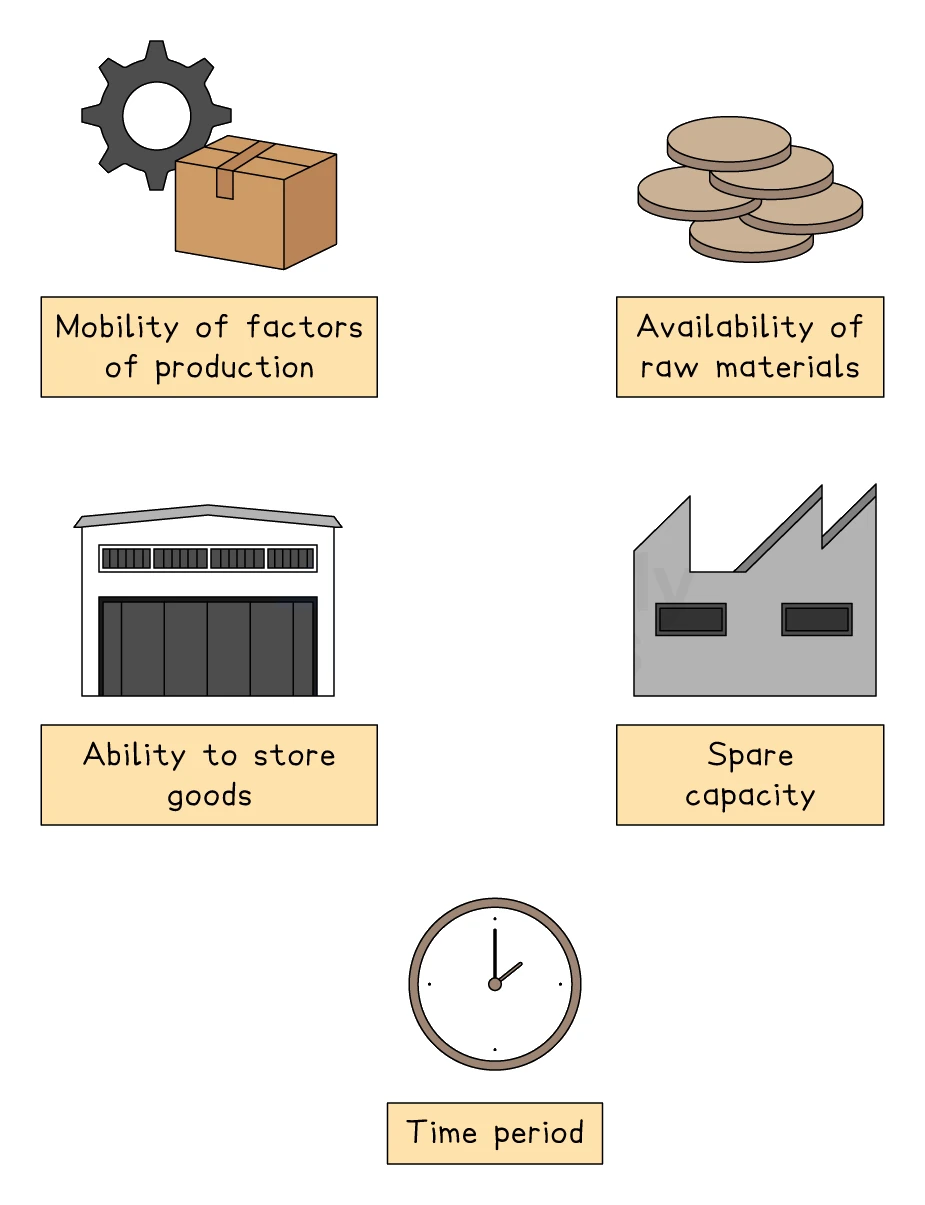
The five determinants in detail
1. Spare capacity. If a factory's machinery is only running at 60% of maximum, and there are idle workers willing to take extra shifts, the firm can increase output very quickly when prices rise. PES is high. A factory already running flat out at 100% capacity cannot increase output until new machinery is installed; PES is low.
2. Time period. Time is the single most important determinant for many real-world goods.
- Very short run (a few days/weeks): most factors are fixed. Supply is close to perfectly inelastic. A coffee farmer cannot grow more coffee in a week.
- Short run (a few months): firms can hire more workers, work overtime, source slightly more raw materials. Supply becomes a little more responsive.
- Long run (years): firms can build new factories, plant new crops, train new workers. Supply is much more elastic.
The same good can have very different PES at different time horizons. This is why oil supply is inelastic in the short run (existing wells produce at fixed rates) but more elastic in the long run (new wells can be drilled).
3. Stock / ability to store. Goods that can be stored have higher PES: firms can build inventory in low-price periods and release it when prices rise. Tinned food, electronics and clothing are easy to store. Fresh fish, cut flowers and live concert tickets cannot be stored at all, so their PES is very low.
4. Factor mobility. If a firm's resources can be redirected easily from making other products into making this one, supply is more elastic. A clothing factory can quickly switch from making T-shirts to making dresses; PES for both is relatively high. A car-engine plant cannot quickly switch to making solar panels; PES is lower.
5. Raw-material availability. If the inputs needed to make the good are abundant and cheap, firms can scale up quickly when prices rise. If raw materials are scarce, geographically restricted, or only available from specific suppliers, PES is low. Lithium for electric-vehicle batteries is a good example: even with strong price signals, supply cannot expand as fast as demand because mining and refining take years.
Analyse the key determinants of PES (4-mark and 6-mark questions)
What comes up: "Explain two influences on the price elasticity of supply of [good]" (4 marks) or "Analyse the key determinants of price elasticity of supply" (6 marks). Each determinant earns 1 mark for identification and 1 mark for a developed explanation linking it to elastic or inelastic supply.
Write: For each determinant, identify it, then explain the mechanism. Three key chains the mark scheme rewards: (1) Availability of stocks — firms holding unsold finished goods can release inventory when prices rise, making supply more elastic. (2) Level of spare capacity — if factors of production are idle (machines not running at full capacity, workers on part-time hours), firms can raise output quickly, so supply is more elastic. (3) Time period — in the short run at least one factor is fixed, limiting output and making supply inelastic; in the long run all factors are variable and firms can build new capacity, so supply becomes more elastic.
Watch out: naming a determinant without explaining the mechanism gets only 1 mark. You need the chain of reasoning — e.g. "long run: all factors variable (1) → easier to increase production → supply more elastic (1)".