Market Equilibrium & Price Mechanism
Allocation of Resources · 4 question types
Whenever the actual price sits above or below the , the market is in . Two distinct cases.
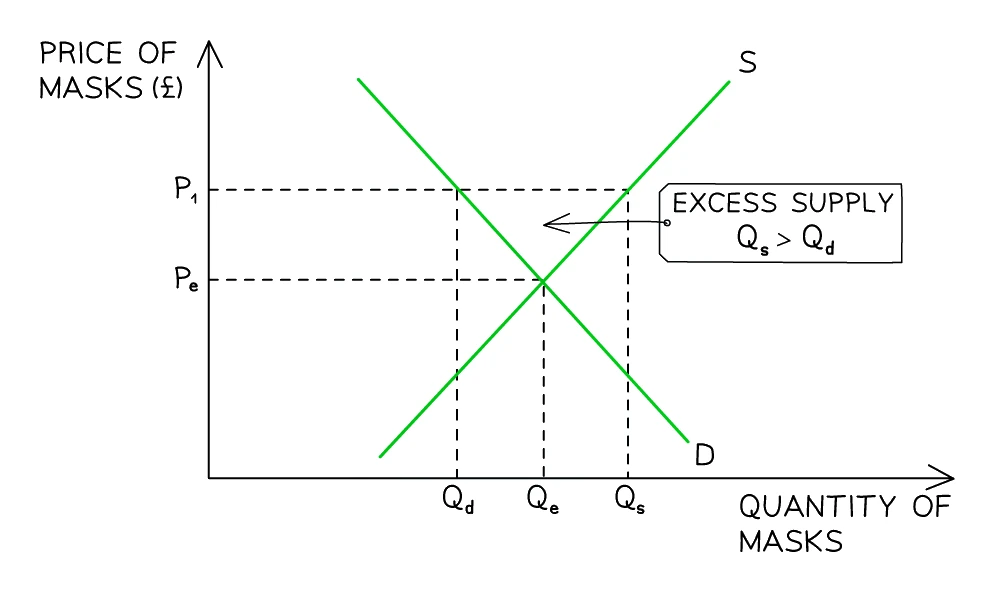
Surplus (excess supply)
A (or excess supply) exists whenever the actual price sits above the equilibrium price. At that high price, quantity supplied exceeds quantity demanded (Qs > Qd). Sellers cannot shift all the stock they produce.
What happens next:
- Stock builds up in warehouses and on shelves.
- Sellers, frustrated by unsold stock, lower the price to attract more buyers.
- As the price falls, quantity demanded extends (a movement down the demand curve) and quantity supplied contracts (a movement down the supply curve).
- The two adjustments shrink the gap. The market returns to equilibrium at the lower price.
Shortage (excess demand)
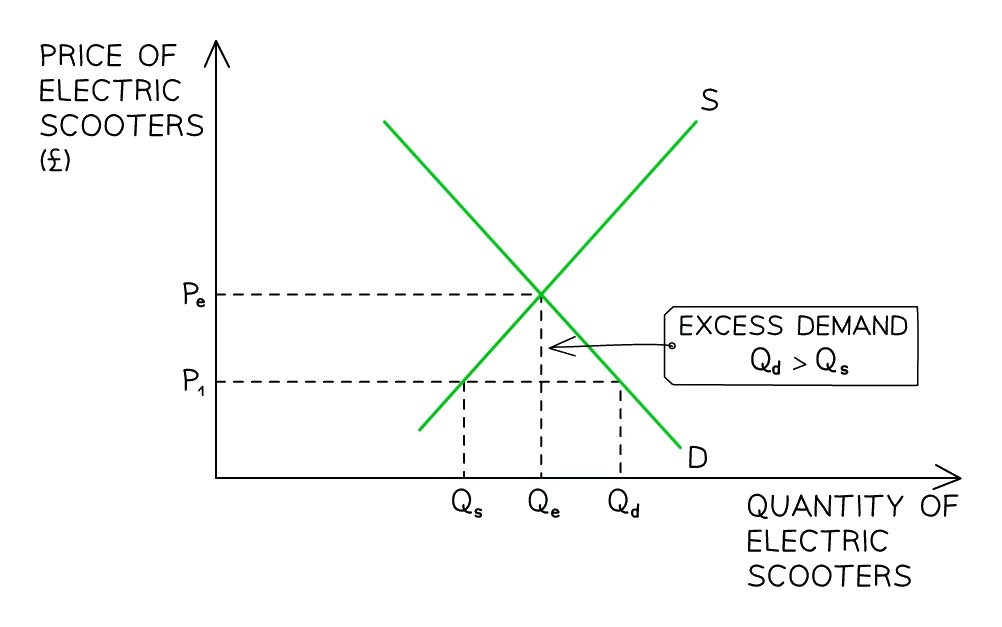
A (or excess demand) exists when the price is below the equilibrium price. At that low price, quantity demanded exceeds quantity supplied (Qd > Qs). Some buyers go away empty-handed.
What happens next:
- Stock sells out faster than sellers can restock. Queues form.
- Sellers, realising they can charge more, raise the price.
- As the price rises, quantity demanded contracts (a movement up the demand curve) and quantity supplied extends (a movement up the supply curve).
- The market returns to equilibrium at the higher price.
In both cases, the price moves toward the equilibrium automatically through buyer and seller behaviour. No central authority has to fix it.
Memorise the rule the exam tests on almost every paper: price below equilibrium → shortage; price above equilibrium → surplus. The two are not interchangeable, and the direction matters.
How a market moves from disequilibrium to equilibrium
What comes up: A 4-mark question asks you to explain how a market restores equilibrium after being in disequilibrium.
Write (four marks): Cover both cases. (1) If quantity demanded exceeds quantity supplied (shortage/excess demand), the price will rise. (2) If quantity supplied exceeds quantity demanded (surplus/excess supply), the price will fall. (3) As price adjusts, Qd and Qs move toward each other until they are equal again — the market is back in equilibrium.
Watch out: You need at least one explicit reference to a change in price to unlock the first mark — statements about buyers or sellers acting without naming the price movement will not score.