Living Standards & Development Indicators
Economic Development
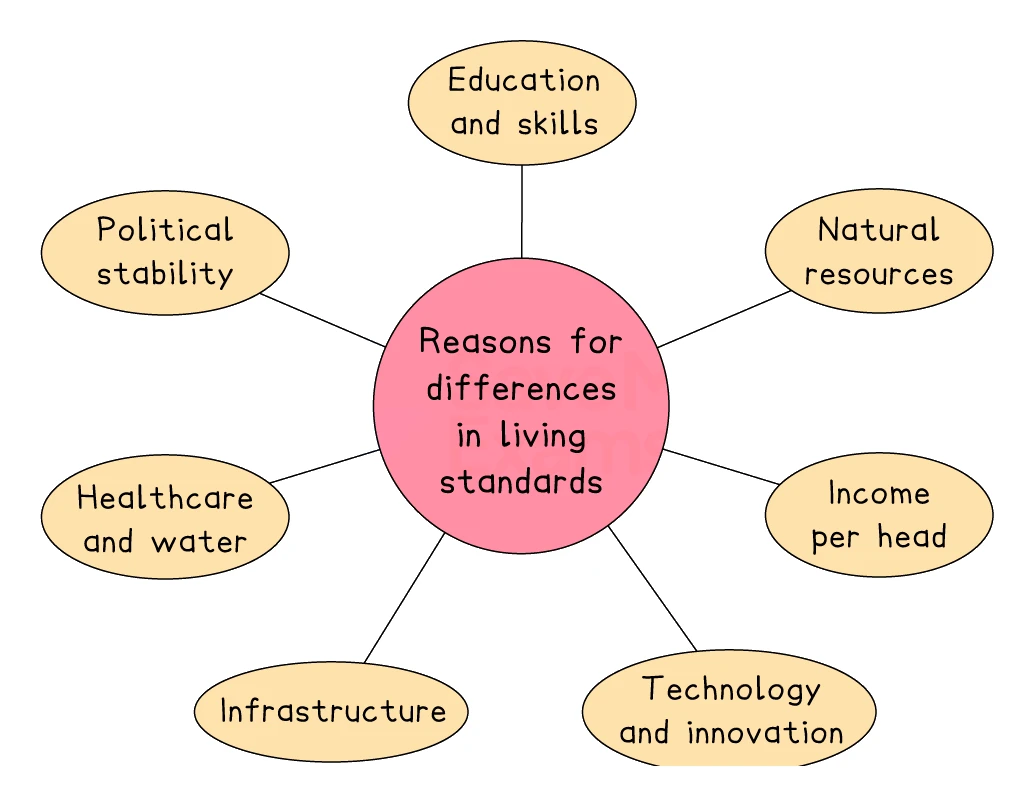
A 4-mark question on what influences living standards asks for two factors, with one mark for naming each and one for explaining it. Most of the reasons below compare one country with another; the last group explains why living standards also vary inside a single country.
Income and productivity differences
Richer countries can afford more goods, services, healthcare and education. The underlying cause is usually higher productivity (output per worker), driven by:
- More capital per worker (machines, infrastructure).
- Better technology.
- Higher human capital (education, training).
- Larger or more efficient markets.
Quality of human capital (education and healthcare)
Countries with good schools, universities and healthcare produce a workforce that is more productive and healthier. Both feed back into still higher productivity, in a virtuous cycle. Conversely, countries with weak education and high disease burden are trapped in low-productivity equilibrium.
Natural resources and technology
Two distinct paths to high living standards:
- Resource-rich countries (Norway with oil, Australia with minerals, Saudi Arabia with oil) can fund high public services from resource revenues.
- Technologically advanced countries (South Korea, Japan, Germany) export high-value manufactured goods and services that command high prices.
A country with neither (limited resources and low technology) finds it harder to lift living standards.
Political stability, governance, and institutions
- Stable politics encourages investment.
- Low corruption means public spending actually reaches public services.
- Strong rule of law protects property rights and contracts.
- Lower income inequality spreads the benefits of growth more widely.
- Effective government runs schools, hospitals and infrastructure well.
Even a country with abundant resources can have low living standards if its institutions are weak (the "resource curse").
Demographics and population structure
Countries with a large dependency ratio (many children and elderly per working-age adult) spread their output thinly. Countries with a healthy working-age share have higher per-capita output. Pop-growth differences also matter: if population grows faster than GDP, real GDP per head falls.
Why living standards differ within a country
The same national average hides big gaps between regions and between groups of people inside a single country.
- The urban-rural gap. Towns and cities usually have better infrastructure, more schools and hospitals, and a wider choice of higher-paid jobs. Rural households can therefore have a lower standard of living even where money incomes look similar.
- Regional economic differences. Industry, natural resources or access to a major port tend to concentrate in particular regions, so those regions have higher incomes and better-funded local services, while a region whose main industry has declined falls behind.
- Unequal access to public and merit goods. The quality of state healthcare and education varies from area to area and from group to group, so two households on the same income can still end up with very different health, schooling and quality of life.
Common exam question
What makes living standards higher or lower
Question: Explain two factors affecting living standards, or analyse or discuss why one group is worse off than another (4–8 marks).
Asked in 3 of the 11 structured papers. In the 4-mark version each factor earns a mark and its explanation a second; reasons in either direction count. Credited factors include income, education, healthcare, cost of living, working hours, sanitation, pollution, public and merit goods, and crime, each tied to its effect: more goods, better jobs, less illness, more leisure. The HDI is accepted when tied to GDP per head, education or health.
To analyse why low-income farmers are badly off (6 marks), build chains from the low income: necessities take most of it, so poor housing, food and healthcare bring illness and shorter lives, with little saving or education. To discuss city against rural life (8 marks, levels), weigh more jobs, higher incomes and nearer schools and healthcare against congestion, overcrowding, pollution, stress and a higher cost of living.