Exam Frequency Analysis
Past paper frequency (2018 to 2024)
This topic accounts for approximately 11% of your exam marks.
increasing
Medium
Increasing11%
Exchange rate definitions, depreciation/appreciation effects on exports, imports, and inflation are increasingly examined since 2021.
Countries use one of two main systems to set their exchange rate, with various hybrids in between.
Floating exchange rate
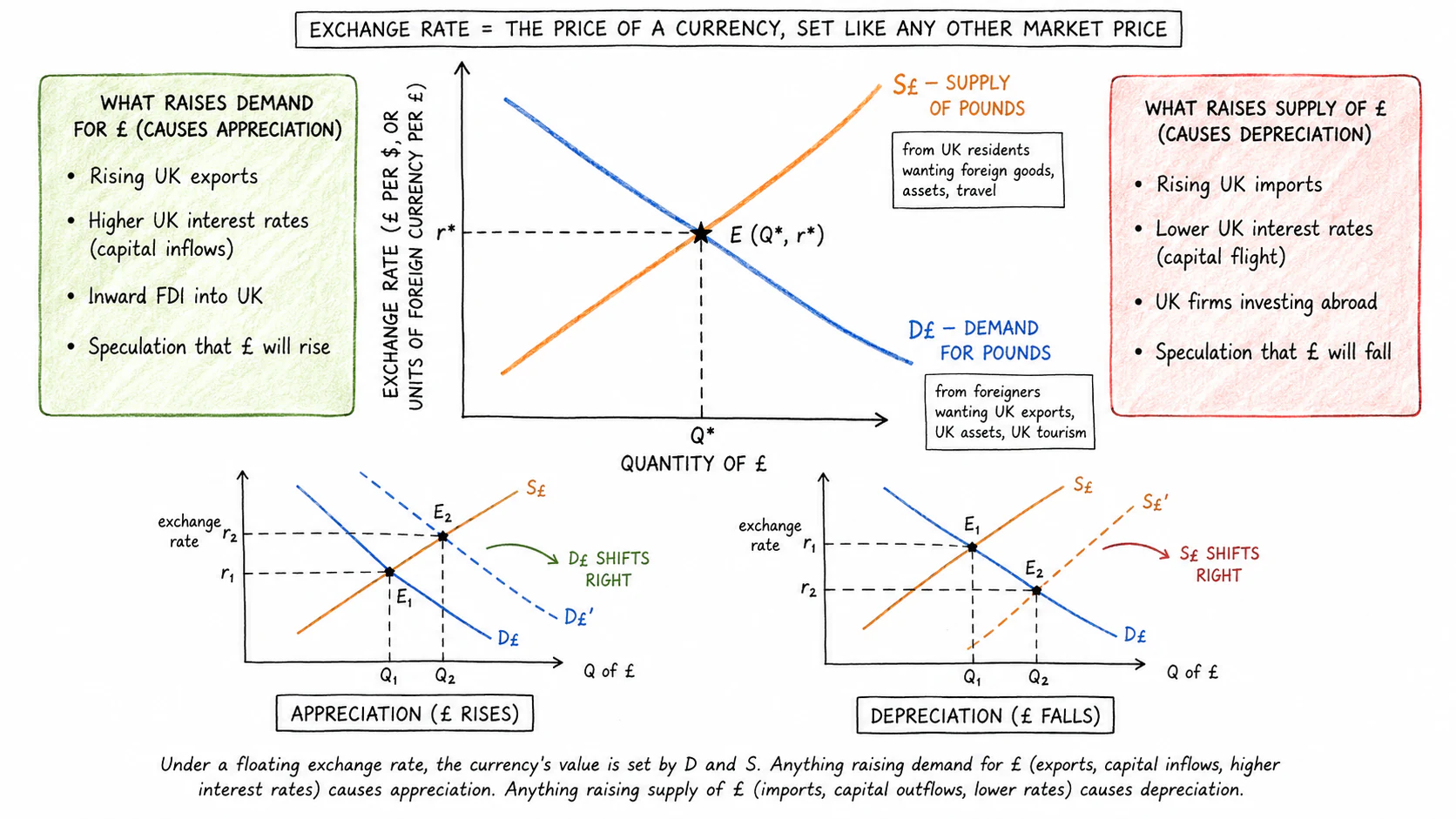
A floating exchange rate is determined by market forces: the demand for and supply of the currency on the foreign exchange (FX) market. The government does not target a specific rate.
How the rate is set:
- Demand for the currency comes from foreigners who want to buy this country's goods, services or assets (exports, FDI inflows, inward tourism, financial investment).
- Supply of the currency comes from domestic residents who want foreign currency (to pay for imports, to invest abroad, to travel).
- The rate moves until demand equals supply.
If something raises the demand for the currency (more exports, higher interest rates attracting foreign capital), the currency appreciates. If something raises supply (more imports, capital flight), it depreciates.
Examples of floating currencies: US dollar, UK pound, euro, Japanese yen, Australian dollar.
Fixed exchange rate
A fixed exchange rate is a rate that the government or central bank sets and maintains at a particular value (a "peg"), usually against another major currency or a basket of currencies.
How the rate is maintained:
- If demand for the currency falls and pushes the rate below the peg, the central bank buys its own currency (using foreign-currency reserves), reducing supply and pushing the rate back up.
- If demand rises and pushes the rate above the peg, the central bank sells its currency (and accumulates foreign-currency reserves), increasing supply and pulling the rate back down.
The central bank needs substantial foreign-currency reserves to defend a peg. If the reserves run out, the peg can break (a currency crisis).
Examples of fixed-rate currencies: the Hong Kong dollar (pegged to the US dollar), the Danish krone (pegged to the euro), several Gulf currencies (pegged to the US dollar).
Managed float
Many countries use a hybrid system called a managed float. The currency mostly trades freely, but the central bank intervenes occasionally to smooth large swings or to nudge the rate in a desired direction. Examples: India's rupee, China's renminbi, Singapore's dollar.