Digital Currency
Internet and Its Uses
The clever property of a blockchain is that an attacker cannot simply change an old transaction and get away with it. Several mechanisms work together to make tampering nearly impossible.
Mechanism 1: Hash linking propagates changes
If an attacker modifies a transaction inside an old block:
- That block's contents change.
- So the block's changes.
- But the next block still stores the old hash as its
prevvalue. - So the chain is broken: the next block's
prevno longer matches the previous block's actual hash. - The attacker would also need to re-calculate the next block's hash to fix the link, and then the one after that, all the way to the current end of the chain.
This means a tampered block forces the attacker to rewrite every block after it, not just one. The longer ago the block was, the more work this is.
Mechanism 2: Proof-of-work makes rewriting blocks expensive
Adding a new block (mining) is computationally expensive on purpose. The network requires the new block's hash to meet a specific mathematical condition (e.g. starting with a certain number of zeros). To find a hash that meets the condition, a miner must try many random small adjustments (called the nonce) until one works.
For the Bitcoin network in particular, finding a valid block hash takes the entire global mining network roughly 10 minutes. To rewrite the last 6 blocks, an attacker would need to redo 60 minutes of the world's combined mining work, while also keeping up with honest miners who keep extending the legitimate chain. This is practically impossible for anyone short of a state-level adversary.
Mechanism 3: Distributed copies make local tampering useless
Many computers hold a copy of the blockchain. Even if one attacker quietly rewrites their own local copy, they still have to convince the rest of the network to accept it. The rule of consensus is that nodes accept the longest valid chain. An attacker's tampered chain will be shorter than the honest one (because the honest network is mining ahead), so the network simply ignores it.
To beat the honest network, an attacker would need to control more than half of the entire network's power (the "51% attack"). For large blockchains like Bitcoin, this would cost billions of pounds in hardware and electricity.
Mechanism 4: Every transaction is signed
Each transaction is digitally signed by the sender using their private key. Anyone in the network can use the sender's public key to verify that the signature is valid (asymmetric encryption, topic 6). Without the private key, no one can forge a transaction from someone else's wallet.
Why these four mechanisms together make tampering impractical
A blockchain is tamper-resistant because:
- A change to an old block breaks the hash chain, which everyone can detect.
- Re-doing the work to repair the chain requires more computing power than the rest of the world combined.
- Many copies of the ledger across the network mean local tampering is ignored.
- Digital signatures stop anyone from forging a transaction from someone else's wallet.
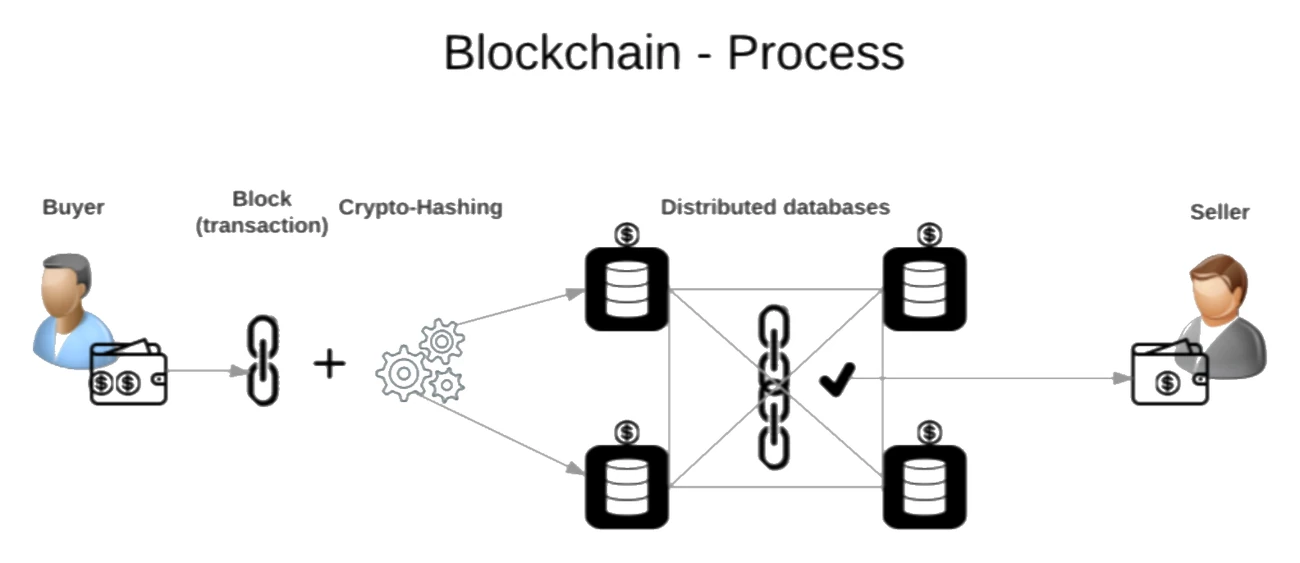
Putting the whole payment flow together: a buyer creates a transaction, the transaction is distributed and validated across the network using cryptographic hashing, the block holding it is then committed to the blockchain held by many distributed copies, and the seller receives the payment.