Selective Breeding
Use of Biological Resources
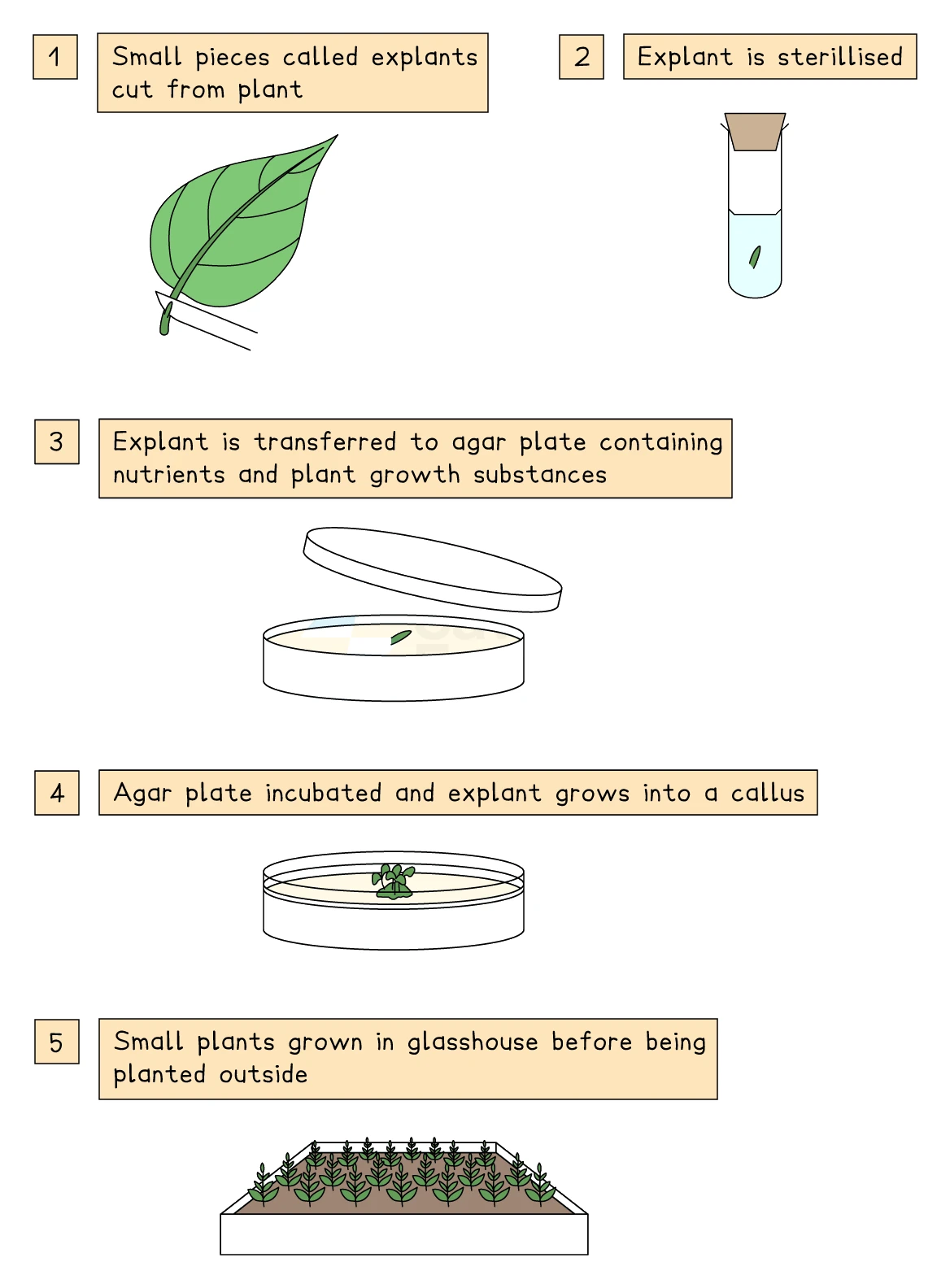
(also called micropropagation) is a modern technique for rapidly cloning plants by growing many small pieces of plant tissue in sterile laboratory conditions. It is an alternative to traditional methods like taking cuttings (covered in topic 12).
How tissue culture works
- Select a parent plant with the desired characteristics (high yield, disease resistance, attractive flowers).
- Take small (small pieces of tissue) from a fast-growing region of the plant, usually a shoot tip or meristem.
- Sterilise the explants by washing in dilute bleach to kill any microbes on the surface.
- Place the explants on a sterile nutrient medium (agar containing sugars, mineral ions, and plant hormones such as auxin and cytokinin) in a sealed Petri dish or culture vessel.
- The cells divide and form a callus (a mass of unspecialised cells) under the influence of the hormones.
- Change the hormone balance in the medium to encourage the callus to develop into tiny plantlets (shoots and roots).
- As soon as small plantlets have formed, transfer them to soil and grow them on like ordinary plants.
The entire process can take just a few weeks. A single parent plant can produce thousands of identical offspring in one year, all genetically identical to the parent and to each other.
Common exam question
Describing the process of micropropagation
Question: Describe the process of micropropagation, or fill the gaps in a passage about it (3–6 marks).
Asked in 2 of the 23 papers, one mark per step or gap. Take small pieces of tissue (explants) from the parent plant, such as shoot tips or meristems. Sterilise them with ethanol, disinfectant or bleach so that microorganisms cannot grow. Place them on agar that supplies minerals and glucose (an energy source) plus plant growth substances such as auxin; "hormones" and "rooting powder" are accepted. The plants produced are clones, genetically identical to the parent.
"Sterile agar" earns both the sterilising mark and the agar mark in one phrase. "Nutrients" on its own is ignored, so name the mineral or the sugar; "carbohydrate" was also ignored where a named energy source was wanted, while "glucose" is credited every time.
Advantages of tissue culture
- Very fast: thousands of clones from one parent in months, not years
- Genetically identical offspring, so all share the parent's desirable traits
- Disease-free: the sterile starting conditions and small explants mean the new plants are free of viruses and other pathogens that the parent might have been carrying
- Year-round production, not dependent on natural growing seasons
- Small space: many plantlets can be grown in a single laboratory
- Useful for endangered plant species where there are too few individuals left to propagate by traditional methods
Common exam question
Why micropropagation is used to copy a plant
Question: Explain why micropropagation, rather than pollination or seeds, is used to make copies of a plant, or give reasons for using it (1–3 marks).
Asked in 4 of the 23 papers, once as gaps in a passage. Every version credits that the new plants are genetically identical to the parent (clones), so each copy keeps the wanted trait or inserted gene. Further marks: it is fast and gives large numbers; it is not tied to a growing season, so copies can be made all year round, and it is quicker than sexual reproduction with its flowers and seeds; when only a single plant exists there is nothing to breed it with, and the genetic modification need not be repeated; and there is less risk of the plants cross-pollinating wild relatives and spreading the gene.
Keep the speed point about producing plants: "the plants grow faster" is ignored.
Disadvantages
- Expensive: needs sterile equipment, trained staff, and specific growing media
- All plants are genetically identical, with the same reduced gene pool problem as in selective breeding. A disease that affects one will affect all
- Some plant species do not respond well to tissue culture
- The plantlets are delicate during transfer to soil; many die at this stage
Uses in practice
Tissue culture is widely used for:
- Mass production of commercially valuable plants (orchids, banana, oil palm, sugar cane, potato)
- Disease elimination in seed potato production (small pieces of meristem from infected plants are free of virus and grow into virus-free plants)
- Plant breeding programmes, where new varieties can be quickly multiplied for testing
- Conservation of rare and endangered species
- Genetic engineering (covered in topic 18), where modified cells need to be grown into whole plants