Natural Selection & Evolution
Reproduction and Inheritance · 6 question types
Darwin's theory of evolution by natural selection follows a clear logical sequence. There are four key steps, and exam questions on this topic almost always ask you to list them in order.
Step 1: Variation
Every population contains variation: differences between individuals. Some of this variation is genetic, caused by different alleles of the same genes. New genetic variation arises through:
- in DNA (random changes)
- Meiosis, which shuffles existing alleles into new combinations in gametes
- Random fertilisation, where any sperm can fuse with any egg
This means no two individuals in a population are genetically identical (except identical twins or clones).
Step 2: Differential survival
Members of a population have to compete for limited resources: food, water, space, mates. Not every individual survives long enough to reproduce. Some individuals happen to have genetic variations that give them an advantage in their environment:
- A rabbit with thicker fur survives a harsh winter
- A bacterium with a slightly different cell wall is harder for the immune system to attack
- A moth with darker wings is better camouflaged on a sooty tree
- A plant with deeper roots survives drought
Individuals with these advantageous alleles are more likely to survive to reproductive age than those without them. This is sometimes called "survival of the fittest", though "fittest" here means best suited to the environment, not strongest or fastest.
Step 3: Differential reproduction
Survivors are more likely to reproduce and pass on their genes. Each surviving individual passes on all of its alleles to its offspring, including the advantageous ones that helped it survive.
Individuals that did not survive long enough to reproduce never pass on their alleles, no matter how good their genes might have been at other things. Evolution is shaped by which individuals leave offspring, not by which live the longest.
Step 4: Change in allele frequency
Over many generations, the advantageous alleles become more common in the population. Less helpful alleles become rarer because the individuals carrying them leave fewer offspring.
After enough generations, the average characteristics of the population have shifted: the population has evolved.
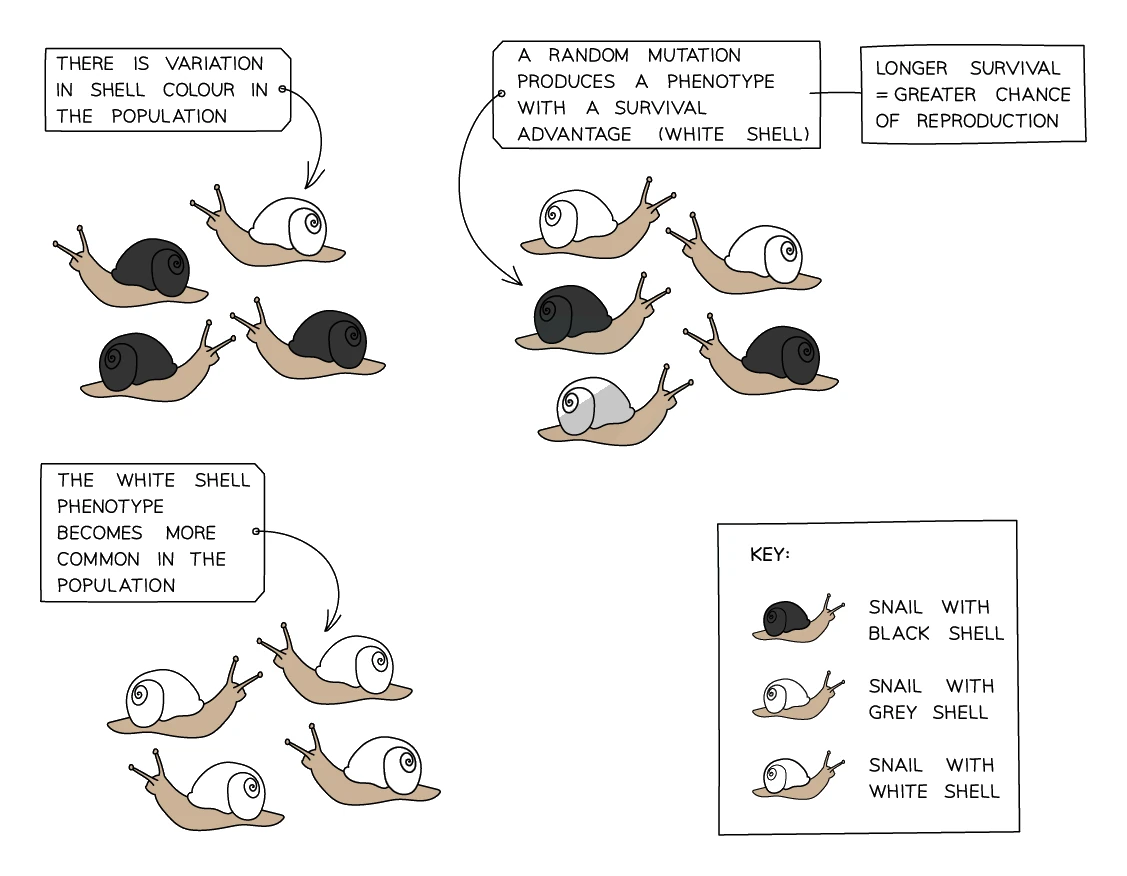
Explaining evolution by natural selection
What comes up: questions ask you to "explain how a population evolved [characteristic X] by natural selection" or "describe how natural selection led to [outcome]" — typically worth 4 marks.
Write (four marks): (1) A mutation produced a new allele in some individuals. (2) This created variation — individuals in the population differed in the characteristic. (3) Individuals with the advantageous allele were more likely to survive and compete successfully (they were better adapted to their environment). (4) These survivors reproduced, passing the allele on to their offspring — so over many generations the advantageous allele became more common in the population.
Watch out: the final mark requires you to say they passed on the allele (or gene), not just "passed on the mutation" or "passed on the behaviour." Saying only "passed on the characteristic" is not enough for that mark.