Natural Selection & Evolution
Reproduction and Inheritance
The peppered moth (Biston betularia) is a textbook example of natural selection caught in the act. The species naturally comes in two colour forms:
- A pale, speckled form (the original form)
- A dark (melanic) form (rare, caused by a mutation)
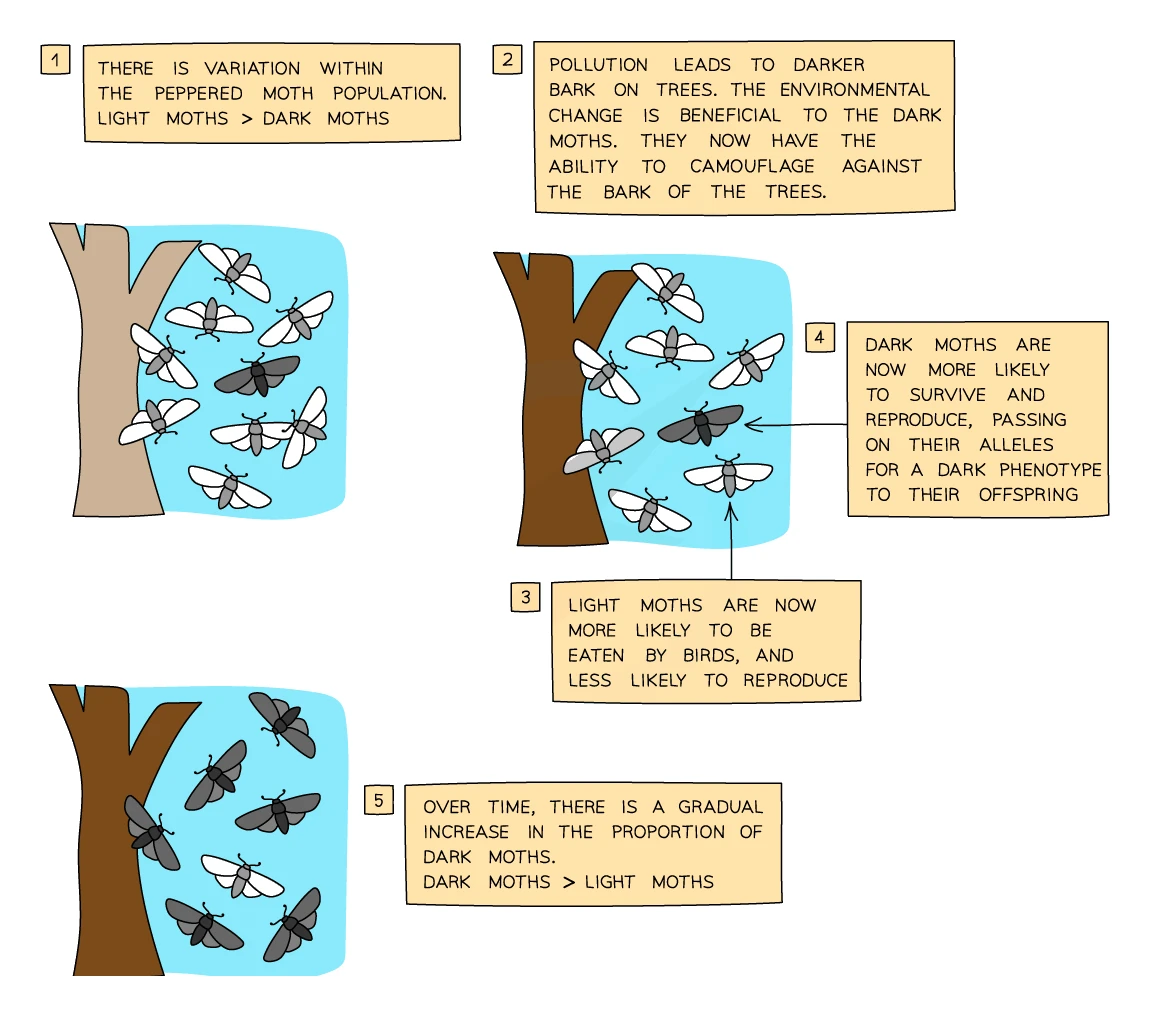
In the 19th century, before the Industrial Revolution, the trees these moths rested on were covered in pale lichens. The pale moths were well camouflaged; the rare dark moths stood out and were quickly eaten by birds. The pale allele was much more common in the population.
The Industrial Revolution covered tree trunks in soot from coal burning. Now the trees were dark and the lichens died:
- Pale moths became visible to predators and were eaten.
- Dark moths were now camouflaged and survived better.
Within a few decades, the dark form had become the more common one in industrial areas. The population had evolved by natural selection, with no new alleles needed; just a shift in the relative frequency of two existing alleles.
After the Clean Air Act in the 1950s, soot deposits fell and lichens returned. Pale moths regained their advantage and the dark form has been declining again. The peppered moth example shows natural selection working in both directions as the environment changes.
Exam tip
Commenting on peppered moth data
One paper printed yearly counts of light and dark moths trapped in a city as coal burning was being banned and asked for a comment on the changes: five marks from ten points, half data and half biology. Data: each form's trend, the fall in the total catch, and which form was commoner at the start and at the end. Biology: disease, predation or food shortage causing that fall, less coal burned so less pollution, dark moths no longer camouflaged on clean bark and so seen and eaten by birds, and the better-adapted pale moths passing their alleles on.