Food Production
Use of Biological Resources · 3 question types
When a useful product (such as the protein insulin from genetically engineered bacteria in topic 18, mycoprotein, or an antibiotic) is made by culturing microorganisms on a large scale, the microorganisms are grown in a large stainless-steel vessel called an . The fermenter must provide and maintain the conditions the microorganisms need to grow quickly and make the product, while keeping unwanted microorganisms out.
| Condition the fermenter provides | Why it is needed | How the fermenter does it |
|---|---|---|
| Aseptic (sterile) conditions | Stop other microorganisms contaminating the culture, competing for nutrients or spoiling the product | The vessel and the nutrient medium are sterilised (e.g. with steam) before use, and only filtered air is let in |
| Nutrient medium | Supply the carbon, nitrogen and mineral ions the microorganisms need to respire and build new cells | A measured supply of nutrients (such as sugars and a nitrogen source) is added |
| Optimum temperature | Enzymes work fastest at the optimum; too hot and they denature, too cold and growth is slow | A water jacket around the vessel removes the heat released by respiration and a temperature probe keeps it steady |
| Optimum pH | Enzymes work best at a particular pH; the wrong pH slows growth | A pH probe monitors the culture and acid or alkali is added automatically to correct it |
| Oxygenation | Aerobic microorganisms need oxygen for respiration to release energy and grow | Sterile air is bubbled in through a sparger at the base |
| Agitation (stirring) | Keeps the microorganisms, nutrients, oxygen and heat evenly distributed so every cell has the conditions it needs | A motor-driven paddle or stirrer mixes the contents continuously |
When all of these are kept at their best values, the microorganisms multiply rapidly and make large amounts of the product, which is then extracted and purified.
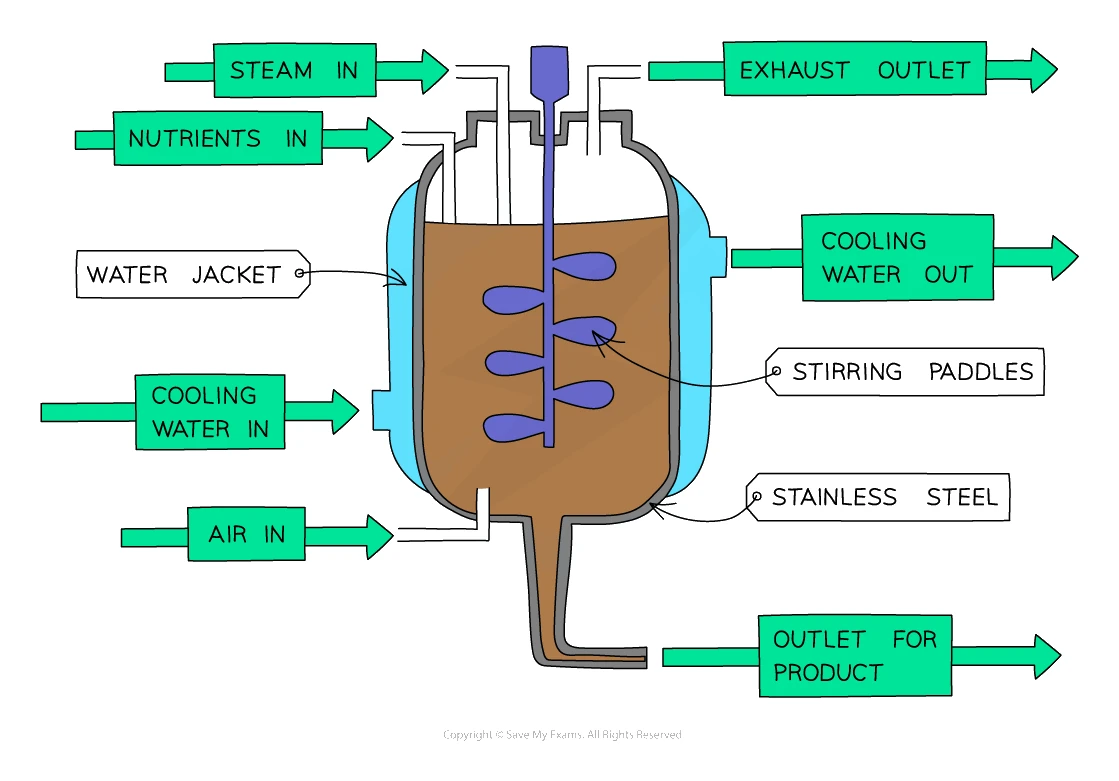
Controlling the conditions inside an industrial fermenter
What comes up: explain how a fermenter provides and keeps the conditions microorganisms need (a common 3–4 mark "explain how" question).
Write: name each condition and how it is controlled — a water jacket removes the heat from respiration so the culture does not overheat and denature the enzymes; a pH probe monitors pH and acid or alkali is added to correct it; the vessel is sterilised (steam-cleaned) and kept aseptic to stop other microorganisms contaminating the culture; sterile air is bubbled in for aerobic respiration; and a paddle/stirrer keeps the cells, nutrients, oxygen and heat evenly distributed.
Watch out: the jacket cools the fermenter — respiration releases heat, so overheating (not cold) is the usual danger. "Keep it sterile" only earns the mark if you link it to preventing contamination by unwanted microorganisms.