Exam Frequency Analysis
Past paper frequency (2018 to 2024)
This topic accounts for approximately 8% of your exam marks.
stable
Low
Stable8%
MRS GRENC (8 characteristics) listed in almost every series, usually 1 to 2 marks.
All known living organisms can be sorted into five kingdoms:
Plants, Animals, Fungi, Protoctists and Prokaryotes
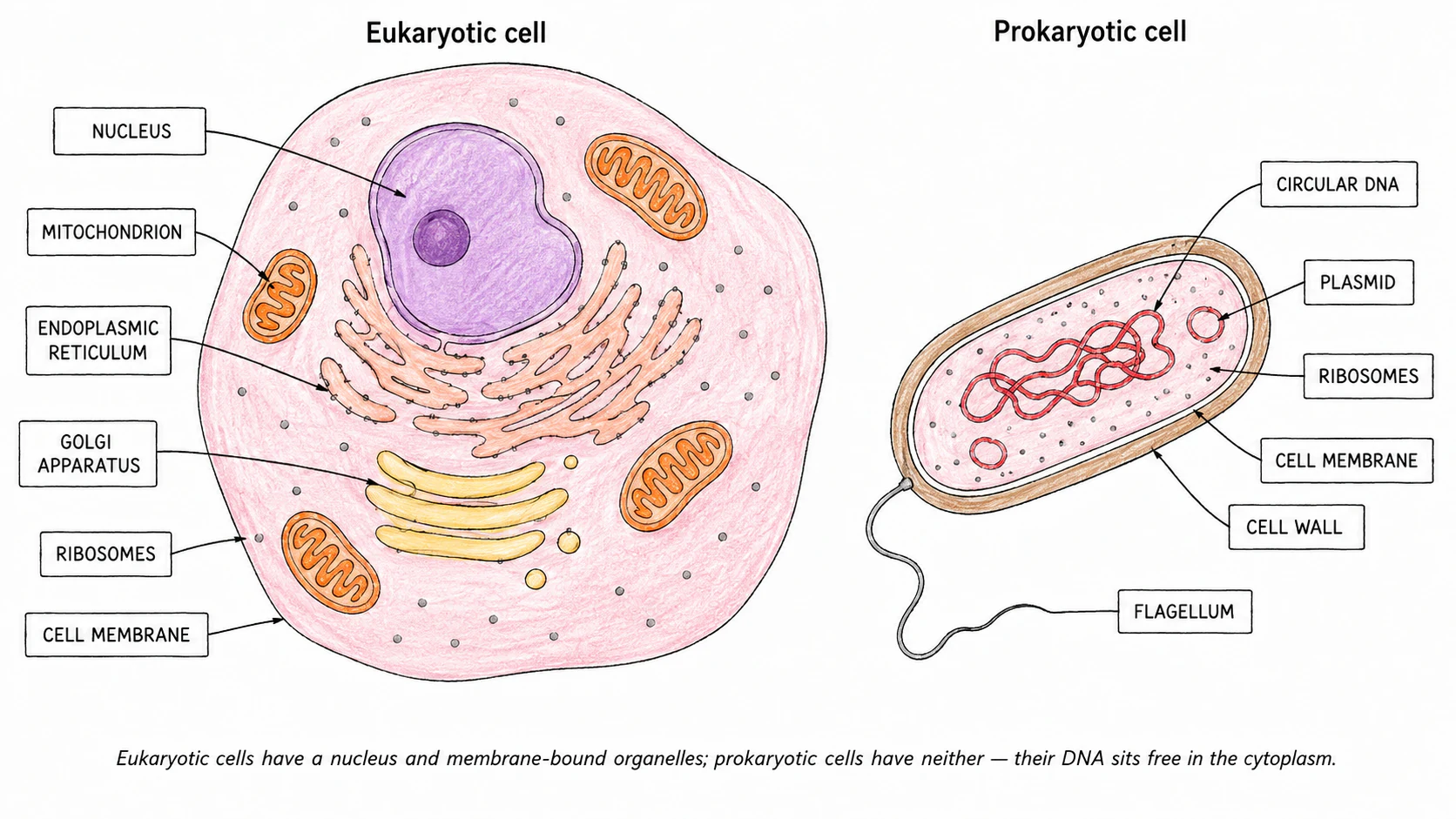
The first four (plants, animals, fungi and protoctists) all have cells with a true nucleus, so they are called eukaryotes. Only prokaryotes have cells without a true nucleus.
Eukaryotes vs prokaryotes: the headline difference
| Eukaryotes | Prokaryotes | |
|---|---|---|
| Cell size | Larger (typically 10–100 μm) | Much smaller (typically 1–10 μm) |
| Nucleus | Yes, a true nucleus surrounded by a membrane | No; the DNA floats free in the cytoplasm |
| Genetic material | Long linear chromosomes inside the nucleus | A single circular chromosome in the cytoplasm, often with small extra rings of DNA called plasmids |
| Other membrane-bound organelles | Yes: mitochondria, chloroplasts, ER, Golgi etc. | None at all |
| Cell wall? | Some have one (plants, fungi); animals do not | Always; all bacteria have a cell wall made of peptidoglycan (not cellulose or chitin) |
| Single-celled / multicellular? | Can be either | Always single-celled |
Animals
- Multicellular, built from many cells working together
- Cells have a nucleus and no cell wall
- Cells have no chloroplasts, so animals cannot photosynthesise
- Feed by eating other organisms (heterotrophic). They digest food in a gut and absorb the products
- Often store carbohydrate as glycogen in the liver and muscles
- Have nervous coordination to respond quickly to stimuli
- Can usually move from place to place (locomotion)
- Examples: humans, dogs, fish, insects, worms
Plants
- Multicellular
- Cells have a nucleus
- Cells have cell walls made of cellulose (a rigid carbohydrate)
- Cells contain chloroplasts, so plants are autotrophic and feed by photosynthesis
- Store carbohydrate as starch in roots and tubers, or as sucrose in fruit and storage tissue
- No nervous coordination; responses to stimuli are slower and chemical
- Are rooted and unable to relocate, although they can reorient themselves (for example, shoots bending towards light)
- Examples: rose bushes, oak trees, grasses, ferns, cabbages
Fungi
- Usually multicellular, but some (e.g. yeast) are single-celled
- Multicellular fungi are built from long thread-like cells called hyphae, which form a tangled network called the mycelium. Each hypha contains many nuclei stretched along its length
- Cells have a nucleus
- Cells have cell walls made of chitin (the same material as insect exoskeletons), not cellulose
- Cells contain no chloroplasts, so fungi cannot photosynthesise
- Feed by saprotrophic nutrition: they release digestive enzymes out onto the surrounding food (dead organic matter), the enzymes break the food down to small molecules outside the fungus, and the fungus then absorbs the digested molecules
- Some fungi are parasitic and feed on living organisms (e.g. athlete's foot fungus feeding on human skin)
- Often store carbohydrate as glycogen
- No nervous coordination
- Examples: mushrooms, mould (e.g. Mucor), yeast (used in baking and brewing)
Protoctists
- A very mixed bag. The protoctists are the "kingdom of leftovers", containing every eukaryote that is not clearly a plant, animal or fungus
- Mostly single-celled and microscopic, but some form colonies or chains of cells
- Cells have a nucleus
- Some protoctists are plant-like: they have cellulose cell walls and chloroplasts, and they photosynthesise. Example: Chlorella (a green alga)
- Some protoctists are animal-like: no cell walls, no chloroplasts, and they feed on other organisms. Example: Plasmodium (the malaria parasite)
- No nervous coordination
- Examples: Amoeba (single-celled animal-like), Paramecium (a swimming cilia-covered animal-like protoctist), Plasmodium (parasite that causes malaria), Chlorella (single-celled plant-like alga)
Prokaryotes
- Always single-celled and microscopic
- Cells have no nucleus. The DNA is a single circular chromosome sitting free in the cytoplasm, sometimes with smaller circular pieces called plasmids
- No membrane-bound organelles at all (no mitochondria, no chloroplasts, no nucleus)
- Have a cell wall (made of peptidoglycan, not cellulose or chitin), a cell membrane inside the wall, and cytoplasm
- Feed in many different ways:
- Some photosynthesise even though they have no chloroplasts. They use chlorophyll-like pigments dissolved in the cytoplasm instead
- Most are heterotrophs, taking nutrients from the bodies of other organisms (alive or dead)
- Those that break down dead organic matter are called saprobionts (or decomposers); they recycle the building blocks of life back into the soil
- The only kingdom in which all members are prokaryotes is Bacteria
- Examples of bacteria:
- Lactobacillus bulgaricus: rod-shaped; used to make yoghurt from milk
- Pneumococcus (Streptococcus pneumoniae): spherical; causes pneumonia
- Escherichia coli (E. coli): rod-shaped; lives harmlessly in our guts (some strains are harmful)