1. Light and sound as waves
Light
- Light is part of the electromagnetic spectrum, so it is a transverse wave
- The vibrations of the electric and magnetic fields that make up the wave are at right angles to the direction the light is travelling
- Light can be reflected off a boundary and refracted through a boundary; both effects are covered in detail in the rest of this topic
Sound
- Sound waves are longitudinal waves; the air particles oscillate back and forth along the same line that the wave is travelling along
- Sound can also be reflected and refracted:
- the of a sound wave off a hard surface is called an echo
- sound refracts when it crosses between media of different densities (for example, layers of warm and cold air, or air and water), bending its direction of travel
Why both bend
- The same wave phenomena work for any wave type (water ripples, sound, light, microwaves, even seismic waves) because reflection and refraction depend on how a wave's speed changes when it meets a boundary, not on whether it is transverse or longitudinal
2. Reflection and refraction at a boundary
Definitions
- Reflection is what happens when a wave hits the boundary between two media and bounces back into the original medium without crossing the boundary
- Refraction is what happens when a wave passes through a boundary between two transparent media and changes direction as it does so
- The word medium (plural media) means any material that transmits the wave, such as air, glass, water, or perspex
The normal line
- Every ray diagram for reflection or refraction is measured from an imaginary line drawn at 90° to the surface at the exact point the ray hits; this line is called the
- Angles are measured between the ray and the normal, not between the ray and the surface itself
Common exam question
Measuring an angle of incidence or refraction on a diagram
Question: Use a protractor to measure the angle of incidence, the angle of refraction, or both, on the printed ray diagram (1 mark per angle).
Asked in 9 of the 24 papers. Measure between the ray and the normal, never between the ray and the surface, and give a whole number of degrees. The schemes accept a reading within one or two degrees of the true angle, so careful placement of the protractor is all the mark needs. In three papers a one-mark part first asks you to name the instrument: a protractor.
Your reading is then carried into the refractive index calculation by follow-through, so an angle that is slightly out costs this one mark only. In one paper the angle had to be labelled first: marking it between the ray and the mirror lost that mark, although the measurement of the wrongly chosen angle was still followed through.
Law of reflection
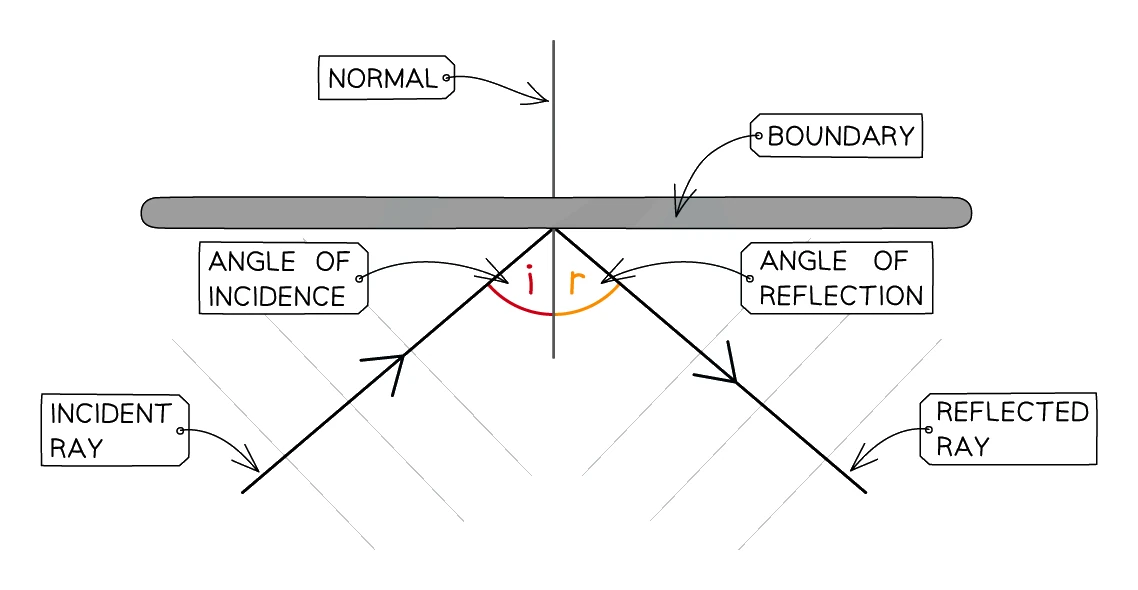
- The states:
angle of incidence (i) = angle of reflection (r)
- where:
- angle of incidence is the angle between the incoming (incident) ray and the normal
- angle of reflection is the angle between the outgoing (reflected) ray and the normal
- On a flat mirror, every ray reflects neatly, which is and produces a clear image. On a rough surface every tiny patch tilts a different way, so reflected rays scatter, which is and produces no image
Common exam question
Drawing the reflected ray or reflected wavefronts
Question: Draw the normal and the reflected ray where a ray meets a mirror or block, or complete a diagram with the wavefronts after reflection (1–3 marks).
Asked in 7 of the 24 papers, once as multiple choice. Rule the normal at 90° to the surface where the ray arrives, even on a curved mirror (not a tangent). The reflected ray starts at the same point, on the other side of the normal, at an angle judged by eye to equal the angle of incidence: one mark for a ray from the point of incidence on the correct side, one for the correct angle. A ray that carries on into the mirror is rejected; dotted or arrowless lines are accepted.
For wavefronts, draw the reflected direction first, then rule the wavefronts at right angles to it, parallel and with the same spacing as the incident ones. One scheme awards the perpendicular and spacing marks only after the direction mark.
Refraction: which way the bend goes
- When a light ray crosses from one transparent medium to another, its speed changes, and that speed change forces the ray to change direction
- The bend depends on which way the speed is changing:
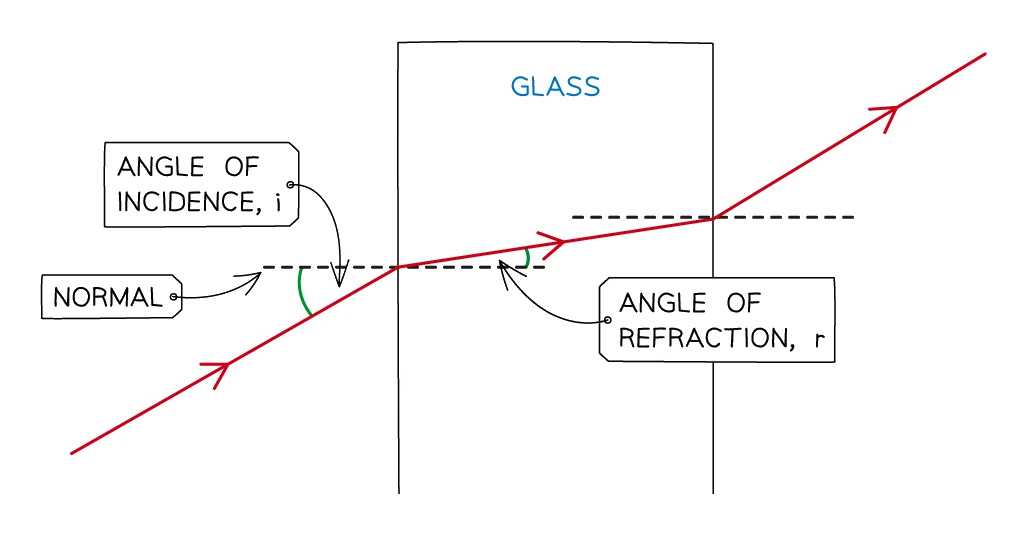
- Entering an optically denser medium (for example, air into glass): the ray slows and tilts towards the normal
- Leaving a denser medium for a thinner one (for example, glass back into air): the ray speeds up and tilts away from the normal
- A ray that strikes the surface along the (perpendicular, 0°) keeps going straight; only its speed changes, never its direction
Common exam question
Completing the path of a ray through a block or prism
Question: Complete the path of the ray as it enters, crosses or leaves a glass block, prism or optical fibre, or draw the ray in air before it reached the boundary (1–3 marks).
Asked in 5 of the 24 papers. The marks are for the direction of each bend, judged by eye: towards the normal going from air into glass, away from the normal coming out, and for a rectangular block the emerging ray parallel to the incoming one. Where a ray leaves a block or prism, one mark is simply for a ray that emerges into the air and the second for it bending away from the normal, so draw the emergent ray even if the angle is uncertain. Dashed lines are allowed, arrows are not required, and any reflected ray you add is ignored. In a six-mark explanation of two rays meeting water, a ray drawn bending the wrong way capped the drawing marks at one.
What changes and what does not
- During refraction, two wave properties change and one stays the same:
- Speed changes (slows in denser medium, speeds up in less dense one)
- Wavelength changes in step with the speed (using v = f × λ)
- Frequency stays the same, because the source still emits the same number of crests per second, so the same number must arrive in the new medium. A red ray of light staying red when it dives into water is the everyday evidence of this
Exam tip
Explaining refraction: say what happens to the speed
When asked why a ray or wave bends at a boundary, or why its wavelength changes, you need more than the direction: the two media have different optical densities, the wave travels more slowly in the denser one, its frequency is unchanged, so by speed = frequency × wavelength the wavelength is shorter and the wavefronts closer together. One scheme accepts "it bends towards the normal" only as a way of saying the second medium is denser. Light entering the denser medium cannot totally internally reflect; do not calculate a critical angle there: one scheme ignored those values as irrelevant.
3. Snell's law and refractive index
The refractive index
- The (n) of a material is the ratio of the speed of light in a vacuum to the speed of light in the material:
n = (speed of light in a vacuum) / (speed of light in the medium)
- A few key facts about n:
- Light always travels slower in matter than in a vacuum, so n is always greater than 1
- The higher the refractive index, the slower light moves through the material and the more the ray bends when it enters
- Refractive index is a ratio of two speeds, so it has no units
- Typical values for common materials:
- air ≈ 1.00 (effectively the same as vacuum)
- water ≈ 1.33
- perspex / acrylic ≈ 1.49
- crown glass ≈ 1.50
- diamond ≈ 2.42 (one of the largest of any everyday material, which is why cut diamonds sparkle so brightly)
Common exam question
Comparing how two colours refract
Question: Given that glass has a higher refractive index for blue, violet or green light than for red, draw or explain what happens to the other colour's path, or deduce how refractive index depends on wavelength (3 marks).
Asked in 3 of the 24 papers. The colour with the higher refractive index bends more, so it has the smaller angle of refraction on entering the glass. The deduce version's three marks: red refracts less than violet, so red has the lower refractive index, and since red has the longer wavelength, refractive index decreases as wavelength increases. Drawing marks go to a ray with a smaller angle of refraction than the red ray inside the block, bending away from the normal on the way out and leaving parallel to the red ray. When two rays crossed after a block, swapping green for red moved the crossing point further away, because red bends less at each face; "less refraction" was condoned.
Snell's law
n = sin i / sin r
- where:
- n = refractive index of the second medium (taking the first medium as air, where n ≈ 1)
- i = angle of incidence in air (measured from the normal)
- r = angle of refraction in the denser medium (measured from the normal)
- Important details:
- sin i / sin r is not the same as i / r; never just cancel the "sin"
- When solving for r, find sin r first, then take sin⁻¹ to get the angle
Common exam question
Stating and using the refractive index formula
Question: State the equation linking refractive index to the angles of incidence and refraction, then use it to find the refractive index from two angles, or an angle from the index (1 mark, then 2–3 marks).
Asked in 8 of the 24 papers. The equation mark is for n = sin i / sin r in symbols or words; any correct rearrangement scores, and one scheme rejects n = i / r. The calculation gives one mark for substitution and one for evaluation; a three-mark version also credits writing the two sines as decimals. Angles you measured earlier are followed through, so a slightly different reading loses nothing here.
Dividing the angles themselves is rejected. Give a "show that" answer to more significant figures than printed; when two are asked for, that rounding is a separate mark. Round, never truncate: 1.35 written as 1.3 lost the evaluation mark. One scheme gives full credit to a correct answer with no working.
Worked example
Using n = sin i / sin r
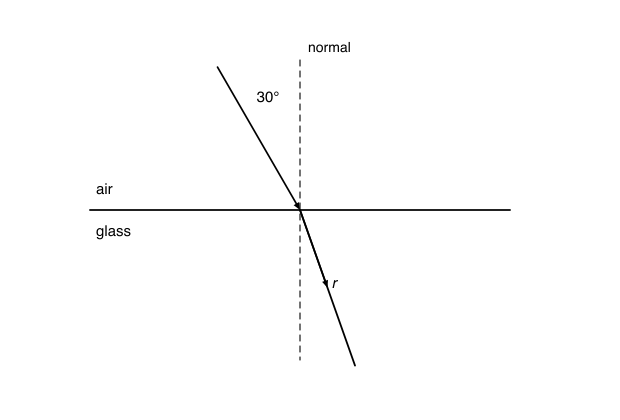
Light passes from air into glass of refractive index 1.5, meeting the surface at an angle of incidence of 30°. Calculate the angle of refraction.
Solution:
- Rearrange n = sin i / sin r to make sin r the subject: sin r = sin i ÷ n
- Substitute, taking the sine of the angle first: sin r = sin 30° ÷ 1.5 = 0.5 ÷ 1.5 = 0.333
- Take the inverse sine to find the angle: r = sin⁻¹(0.333) = 19.5°
Take the sine of each angle before dividing: the schemes reject dividing the angles themselves, so 30 ÷ 1.5 = 20° is wrong. Never treat "sin" as a multiplier that can be cancelled.
Example — a light ray enters a water tank from air. The angle of refraction inside the water is 22°. The refractive index of the water is 1.33. Calculate the angle of incidence.
- Rearrange Snell's law: sin i = n × sin r
- sin i = 1.33 × sin 22° = 1.33 × 0.3746 = 0.4982
- i = sin⁻¹(0.4982) = 29.9°
4. Core practical: investigating refraction and Snell's law
Aim
- Measure pairs of angles of incidence and refraction as light passes from air into a rectangular block, plot a graph of sin i against sin r, and use the gradient to find the of the block
- The same investigation can be carried out with other shapes: a semi-circular block lets the ray enter through the curved face along a radius so it meets the flat face along the normal, which is useful for studying refraction and total internal reflection at the flat side, while a triangular prism shows how the ray refracts towards the normal on entry and away on exit, bending the same way at both faces and spreading white light into a spectrum
Variables
- Independent variable: angle of incidence, i (degrees), set by rotating the incoming ray
- Dependent variable: angle of refraction, r (degrees), read off the paper after tracing the ray
- Control variables: the same block (same material, same shape, same orientation); the same narrow beam from the ray box; the same room lighting
Apparatus
| Equipment | Purpose | Resolution |
|---|---|---|
| Ray box with single-slit attachment | Provides a thin, well-defined beam of light | — |
| Rectangular perspex (or glass) block | The material whose refractive index is being measured | — |
| Plain white A3 paper | Provides a flat working surface on which to trace rays | — |
| Sharp pencil and 30 cm ruler | Mark and join the points along each ray | 1 mm |
| Protractor (preferably 360°) | Measures i and r | 1° |
| Set square | Helps draw the normal exactly at 90° to the block's edge | — |
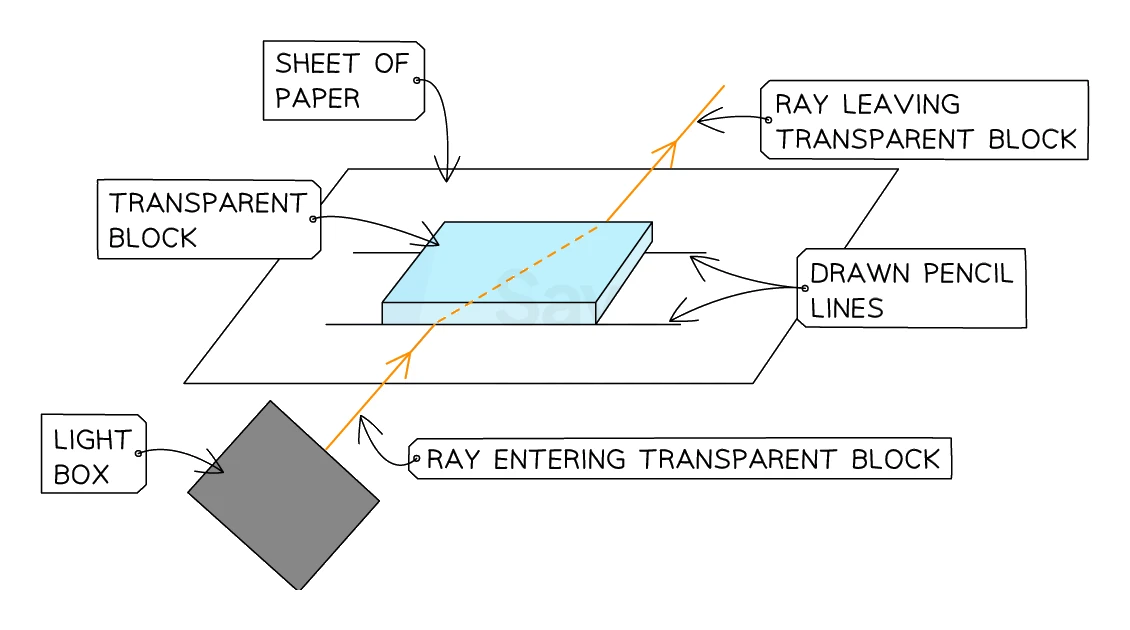
Method
- Lay the paper flat and draw round the outline of the rectangular block with a sharp pencil
- At a chosen point on the long edge of the outline, use the set square to draw a dashed line perpendicular to that edge, extending well into the air outside the outline
- Replace the block exactly within its outline, turn on the ray box, and angle the beam so that it meets the chosen entry point at a sensible angle (begin near i ≈ 20°)
- With the block still in place, mark four pencil dots:
- one along the incident beam, about 5 cm before it reaches the block
- one where the beam enters the block
- one where the beam exits the far side of the block
- one along the emergent beam, about 5 cm beyond the exit point
- Turn the ray box off, remove the block, and use a ruler to join the four dots with two straight lines: the incident ray and the emergent ray (and where they intersect the outline)
- With the protractor, measure the angle of incidence i and the angle of refraction r (the angle the ray makes with the normal inside the block)
- Repeat steps 3–6 for at least six more angles of incidence (sensible values are 25°, 35°, 45°, 55°, 65° and 75°), using a fresh sheet of paper or a clean part of the same sheet each time
Analysis
- For every pair, calculate sin i and sin r on the calculator
- Plot sin i (y-axis) against sin r (x-axis); draw the best straight line through the points and through the origin
- The gradient of the line equals the refractive index of the block:
gradient = sin i / sin r = n
- A reasonable result for perspex is n ≈ 1.49; for crown glass n ≈ 1.50
Common exam question
Describing or improving the refractive index experiment
Question: Describe a method (often with a labelled diagram) to find the refractive index of a glass block, or how to make the investigation more reliable or accurate (2–6 marks).
Asked in 4 of the 24 papers. The method marks: a thin beam from a ray box (not a torch), draw round the block, shine the ray in at an angle to the normal, mark the incident and emergent rays and the normal where the ray enters, measure both angles from the normal with a protractor, repeat for a range of angles of incidence, then find n as sin i ÷ sin r averaged over the pairs, or as the gradient of sin i against sin r. One paper reserves two marks for that last step, so say how n is obtained.
Improvements that score are the same: vary the angle of incidence, repeat each angle and average, find n from the gradient. A bare "repeat and average" is ignored.
Sources of error and safety
- Systematic errors:
- the normal not drawn exactly at 90° to the surface (use the set square, not the protractor)
- the ray box positioned slightly above or below the paper, so its beam is at an angle to the surface; keep the ray box level with the paper
- Random errors:
- the beam fades and broadens with distance, so mark each ray near to its endpoints so the dot is in the middle of the visible line
- the protractor only reads to the nearest degree, so repeat each angle three times and average
- Safety:
- the ray box lamp gets hot, so do not touch the front bulb or aperture
- do not stare into the beam, even via a reflection from the block
5. Total internal reflection (TIR)
When refraction stops working
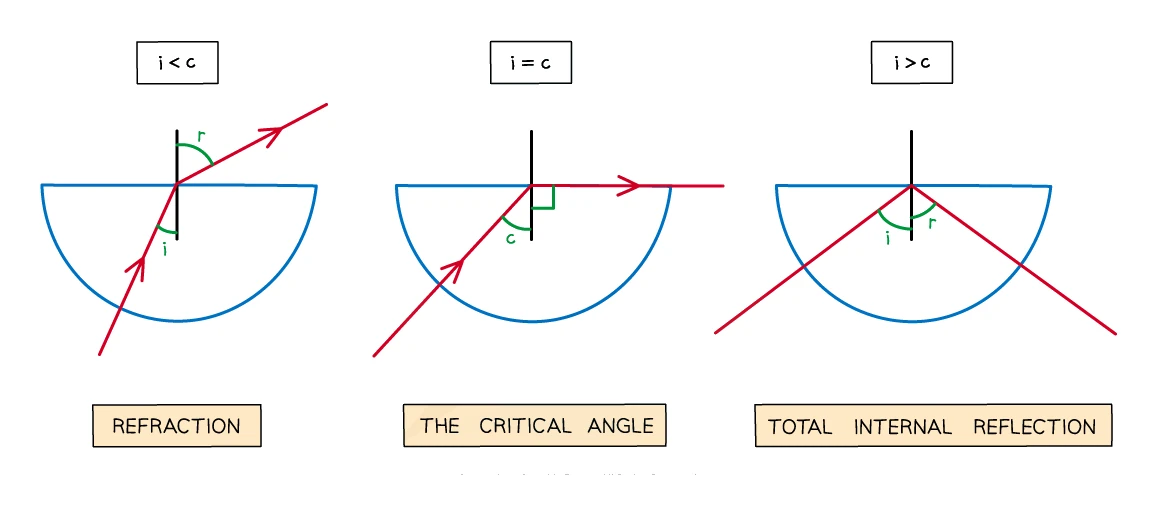
- As the angle of incidence inside a dense medium is gradually increased, the angle of refraction in the surrounding less-dense medium also increases, but it grows faster than i, because the ray is bending away from the normal as it leaves
- Eventually, at one particular incident angle, the refracted ray bends right round to lie flat along the boundary (refraction angle = 90°). This incident angle is called the , c
- Any incident angle larger than the critical angle can no longer produce a refracted ray at all; all the light is instead reflected back inside the dense medium
Definition
- Total internal reflection (TIR) is the complete reflection of a wave back into its original medium when:
- the ray is travelling from a denser medium into a less dense one (so refraction would bend it away from the normal), and
- the angle of incidence is greater than the critical angle
- Both conditions are needed; if the light is travelling from less dense to denser, no critical angle exists
Common exam question
Explaining total internal reflection
Question: Explain the path of the ray along an optical fibre or at the inner face of a block, state what happens to a ray that meets the boundary beyond the critical angle, or describe what total internal reflection means (1–3 marks).
Asked in 5 of the 24 papers. Three ideas earn the marks: name total internal reflection ("TIR" is accepted), meaning all the light is reflected back inside the medium rather than refracted out; the light is going from a higher refractive index into a lower one (more to less optically dense, or "the core is denser than the air", is accepted); and the angle of incidence exceeds the critical angle. A three-mark version wants all three, a two-mark version drops the density point, and the one-mark "state what happens" wants the name or the angle condition. One paper asked for two uses: optical fibres and a prism application such as a periscope, binoculars or a cat's eye reflector.
Critical angle and refractive index
sin c = 1 / n
- Rearranges to:
- c = sin⁻¹(1 / n)
- n = 1 / sin c
- A consequence: the larger the refractive index, the smaller the critical angle, and the more easily light gets trapped by TIR. This is exactly why cut diamonds (n = 2.42) sparkle so brightly; most rays striking the diamond's back surfaces have angles bigger than the critical angle and bounce repeatedly inside the gem before emerging
Worked example
Calculating the critical angle from the refractive index
A block of glass has a refractive index of 1.45. Calculate its critical angle.
Solution:
- Write the formula: sin c = 1 / n
- Substitute: sin c = 1 ÷ 1.45 = 0.6897
- Take the inverse sine: c = sin⁻¹(0.6897) = 43.6°
This calculation is set in 4 of the 24 papers, usually after a one-mark part asking for the formula, where a word version or any correct rearrangement scores. The marks are for the substitution or rearrangement and for the evaluation, with a third in one paper for using the formula; a refractive index found in an earlier part is followed through. Give the angle to the nearest degree or to one decimal place; the schemes accept either.
Useful applications of TIR
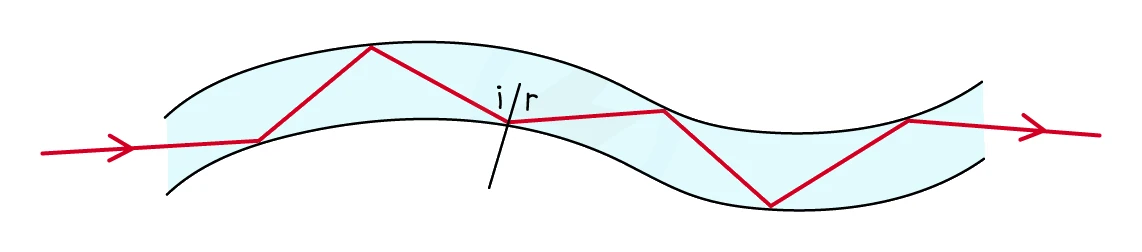
- Optical fibres:
- A long, thin core of high-refractive-index glass (or plastic) is surrounded by a slightly lower-index outer cladding
- Light injected at one end of the fibre keeps striking the core–cladding boundary at angles bigger than the critical angle, so it total-internal-reflects along the entire length, even round bends
- Applications:
- telecommunications: fibre-optic cables carry the world's internet traffic at near-light speed, using infrared pulses
- medical endoscopes: a flexible bundle of fibres carries an image of the inside of a patient's body out through a small incision
- decorative lighting: fibre lamps glow at the tip from a light source at the base
- Right-angled prisms:
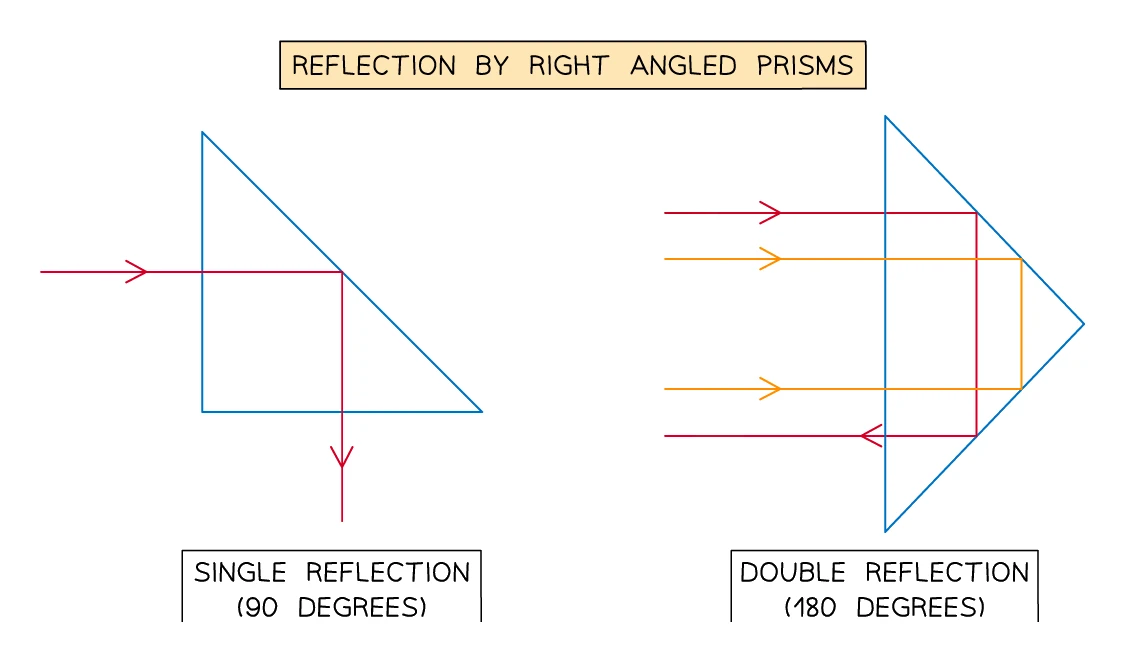
- A right-angled prism cut from glass has a critical angle of about 42°; a ray striking its long face at 45° therefore undergoes TIR
- Applications:
- periscopes: a vertical tube with a right-angled prism at the top and another at the bottom turns light through 90° twice, letting a viewer below see what is above the obstruction
- binoculars and telescopes: internal prisms fold the light path so the instrument can be made short and still have a long total path
- bicycle and road safety reflectors: built from tiny corner-cube prisms that bounce headlight light straight back to the source