1. Objects in space
The hierarchy from Earth to Universe
Everything in space sits inside a tidy nested structure. Working from biggest to smallest:
- The Universe is everything that exists. All the matter, energy, space and time, taken together. The Universe contains roughly 100 billion galaxies
- A galaxy is a vast collection of billions of held together by their mutual gravity. Our galaxy is the Milky Way, and it contains around 200 billion stars
- A star is a huge ball of hot gas (mostly hydrogen) powered by nuclear fusion in its core. The Sun is one such star, fairly average in size and brightness
- A planetary system is a star together with everything that orbits it. Our planetary system is the
- A planet is a roughly spherical body that orbits a star, big enough for its own gravity to pull it into a sphere, but not big enough for fusion. The Earth is the third of the eight in the Solar System
- A moon is a smaller body that orbits a planet. Earth has one moon; Jupiter has 95 known moons
Common exam question
Size order of the Universe, galaxies and solar systems
Question: Which of a galaxy, the Solar System, the Sun, the Moon and the Universe has the largest or the smallest diameter, or which of them is a large collection of billions of galaxies? (1 mark)
Asked in 2 of the 24 papers, each time as multiple choice. The Universe is the largest: it contains billions of galaxies, and each galaxy contains billions of stars with their solar systems, so the Universe is also the "large collection of billions of galaxies". The Milky Way is the name of one galaxy, so it is a distractor there, and a nebula is a cloud of dust and gas rather than a level in the hierarchy. At the small end, a moon is smaller than a star, a solar system or a galaxy, because a moon orbits a planet, which in turn orbits a star.
Other objects in the Solar System
- Asteroids are small rocky bodies, mostly orbiting the Sun in a band between Mars and Jupiter called the asteroid belt
- Comets are small icy bodies that orbit the Sun on highly stretched paths, swinging in from the outer Solar System
- Artificial satellites are human-built objects placed in orbit around the Earth or another planet, for communications, weather, GPS, science, and spying
Where everything orbits what
| Orbiting body | What it orbits |
|---|---|
| Planet | The Sun |
| Moon | A planet |
| Comet | The Sun |
| Asteroid | The Sun |
| Artificial satellite | The Earth (or another planet) |
- Smaller bodies always orbit larger bodies. The bigger gravitational pull belongs to the larger object, so the smaller one is the one that swings around
Common exam question
Knowing what orbits what
Question: Which object do planets orbit, which object also orbits the Earth, or what type of object has a circular or an elliptical orbit around a star? (1 mark)
Asked in 4 of the 24 papers. Planets orbit a star: satellites orbit planets and comets orbit stars, so neither can be the thing a planet goes around. The bodies that orbit the Earth are the Moon and artificial satellites such as a space station; a comet is rejected (comets orbit the Sun, not the Earth). An object on a circular orbit around a star is a planet and one on an elliptical orbit is a comet (that scheme also accepted "planet", whose orbit is a slight ellipse).
2. Gravitational field strength
What gravity does
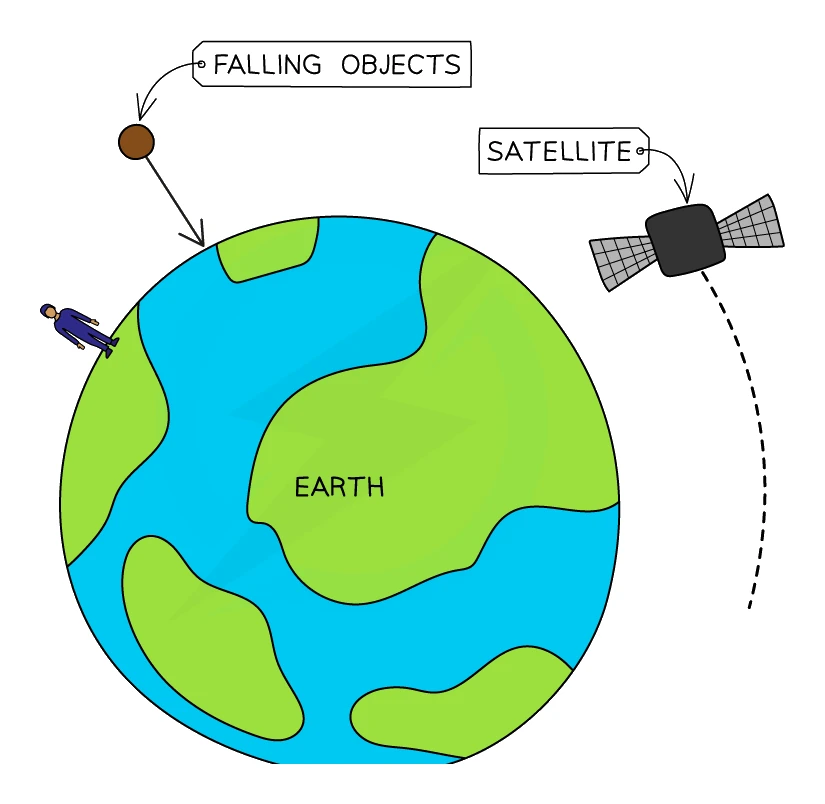
- Every object with mass attracts every other object with mass. This pull is the gravitational force
- The bigger the masses, the bigger the pull. The Sun pulls on planets; planets pull on moons; the Earth pulls on everything on its surface, including you
- On a planet's surface, the force pulling everything towards the centre is what we call weight:
= the force on an object due to gravitational attraction
Definition of gravitational field strength
- The , given the symbol g, is defined as:
g = the gravitational force per unit acting on an object placed in the field
- Units: N/kg (newtons per kilogram)
- The relationship between weight and mass is:
weight W = mass m × gravitational field strength g
W (N) = m (kg) × g (N/kg)
- On Earth's surface, g ≈ 10 N/kg. So a 50 kg pupil has a weight of 50 × 10 = 500 N
Mass vs weight: keep them separate
| Mass | Weight | |
|---|---|---|
| What it measures | How much matter an object contains | The force that gravity exerts on it |
| Unit | kilogram (kg) | newton (N) |
| Type of quantity | Scalar | Vector, points downwards |
| Changes with location? | No, same everywhere | Yes, depends on local g |
| Measured with | Balance | Newtonmeter (or scale calibrated for the local g) |
- A 70 kg astronaut is always 70 kg, whether on Earth, on the Moon, or in deep space. But the astronaut weighs 700 N on Earth, only about 112 N on the Moon (70 × 1.6), and zero N in deep space far from any planet
How g varies around the Solar System
- The larger the planet's mass and the smaller its radius, the stronger the gravitational field at its surface
| Body | g at surface (N/kg) | Compared to Earth |
|---|---|---|
| Moon | ≈ 1.6 | About 1/6 of Earth's |
| Mercury | ≈ 3.7 | About 1/3 |
| Mars | ≈ 3.7 | About 1/3 |
| Earth | ≈ 10 | 1 (baseline) |
| Saturn | ≈ 10.4 | Similar to Earth |
| Neptune | ≈ 11.0 | Slightly higher |
| Jupiter | ≈ 25 | About 2.5× Earth's |
| The Sun | ≈ 270 | About 27× Earth's |
- On the Moon, gravity is weak. The Apollo astronauts could bounce in long, slow strides. Lifting a 100 kg lump of rock there feels like lifting 16 kg on Earth
- On Jupiter, gravity is so strong that a person standing on the cloud-tops (if they could) would weigh more than 2.5 times what they do on Earth. Human leg muscles cannot push against that much force, so a person on Jupiter would collapse to the floor and could not get back up
Common exam question
Why gravitational field strength differs between bodies
Question: Explain why g on the Moon is lower than g on the Earth, or suggest why different planets have different values of g at their surfaces (1–2 marks).
Asked in 4 of the 24 papers, once as multiple choice. The credited reason is mass: the Moon's mass is smaller than the Earth's, and gravitational field strength is proportional to the mass of the body, so g on the Moon is less. For two marks give the difference in mass and then its consequence (g is proportional to mass, or g on the Moon is lower). Density is accepted in place of mass, but distance from the Sun and the presence of an atmosphere are wrong answers: one scheme states that neither affects g. Size on its own is ignored in one scheme and accepted in another, so lead with mass every time. One multiple-choice item also asked for the unit of g: newtons per kilogram (N/kg), not newtons.
Why g varies with height
- The strength of a gravitational field falls with distance from the centre of the planet
- On the surface of Earth, g is about 10 N/kg
- At the height of the International Space Station (about 400 km up), g has only dropped to about 8.9 N/kg, only 11% less than at the surface. Astronauts on the ISS are not weightless because gravity has vanished; they appear weightless because they are in free-fall, falling around the Earth at the same rate as the station
- For ordinary problems at this level, treat g as constant at the surface of any given planet. It does not change appreciably between the top and bottom of a mountain
3. Orbital motion
Why orbits happen
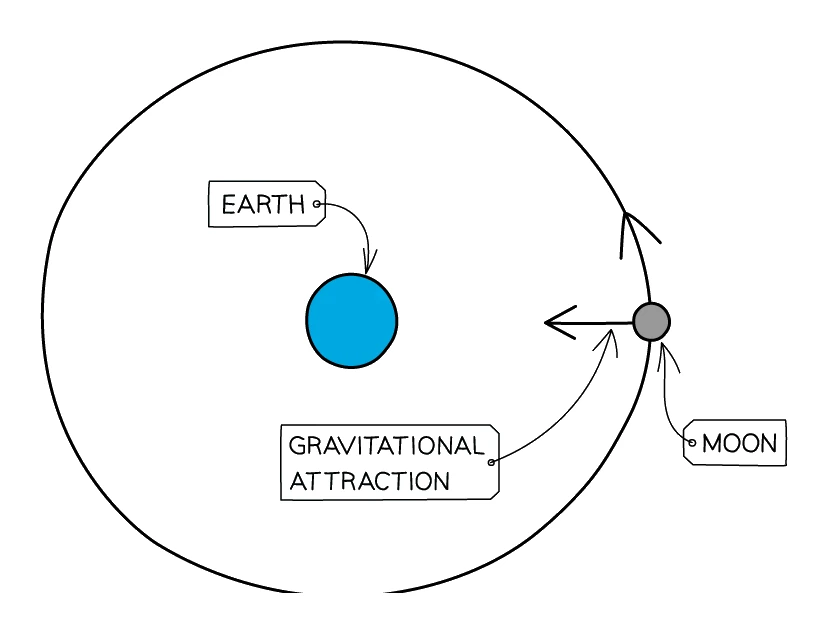
- The Moon does not fly off into space, and it does not crash into the Earth. Instead it keeps going around at a roughly constant distance
- The reason is gravity:
- The Moon is pulled towards the Earth by gravitational attraction
- But the Moon is also moving sideways (tangentially) very fast
- The two effects combine to keep the Moon moving in a near-circular path around the Earth
- For a stable circular orbit:
- The gravitational pull from the central body acts as a centripetal force, always pointing towards the centre of the orbit
- This force constantly changes the direction of the orbiting body's velocity, but not its speed
- The orbiting body falls towards the central body forever, but always misses, because its sideways motion carries it past the centre
Properties of any orbit
For any object in a stable orbit:
- The gravitational force always points towards the centre of the larger body
- The orbiting body moves in a roughly circular path (or, for some comets, a very stretched ellipse)
- The speed is constant for a circular orbit (varies for an elliptical one, see below)
- The orbiting body is always accelerating, because its direction is changing even when its speed is not
Common exam question
Naming or drawing the force that keeps a body in orbit
Question: Give the name of the force that keeps a satellite, moon or planet in orbit, or draw an arrow on a diagram to show that force (1–2 marks).
Asked in 7 of the 24 papers as a one-word answer, a multiple-choice item or an arrow to draw. The answer is the gravitational force (gravity is accepted). "Weight" is allowed by two schemes but ignored by a third, "centripetal" and "centrifugal" are ignored, and "gravitational potential" and "gravitational field strength" are rejected outright, so write "gravitational" every time.
The arrow points from the orbiting body towards the centre of the body it orbits: comet to star, moon to planet, star to the centre of its galaxy. It need not start on the body as long as its line passes through both, but a second, contradictory arrow loses the mark. A labelled arrow earns a second mark for the label "gravitational".
Orbits of planets, moons and comets
All three are caused by gravity, but they look quite different:
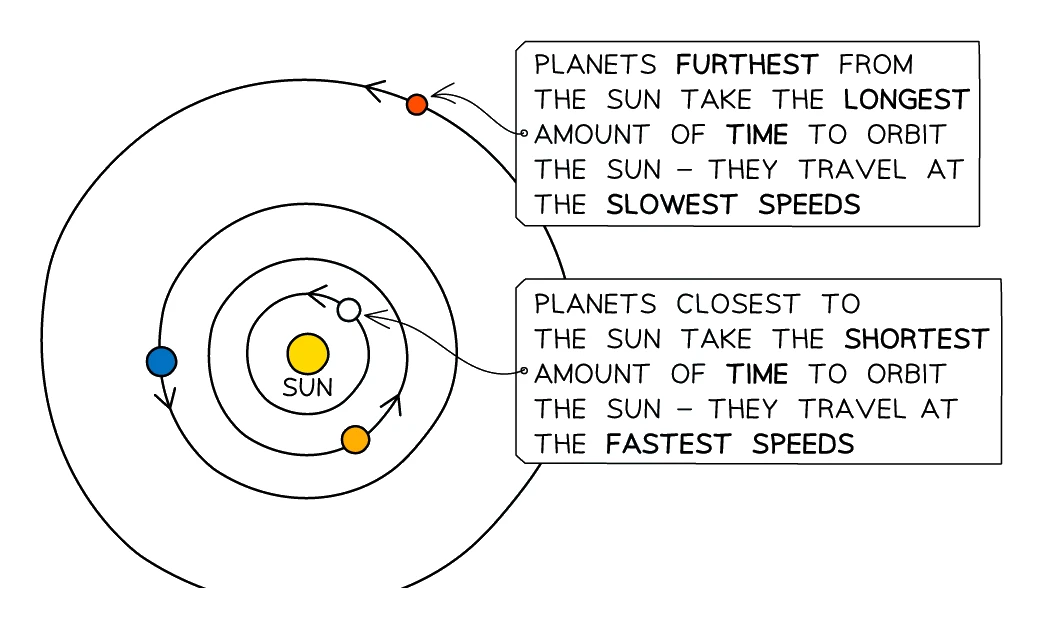
around the Sun
- Each planet moves in a slightly elliptical orbit (close to circular) with the Sun at one focus
- All eight planets orbit in the same direction and in roughly the same plane (the plane of the Solar System)
- Each planet has a different orbital radius and therefore a different orbital speed and period:
- Mercury is closest to the Sun, fastest, period ≈ 88 days
- Earth has a period of 1 year (365.25 days)
- Jupiter has a period of ≈ 12 years
- Neptune is the furthest planet, slowest, period ≈ 165 years
- The closer a planet is to the Sun, the faster it orbits (because the Sun's gravitational pull is stronger near in), and the shorter its year
Moons around their planets
- Moons travel in near-circular orbits around their parent planet
- The closer the moon to the planet, the faster it orbits and the shorter its period, for the same reason
- The Moon takes about 27.3 days to orbit the Earth
Comets around the Sun
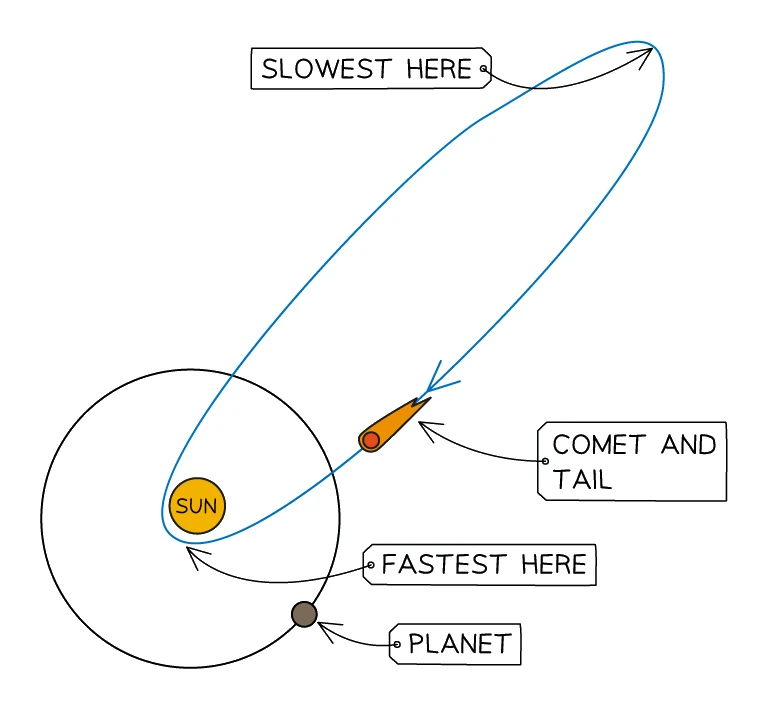
- Comets follow highly elliptical orbits, which are very stretched ovals
- They spend most of their time in the outer , moving slowly. When they swing close to the Sun they accelerate to very high speeds, then slow again as they head back out
- Many comets travel through space at a steep angle to the flat disc the planets occupy, and a few even loop round the Sun backwards (in the opposite sense to the planets)
- Comet Halley has a period of 76 years; some comets have periods of millions of years; some never come back at all (they are on hyperbolic trajectories that take them out of the Solar System)
- The speed of a comet changes a lot during one orbit: fastest at the closest point to the Sun, slowest at the furthest point
Common exam question
Drawing the orbit of a moon or a comet
Question: On a diagram showing a star and a planet, draw the orbit of a moon around the planet, or the orbit of a comet around the star (2 marks).
Asked in 4 of the 24 papers. A moon's orbit earns one mark for being any orbit around the planet (not around the star) and the second for being circular and centred on the planet, judged by eye. A comet's orbit earns one mark for a stretched ellipse around the star and the second for placing the star at one focus, towards one end of the ellipse; a star drawn at the centre of the ellipse loses that mark. If you are asked where the comet moves fastest, mark the point on its orbit closest to the star.
Common exam question
Comparing a comet's orbit with a planet's or a moon's
Question: Describe the differences between the orbit of a comet and the orbit of a planet or a moon (1–3 marks).
Asked in 3 of the 24 papers. Every mark needs a clear comparison, so write both halves of each point: the comet's orbit is highly elliptical while the planet's or moon's is almost circular; the comet's speed varies around its orbit while the planet's stays constant; the comet's distance from the star changes while the planet's orbital radius does not. Also credited: the star sits at the centre of a planet's orbit but not of a comet's, the comet's orbit can lie in a different plane, and a moon orbits a planet whereas a comet orbits a star. Saying the comet's orbit is longer or takes more time is accepted by two schemes but ignored by a third, so do not rely on it.
4. Orbital period
Definition
Orbital period (T) = the time taken for an object to complete one full orbit
- Units: seconds (s) in SI, but in practice often expressed in minutes, hours, days or years depending on the orbit
- Examples:
- International Space Station: T ≈ 90 minutes
- The Moon around Earth: T ≈ 27.3 days
- Earth around the Sun: T = 1 year
- Halley's Comet around the Sun: T ≈ 76 years
Orbital speed equation
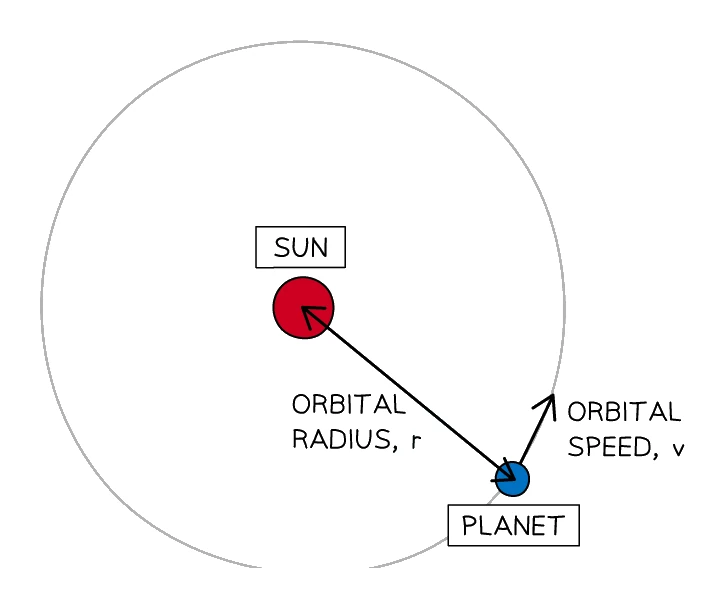
- In one complete orbit, the body sweeps out a path whose length is the circumference of the orbit (treating it as a circle):
distance per orbit = 2πr
- where r is the average orbital radius (measured from the centre of the body being orbited to the orbiting body, not from the surface)
- Combine this with speed = distance / time to get the orbital speed equation:
v = 2πr / T
- Where:
- v = orbital speed (m/s)
- r = orbital radius (m)
- T = orbital period (s)
Common exam question
Using the orbital speed equation
Question: Calculate the orbital speed of a planet, moon or satellite from its radius and period, or rearrange the equation for the period or radius (2–4 marks).
Asked in 10 of the 24 papers, twice on Paper 2 for charged particles moving in a circle. For the speed, the marks are substituting into v = 2πr/T, converting the period into seconds (days, minutes or years) and evaluating. With the radius in km and the answer wanted in km/s, keep kilometres: one scheme docks a mark for changing to m/s unnecessarily, and an unconverted period in days scores only two of the three marks in another.
Finding the period or radius adds a rearrangement mark (T = 2πr ÷ v or r = vT ÷ 2π). Match the units first: a speed in km/s used with a period in years earned at most three of four marks in one scheme. Two significant figures or standard form, when asked for, is its own mark.
Watch out for the radius
- r is from centre to centre, not from the planet's surface
- For a satellite in low Earth orbit at a height h above the surface, the orbital radius is:
r = R_Earth + h
- where R_Earth ≈ 6400 km. Forgetting to add R_Earth is the single most common mistake in this calculation
Why faster-orbiting bodies are closer in
- Looking at v = 2πr / T together with the fact that gravity falls off with distance, you can see the pattern:
- Close to the central body, gravity is strong, needs high speed to balance, period is short
- Far from the central body, gravity is weak, only slow speed needed to balance, period is long
- That is why Mercury has a year of 88 days and Neptune has a year of 165 years; and why low satellites zip around the Earth in 90 minutes while geostationary satellites take 24 hours
- Quantitatively, Kepler's third law says T² ∝ r³, but the qualitative rule "closer = faster" is enough here
Worked example
Calculating orbital speed from radius and period
A moon orbits its planet with an orbital radius of 600 000 km and a period of 4 days. Calculate the orbital speed of the moon in m/s.
Solution:
- Convert the period to seconds: 4 days × 24 × 60 × 60 = 345 600 s
- Convert the orbital radius to metres: 600 000 km × 1000 = 6.0 × 10⁸ m
- Apply v = 2πr / T: v = (2 × π × 6.0 × 10⁸) / 345 600
- v = 10 900 m/s (to 3 s.f.)
Worked example
Finding the orbital period from the speed and radius
A satellite moves in a circular orbit of radius 4.2 × 10⁷ m at an orbital speed of 3.1 km/s. Calculate its orbital period in hours.
Solution:
- Match the units first: 3.1 km/s = 3100 m/s, so the speed and the radius are both in metres
- Rearrange v = 2πr / T to make T the subject: T = 2πr / v
- Substitute: T = (2 × π × 4.2 × 10⁷) / 3100 = 85 100 s (to 3 s.f.)
- Convert to hours: 85 100 / 3600 = 23.6 hours
Write the rearranged equation down before you substitute: that line is the rearrangement mark.