1. Calculating momentum
What momentum is
- Momentum is a property carried by every moving object, telling you how hard it would be to stop or to turn
- A heavier object moving at the same speed has more momentum than a lighter one; the same object moving faster has more momentum than when it was moving slowly
- A stationary object has zero , so at v = 0, p = 0
The equation
p = m × v
- where:
- p = momentum (kg m/s)
- m = mass (kg)
- v = velocity (m/s)
- The SI unit follows from the equation: kilograms × metres per second → kg m/s
Common exam question
Stating and using momentum = mass × velocity
Question: State the formula linking momentum, mass and velocity, then use it to find a momentum, mass or velocity, often as a "show that" (1 mark, then 2–3 marks for the calculation).
Set in 4 of the 24 papers, two of which first ask for the formula as a separate mark: write momentum = mass × velocity or p = m × v. Any correct rearrangement is accepted, but use p for momentum; m or M for momentum is ignored. The calculation earns one mark for the substitution and one for the evaluation; a third mark, when there is one, is for the rearrangement or for writing the formula down unasked.
In a "show that" question give the value to two or more significant figures before comparing it with the target: one scheme gives two of three marks to a value cut short to the wrong two figures. Convert km/s to m/s first; a power-of-ten slip costs a mark.
Momentum is a vector
- Velocity carries a direction, and momentum is mass × velocity, so is a vector quantity that points the same way the object is moving
- When working with momentum on a straight line:
- Pick one direction as positive (rightwards and upwards are the usual conventions)
- The opposite direction is then negative
- A momentum that comes out negative simply means the object is moving the opposite way to the direction you chose as positive
When momentum changes
- An object's momentum changes whenever any of the following happen:
- its velocity increases or decreases (any acceleration along the line of motion)
- its direction of travel changes (which is also an acceleration, even at constant speed)
- its mass changes (such as a rocket burning off fuel)
Worked example
Calculating momentum: p = mv
A 3.0 kg ball rolls along a track at 8.0 m/s. Calculate the momentum of the ball.
Solution:
- Recall the formula: p = m × v
- Substitute: p = 3.0 × 8.0
- p = 24 kg m/s (in the direction of motion)
2. Conservation of momentum
The principle
- The states that, when no outside force acts on a group of interacting objects, the total of the group before the interaction equals the total momentum after the interaction
- "Interaction" in this context can mean:
- a between two objects that come together
- an where one object breaks into two or more pieces
- Because momentum is a vector, the signs of velocities must be tracked carefully when totals are taken, because opposite-direction velocities can partially or fully cancel
Common exam question
Stating the principle of conservation of momentum
Question: State the principle of conservation of momentum, or state what it means (1 mark).
Asked in 3 of the 24 papers, and the one mark is for an equality: the total momentum before a collision or explosion equals the total momentum after it. "Momentum is conserved" on its own is not enough; one scheme calls it insufficient and another ignores it. The third scheme ignores the symbol equation m₁u₁ + m₂u₂ = m₁v₁ + m₂v₂ written in place of the sentence. Naming the event as a collision, an explosion or just an event is fine, and so is adding that no external force acts, but neither earns the mark on its own: the mark is for the before-and-after equality, so make sure that sentence is there.
Applying conservation to a collision
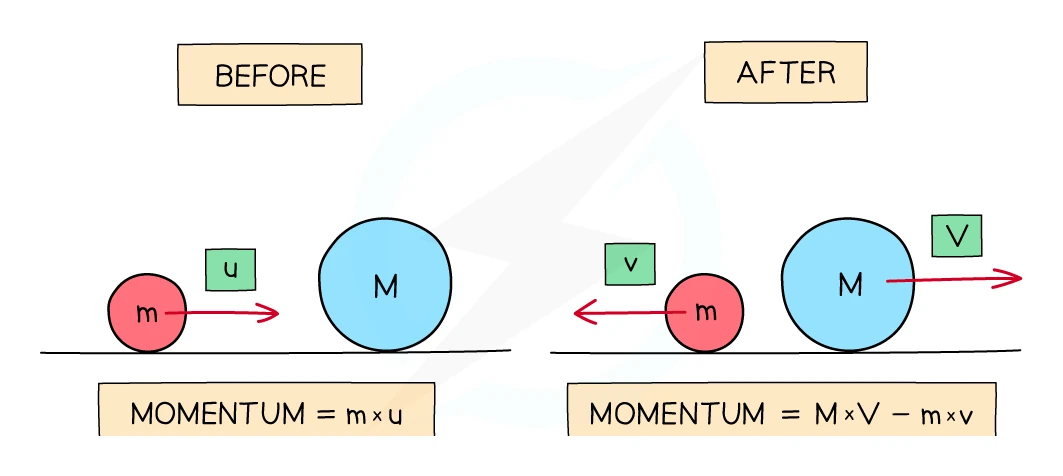
- Pick a positive direction for the whole problem at the start
- Write the total momentum before the collision:
p_before = m₁u₁ + m₂u₂
- Write the total momentum after the collision:
p_after = m₁v₁ + m₂v₂
- Set the two equal (the heart of conservation) and solve for the unknown velocity:
m₁u₁ + m₂u₂ = m₁v₁ + m₂v₂
- If two objects start moving towards each other at equal and opposite momenta, the system's total momentum is zero, and the same zero must come out after the collision (e.g. the two objects might end up at rest, or they might fly off back-to-back at matched momenta)
Common exam question
Finding a velocity or momentum by conservation of momentum
Question: Two objects collide and stick together, or a stationary object splits in two: find one object's velocity afterwards, or the other's momentum (1–3 marks).
Asked in 4 of the 24 papers. Start from total momentum before = total momentum after. When the objects join, add the momenta before, keep that total after and divide by the combined mass: the marks are for the total mass, substituting your total, and the rearrangement and evaluation; a correct answer with no working earns all three.
When the total is zero (an explosion or recoil from rest, or two objects that stick together and stop), the two have equal and opposite momenta: set the two momenta equal (or their sum to zero), rearrange and evaluate; the sign of the final answer is ignored. Asked only for the other object's momentum, give the same magnitude and the opposite direction. One part's momentum worked out correctly still scores a mark if nothing else does.
Worked example
Conservation of momentum: finding velocity after a collision
A 4.0 kg trolley moving at 5.0 m/s collides with and sticks to a 6.0 kg trolley that is at rest. Find the velocity of the combined trolleys immediately after the collision.
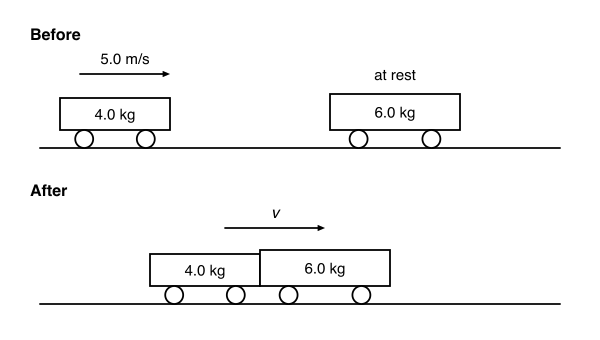
Solution:
- Total momentum before: p = 4.0 × 5.0 + 6.0 × 0 = 20 kg m/s
- By conservation of momentum, total momentum after = 20 kg m/s
- Total mass after: 4.0 + 6.0 = 10 kg
- Combined velocity: v = p ÷ m = 20 ÷ 10 = 2.0 m/s (in the original direction of travel)
3. Force and rate of change of momentum
Force as the rate of change of momentum
- Combining F = ma and the definition p = mv gives a more general form of Newton's second law:
F = Δp / t = (mv − mu) / t
- where:
- F = resultant force (N)
- mv − mu = change in momentum, Δp (kg m/s), i.e. final momentum minus initial momentum
- t = time over which the change happens (s)
- In words: the resultant force on an object equals its
Common exam question
Calculating a force or a time from the change in momentum
Question: An object is brought to rest in a collision: calculate the average force on it, or the time the collision takes, using force = change in momentum ÷ time taken (2–3 marks).
Asked in 3 of the 24 papers. The change in momentum is the momentum lost, mass × velocity or the momentum value you were given, and the marks are for substituting it with the time or force into the formula, rearranging when the time is the unknown, and evaluating. Working through F = ma with a = (v − u) ÷ t instead earns the same marks. Two slips cost the final mark: leaving a force in kN rather than N when you divide (a power-of-ten error), and cutting the answer short instead of rounding it (one scheme gives a cut-short time two of three marks but allows the rounded one-figure value). The sign of the force is ignored, so a magnitude is enough.
Contact time and impact force
- For a given change in momentum, the force and the contact time are inversely proportional to one another:
- Halve the contact time and the impact force doubles
- Triple the contact time and the impact force falls to a third
- Real safety design therefore aims to extend the during a collision to make the impact force as small as possible (see section 5)
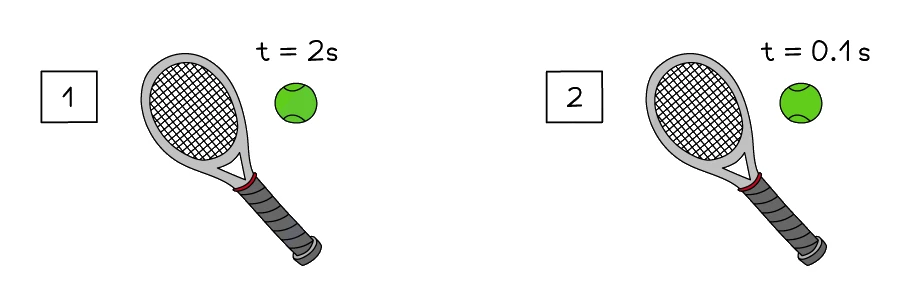
Example A — during the same return shot, a 0.40 kg football undergoes the same change in momentum of 8.0 kg m/s in two different scenarios: scenario 1 has a foot-on-ball contact time of 0.050 s, scenario 2 has a contact time of 0.50 s. Compare the average force on the ball.
- Scenario 1: F = Δp / t = 8.0 / 0.050 = 160 N
- Scenario 2: F = Δp / t = 8.0 / 0.50 = 16 N
- The same change in momentum, delivered over ten times longer, gives a force that is ten times smaller
Example B — a 1200 kg car drives at 18 m/s into a wall and rebounds at 4.0 m/s in the opposite direction. The collision lasts 0.20 s. Calculate the average force on the car and state its direction.
- Take the car's forward (towards-wall) direction as positive: u = +18 m/s, v = −4.0 m/s
- Δp = m(v − u) = 1200 × (−4.0 − 18) = 1200 × (−22) = −26 400 kg m/s
- F = Δp / t = −26 400 / 0.20 = −132 000 N
- The minus sign tells you the force on the car points in the opposite direction to its original motion, that is, backwards from the wall, as you would expect
4. Newton's third law
Statement of the law
- of motion states:
Whenever two objects interact, the forces they exert on each other are equal in magnitude and opposite in direction.
- The first two laws are statements about forces on one object at a time; the third law is the one that compares a pair of forces, each on a different object
How to spot a true third-law pair
- A pair of forces is a Newton's-third-law pair if and only if all three of the following are true:
- The two forces act on two different objects (never on the same object)
- The two forces are equal in magnitude and opposite in direction
- The two forces are the same type (e.g. both gravitational, both normal contact, both electrostatic). If you can't name the force type, calling them both "push" or both "pull" is enough
Walking as a third-law example
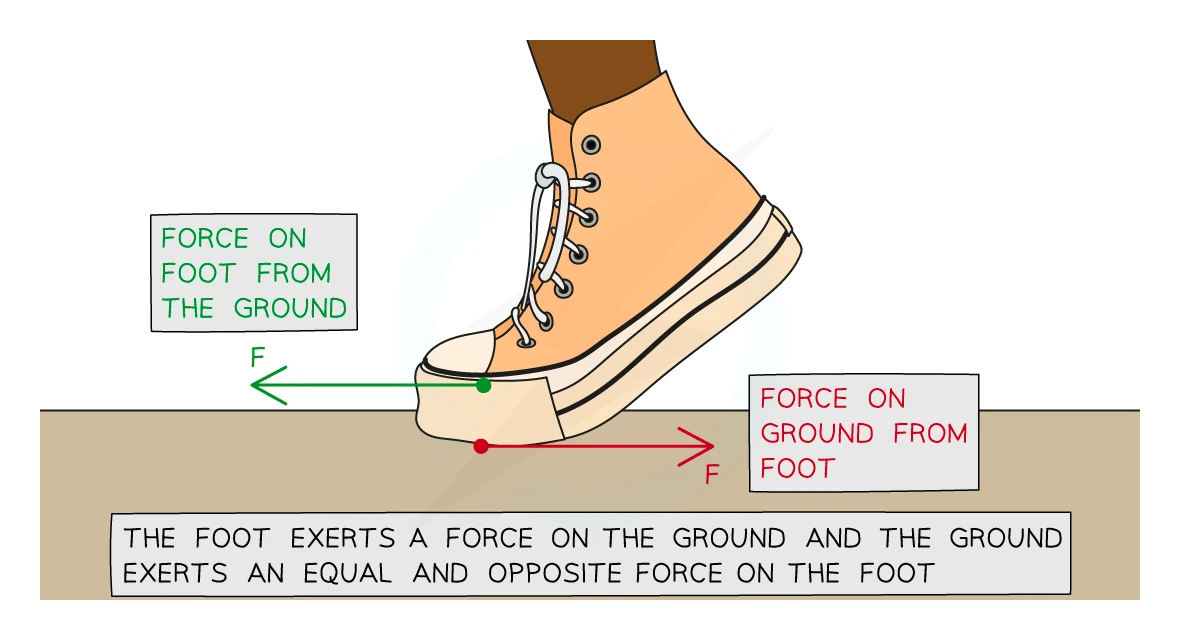
- When you walk, your foot pushes backwards on the ground (a contact force from foot on ground)
- The ground, by Newton's third law, pushes forwards on your foot with an equal-sized force (a contact force from ground on foot)
- The forwards push on you is what actually accelerates you across the room. The energy to move, though, comes from your own muscles, not from the ground
The book-on-table trap
- A common mistake is to call the weight of a book and the upward reaction of the table a third-law pair. They are not:
- both arrows act on the same object (the book), failing rule 1
- they are different types of force (gravity vs contact), failing rule 3
- The book-on-table picture is really a worked illustration of Newton's first law: two balanced forces on one object, so its motion does not change
- The genuine third-law partner of the book's weight is the pull the book exerts back on the Earth, equal in size and opposite in direction, but acting on the Earth rather than on the book
Exam tip
Why weight and the support force are not a third-law pair
When a question asks why the two forces on a stationary object, its weight and the tension or support holding it up, are not a Newton's third law pair, any two of three points earn the marks: the forces act on the same body; they are not the same type (one gravitational, one a contact or tension force); and the true partner of the weight is the object's equal gravitational pull on the Earth. "They are equal and opposite" is true of both kinds of pair, so it does not answer the question.
Third law in a collision
- When two objects collide, the force one exerts on the other is matched by an equal and opposite force back:
F_{A on B} = − F_{B on A}
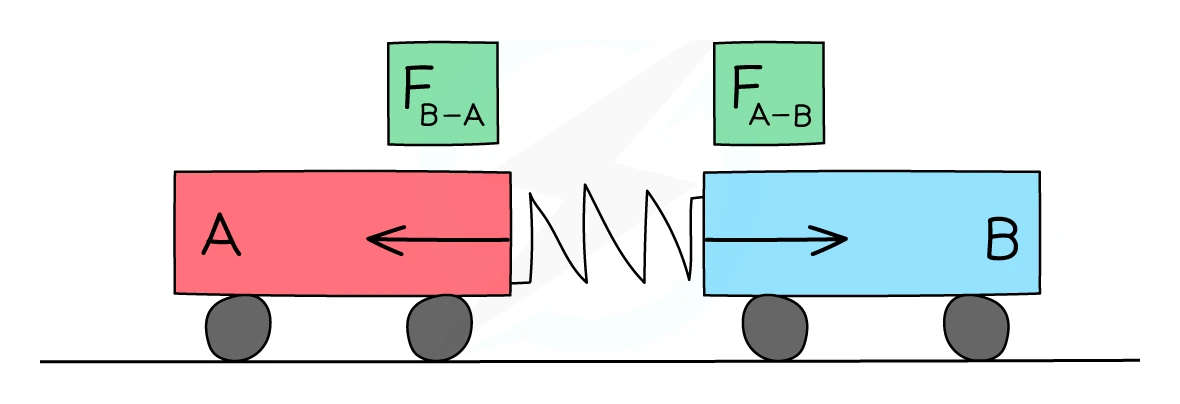
- Equal forces do not mean equal accelerations, because Newton's second law (a = F / m) shows that for a fixed force, a smaller mass picks up a larger acceleration. A small car colliding with a heavy lorry feels the same-size force but is flung backwards far more than the lorry creeps forwards
Common exam question
Giving the force on the other object in a collision
Question: Given the force on one object in a collision, or having just calculated it, state the magnitude and direction of the force on the other object (2 marks).
Asked in 2 of the 24 papers, and it is Newton's third law in numbers: the force on the second object has the same magnitude as the force on the first (read from the data, or carried forward from your answer to the previous part) and acts in the opposite direction. Give the direction as the diagram shows it, such as "to the right", or say it is opposite to the force on the first object; a compass direction such as "east" is ignored.
5. Momentum and safety features
The design idea
- The force a passenger feels in a crash equals their , F = Δp / t
- For a given change of momentum (e.g. going from 25 m/s to rest at the same mass), the only thing engineers can change is the time taken to make that change
- Longer → smaller force, and every modern road-safety feature uses this trick
Safety features in vehicles
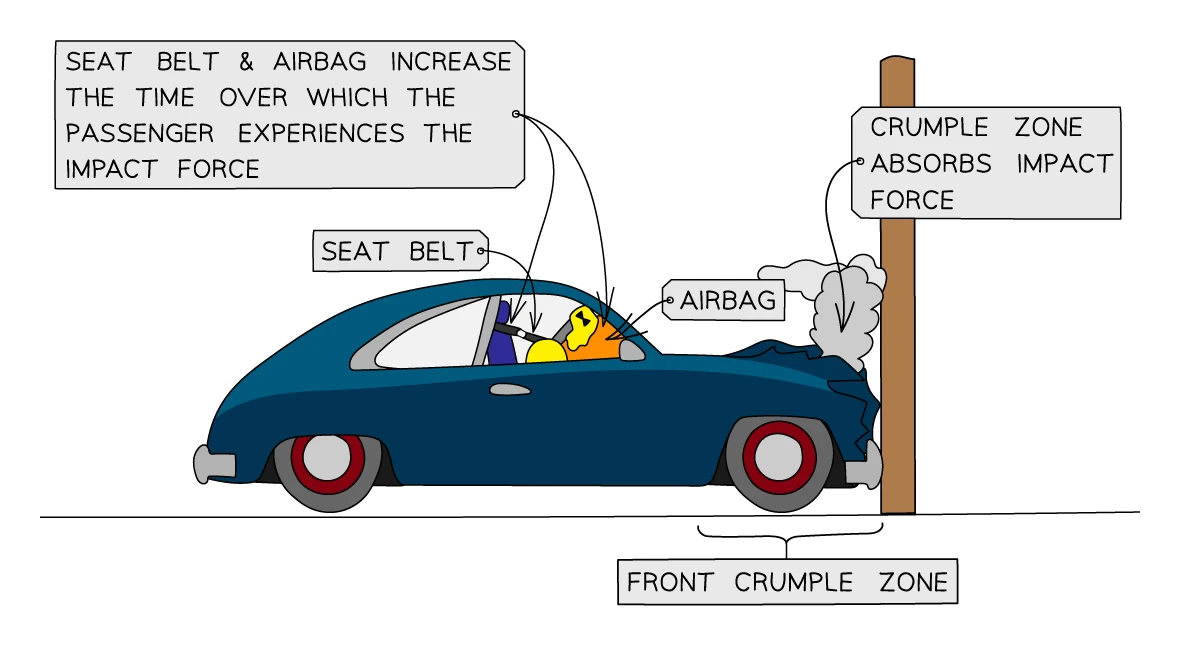
- Crumple zones: areas at the front and rear of a car designed to deform plastically in a collision rather than rebound. They lengthen the time it takes for the car (and hence the passenger compartment) to come to a halt, lowering the peak force on the occupants. This is why an apparently "small" bump can still leave the bonnet visibly crushed, because the crumple zone is meant to do that
- Seat belts: designed to stretch slightly under the loading of a collision. Stretching keeps the passenger fixed to the seat but lets their body decelerate over a longer time and a few extra centimetres of travel, so the force on the chest is reduced. They also prevent secondary collisions of the passenger with the dashboard or windscreen
- Airbags: gas-filled cushions that inflate within milliseconds of a sensor detecting an impact. The passenger's head and chest strike the airbag rather than the steering wheel or dashboard, and the airbag squashes down over many centimetres, again lengthening the contact time and so reducing the impact force
- Headrests: limit how far the head can snap backwards in a rear-end collision, cushioning the head-and-neck momentum swing and so reducing the chance of whiplash injury
Common exam question
Explaining how a safety feature reduces the force
Question: Use ideas about momentum to explain how an airbag or crumple zone reduces the force in a collision, or why an egg is less likely to break on a thick carpet than on a hard floor (2–3 marks).
Asked in 3 of the 24 papers. The marks are a chain: the feature increases the time taken to stop; the change in momentum is the same; so the rate of change of momentum is smaller and, since force equals change in momentum divided by time, the force is smaller. A 2-mark version wants the longer time and the smaller rate of change of momentum; quoting the equation with a statement that the change in momentum is constant also earns that second mark, and "smaller deceleration" is accepted for it.
"It absorbs the impact", "it absorbs the force" and anything about energy are ignored, as is calling the floor hard or soft: answer in terms of momentum and time.
Safety surfaces beyond cars
- Bicycle helmets: the polystyrene foam liner is designed to crush on impact, extending the time over which the head's momentum drops to zero
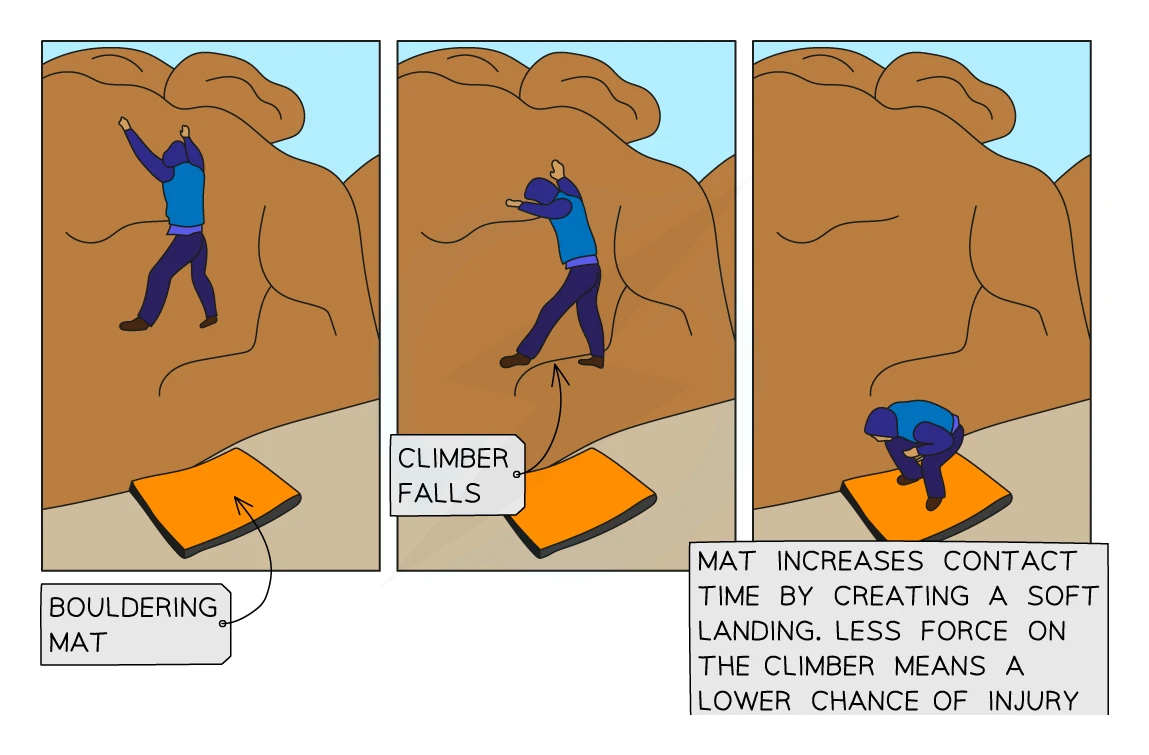
- Gymnasium and bouldering crash mats: thick, low-density foam pads under climbing walls or below gym apparatus stretch the contact time of a fall from milliseconds to tenths of a second, dropping the peak force on the body to a survivable level
- Playground rubber surfacing: replaces tarmac under climbing frames so a child's fall has a longer stop, reducing the force absorbed by bones and joints
Choosing the right thickness of safety surface
- The contact time needed depends on the change in that has to be absorbed:
- Large mass and high speed → large change in momentum → thicker / longer-stopping surface needed (a lorry crashing into a barrier needs more deformable material than a bicycle hitting a kerb)
- Small mass and low speed → smaller change in momentum → thinner surfacing is enough (a child stepping off a low platform onto a soft surface; a thin yoga mat under simple floor exercises)
- Safety features lower the risk of serious injury without erasing it altogether; they swap a brutally large force over a short time for a smaller, but still real, force over a longer one