1. The moment of a force
What a moment is
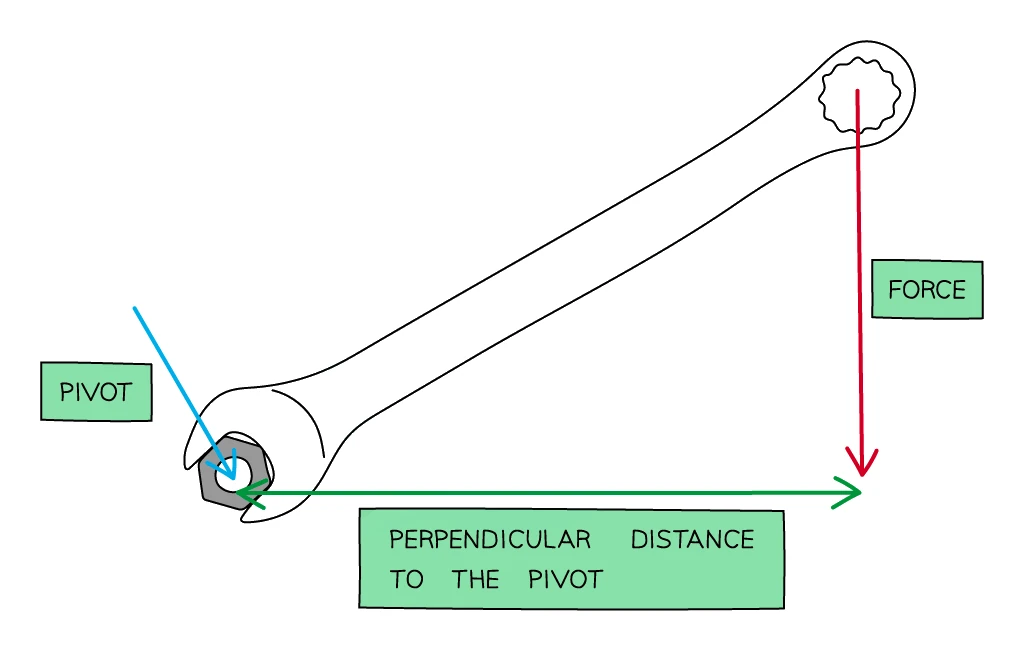
- A moment is the turning effect of a force about a fixed point called the
- A force does not always make an object change its straight-line motion; if the object is free to rotate about a hinge or axle, the force instead makes it spin
- Common everyday moments include:
- the handle of a door rotating about its hinges
- a spanner loosening a bolt
- a child on one end of a see-saw lifting another child at the far end
- a screwdriver prising open a tin lid
- a tap being twisted on or off
- a wheelbarrow being tipped up to be wheeled
- the blades of a pair of scissors closing about the rivet
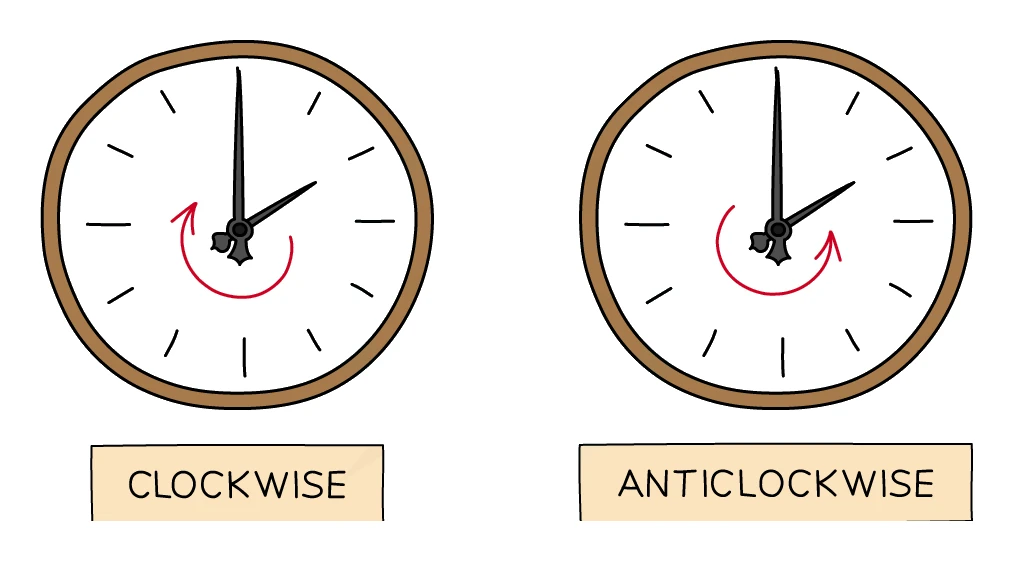
- The rotation may be clockwise or anticlockwise, depending on which side of the pivot the force is applied and which way it points
The equation
M = F × d
- where:
- M = moment of the force (newton metres, N m)
- F = force applied (N)
- d = from the pivot to the line of action of the force (m)
- The unit follows from the equation: newton × metre → newton metre (N m). If the lever arm is given in centimetres, the moment can equally be quoted in N cm; convert to metres unless the question asks otherwise
Common exam question
Stating the moment equation
Question: State the equation that links moment, force and perpendicular distance (1 mark).
Asked in 2 of the 24 papers, both on Paper 2, each time as the first part of a question that goes on to a moment calculation. Write moment = force × perpendicular distance. Words or standard symbols earn the mark, and so does a correct rearrangement such as force = moment ÷ distance. Neither scheme insists on the word "perpendicular". Both allow d for the distance and tolerate M for the moment; one also allows s and tolerates a lower-case m.
Common exam question
Calculating a moment from a force and a distance
Question: Calculate the moment of a force about the pivot, or the force that produces a given moment, sometimes with a suitable unit or as a "show that" (2–3 marks).
Asked in 5 of the 24 papers, all on Paper 2. One mark is for the substitution into moment = force × distance and one for the evaluation; when a unit is asked for, a third is for a unit that matches the distance you used, N m with metres or N cm with centimetres. The answer line sometimes fixes the unit, and a power-of-ten slip between the two costs a mark.
Use the perpendicular distance: for a weight, the horizontal distance from the pivot, not a vertical height or a distance to another force. With two forces turning a tap, work out one moment and add the other. In a "show that", give at least three significant figures; working back from the printed value earns one mark at most.
Why the distance must be perpendicular
- The lever arm d is the shortest distance from the pivot to the line along which the force acts, measured at right angles to that line
- A force pointing straight at the pivot has zero perpendicular distance, so it produces no no matter how large it is; it simply tries to push the pivot itself
- For a beam lying flat, only the vertical forces (those pointing straight up or straight down) turn it about a pivot on the beam; a force directed along the length of the beam contributes no moment at all
Long lever arms make life easier
- For a fixed pivot, a longer lever arm reduces the force you must apply to get the same moment
- Real-life consequences:
- A door is far easier to push open at the handle (far from the hinge) than near the hinge itself; the same moment comes from a much smaller hand force when d is large
- A wheel nut wrench with a long extension bar makes seized nuts shift that a stubby spanner cannot
- A short crowbar prises open a crate with a much smaller hand force than fingers alone
Worked example
Calculating a moment
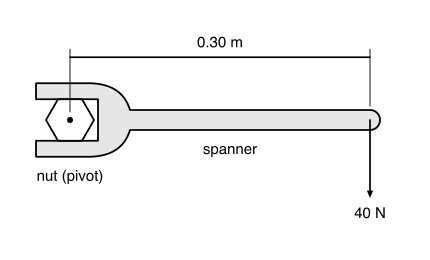
A spanner applies a force of 40 N at a perpendicular distance of 0.30 m from the centre of the nut (the pivot). Calculate the moment of the force about the nut and give a suitable unit.
Solution:
- Write the formula: moment = force × perpendicular distance
- Substitute: moment = 40 × 0.30
- = 12 N m
The unit follows the distance you used: in centimetres the same moment is 40 × 30 = 1200 N cm, so match the unit to the one on the answer line.
2. The principle of moments
The balancing condition
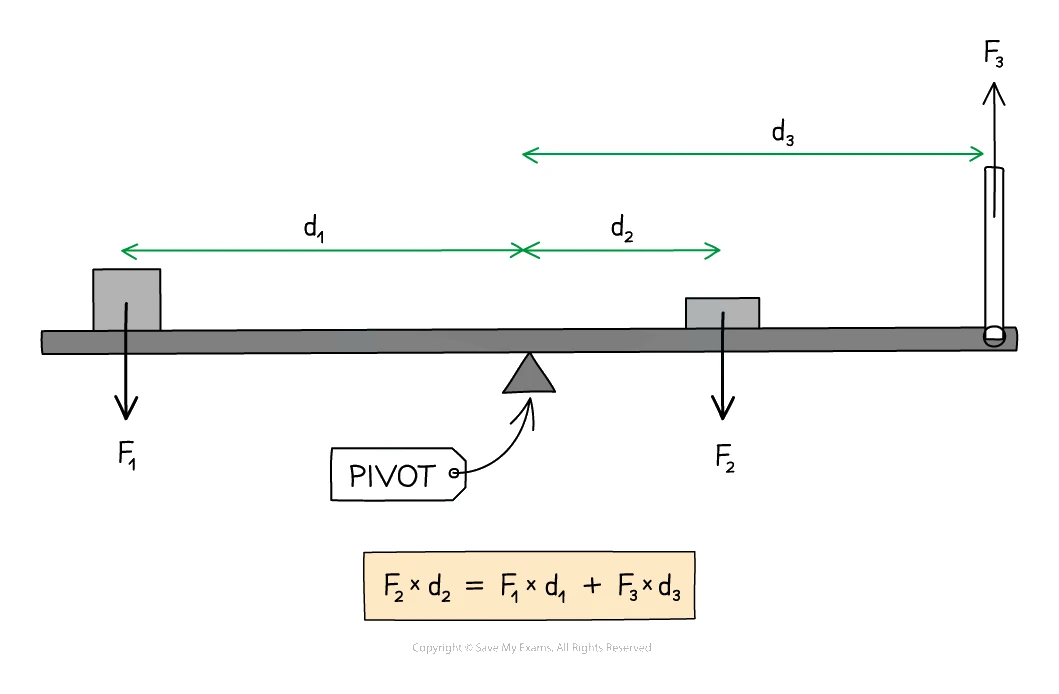
- The states that, when an object is balanced about a pivot:
total clockwise moment about the pivot = total anticlockwise moment about the pivot
- "Balanced" here means the object is in , so it is either not rotating, or rotating at a steady rate
- If the totals are not equal, the side with the larger total wins, and the object turns that way until something stops it (or until the geometry rebalances)
Using the principle on a beam
- For a horizontal beam pivoted at one point with several vertical forces acting on it:
- work out the moment of each force separately using M = F × d
- add up every moment that turns the beam clockwise
- add up every moment that turns the beam anticlockwise
- set the two totals equal to find the unknown quantity
Common exam question
Balancing moments to find an unknown force
Question: Take moments about a pivot or support to calculate an unknown force on a balanced object, or show that it has a stated value (3–4 marks).
Asked in 3 of the 24 papers, all on Paper 2. Find the moment of the known force first, then write the principle of moments as an equation, clockwise moment = anticlockwise moment or weight × its distance = F × its distance: that step is credited in words or implied by the substitution. Rearranging and evaluating earn the rest, less one for a power-of-ten slip. If a part first asks you to state the moment of the unknown force, it equals the moment you just found.
Measure every distance from the point you are taking moments about. In one paper the unknown force acted 25 cm + 55 cm from the chosen support, and using the 55 cm gap between the two forces instead scored two of the three marks.
Worked example
Using the principle of moments to find an unknown force
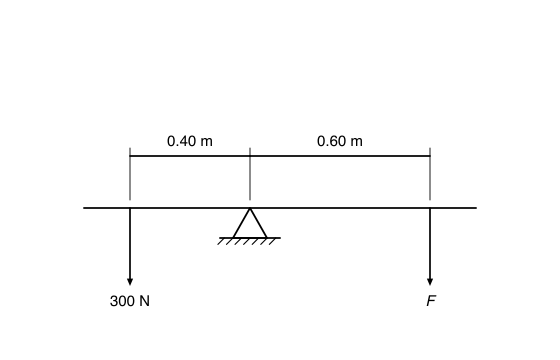
A uniform light beam is pivoted at its centre. A downward load of 300 N acts at 0.40 m from the pivot. A second downward force F acts at 0.60 m on the opposite side of the pivot.
Solution:
- Anticlockwise moment = 300 × 0.40 = 120 N m
- For balance (principle of moments): clockwise moment = 120 N m
- So: F × 0.60 = 120
- F = 120 ÷ 0.60 = 200 N
Supporting a beam with two upward forces
- A light beam is one whose own mass is small enough to be ignored, so its weight contributes nothing to the moment calculation
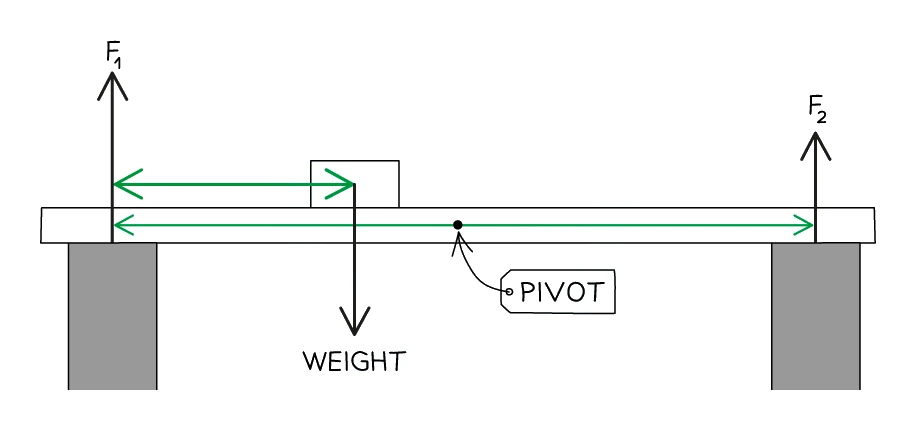
- When a light beam is held up by two supports with an object resting somewhere along it:
- the two upward support forces F₁ and F₂ must together equal the downward weight of the object (translational equilibrium)
- taking moments about either support also gives a second equation relating F₁ and F₂ to the load position (rotational equilibrium)
- As the load is slid from one support towards the other:
- the support closer to the load takes a larger share of the upward force
- the support further from the load takes a smaller share
- in the limit where the load sits directly above one support, that support takes the entire weight and the other takes none
Common exam question
How the two support forces change as a load moves
Question: Explain which of two support forces is larger, or how a support force changes when the load moves along the beam (3 marks).
Asked in 2 of the 24 papers, both on Paper 2. State the result first: which support force is larger, or whether it rises or falls. Then reason in moments: the support nearer the load takes the larger force, and moving the load changes its distance from the supports, so the load's moment changes and the support force must change to keep the clockwise and anticlockwise moments equal. Link the distance to the force, because repeating what the question tells you, that the centre of gravity is closer to one support or that the load moves closer to the other, earns nothing by itself.
A describe-how version wants three of: the force at the support the load approaches increases, the other decreases, by the same amount, and their total stays the same (it equals the weight).
3. Centre of gravity
What centre of gravity means
- The of an object is the single point through which its entire weight can be treated as acting
- When drawing a free-body diagram, the weight arrow is always drawn from this point pointing straight down
- The centre of gravity is a useful fiction; the object's weight is really shared across every particle in it, but treating it as a single force at one point gives the same moment about any pivot
Centre of gravity of symmetrical objects
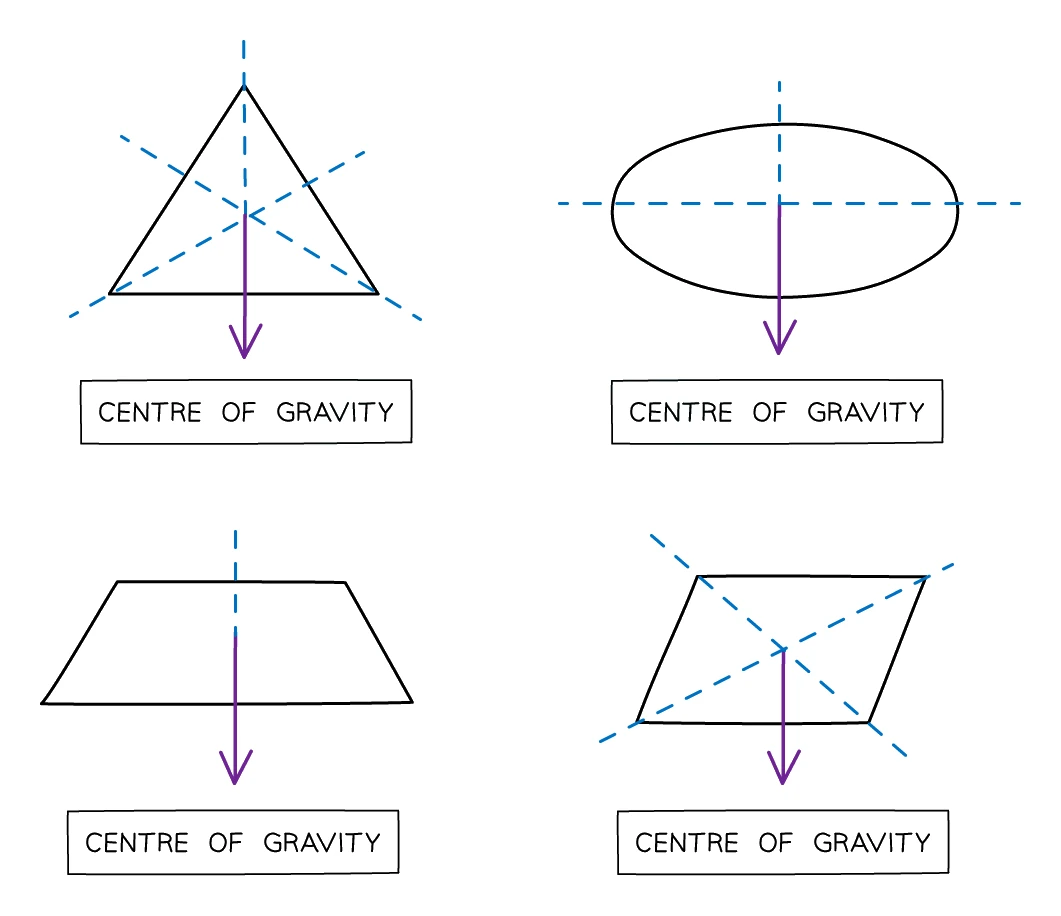
- For an object with uniform density and a clear axis of symmetry, the centre of gravity sits on every axis of symmetry; for a fully symmetric object it sits at the geometric centre:
- a uniform sphere → at the very centre of the sphere
- a uniform cube → at the centre of the cube
- a uniform thin rectangular sheet → at the point where the two diagonals cross
- a uniform thin disc → at the centre of the disc
Exam tip
Drawing the weight arrow from the centre of gravity
When a diagram marks the centre of gravity and asks you to draw the object's weight, the two marks are for a single vertical arrow pointing downwards and, dependent on that, for the arrow starting at the centre of gravity; a label is ignored. An arrow drawn from the base or an edge of the object loses the second mark. The same point fixes the distances in a moments calculation: the weight acts at the centre of gravity, so measure the horizontal distance from the pivot to that point, not to the end of the object.
Finding the centre of gravity of an irregular shape
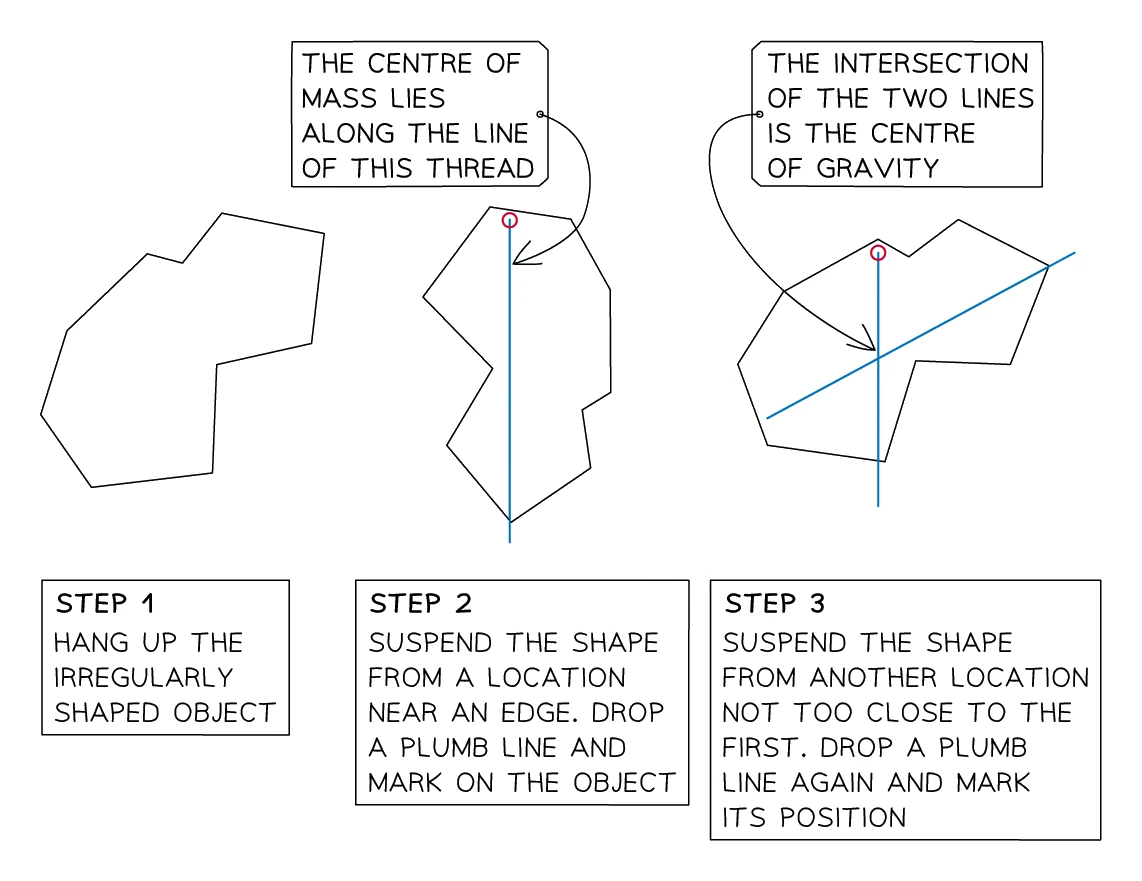
- For an awkward, irregular flat shape the centre of gravity is found experimentally using a plumb line:
- Punch or drill a small hole near one edge of the shape and hang it from a horizontal pin or nail so it can swing freely
- Wait until the shape stops swinging; the centre of gravity must now lie somewhere directly below the pin (otherwise there would still be an unbalanced moment about the pin)
- Hang a plumb line (a string with a small weight tied to its lower end) from the same pin so it falls straight down across the shape
- With a pencil, trace the line of the string onto the shape
- Take the shape off the pin, choose a second hole well away from the first, and repeat steps 1–4 from this new pivot
- The two pencil lines cross at a single point, and that intersection is the centre of gravity
- Repeating with a third hole and a third line gives a sanity check; if the third line does not pass through the same intersection, one of the readings was off
Centre of gravity can lie outside the object
- The centre of gravity does not have to be inside the solid material of the object:
- a doughnut (torus) has its centre of gravity in the empty space at the middle of the ring
- an L-shaped bracket has its centre of gravity inside the concave corner, outside the solid metal
- a C-shaped magnet has its centre of gravity in the air gap between the two pole faces
- This is why such objects can balance in surprising ways; the relevant pivot only has to lie under the centre of gravity, even if that point is in empty air
Centre of gravity, posture and stability
- The position of an object's centre of gravity shifts when its shape changes:
- a person standing upright has a centre of gravity in the lower abdomen, about one metre off the ground
- the same person leaning forward to touch their toes has a centre of gravity that has moved forward and lower, far enough that if they overbalance, their feet leave the ground
- A wide base and a low centre of gravity make an object harder to tip over:
- a sports car with a low centre of gravity corners more sharply without rolling than a tall delivery van
- racing bicycles drop the rider's centre of gravity by tilting the body forward, improving stability into a turn