1. Nuclear energy
What "nuclear energy" means
- An atomic nucleus contains an enormous amount of stored energy, held in place by the strong nuclear force that binds protons and neutrons together
- Any time the arrangement of nucleons in a nucleus changes (by splitting it apart, joining nuclei together, or letting a nucleus decay), some of that stored energy is released
- The three ways to release energy from the nucleus are:
- Nuclear fission: one large unstable nucleus splits into two smaller nuclei
- Nuclear fusion: two light nuclei join to form one heavier nucleus
- Radioactive decay: an unstable nucleus emits an alpha, beta or gamma particle and changes into another nucleus (covered in topics 19 and 20)
- The amounts of energy involved per reaction are millions of times larger than for chemical reactions (combustion, batteries, food). Burning a single hydrogen atom in oxygen releases about 10⁻¹⁸ J; fusing a single hydrogen atom releases roughly 4 million times more
Where nuclear energy is used
- Fission is the basis of every working nuclear power station on Earth, and of nuclear weapons
- Fusion is what powers the Sun and all other stars. Fusion is also being developed as a future energy source on Earth, but no commercial fusion power station exists yet
- Radioactive decay is used in medical tracers, smoke detectors, thickness gauging, and (on a planetary scale) to keep the Earth's interior hot enough to drive plate tectonics
2. Nuclear fission
Definition
Nuclear fission is the splitting of a large unstable nucleus into two smaller nuclei
- The large nucleus that breaks apart is called the parent nucleus
- The two smaller nuclei produced are the
- The reaction also produces 2 or 3 free neutrons and a burst of gamma radiation
- The daughter nuclei are themselves unstable and usually radioactive, decaying further over time
Exam tip
Write nuclei, not atoms
Every answer on fission and fusion is about nuclei: a nucleus absorbs a neutron, a nucleus splits, two nuclei join. The mark schemes for three questions reject "atoms", "particles" or "molecules" in place of nuclei (both questions on the difference between fission and fusion, and one of the chain-reaction questions), while two condone them. Take the same care with the products: the fragments are daughter nuclei, and "daughter cells" is rejected or ignored wherever it appears.
Fissile materials
- Only certain isotopes will undergo fission. These are called . The two used in practice are:
- Uranium-235 (²³⁵₉₂U), the fuel in almost every commercial fission reactor
- Plutonium-239 (²³⁹₉₄Pu), used in some reactors and in most nuclear weapons; produced inside reactors from non-fissile uranium-238
Spontaneous vs induced fission
- A small number of nuclei split all on their own, without anything hitting them. This is spontaneous fission. It is rare and far too slow to be useful for generating electricity
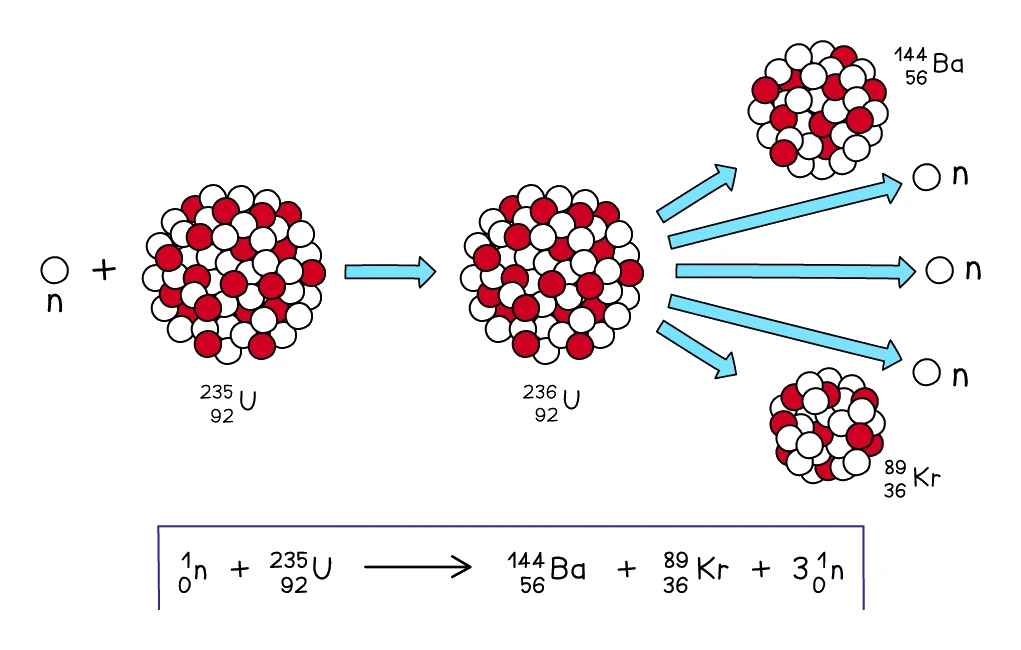
- The fission used in reactors is , where a free neutron is fired at the nucleus and triggers the split:
- A slow-moving (thermal) neutron is absorbed by a uranium-235 nucleus
- The nucleus becomes uranium-236, which is highly unstable
- Within a tiny fraction of a second, uranium-236 splits into two daughter nuclei and emits 2 or 3 fresh neutrons plus gamma rays
Why uranium-235 needs help to fission
- Uranium-235 has a half-life of about 700 million years, so on its own it decays incredibly slowly. The amount of energy released by spontaneous fission is far too small to power a reactor
- Adding the extra neutron pushes uranium-235 over the edge into uranium-236, which has no stable existence and falls apart almost immediately. Inducing fission speeds up the energy release by many orders of magnitude
Common exam question
Describing nuclear fission
Question: Describe what is meant by nuclear fission, or describe the process of fission inside a reactor, sometimes as sentences to complete (2–5 marks).
Asked in 3 of the 24 papers. The credited steps are: a neutron is absorbed by a uranium nucleus; the nucleus formed is unstable and splits; it releases two daughter nuclei and two or three neutrons, with energy that ends up in the kinetic store of the products. The 4-mark version also wants the final step: the released neutrons go on to repeat the process in other nuclei. That repeat mark is lost if you say the daughter nuclei split again, because it is the neutrons that trigger the next fission.
If a part asks you to name the fuel, "uranium" or "plutonium" scores on its own and a wrong isotope number is condoned; the particle that starts the process is the neutron.
A typical fission equation
- One of many possible fission outcomes for uranium-235 is:
²³⁵₉₂U + ¹₀n → ¹⁴⁴₅₆Ba + ⁸⁹₃₆Kr + 3 ¹₀n + energy
- Check the totals:
- Mass numbers: 235 + 1 = 236 on the left; 144 + 89 + (3 × 1) = 236 on the right ✓
- Atomic numbers: 92 + 0 = 92 on the left; 56 + 36 + (3 × 0) = 92 on the right ✓
- The daughter nuclei vary from one fission event to the next. Barium-144 and krypton-89 are one possibility; strontium-90 and xenon-143 another. The reactor does not produce a single pair of products every time
Common exam question
Completing a fission or fusion equation
Question: Complete a nuclear equation for fission or fusion by filling in a missing mass number and atomic number, or calculate the number of neutrons released (2 marks).
Set in 2 of the 24 papers. Both totals must balance: the mass numbers on the right add up to those on the left, and so do the atomic numbers. For a missing particle there is one mark for each number, so a product with mass number 1 and atomic number 0 is a neutron. For the number of neutrons released, add the mass numbers on the left (235 + 1 = 236), subtract the mass numbers of the two daughter nuclei, and the difference is the answer. That subtraction is the method mark, and a correct answer on its own scores both marks.
Where the energy goes
- The products of fission fly apart at very high speed. The energy that was locked up inside the parent nucleus reappears as the kinetic energy of the fast-moving daughter nuclei and neutrons, plus the energy carried away by gamma rays
- When the fast-moving daughter nuclei collide with surrounding atoms in the fuel, their kinetic energy is transferred as heat. That heat is what is harvested to make electricity in a power station
3. Chain reactions
How a chain reaction starts
- Each induced fission of uranium-235 needs one neutron going in but releases 2 or 3 neutrons coming out
- If any of those released neutrons strikes another uranium-235 nucleus, it can trigger another fission, releasing more neutrons, which trigger more fissions, and so on
- This self-sustaining sequence is a chain reaction:
a chain reaction is a process in which the neutrons released by one fission go on to cause further fissions, releasing more neutrons that cause still more fissions
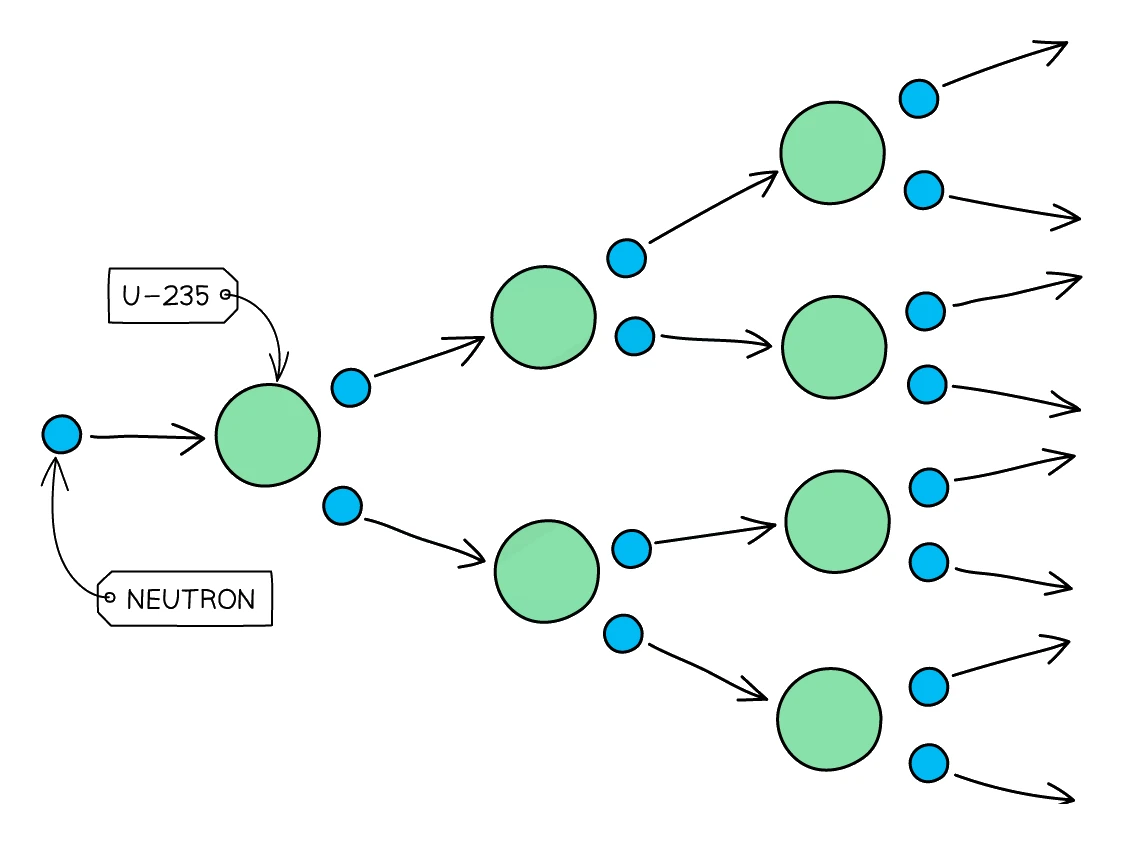
- The number of fissions per second grows exponentially unless something stops it
Common exam question
Describing a chain reaction
Question: Describe what is meant by a chain reaction, or describe how a chain reaction occurs in a fission reactor (2–3 marks).
Asked in 3 of the 24 papers. The marks follow the neutrons: a fission releases neutrons; those neutrons are absorbed by other uranium nuclei; and those nuclei undergo fission in turn, releasing more neutrons. The 3-mark versions either start one step earlier, with a uranium nucleus absorbing a neutron and splitting, or credit the three steps above separately. Each step is its own mark, so spell out all of them.
Say the neutrons are absorbed by (or captured by) uranium nuclei: on the step where the first nucleus takes in a neutron, "collide with", "hit" and "aimed at" are ignored.
Generations of a chain reaction
- Each "generation" of the chain is one round of fissions:
| Generation | Fissions in this generation (3 neutrons per fission, all triggering further fissions) |
|---|---|
| 0 | 1 |
| 1 | 3 |
| 2 | 9 |
| 3 | 27 |
| 4 | 81 |
| 5 | 243 |
| 10 | 59 049 |
- In practice not every neutron causes a fission; some escape from the fuel, some are absorbed by impurities. The effective number of new fissions per old fission is called the multiplication factor k:
- k > 1: supercritical, fission rate grows; bomb-like behaviour
- k = 1: critical, fission rate is steady; this is what a working reactor maintains
- k < 1: subcritical, fission rate dies away
Critical mass
- For a chain reaction to keep going at all, there has to be enough fissile material in one place so that a typical neutron meets another uranium-235 nucleus before escaping
- The smallest mass of fissile material that can sustain a chain reaction is the critical mass. For pure uranium-235 it is around 50 kg; for plutonium-239 it is about 10 kg
- Below the critical mass, neutrons escape from the surface faster than new fissions can replace them, so the chain dies. Above the critical mass, the chain takes off
- In a power station the mass of fuel exceeds the critical mass but the chain reaction is held at k = 1 by absorbing the excess neutrons (see control rods, below)
- In a nuclear weapon a supercritical mass is assembled suddenly, k jumps well above 1, and the entire fuel undergoes fission in a fraction of a second. The uncontrolled release of energy is a nuclear explosion
4. Nuclear reactors
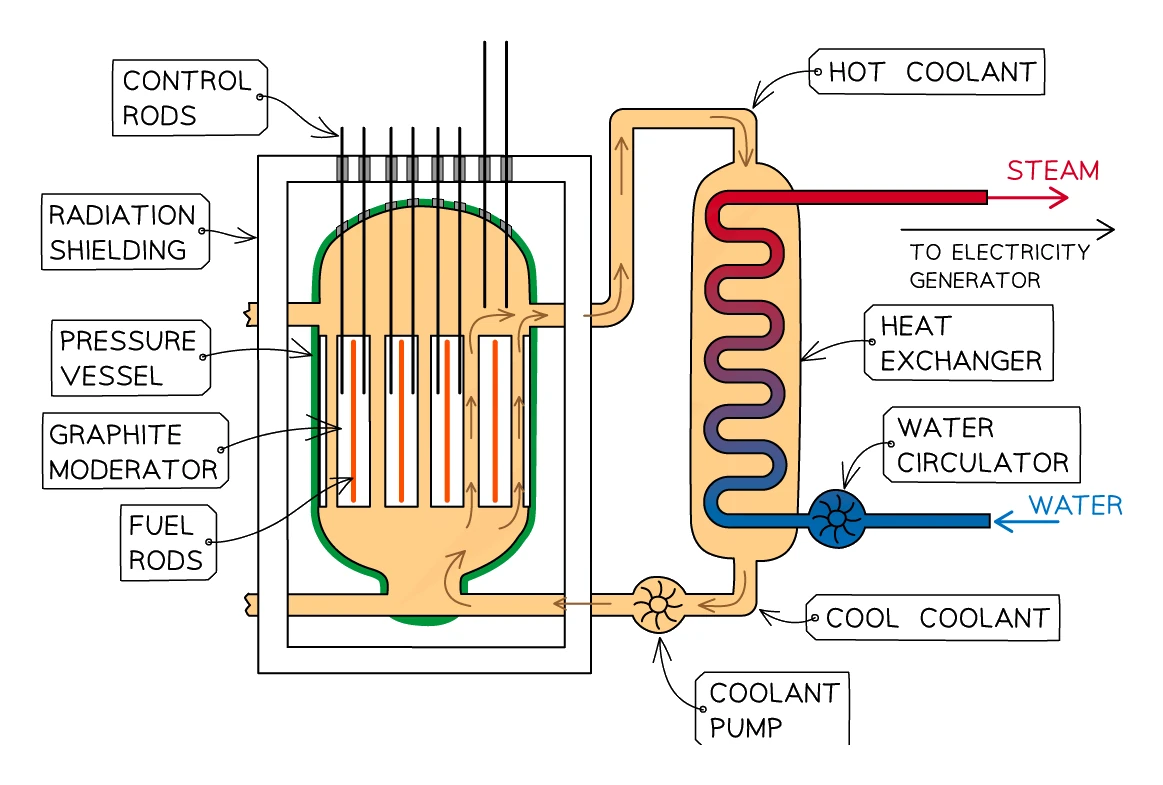
A nuclear reactor's job is to keep the chain reaction running steadily (k = 1) so that the heat output is constant and controllable. To do that it needs four key components:
Fuel rods
- Long thin rods of uranium dioxide containing enriched uranium (uranium ore is mostly uranium-238; for reactor fuel it is enriched to a few percent uranium-235)
- The fuel rods sit in a regular array inside the reactor core
- The geometry matters: the rods are spaced so that neutrons leaving one rod have a good chance of triggering fission in a neighbouring rod, but not so close that the reaction runs out of control
Moderator
- The neutrons released from fission are fast, far too fast to be absorbed efficiently by uranium-235
- A moderator is a material that fills the space between the fuel rods. As fast neutrons travel through it, they bounce off the moderator atoms and lose kinetic energy in each collision
- After many collisions, the neutron is travelling slowly enough that it is in thermal equilibrium with the moderator. These slow neutrons are called thermal neutrons and are very efficiently absorbed by uranium-235
- Common moderators: water (the most widely used), heavy water (D₂O), and graphite
- A good moderator must:
- Have light atoms (light atoms absorb more energy per collision, the same as a billiard ball bouncing off another billiard ball rather than off a bowling ball)
- Not absorb neutrons itself, otherwise it would shut the chain reaction down
Control rods
- The reactor needs to swallow up the excess neutrons left over after each fission has triggered exactly one more fission. That is the job of control rods
- Control rods use a material that soaks up neutrons very efficiently but does not itself fall apart in the process. The standard choices are boron and cadmium
- The rods are lowered into, or raised out of, the reactor core to adjust the absorption rate:
- Lower the rods deeper → more neutrons absorbed → fewer fissions → reactor cools down
- Raise the rods further → fewer neutrons absorbed → more fissions → reactor heats up
- An automatic feedback system continuously adjusts the rod position to keep k at exactly 1
- In an emergency shutdown, the rods are dropped all the way into the core. Almost every neutron is absorbed and the chain reaction stops within seconds
Common exam question
The moderator and the control rods
Question: Give the material and the job of the moderator and the control rods (as a tick table or sentences to complete), or describe the role of the control rods (2–4 marks).
Asked in 3 of the 24 papers. The moderator (graphite, or water) slows the neutrons down, and slow neutrons are much more likely to cause fission. The control rods (boron) absorb the excess neutrons, which stops those neutrons causing fission and so slows the rate of fission; they are lowered into or raised out of the core to adjust that rate. Keep "slow" with the moderator and "absorb" with the control rods, and do not swap them.
When the question asks for the role of the control rods, the material scores nothing: the two marks are any two of absorbing neutrons, stopping those neutrons causing fission and slowing the rate of fission, so "made of boron" on its own earns none.
Shielding
- Fission products, neutrons and gamma rays are all dangerous
- The reactor core is surrounded by thick shielding, typically a steel pressure vessel inside a reinforced concrete containment building several metres thick
- The shielding has two jobs:
- Absorb the radiation so that workers and the surrounding area are safe
- Contain any radioactive material in the event of an accident
Common exam question
The role of the shielding
Question: Describe the role of the shielding around a nuclear reactor, or name a material suitable for the reactor walls (1–2 marks).
Asked in 2 of the 24 papers. One mark is for saying that the shielding prevents radiation escaping from the core (saying that it absorbs the radiation, or that it protects the people working outside the core, is accepted instead); the second is for saying how: it absorbs the neutrons, fission products and gamma rays. For the material, concrete, lead or thick steel each score.
Be exact about what the shielding does to the radiation: vague wording such as "stops it" or "it can't pass through" is ignored, while "absorbs" is credited. Points about the strength or structure of the reactor are ignored too.
Heat extraction and electricity generation
- The heat from the fissioning fuel is removed by a coolant (usually water, sometimes pressurised carbon dioxide gas or liquid sodium) flowing through the core
- The hot coolant heats water in a separate loop, producing high-pressure steam
- The steam drives a turbine connected to a generator, which produces electricity by electromagnetic induction (topic 18)
5. Nuclear fusion
Definition
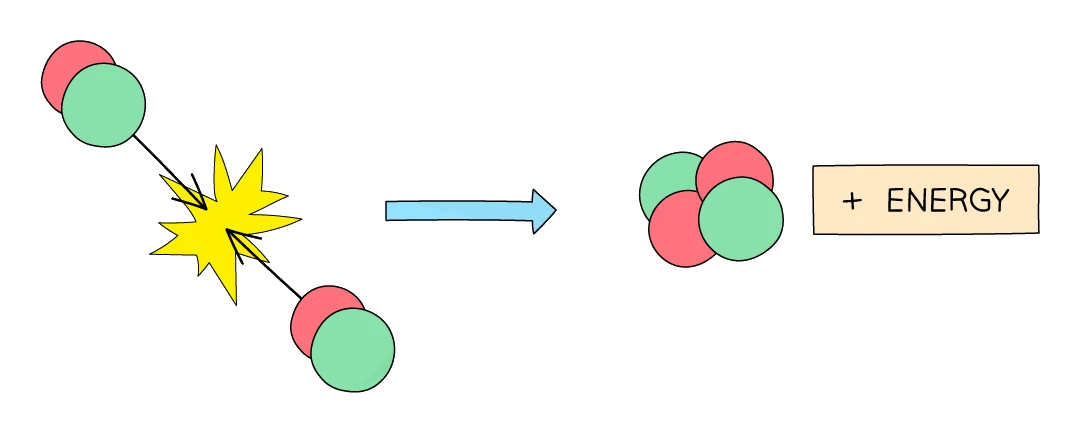
Nuclear fusion is the joining together of two small nuclei to form a larger nucleus
- The combined nucleus is more stable (more tightly bound) than the two separate nuclei, so the reaction releases energy
- Fusion is the opposite of fission. Fission breaks a heavy nucleus apart; fusion glues light nuclei together. Both release energy because nuclei in the middle of the periodic table (around iron) are the most tightly bound
Common exam question
Difference between fission and fusion
Question: Describe the difference between nuclear fusion and nuclear fission, or tick which statements apply to each (2–3 marks).
Asked in 3 of the 24 papers. For the two-mark version one mark is for fission as the splitting of a nucleus and the other for fusion as the joining of two nuclei; "breaking down", "dividing", "combining" and "fusing" are all accepted. Both halves must be about nuclei: "atoms", "particles" and "molecules" are rejected, and so is describing fusion as neutrons joining.
For the tick table, sort the facts: fusion takes place in the cores of stars and turns hydrogen into helium; fission starts when a nucleus absorbs a neutron, splits a large nucleus and leaves radioactive daughter nuclei. The energy source of stars also appears as a one-mark multiple-choice question in two papers, and the answer is fusion.
A typical fusion equation: deuterium + tritium
- The easiest fusion reaction to achieve on Earth is between two heavy isotopes of hydrogen, deuterium (²₁H) and tritium (³₁H):
²₁H + ³₁H → ⁴₂He + ¹₀n + energy
- Check the totals:
- Mass numbers: 2 + 3 = 4 + 1 ✓
- Atomic numbers: 1 + 1 = 2 + 0 ✓
- The products are a helium-4 nucleus plus a free neutron, and a huge release of energy (roughly 17 MeV per fusion, four times the energy per nucleon released by uranium-235 fission)
How fusion releases energy
- The mass of the products is slightly less than the mass of the starting nuclei
- The "lost" mass has been converted into energy according to Einstein's relation E = mc². Even a tiny mass difference becomes a huge amount of energy because c² is so large
- This same mass-into-energy conversion happens in fission, but the fraction of mass converted per fusion event is larger, which is why fusion produces more energy per kilogram of fuel
Why fusion is special
- Fusion is the energy source of the Sun and all stars
- The sunlight you receive each day is produced by hydrogen-fusion reactions in the Sun's core, and takes about 8 minutes to travel from the Sun to Earth
- On Earth, fusion has been demonstrated in hydrogen bombs (uncontrolled) and in experimental fusion reactors (controlled), but a commercially viable fusion power station does not yet exist
6. The conditions for fusion
The electrostatic barrier
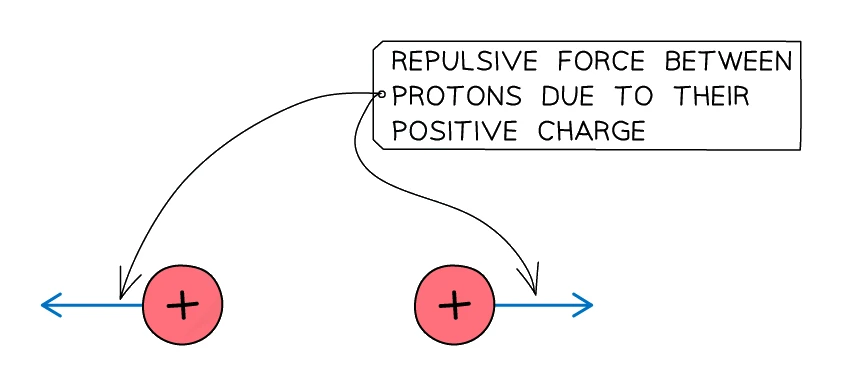
- Hydrogen nuclei are protons, each carrying a positive charge of +1
- Two positive charges repel each other. The closer they come, the stronger the repulsion (Coulomb's law: F ∝ 1/r²)
- For fusion, the two protons have to come close enough that the strong nuclear force can take over and bind them. The strong force has a very short range, about 10⁻¹⁵ m
- To get that close, the protons have to overcome an enormous electrostatic repulsion. They need a huge amount of kinetic energy to bull through the barrier and reach the strong-force range
Why fusion needs extreme conditions
- High kinetic energy means high speed, and high speed means high temperature, because temperature is a measure of the average kinetic energy of the particles
- The conditions for fusion are:
- Extremely high temperature (many millions of degrees), so that the nuclei are moving fast enough to overcome electrostatic repulsion
- Extremely high pressure (or density), to pack the nuclei close together so that they collide often enough for fusion to happen at a useful rate
- In the core of the Sun:
- Temperature ≈ 15 million °C
- Pressure ≈ 250 billion atmospheres
- At anything like Earth-surface conditions, two hydrogen nuclei almost never approach close enough to fuse. The gas would have to be heated to tens of millions of degrees to produce a meaningful fusion rate. That is why fusion is so difficult to reproduce on Earth
Common exam question
Why fusion needs high temperature and pressure
Question: Explain the two conditions needed for nuclear fusion to happen, or give a reason why fusion cannot happen at low temperatures and pressures (1–4 marks).
Asked in 2 of the 24 papers. The reason is the electrostatic repulsion between the nuclei (or protons), which are all positively charged. For the full explanation, state each condition and link it to its effect, four separate marks: a very high temperature, so that the nuclei move fast enough (have enough kinetic energy); and a very high pressure, so that the nuclei are closer together, or collide more often.
In the four-mark version, saying that the temperature "overcomes the repulsion" adds nothing: references to repulsion are ignored there, and the second mark is for the speed or kinetic energy of the nuclei. "Particles", "atoms" and "molecules" are condoned here, but nuclei is still the safe word.
How stars achieve those conditions
- A star is a vast ball of hydrogen gas held together by its own gravity
- Gravity pulls every atom of the star towards the centre, squeezing the gas into a dense, hot core
- At the temperatures and pressures inside the core, hydrogen fuses into helium, releasing energy
- The energy released flows outwards and creates an outward pressure (radiation pressure plus hot-gas pressure) that resists the inward pull of gravity
- A stable star is in equilibrium: the inward gravitational force equals the outward pressure force at every depth. As long as the core has hydrogen left to fuse, the star stays the same size
Inside a star: building heavier elements
- Once the hydrogen in the core runs out, the core contracts and heats up further until helium nuclei start to fuse into heavier elements such as carbon, oxygen, and so on
- In very large, hot stars, fusion can continue all the way up to iron. Iron is the most tightly bound nucleus, so fusing iron does not release energy; it absorbs it. When the core of a very large star reaches iron, fusion stops and the star collapses, often triggering a supernova (covered in topic 23)
7. Fission vs fusion compared
| Nuclear fission | Nuclear fusion | |
|---|---|---|
| What happens | One large nucleus splits into two smaller ones | Two small nuclei join to form a larger one |
| Typical fuel | Uranium-235, plutonium-239 | Deuterium and tritium (isotopes of hydrogen) |
| Conditions needed | Slow (thermal) neutrons; critical mass of fuel | Extremely high temperature and pressure |
| Where it happens | Nuclear power stations and weapons on Earth | The cores of stars; experimental reactors on Earth |
| Products | Two smaller daughter nuclei (usually radioactive) + 2 or 3 neutrons + gamma rays | A larger nucleus (usually stable, not radioactive) + sometimes a neutron + gamma rays |
| Radioactive waste? | Yes, long-lived, dangerous, must be stored for thousands of years | No long-lived waste; the helium product is inert |
| Energy per kg of fuel | Very high (≈ 10⁷ × chemical reactions) | Even higher (≈ 4 × fission per kg) |
| Fuel availability | Uranium ore is rare and concentrated in few countries | Deuterium can be extracted from sea water; abundant everywhere |
| Practical on Earth? | Yes, has powered electricity for 70 years | Not yet, still experimental |
Common exam question
Weighing fission against fusion as an energy source
Question: Give disadvantages of using nuclear fission to generate electricity, or discuss why a fusion reactor would be safer than a fission one (2–3 marks).
Set in 2 of the 24 papers. For fission's drawbacks, any two of: it produces radioactive waste that needs long-term storage; uranium is itself radioactive; the fuel is non-renewable; there is a risk of a nuclear accident (naming one is fine); and the set-up and decommissioning costs are higher. An unqualified "it is expensive" is ignored.
For fusion's safety case, compare the two reactors: fusion's fuel is less hazardous and the products of fusion are not radioactive, unlike fission's daughter nuclei, so there is no cancer or cell damage from the products, no long-term waste storage, a lower risk of meltdown (or none) and no runaway chain reaction. Any three distinct points earn the three marks.
- Fusion is, in principle, a far better energy source than fission: more energy per kg, more abundant fuel, no long-lived radioactive waste, no risk of meltdown. The only problem (but it is an enormous one) is that no one has yet built a fusion reactor that produces more electrical energy than it consumes