1. Energy stores and transfer pathways
The store-and-pathway model
- Energy in any physical situation is described as sitting in one of several stores and being moved between those stores by one of a few transfer pathways
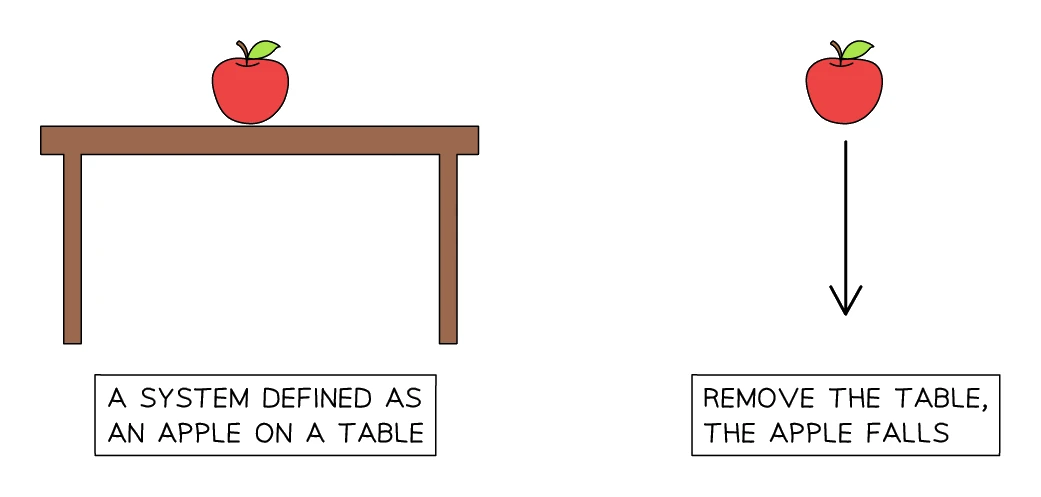
- A system is the object (or group of objects) you have chosen to focus on; defining the system fixes the boundaries of which stores and which transfers count for the question
- When a system is in equilibrium, no stores are changing and nothing happens; when something changes, energy moves between stores
The eight energy stores
| Store | Where it sits |
|---|---|
| Kinetic | Any moving object |
| Gravitational potential | An object raised above the ground in a gravitational field |
| Elastic potential | A material that has been stretched, squashed, bent or twisted |
| Magnetic | Magnetic materials interacting through their fields |
| Electrostatic | Charged particles or objects interacting through their fields |
| Chemical | Chemical bonds inside fuels, foods, batteries and other reactants |
| Nuclear | The bonds holding protons and neutrons together inside the nucleus |
| Thermal (internal) | The random kinetic and potential energy of the particles inside any object above absolute zero |
The four transfer pathways
| Pathway | Mechanism |
|---|---|
| Mechanical | A force acting on an object as the object moves (pushing, pulling, stretching, squashing) |
| Electrical | A current carrying charge through a potential difference |
| Heating | Energy transferred from a hotter object to a colder one by conduction or convection |
| Radiation | Energy carried away from a surface by electromagnetic waves (most commonly infrared) |
Reading an energy transfer
- To describe what happens in a system in store-and-pathway language, answer three questions:
- which store is the energy moving from?
- which store is it moving to?
- which pathway is carrying it?
Example A — a wound-up clockwork toy is released and runs across the floor. Identify the stores and pathway.
- Wound up, the toy holds its energy in the elastic potential store of its coiled spring
- Once the spring unwinds, the gears and wheels carry the toy across the floor, so the energy ends in the kinetic store of the moving toy
- A spring force acting through the gear teeth does the work, so the pathway is mechanical
- A small amount also leaks to the thermal store of the gears as friction warms them, and this is the wasted share
Example B — a stone is dropped from a window ledge. Identify the stores and pathway.
- Before release, all the stone's energy sits in its gravitational potential store, because it has been raised above the ground
- As gravity pulls it downwards and it picks up speed, the energy fills its kinetic store instead
- The pull of weight acting along the fall distance is the work being done, so the pathway is mechanical
- Net effect: a mechanical pathway carries the energy out of the stone's gravitational potential store and into its kinetic store
Common exam question
Describing an energy transfer in stores and pathways
Question: Describe the energy transfers in a situation (a falling car, a marble run) using stores and pathways, or name a store that increases or decreases, or the method of transfer (1–5 marks).
Asked in 14 of the 24 papers. Name every store and every pathway in order: for a falling car, energy goes from its gravitational store to its kinetic store, mechanically (by a force such as weight); a person lifting a marble that then rolls moves energy from their chemical store to its gravitational store, then its kinetic store, mechanically each time. Then the wasted share: the thermal store of the object and surroundings increases, by heating or radiation (sound counts as radiation). Each pathway is a separate mark, so stores alone leave marks behind.
When asked which store changes, give its direction as well as its name: the gravitational store of a falling object decreases while its kinetic store increases. Say thermal, not heat, which one scheme rejects.
2. Conservation of energy
The principle
- The states:
Energy cannot be created or destroyed; it can only be transferred from one store to another.
- For any closed system, the total energy across all the stores stays constant
- Energy is never truly lost, but it can be (spread out) into the surroundings by heating or radiation; once dissipated, it is wasted because the original task cannot reclaim it
Useful and wasted energy
- Every real transfer produces a mixture of:
- Useful energy in the store the designer wanted (the kinetic store of the moving fan, the thermal store of the food)
- Wasted energy spread around the surroundings (heating from friction, sound carried away into the air, infrared radiation off hot casings)
- The total of useful + wasted output always equals the input, which is conservation of energy in practice
Exam tip
State conservation of energy with both halves
When a question asks what the principle of conservation of energy means (one mark), write that energy cannot be created or destroyed, only transferred from one store to another. The scheme wants both words: "lost" or "removed" in place of "destroyed" earns nothing. The same principle is the first mark when you justify an amount of wasted energy: energy is conserved, so the total input equals the useful output plus the wasted energy; then show that subtraction with the numbers given, which is the second mark.
Worked example
Calculating kinetic energy
A 4 kg ball rolls along a surface at 6 m/s. Calculate its kinetic energy.
Solution:
- Write the formula: KE = ½ × mass × speed²
- Substitute: KE = ½ × 4 × 6²
- Square the speed first: 6² = 36
- KE = ½ × 4 × 36 = 2 × 36 = 72 J
3. Efficiency
Definition
- The of a system is the fraction of the energy supplied to it that comes out in the useful form
- Stated as an equation:
efficiency = (useful energy output / total energy input) × 100 %
- Efficiency is a pure ratio and has no units; it may be given as a decimal between 0 and 1 or as a percentage between 0 and 100 %
- A high-efficiency system wastes very little; a low-efficiency system spreads most of its input into the surroundings
Useful and wasted always add to the input
- Because energy is conserved:
total energy input = useful energy output + wasted energy
- This lets you find any one of the three when the other two are known
Common exam question
Calculating efficiency or the energy wasted
Question: Calculate the efficiency of a motor or turbine from its useful and total energy, or use a given efficiency to find the total or wasted energy, sometimes after stating the formula (3–4 marks).
Asked in 7 of the 24 papers. The formula mark is efficiency = useful energy output ÷ total energy output × 100%; "input" for "output" and a missing × 100% are both accepted. Substitution (which can imply the formula), rearrangement and evaluation score separately, as does any energy calculated first: the total (E = I × V × t) or useful energy (½ × m × v²). Match the answer line: with % printed write 83 (or cross it out and write 0.83); without it write 0.29 or 29%, as a bare 29 was treated as a power-of-ten slip.
Given the efficiency and the useful or total energy, find the other, then subtract to get the wasted energy; the wasted percentage of the total also scores.
Worked example
Calculating efficiency
A motor receives 120 J of electrical energy and transfers 90 J as useful kinetic energy. Calculate its efficiency.
Solution:
- Write the formula: efficiency = (useful energy output ÷ total energy input) × 100 %
- Substitute: efficiency = (90 ÷ 120) × 100 %
- efficiency = 0.75 × 100 % = 75 %
Worked example
Finding the wasted energy from an efficiency
An electric winch has an efficiency of 40%. While it lifts a crate, 600 J of energy is transferred usefully to the crate's gravitational store. Calculate the energy wasted during the lift.
Solution:
- Write the formula: efficiency = (useful energy output ÷ total energy output) × 100 %
- Turn the efficiency into a decimal and substitute: 0.40 = 600 ÷ total energy output
- Rearrange: total energy output = 600 ÷ 0.40 = 1500 J
- Wasted energy = total − useful = 1500 − 600 = 900 J
Finding 60% of the total instead (0.60 × 1500 = 900 J) is an equally valid route.
Sankey diagrams
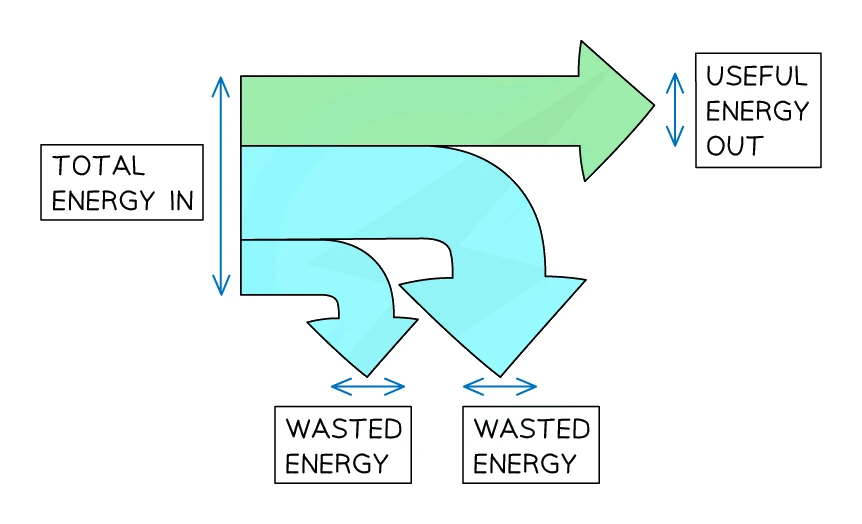
- A Sankey diagram is a visual way to show an energy transfer:
- The width of each arrow is drawn in proportion to the amount of energy it represents
- The left-hand stub is the total input
- The straight horizontal arrow on the right shows the useful output
- The arrows that branch downwards show the wasted outputs (often labelled with the loss mechanism, such as heating, sound, or friction)
- A modern LED bulb has a Sankey diagram with a wide horizontal arrow (light output) and only a thin branch (heat waste); an old filament bulb has the opposite shape, with most of the input wasted as heat
Common exam question
Drawing or completing a Sankey diagram
Question: Draw a labelled Sankey diagram for a transfer with a given efficiency, or complete a printed one by adding the missing arrow, labels or values (3 marks).
Asked in 4 of the 24 papers. From scratch, one mark is for the shape (one input arrow splitting into two outputs, in any direction), one for the labels (total or source store in, useful out, wasted out to the thermal store) and one for the scale: the wasted arrow visibly wider than the useful one in about the right ratio (for 15% efficiency at least four times) and the two outputs together as wide as the input.
On a printed diagram the widths are counted in small squares and must add up to the input. Add only the one missing arrow, labelled as the useful output, never a power. Filling in values means naming the pathway (electrically, from the battery) and the thermal store, and making outputs sum to the input.
4. Conduction, convection and radiation
The three modes of heat transfer
- Three distinct processes carry thermal energy from a hot region to a cold one:
- Conduction: the main heat transfer in solids; energy passes from particle to particle along the material without the particles moving overall
- Convection: the main heat transfer in fluids (liquids and gases); whole regions of hot fluid actually move from one place to another, carrying their energy with them
- Radiation: heat transfer through infrared electromagnetic waves; the only one of the three that can carry energy through a vacuum, because no medium is needed
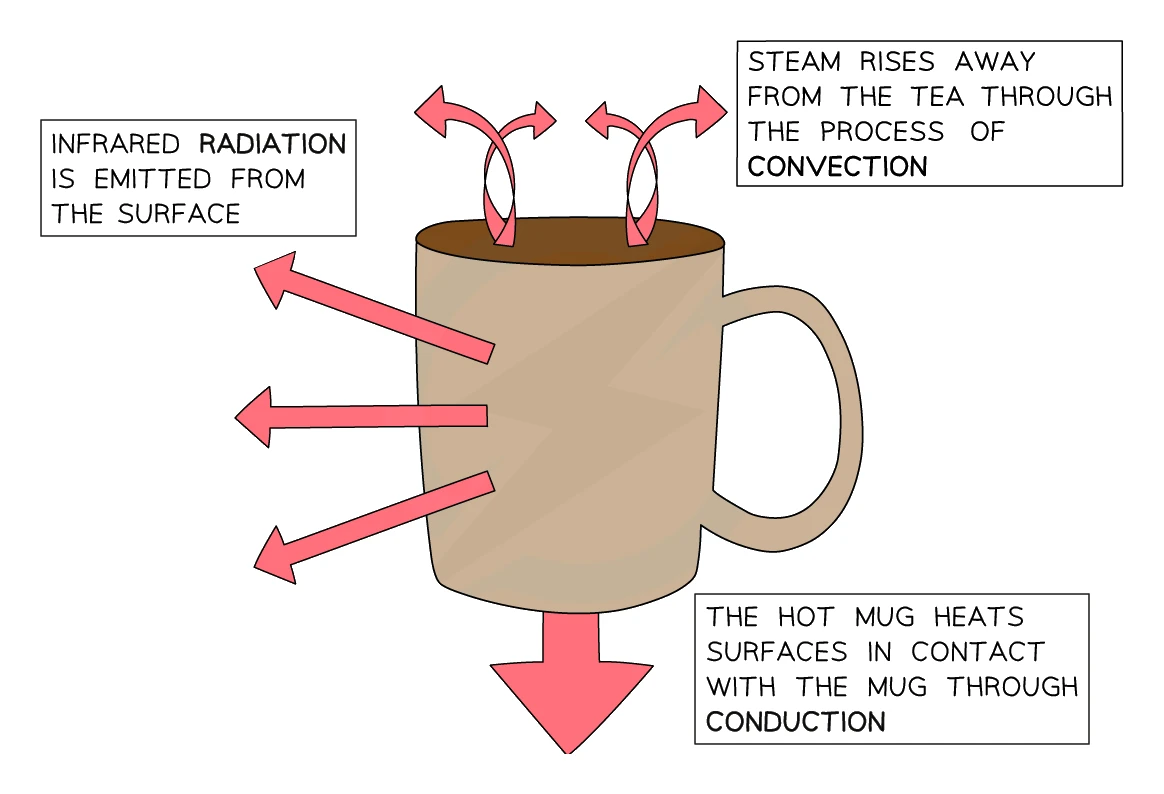
- A real-world example often uses all three at once. A hot mug of coffee: conducts into the table beneath it, sets up a convection current in the steam rising above the surface, and radiates infrared from the outside of the mug
Conduction in detail
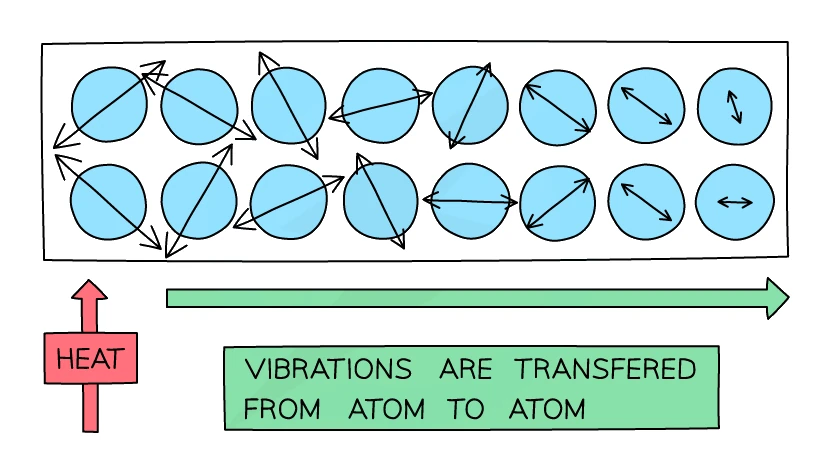
- In any solid, the particles vibrate about fixed positions; the hotter the material, the larger the vibrations
- When one end of a solid is heated, the particles at that end vibrate more strongly. They collide with neighbouring particles, passing the extra vibrational energy along the line
- Metals are especially good thermal conductors because they have delocalised electrons that drift freely through the lattice:
- the free electrons collide far more often with the vibrating ions than the ions collide with each other
- they carry energy across the metal much faster than vibration alone
- this is why a stainless-steel teaspoon left in a hot cup of tea quickly becomes too warm to hold, while a wooden stirrer of the same shape stays cool
Why insulators insulate
- A thermal insulator is a material in which conduction happens only slowly
- Common insulators include wood, plastic, rubber, glass, dry paper, and any material with lots of trapped air
- Trapped air is one of the best insulators:
- the air molecules are far apart, so very few collisions pass energy along
- if the air is trapped in pockets (within wool, fibreglass, foam, feathers), it cannot move as a convection current either, so the convection pathway is also shut down
Convection in detail
- When a region of a fluid is heated:
- the particles in that region gain kinetic energy and push each other further apart
- the fluid in that region expands and becomes less dense than the cooler fluid around it
- the less-dense hot fluid rises, while the cooler, denser fluid sinks to take its place
- The rising and sinking sets up a closed loop of moving fluid called a current
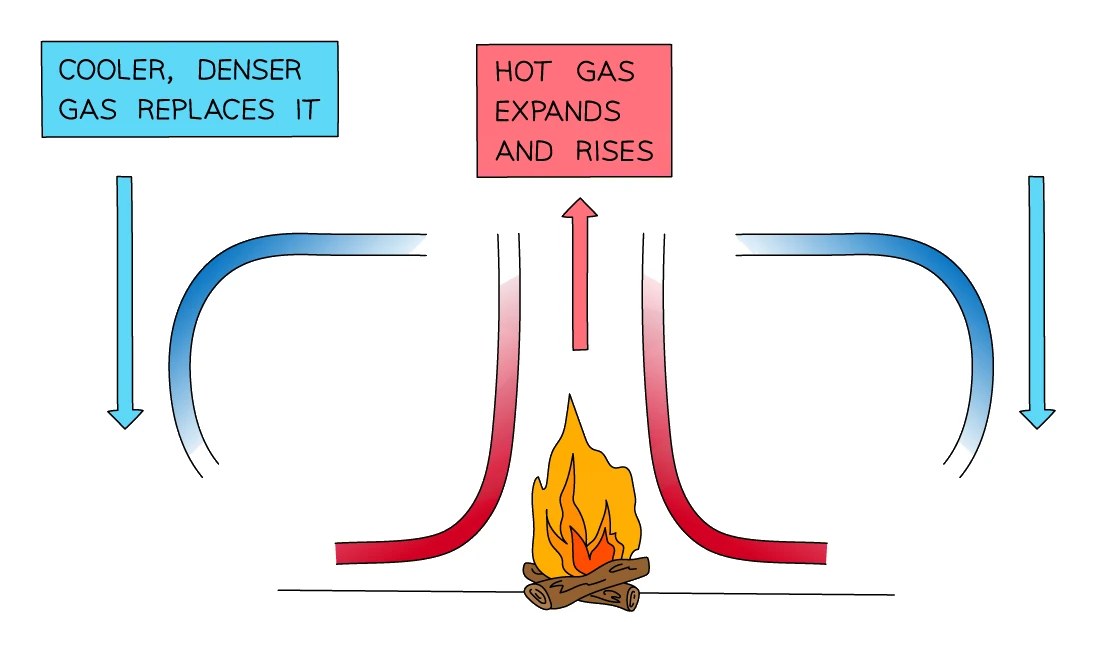
- Convection currents drive everyday heating: radiators warm rooms by setting up a current of air around the room; the sun warms the atmosphere by setting up large convection cells; ocean currents move warm and cool water around the globe
Common exam question
Explaining how a convection current forms
Question: Explain how a convection current forms in the air or water near a heater, or how convection lifts or cools something (2–4 marks).
Asked in 4 of the 24 papers. The marks are a chain of separate points, so give them in order: the fluid near the heater is heated; it expands (its particles move further apart); its density decreases; the warm, less dense fluid rises; cooler, denser fluid sinks to replace it; the process repeats. A four-mark question needs four of these and a two-mark question two, so do not stop at "hot air rises".
Say the fluid expands and becomes less dense, never the particles: "the particles expand" and "the particles become less dense" are both rejected, and "heat rises" earns nothing. For something cooling (the air above snow), the point is that warm air rises away, so the coldest air sits nearest the snow and the energy transfer to it slows.
Radiation in detail
- Every object at any temperature above absolute zero emits infrared (thermal) ; the hotter the object, the more it emits per second
- Thermal radiation is a transverse electromagnetic wave, so it carries energy through a vacuum (the way sunlight reaches Earth across 150 million km of empty space) as well as through transparent media
- The colour and finish of a surface strongly affects how well it emits and absorbs thermal radiation:
| Surface | Absorbs infrared | Emits infrared |
|---|---|---|
| Matt black | Excellent absorber | Excellent emitter |
| Dull / dark | Good absorber | Good emitter |
| Matt white | Poor absorber | Poor emitter |
| Polished, shiny silver | Very poor absorber (reflects most) | Very poor emitter |
- Practical consequences:
- solar panels and solar-heating absorbers are painted matt black to absorb as much sunlight as possible
- emergency space blankets are made of shiny silver foil to reflect a person's body-heat radiation back inwards
- houses in hot climates are often painted white to reduce both absorption from the sun and emission of heat back outwards
- vacuum flasks have silvered inner walls to cut radiation losses (alongside the vacuum that blocks conduction and convection)
Common exam question
Explaining a surface colour in terms of infrared
Question: Explain why a black surface warms up faster than a white one, or which colour a surface should be to absorb or emit the least infrared (2–4 marks).
Asked in 8 of the 24 papers. For two marks, give the property then its consequence: a black surface is a better absorber of infrared radiation than white or shiny ones, so more energy is transferred to it in the same time and it warms up faster. The reverse (white is a poor absorber or good reflector, so stays cooler) scores too. On a spinning satellite a dull black bar absorbed faster facing the Sun and emitted faster facing away (four marks), with no conduction or convection in space.
Answer the property the question targets: to keep something cool in sunlight, write white or silver as poor absorbers (or good reflectors); for the inner walls of a cold box, the scheme wanted poor emitters. Points about the other property are ignored.
5. Core practical: investigating thermal energy transfers
Three sub-experiments
The single Edexcel core practical covers three separate investigations, each one isolating a different mode of thermal energy transfer.
Experiment A: rates of conduction in different metals
- Aim: compare the rate of thermal conduction in several metals (copper, aluminium, brass and iron) by timing how long it takes a wax-attached marker to fall off the cold end of each rod when the hot ends are heated equally
- Independent variable: the metal of the rod
- Dependent variable: the time taken for the wax to melt and the ball bearing (or pin) to fall
- Control variables: identical rod dimensions, identical wax blobs, identical ball bearings, identical heating from the central flame
| Equipment | Purpose |
|---|---|
| Conduction "wheel" of four rods (Cu, Al, brass, Fe) meeting at a central hub | The rods to be compared, all heated symmetrically at one end |
| Bunsen burner and heatproof mat | Heats the central hub equally for every rod |
| Identical balls of wax | Glue an identical ball bearing to the cool end of each rod |
| Four small ball bearings | The marker that falls when the wax melts |
| Stopwatch | Time how long each ball takes to fall once the flame is lit |
| Retort stand | Holds the conduction wheel above the bench |
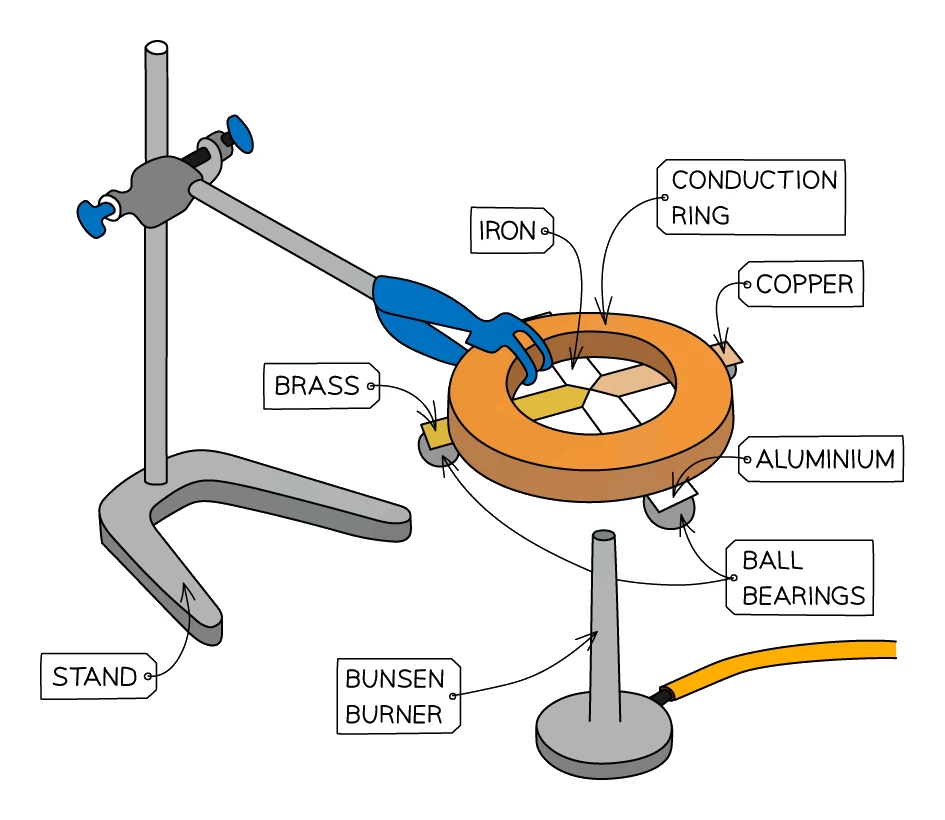
Method:
- Stick an identical small ball bearing to the cold end of each of the four rods using a small piece of wax
- Clamp the conduction wheel to a stand so the central hub sits over a Bunsen burner, with the rods spreading horizontally
- Light the burner so the central hub of all four rods receives the same heat
- Start the stopwatch the moment the flame steadies under the hub
- As the wax on each rod melts, the ball bearing drops; record the time for each rod
- Allow the rods to cool fully before repeating
Analysis:
- The shorter the time before the ball drops, the faster the conduction in that metal
- The expected ranking, fastest first, is copper → aluminium → brass → iron
- Plot a bar chart of mean time against metal to display the ranking
Common exam question
The conduction-in-metals practical
Question: For the rods-and-wax conduction experiment, name the variables, improve the fair test, justify repeats or a bar chart, judge which metal conducts best (1–3 marks per part).
Set in 2 of the 24 papers, worth ten or eleven marks. The independent variable is the metal (not "type of rod"), the dependent the time for the coin to fall. A fair test needs rods of equal length and thickness, equal wax and identical coins; repeating and averaging (or spotting anomalies) is a separate two-mark answer. The metal is categoric, hence a bar chart: a sensible linear time scale, both axes labelled (time with unit) and bars right to within half a small square.
The best conductor is the rod whose wax melted in the shortest time, so picking the slowest metal is wrong; justify from the times. The wooden ring is safer because wood is an insulator, so it does not get hot and nobody is burnt.
Experiment B: convection in water using potassium permanganate
- Aim: see a convection current set up in water by following the path of a coloured dye crystal that dissolves where the water is heated
| Equipment | Purpose |
|---|---|
| Beaker of water on a gauze and tripod | Holds the water to be heated |
| Bunsen burner, heatproof mat | Provides a localised heat source under one corner of the beaker |
| Potassium permanganate crystal | Releases a deep purple trail as it dissolves, marking the moving water |
| Forceps | Dropping the crystal in without dissolving it on your fingers |
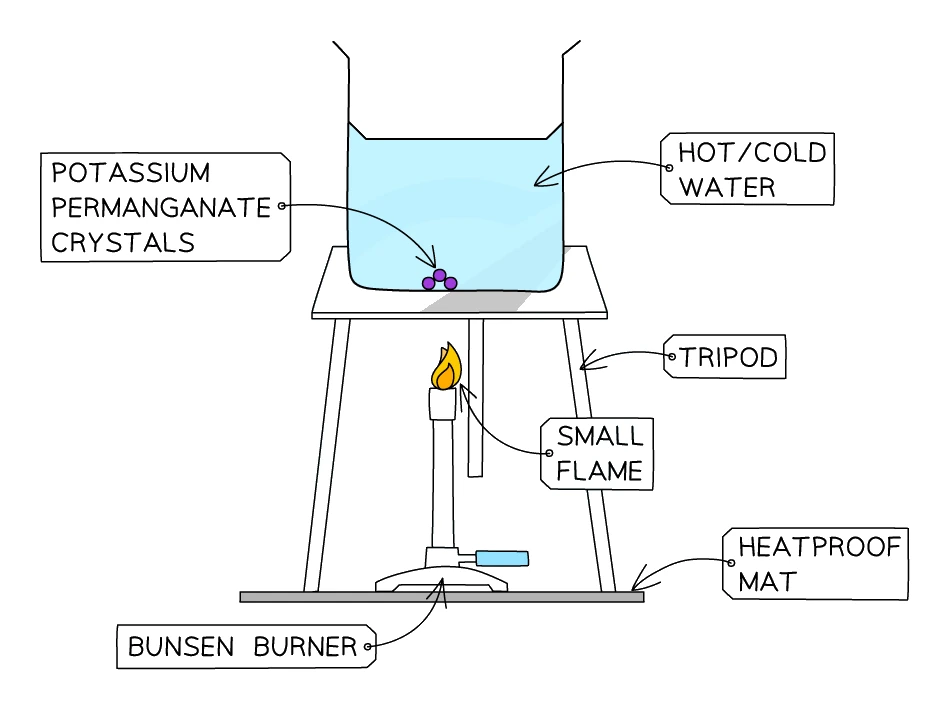
Method:
- Fill the beaker about three-quarters full with cold water and place it on the tripod above the unlit burner
- Carefully pick up a single potassium permanganate crystal with the forceps and drop it gently to the bottom of the beaker, slightly to one side rather than the centre
- Light the Bunsen burner directly below the crystal
- Observe how the purple trail moves through the water
Analysis:
- Where the crystal sits, the water heats, expands, becomes less dense, and rises, carrying the purple dye upwards in a clearly visible plume
- Cooler water from the rest of the beaker flows in to take its place, completing the convection loop
- The visible purple loop is direct evidence that bulk fluid motion (not just particle vibration) is transferring the heat
- Safety: potassium permanganate stains skin, clothing and surfaces; handle only with forceps and rinse spills immediately
Experiment C: thermal radiation from differently coloured surfaces
- Aim: compare how quickly water inside differently coloured but otherwise identical containers cools, and so investigate how surface colour affects emission of infrared radiation
- Independent variable: the colour and finish of the container (matt black, dull grey, matt white, shiny silver)
- Dependent variable: the water temperature recorded at fixed time intervals
- Control variables: identical container shape and size; identical starting volume of water; identical starting temperature; identical room temperature; identical lid arrangement
| Equipment | Purpose |
|---|---|
| Four identical metal cans or flasks painted matt black, dull grey, matt white and polished silver | The varied "surface" variable |
| Kettle of just-boiled water | Source of hot water for the cans |
| Four identical thermometers (or a data logger with four probes) | Read the water temperature in each can |
| Stopwatch | Time the readings |
| Lids with a small thermometer hole for each can | Reduce convection losses out of the top so radiation differences dominate |
Method:
- Set the four cans side by side on the bench at least an arm's length apart so they do not radiate to each other
- Fill each can from the kettle with the same volume of just-boiled water; replace the lid and slot the thermometer through the hole
- Note the starting temperature in each can (all four should match within ~1 °C)
- Take a temperature reading from each can every 30 s for 10 min
- Plot a graph of temperature (y-axis) against time (x-axis) for each can on the same axes
Analysis:
- The cans cooled fastest are the best emitters of infrared radiation
- The expected order, fastest cooling first, is matt black → dull grey → matt white → shiny silver
- All four cans lose roughly the same amount of heat by conduction (through the bench) and convection (out of the lid hole), so any difference between the cooling curves must be due to radiation differences
Sources of error and safety
- Experiment A: ensure all rods are at room temperature before starting; if one rod is still warm from a previous run, its wax will fall too quickly. Avoid handling the wax with your fingers because the heat from your hands also pre-warms the wax
- Experiment B: drop the crystal gently; agitating the beaker will create currents that look like convection but are mechanical. The room should be still
- Experiment C: read each thermometer at eye level to avoid parallax; minimise the size of the lid hole; ideally use a data logger to take all four readings simultaneously
- General safety: wear goggles when using a Bunsen burner; do not lean over hot apparatus; run any burns under cold water for at least five minutes
6. Reducing energy loss
Why bother?
- Real appliances waste energy in three common ways: conduction through casings, convection currents leaving hot regions, and radiation from hot surfaces. The energy is conserved, but the wasted share costs money and adds to greenhouse-gas emissions whenever the source is fossil-fuelled
- Reducing the wasted output raises the of the system: more of the same input ends up in the useful store
Reducing conduction
- Use materials with low thermal conductivity (good thermal insulators) wherever heat needs to stay in (or out)
- Make the insulating layer thicker, because heat takes longer to conduct through a thicker barrier
- Use materials that trap pockets of air, since air is itself a very poor conductor and pockets stop convection currents from forming inside the insulator
- Everyday examples:
- double glazing sandwiches a thin layer of air or argon between two glass panes
- loft insulation made of fibreglass mats placed between the joists
- woolly jumpers and quilted jackets trap air between the fibres
Reducing convection
- Stop the fluid (usually air) from moving and you stop convection currents from forming
- Practical methods:
- Cavity wall insulation: foam blown into the gap between the inner and outer walls of a house traps the air that would otherwise circulate as a current
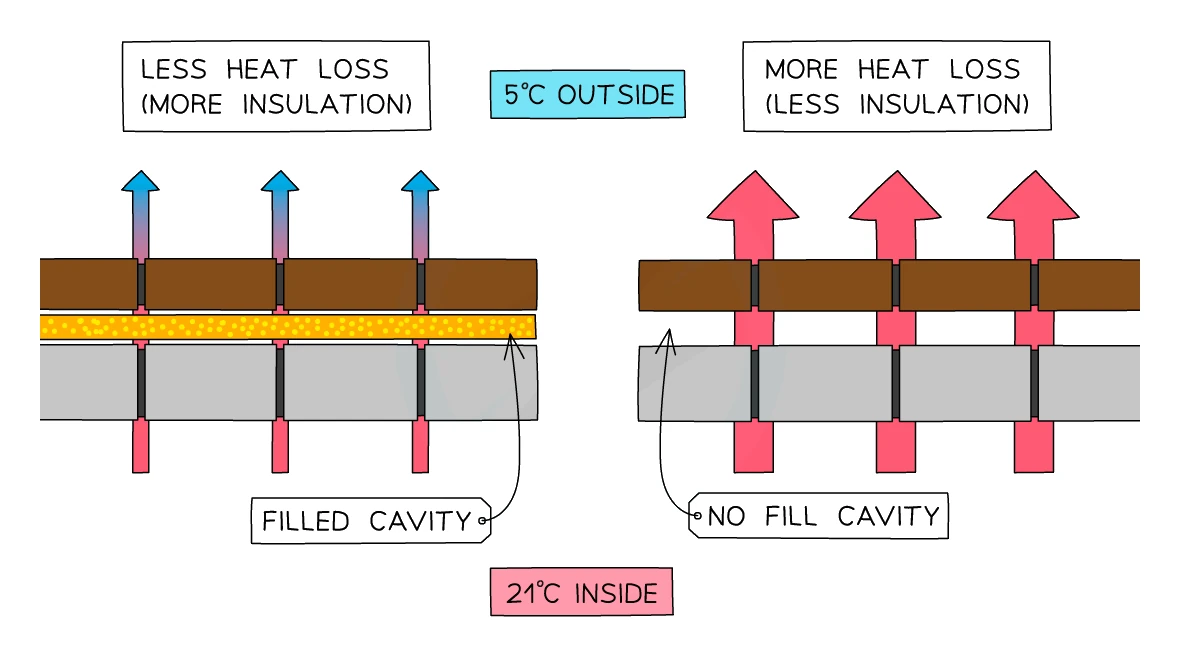
Reducing radiation
- Use surfaces that emit infrared poorly: polished, shiny silver
- Practical methods:
- The inner walls of a vacuum flask are silvered on both sides; the inner silver reflects infrared back inside, the outer silver reflects infrared from outside back out
- Foil-backed loft insulation reflects infrared from a warm room back downwards
- Emergency space blankets wrap a person in shiny silver to retain body heat in a cold environment
A vacuum flask in one sentence per pathway
- A vacuum flask combines all three tricks:
- the double-walled vacuum between the inner and outer flask stops both conduction and convection (no medium for either)
- the silvered surfaces of the inner walls stop radiation
- the insulating stopper at the top stops conduction and convection through what would otherwise be an open neck
Common exam question
Explaining how a design reduces energy transfer
Question: Explain how a design feature (air-filled layers, a lid, a shiny or white surface) reduces energy transfer by conduction, convection or radiation, or suggest changes to cut losses (2 marks per pathway).
Asked in 4 of the 24 papers. One physics reason per mark. Conduction: the material is a poor conductor; air is a gas with particles far apart that rarely collide; a thicker layer conducts more slowly. Convection: the air in the pockets or under the lid cannot move, so no convection current forms. Radiation: white or silver surfaces are poor emitters of infrared.
Explain the pathway named: in a conduction part "trapped air" alone was ignored by one scheme (it is the convection answer): say the air is a poor conductor. A lid on a cooling experiment cuts convection and evaporation, so less energy leaves: higher final temperature, longer cooling time. Improvements score as named changes: insulate the beaker, make the outside shiny.
Common-language traps to avoid
- "Heat rises": what actually rises is hot fluid that has become less dense. Heat itself is not a substance with a direction
- "Shiny things reflect heat": shiny surfaces reflect infrared ; they cannot reflect conduction or convection because neither bounces
- "Black things absorb heat": black surfaces absorb infrared radiation; they do not absorb conduction or convection separately
- A good exam answer almost always mentions more than one of conduction, convection and radiation