1. Solids, liquids and gases
The three states of matter
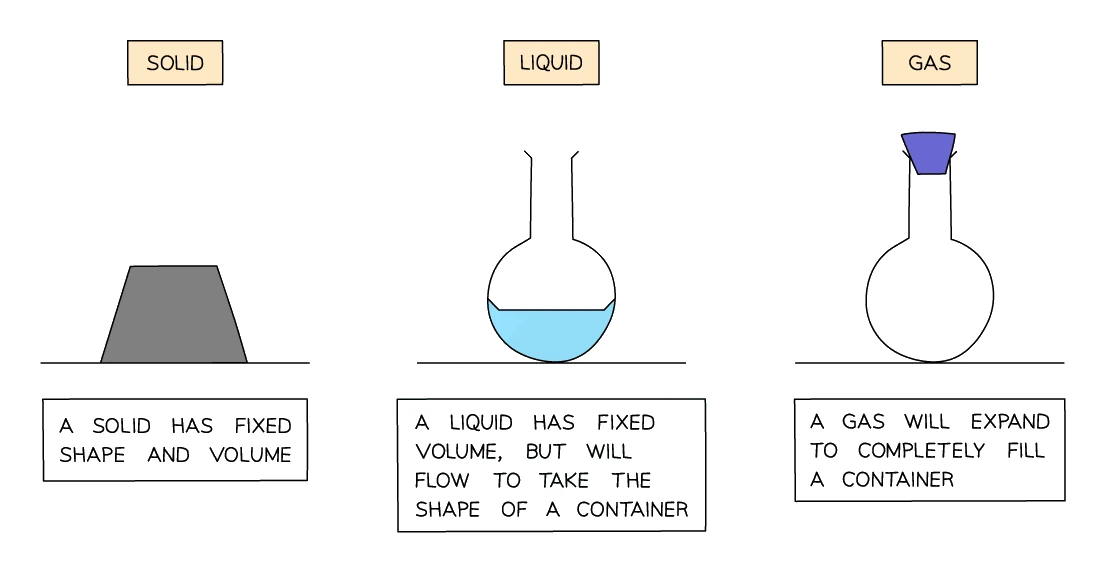
- All ordinary matter exists in one of three states at typical temperatures: solid, liquid or gas
- The state determines whether the material has a fixed shape, a fixed volume, and how easily it flows or compresses
Particle behaviour in each state
- Solid
- Particles are packed tightly in a regular pattern (a lattice)
- Each particle vibrates about a fixed position; it cannot move past its neighbours
- The material has a definite shape and a definite volume
- Liquid
- Particles are still in contact but no longer locked into a lattice; they move freely past one another
- The material has no definite shape (it flows to fit the bottom of any container) but still has a definite volume
- Gas
- Particles are far apart with mostly empty space between them
- Particles move rapidly and randomly in all directions
- The material has no definite shape and no definite volume; it expands to fill any container it is placed in
- Gases are easily compressed because the large gaps between particles can be squeezed out
| Property | Solid | Liquid | Gas |
|---|---|---|---|
| Density | High | Slightly lower than solid | Very low |
| Particle arrangement | Regular lattice | Closely packed but disordered | Far apart, randomly arranged |
| Particle motion | Vibrate about fixed positions | Slide past each other | Move rapidly in all directions |
| Particle energy | Low | Higher than solid | Highest |
| Definite shape? | Yes | No | No |
| Definite volume? | Yes | Yes | No |
| Easily compressed? | No | No | Yes |
Common exam question
Describing the arrangement and motion of particles
Question: Describe the arrangement and motion of the particles in a solid, a liquid or a gas, or compare two states (2–4 marks).
Asked in 6 of the 24 papers. Give both a spacing point and an order point for the arrangement, plus a separate motion point: one scheme ignores "irregular" and credits only the spacing, while others mark spacing and order separately. Solid: close together in a regular arrangement, vibrating about fixed positions ("fixed positions" is the arrangement mark, "vibrating" the motion mark). Liquid: still close together but irregular, and the particles move randomly and slide over each other or flow. Gas: far apart, randomly arranged, moving quickly and randomly in all directions.
Answer only the half that is asked: an arrangement question ignores motion, and a motion question ignores spacing and arrangement. For a liquid write "slide over each other" rather than "move freely", which one scheme ignores. A clear, labelled diagram can earn the arrangement marks on its own.
2. Changes of state
The six named transitions
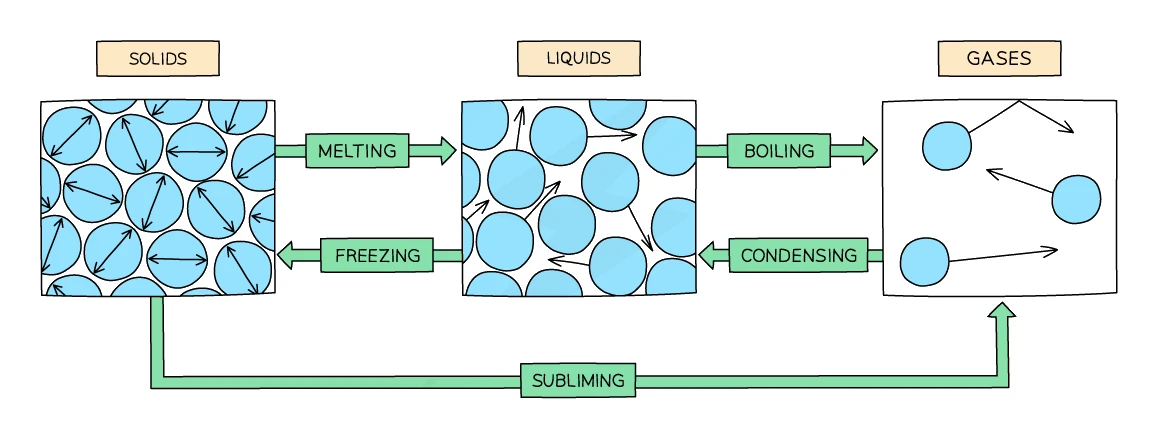
- The transition between two states is given its own name based on which state the material starts and ends in:
| Starting state | Ending state | Name |
|---|---|---|
| Solid | Liquid | Melting |
| Liquid | Solid | Freezing (sometimes "solidification") |
| Liquid | Gas (throughout the bulk, at boiling point) | Boiling |
| Liquid | Gas (at the surface only, below boiling point) | Evaporation |
| Gas | Liquid | Condensation |
| Solid | Gas (directly, without melting first) | Sublimation |
- Melting and freezing happen at the of the substance (0 °C for water, for example); these are exactly the same temperature, just approached from different directions
- Boiling happens at the (100 °C for water at sea level); below this temperature, only the slower surface process of evaporation can happen
Boiling vs evaporation
| Feature | Boiling | Evaporation |
|---|---|---|
| Where does it happen? | Throughout the bulk of the liquid | Only at the surface |
| At what temperature? | Only at the boiling point | At any temperature below boiling |
| Energy source | External heating | Random thermal energy of the liquid itself |
| Bubbles? | Yes: vapour bubbles form inside the liquid | No bubbles, just slow surface escape |
| Speed | Fast | Slow |
| Why specific particles leave? | All particles have enough kinetic energy | Only the most energetic surface particles can overcome the forces of attraction from their neighbours and escape |
- Because evaporation removes the most energetic surface particles, the mean kinetic energy of those left behind drops, so the liquid's temperature falls. This is why sweat cools you down and why a wet glove feels colder than a dry one in a breeze (the moving air carries off the escaping vapour faster, speeding up the evaporation)
Exam tip
State both halves of a boiling and evaporation difference
When a question asks for differences between evaporation and boiling, each mark needs a full comparison: boiling happens only at the boiling point while evaporation happens at any temperature below it, and boiling happens throughout the liquid while evaporation happens only at the surface. A statement about one process alone does not score, and bubbles are ignored by the mark scheme, so do not spend your answer on them.
Heat, internal energy and temperature
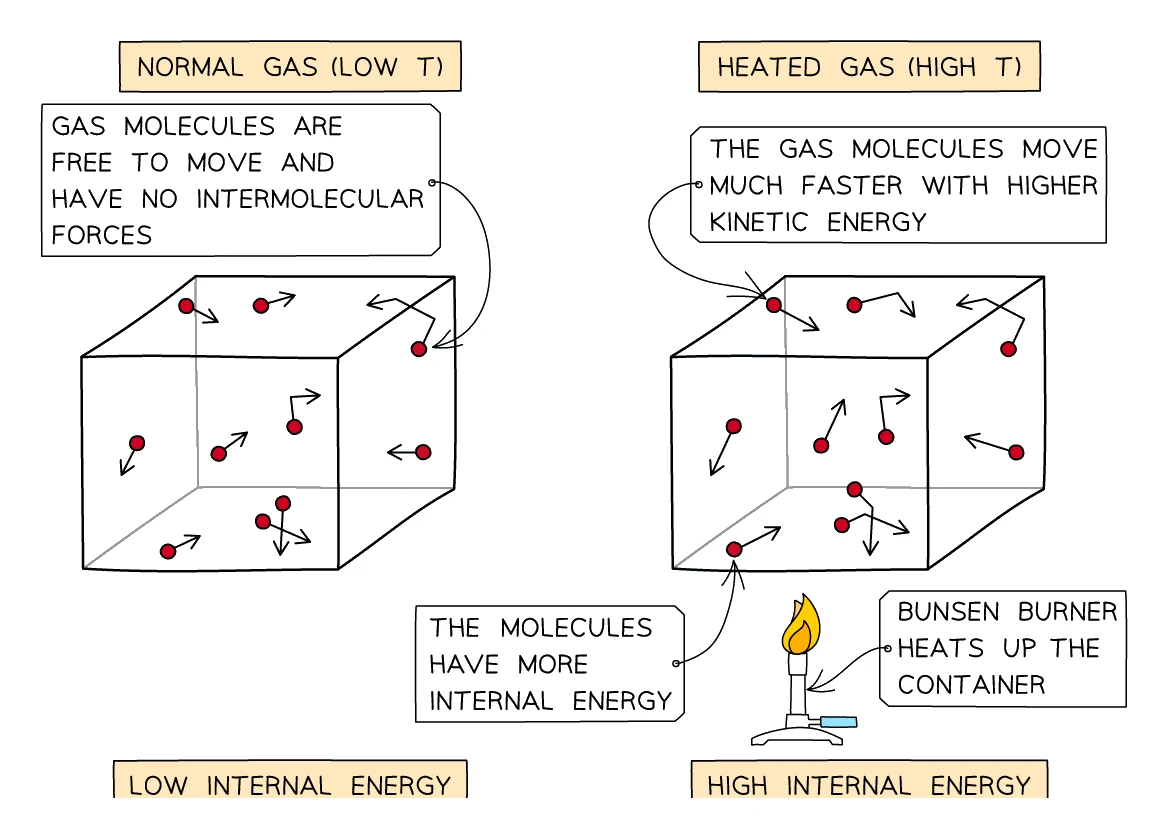
- The of a material is the total energy of all the particles inside it. It has two parts:
- Kinetic energy of the particles, set by how fast they are vibrating or moving
- Potential energy of the particles, set by how far apart they are from each other (and by the strength of the forces of attraction between them)
- The temperature of the material is set by the average kinetic energy of the particles
- When you heat a material, the input energy goes into the internal energy. It does one of two things depending on what state the material is in:
- The temperature rises: the new energy fills the kinetic store, the particles move faster, the thermometer reading climbs
- The state changes: the new energy fills the potential store, the forces of attraction between particles are overcome, but the kinetic energy (and so the temperature) stays the same. The material gets the same hotter-feeling for the same energy input only if it isn't busy changing state at that moment
Exam tip
Temperature follows the average kinetic energy
Whenever a question asks what happens to the energy of the particles, answer in terms of kinetic energy, because temperature is set by the average kinetic energy. When a liquid is heated, "the kinetic energy of the molecules increases" earns both marks on its own. When a sample is changing state, the lead mark is that the kinetic energy stays constant, then two from: the temperature stays constant, the average speed of the particles does not change, and temperature in kelvin is proportional to the average kinetic energy. The energy supplied is overcoming the forces of attraction between the particles (the potential store), not speeding them up.
3. Core practical: investigating a change of state
Aim
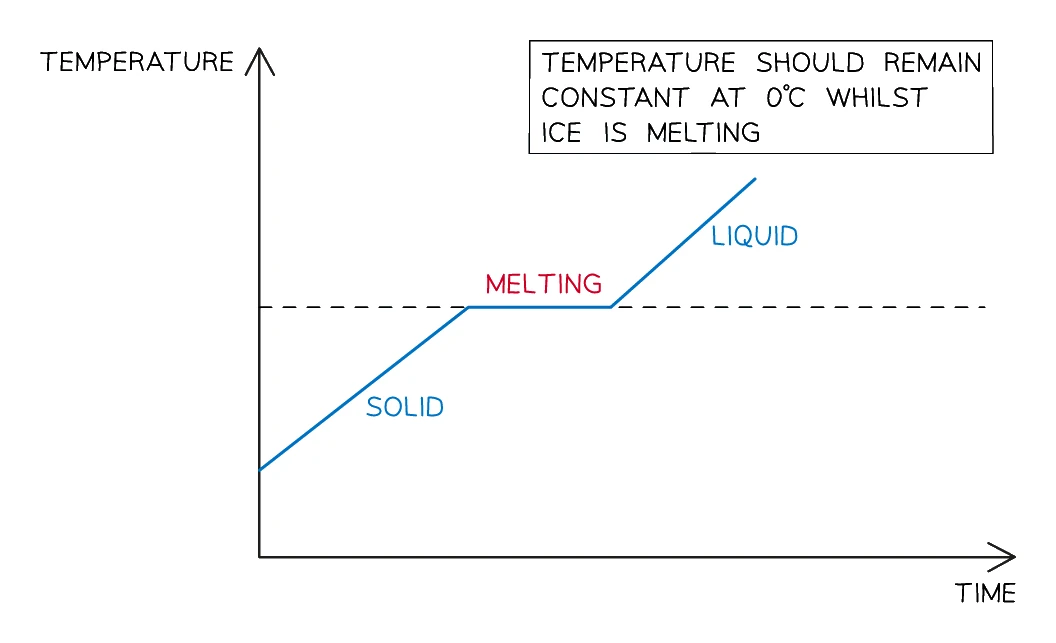
- Measure how the temperature of a sample changes with time as it is heated steadily, and identify the flat region on the temperature-vs-time graph where the sample is changing state
- For ice this is the period when the ice and water sit together at 0 °C while the rest of the ice melts; the thermometer doesn't climb even though the burner keeps supplying heat
Variables
- Independent variable: time t (s)
- Dependent variable: temperature T (°C)
- Control variables: the same burner setting, the same starting mass of ice, the same beaker, the same thermometer position in the beaker
Apparatus
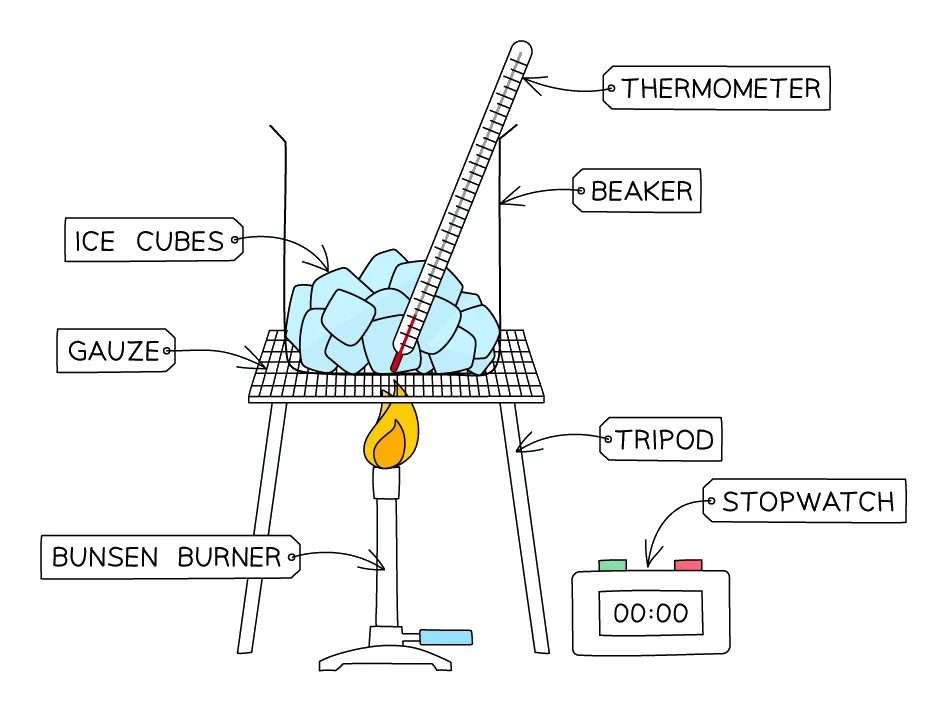
| Equipment | Purpose | Resolution |
|---|---|---|
| 400 ml beaker | Holds the ice and water | — |
| Crushed ice cubes (enough to fill about half the beaker) | The sample being heated | — |
| −10 °C to 110 °C thermometer | Reads the sample temperature | 0.1 °C |
| Tripod, gauze and Bunsen burner | Heat source under the beaker | — |
| Heatproof mat | Sits between the bench and the burner | — |
| Stopwatch | Times the readings | 0.1 s |
| Glass stirring rod | Stirs to keep the temperature even through the sample | — |
Method
- Fill the beaker about half-full with crushed ice. Add a small splash of cold water if needed so the bulb of the thermometer is properly surrounded by the sample
- Hold the thermometer vertically with its bulb in the middle of the ice (clamp it if possible, and don't let it touch the bottom of the beaker)
- Light the Bunsen burner and adjust to a small, steady flame. Start the stopwatch
- Stir the sample gently with the glass rod and record the temperature every 30 s
- Continue past the point where all the ice has melted and the water starts to heat
- Stop once the water reaches a temperature near 90 °C (don't take to boiling for safety)
Analysis
- Plot a graph with temperature up the y-axis and time along the x-axis
- The resulting curve splits into three sections:
- A gentle rise from below 0 °C up to 0 °C, where the ice itself is warming
- A flat plateau sitting at 0 °C while the ice and water coexist; the heat going in is overcoming the forces of attraction between particles (filling the potential store rather than the kinetic one), so the thermometer reading stops climbing
- A steeper rise from 0 °C upwards once all the ice has melted and the water alone is being heated
- The length of the flat region tells you how much energy was needed to melt all the ice (you can calculate this from
energy = power × time)
Common exam question
Sketching or reading a heating or cooling curve
Question: Sketch a graph of temperature against time for a sample heated or cooled at a constant rate through a change of state, or use a given graph to pick out the stages where the state changes and how long one lasts (1–4 marks).
Set in 5 of the 24 papers. For a sketch the marks are: the line runs from the given starting temperature to the given finishing temperature, and it has one horizontal section, at the melting or boiling point (a second flat section between those two temperatures costs that mark). When you are told that one state has the lower specific heat capacity, two more marks go on the slopes: the sloping sections have different gradients, and that state's section is clearly steeper, since the same rate of energy transfer changes its temperature faster; parallel slopes lose both gradient marks.
When a graph is given, the flat stages are the changes of state, and the time a liquid spends boiling is the length of its plateau: stop time minus start time.
Sources of error and safety
- Systematic, thermometer touching the bottom of the beaker. The glass is hotter than the ice during heating, so the reading is too high. Suspend the bulb in the sample
- Systematic, burner flame turned up too high. A fast heat input drives the temperature past 0 °C before the flat region is clearly visible. Use a low flame
- Random, temperature gradients within the beaker. Stir gently between readings so all the sample is at the same temperature
- Safety. Wear goggles; stand throughout the experiment so any spill is dealt with quickly; ensure the heatproof mat is under the burner; let the apparatus cool fully before clearing away
4. Specific heat capacity
Definition
- The (c) of a substance is the amount of energy needed to raise the temperature of 1 kg of the substance by 1 °C
- The SI unit is joules per kilogram per degree Celsius (J/(kg °C)) (equivalent to J/(kg K) since temperature differences are the same in °C and K)
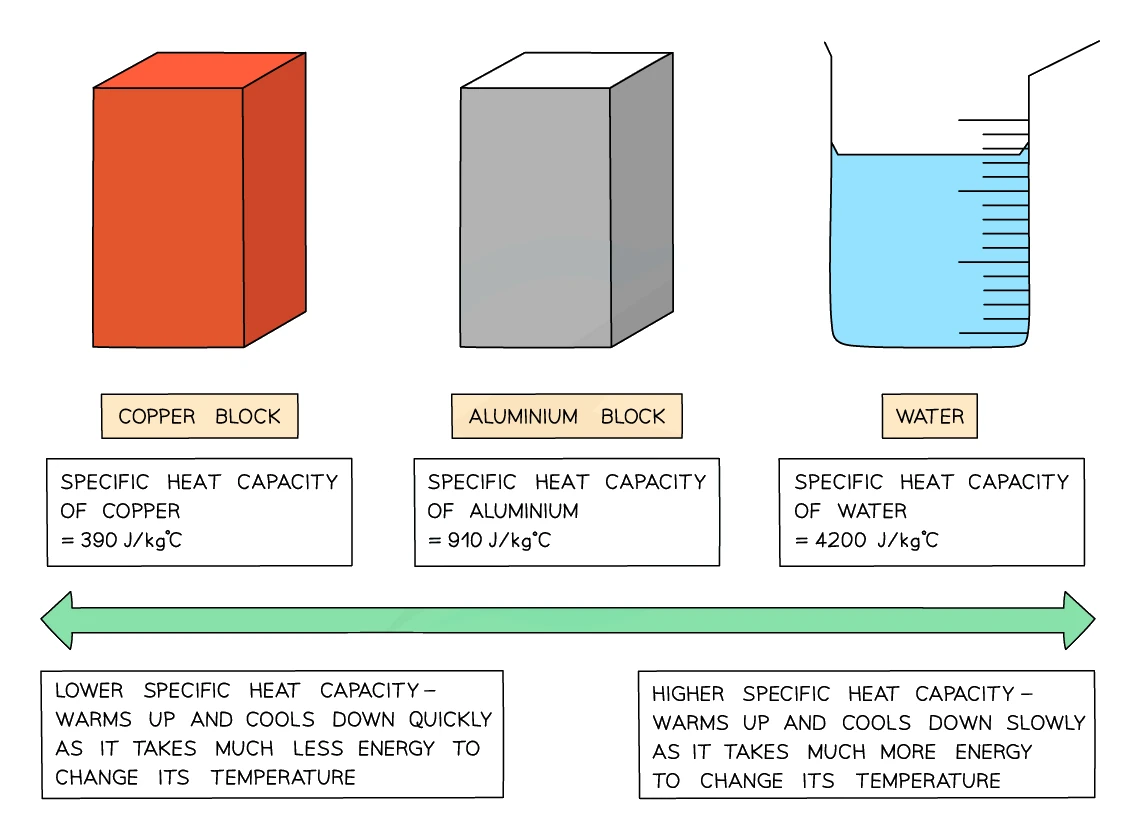
- Reference values for a feel:
- water: 4200 J/(kg °C), very high, which is why oceans moderate climate and water-cooled radiators work
- aluminium: 900 J/(kg °C)
- copper: 385 J/(kg °C)
- iron: 460 J/(kg °C)
- air: 1000 J/(kg °C)
Common exam question
Defining specific heat capacity
Question: State what is meant by specific heat capacity (2–3 marks).
Set in 2 of the 24 papers. The definition has three parts and the marks follow them: the energy required, per kilogram (per unit mass), to change the temperature by 1 °C (1 K is accepted). When it is worth 2 marks, the energy and the temperature change are one mark and the mass is the other, which is given only if you have earned the first. An equation on its own is ignored, and so is "heat" in place of "energy", so write the word energy. "Raise" or "increase" is accepted in place of "change".
Implications of high vs low c
- A substance with a high specific heat capacity:
- heats up slowly for a given energy input
- cools down slowly when energy is removed
- is good for storage heaters, hot-water bottles and household central-heating systems (water carries lots of heat per kilogram)
- A substance with a low specific heat capacity:
- heats up quickly and cools down quickly
- is good for cooking pans and engine pistons (metals heat fast, conduct fast, cool fast)
Common exam question
Explaining a heating system using specific heat capacity
Question: Explain the advantage of using a material with a high specific heat capacity in a heating system, or why two substances that exchange the same energy change temperature by different amounts (2–3 marks).
Set in 2 of the 24 papers. Argue from the equation. The energy transferred is the same for both substances (what one loses the other gains, apart from some lost to the surroundings), so for equal masses the substance with the smaller specific heat capacity has the larger temperature change. Saying which value is smaller earns a point of its own on top of saying they differ, and a short algebraic comparison with ΔQ = m × c × ΔT can earn another. For a store such as concrete or water, the credited ideas are that it absorbs and releases a lot of energy per kilogram, so it keeps supplying heat, or keeps its temperature, for longer.
The energy equation
ΔQ = m × c × ΔT
- where:
- ΔQ = energy supplied to (or removed from) the substance (J)
- m = mass of the substance (kg)
- c = specific heat capacity (J/(kg °C))
- ΔT = change in temperature (°C)
- This equation only applies while the substance is not changing state. During a change of state, the temperature does not change so ΔT = 0 and the equation gives zero, but real energy is still being delivered (into the potential store)
Common exam question
Calculating with ΔQ = m × c × ΔT
Question: Calculate the energy transferred, the specific heat capacity or the mass from the other quantities, sometimes after first finding the energy supplied by an electric heater (3 marks).
Set in 8 of the 24 papers, always for 3 marks and always on Paper 2. When the energy is the unknown the marks are: the temperature change, the substitution, the evaluation; using the final temperature in place of the change loses the first mark only, as the later marks follow through. When c or the mass is the unknown they are substitution, rearrangement and evaluation, so write the rearranged line even when you could do it in your head. Mass goes in kilograms when c is in J/kg °C; a mass left in grams is a power-of-ten error and costs one mark.
When the heater's power, or its voltage and current, is given, first find the energy supplied (energy = power × time, or E = I × V × t) with the time in seconds; leaving minutes unconverted costs a mark. Evaluate a "show that" answer to at least one more significant figure than the printed value.
Worked example
Calculating thermal energy using ΔQ = m × c × ΔT
A 2.0 kg iron pan is heated from 20 °C to 120 °C. The specific heat capacity of iron is 460 J/(kg °C). Calculate the thermal energy transferred to the pan.
Solution:
- Identify the temperature change: ΔT = 120 − 20 = 100 °C
- Write the equation: ΔQ = m × c × ΔT
- Substitute: ΔQ = 2.0 × 460 × 100
- = 92 000 J
Worked example
Rearranging ΔQ = m × c × ΔT for an unknown
A 2.0 kg block of metal absorbs 90 000 J of energy and its temperature rises from 20 °C to 70 °C. Calculate the specific heat capacity of the metal.
Solution:
- Work out the temperature change first: ΔT = 70 − 20 = 50 °C
- Rearrange ΔQ = m × c × ΔT to make c the subject: c = ΔQ ÷ (m × ΔT)
- Substitute and evaluate: c = 90 000 ÷ (2.0 × 50) = 90 000 ÷ 100 = 900 J/kg °C
5. Core practical: investigating specific heat capacity
Aim
- Measure the of a sample (a metal block, a beaker of water, or both) by heating it electrically and recording the energy supplied alongside the temperature rise
Variables
- Independent variable: time t (s), how long the immersion heater has been running
- Dependent variable: temperature T (°C) of the sample
- Control variables: the same mass of sample, the same supply voltage, the same immersion heater, the same sample container, the same starting room temperature
Apparatus
| Equipment | Purpose |
|---|---|
| Solid block of aluminium with drilled holes (for water variant: a 400 ml beaker of water) | The sample whose c is being measured |
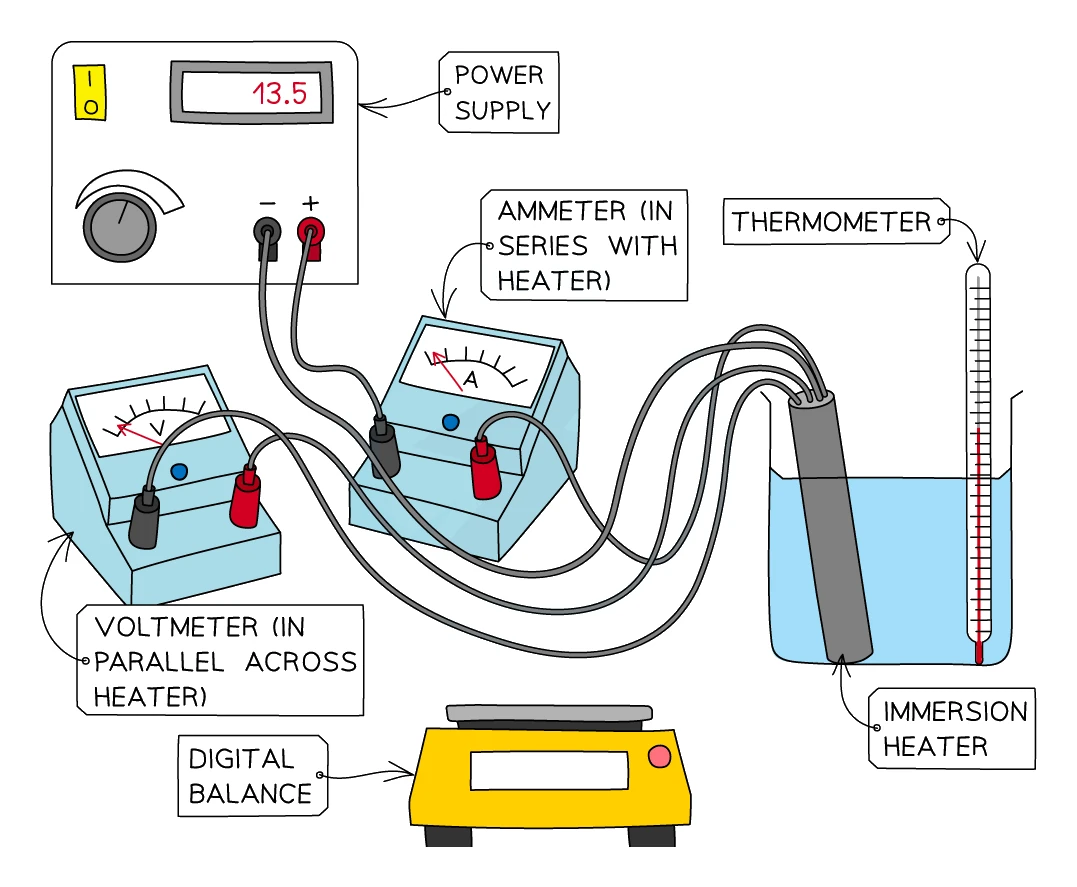
| Immersion heater (low-voltage, 12 V) | Delivers a measurable electrical energy into the sample |
| Variable d.c. power supply (or 12 V battery pack) | Drives the heater |
| Voltmeter (across the heater) | Reads the voltage V |
| Ammeter (in series with the heater) | Reads the current I |
| Thermometer | Reads the sample's temperature |
| Stopwatch | Times the heating |
| Digital balance | Measures the sample's mass |
| Insulation (for metal block: lagging or polystyrene jacket) | Cuts heat loss to the surroundings |
Method (water variant)
- Stand an empty 400 ml beaker on the digital balance and press the tare button to zero the reading; pour in about 250 ml of water and write down the new mass m in kg
- Stand the immersion heater and the thermometer vertically in the water; clamp them so neither touches the bottom of the beaker
- Connect the circuit: power supply → ammeter (in series) → immersion heater. Wire the voltmeter directly across the heater
- Note the starting temperature on the thermometer before any current is switched on; this is the baseline for ΔT
- Switch on the power supply at about 12 V. Start the stopwatch at the same instant
- Record the voltage V, the current I, and the temperature T every 60 s for 10 minutes. Stir the water gently between readings
- Switch off the supply. Allow the water to keep warming for a further minute (the heater is still hot, so there's a lag) and record the maximum temperature reached
Method (solid block variant)
- Identical to the water method, except: the immersion heater goes into a hole drilled in the block; thermometer goes into a separate hole. Pack the block with insulating material to cut heat losses, since solids don't stir themselves
Analysis
- The total electrical energy delivered up to time t is:
ΔQ = V × I × t
- Plot a graph of ΔQ (y-axis) against m × ΔT (x-axis), where ΔT is the rise above the starting temperature
- The graph should be a straight line through the origin once the heater itself has warmed up. The gradient of the linear region is the specific heat capacity:
gradient = ΔQ / (m × ΔT) = c
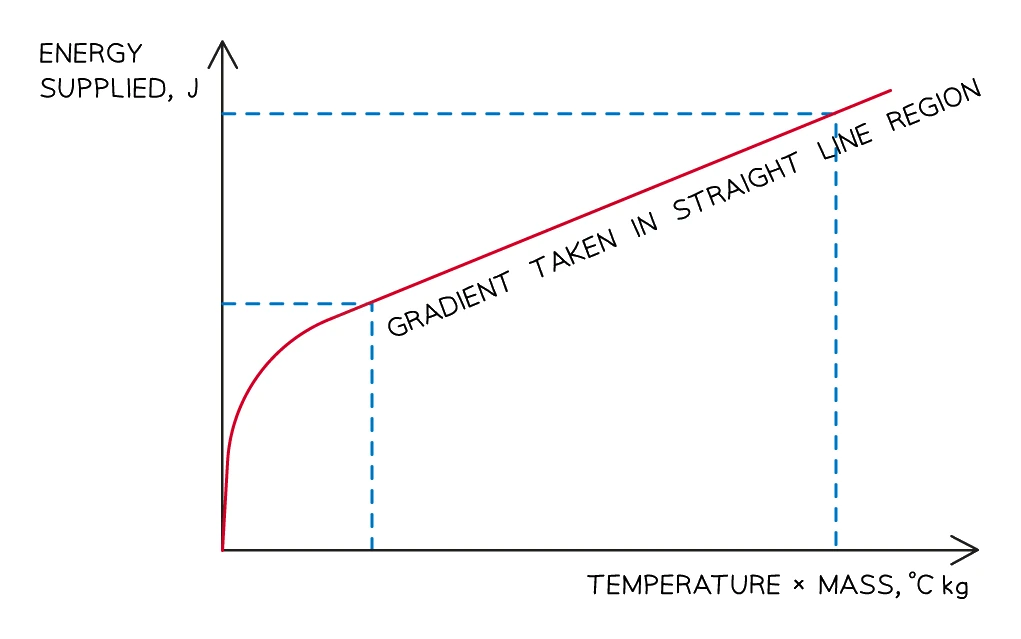
- For pure water you should land near 4200 J/(kg °C); for an aluminium block, near 900 J/(kg °C). A modest discrepancy (typically 5–15 % high) is expected because some energy leaks to the surroundings rather than going into the sample
Common exam question
Describing a method to measure specific heat capacity
Question: Describe a method, or an investigation, to determine the specific heat capacity of water, another liquid or a solid block using an electric heater, including any extra equipment needed (5–6 marks).
Set in 4 of the 24 papers, usually with the apparatus drawn for you. Each mark is one measurement or step, so write them in order: find the mass on a balance (for a liquid, container plus liquid minus the empty container); record the initial and final temperatures; time the heating with a stopwatch; find the energy supplied from the voltmeter and ammeter readings and the time (E = I × V × t) or a joulemeter; then rearrange to c = energy supplied ÷ (mass × temperature change). Further marks: keep reading the thermometer after switching off and use the maximum, stir throughout, repeat the whole experiment and average, or plot temperature against time and use its gradient.
"Scale" for the balance is rejected ("scales" is accepted), an unqualified "repeat and average" earns nothing in one scheme, so say what you repeat, and mentioning the insulation and lid already in the diagram earns nothing.
Sources of error and safety
- Systematic, heat loss to the surroundings. The hot beaker/block warms the room air. Lagging the sample with polystyrene reduces this; using the gradient (which is less affected than a single-point answer) helps too
- Systematic, heater itself absorbing energy. Some of the early electrical energy heats the metal sheath of the immersion heater rather than the sample. Only use the straight-line part of the graph (after the initial dog-leg) when taking the gradient
- Random, temperature gradients across the sample. Stir water samples; insulate solid samples and let them warm slowly so the heat spreads evenly inside
- Safety. Use a low-voltage d.c. supply only, because mains voltage with an immersion heater in water is lethal. The heater becomes very hot; lift it out by the wire, not the metal sheath, and let it cool on a heatproof mat
Common exam question
Energy losses in the specific heat capacity practical
Question: Give reasons why some of the heater's energy does not end up in the sample, why the calculated value differs from the true one, or how to make the method more accurate (1–2 marks).
Set in 3 of the 24 papers. Almost every credited reason is a place the heater's energy went other than into the sample: it heats the container and the thermometer, it is lost to the surroundings because the insulation is not perfect, and gaps around the thermometer and heater in the lid let heat escape, including by evaporation. The energy supplied is therefore more than the sample received, so the calculated value comes out too high (an impure sample is also accepted). For improvements, turn each loss into a fix: insulate the container, add a lid, use a container with a low specific heat capacity such as a polystyrene cup, move a heated block into the water quickly, and repeat to remove anomalies. "Human error" is ignored, as are answers about kinetic energy or sound.