Working with Fractions, Decimals and Percentages
Mathematics revision notes · Cambridge (CIE) · 0580
1. Percentages and decimals
Percentage to decimal
- A percentage counts hundredths, so dividing by 100 recovers the decimal
- Dividing by 100 shifts every digit two columns to the right
- 8% becomes 0.08
- 65% becomes 0.65
- 240% becomes 2.4
- 0.5% becomes 0.005
- A percentage above 100 always gives a decimal above 1
Decimal to percentage
- Multiplying by 100 reverses the process and shifts every digit two columns left
- 0.47 becomes 47%
- 2.06 becomes 206%
- 0.009 becomes 0.9%
- The per cent sign must be written, since 47 and 47% are different quantities
2. Decimals and fractions
Decimal to fraction
- The number of decimal places fixes the denominator: one place gives tenths, two gives hundredths, and n places gives 10ⁿ
- 0.9 is 9/10
- 0.23 is 23/100
- 0.041 is 41/1000
- Write the digits after the point as the numerator, then simplify
- 0.44 is 44/100, which cancels to 11/25
- A whole number is written as a fraction by placing it over 1
Percentage to fraction
- Every percentage is already a number of hundredths, so it goes straight over 100 and is then cancelled
- 44% is 44/100, which cancels to 11/25
Fraction to decimal
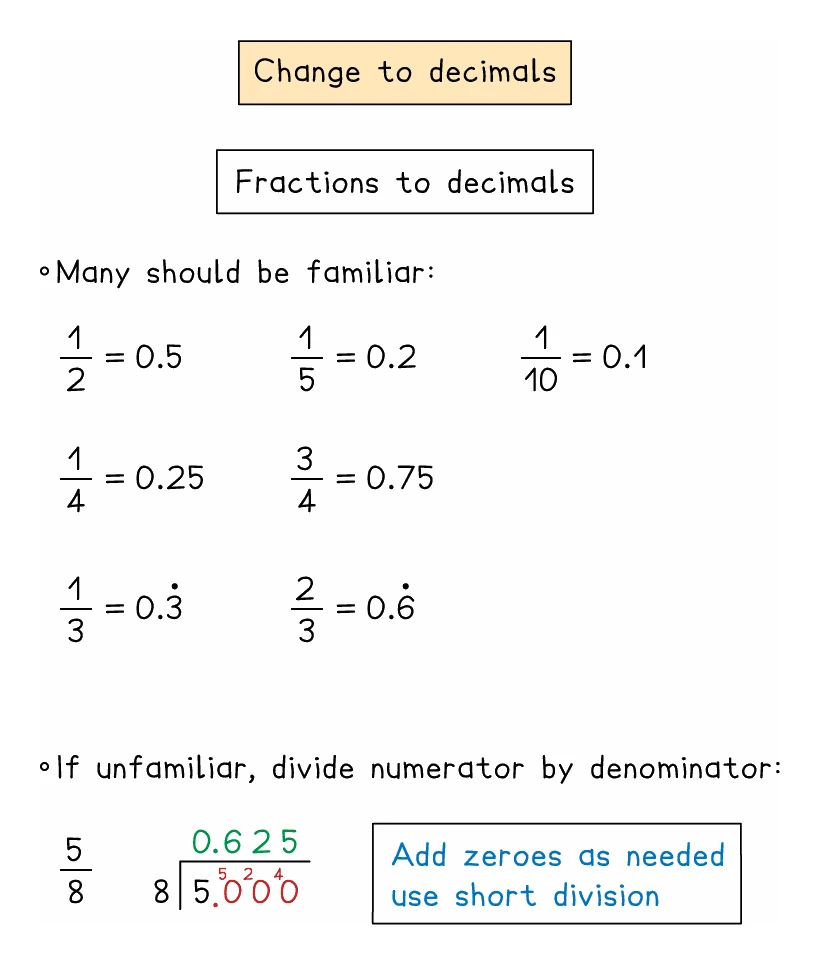
- Where the denominator divides into a power of ten, scale up to that power and read the decimal straight off
- 25 goes into 100 four times, so 7/25 becomes 28/100, or 0.28
- Otherwise divide the numerator by the denominator
- Denominators that are powers of 2 can be reached by repeated halving
- 3/8: halving 3 gives 1.5, then 0.75, then 0.375
Fraction to percentage
- Convert to a decimal first, then multiply by 100
- 9/20 scales to 45/100, which is 0.45, and therefore 45%
Worked example
The four conversions
Write 0.36 as a fraction in its simplest form, and write 3/8 as a decimal and as a percentage.
Solution:
- 0.36 has two decimal places, so it is 36 hundredths: 0.36 = 36/100
- Cancel by 4: 36/100 = 9/25
- For 3/8, divide the numerator by the denominator: 3 ÷ 8 = 0.375
- To reach a percentage, multiply the decimal by 100: 0.375 × 100 = 37.5%
- Check the other way round: 37.5 ÷ 100 = 0.375, and 0.375 × 8 = 3
3. Ordering fractions, decimals and percentages
Ordering fractions only
- Rewrite every fraction over the lowest common denominator, then compare numerators
- For 2/3, 5/8, 7/12 and 3/4 the lowest common denominator is 24
- These become 16/24, 15/24, 14/24 and 18/24
- Ascending order is therefore 7/12, 5/8, 2/3, 3/4
- Give the answer in the form the values were originally written in
Ordering a mixed list
- Convert every value to a decimal, since decimals are the one form that can be compared column by column
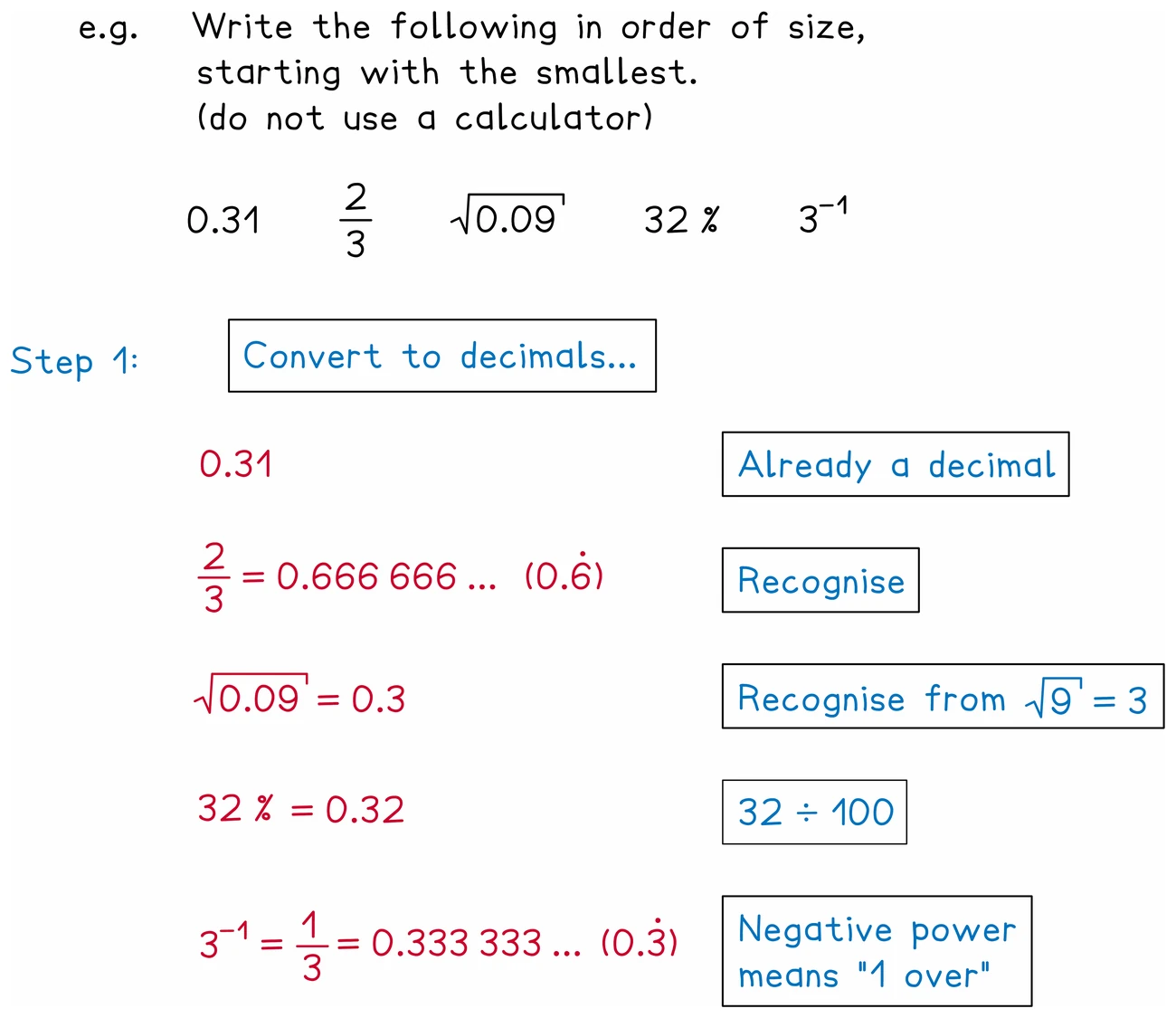
- Pad the decimals to a common number of places before comparing
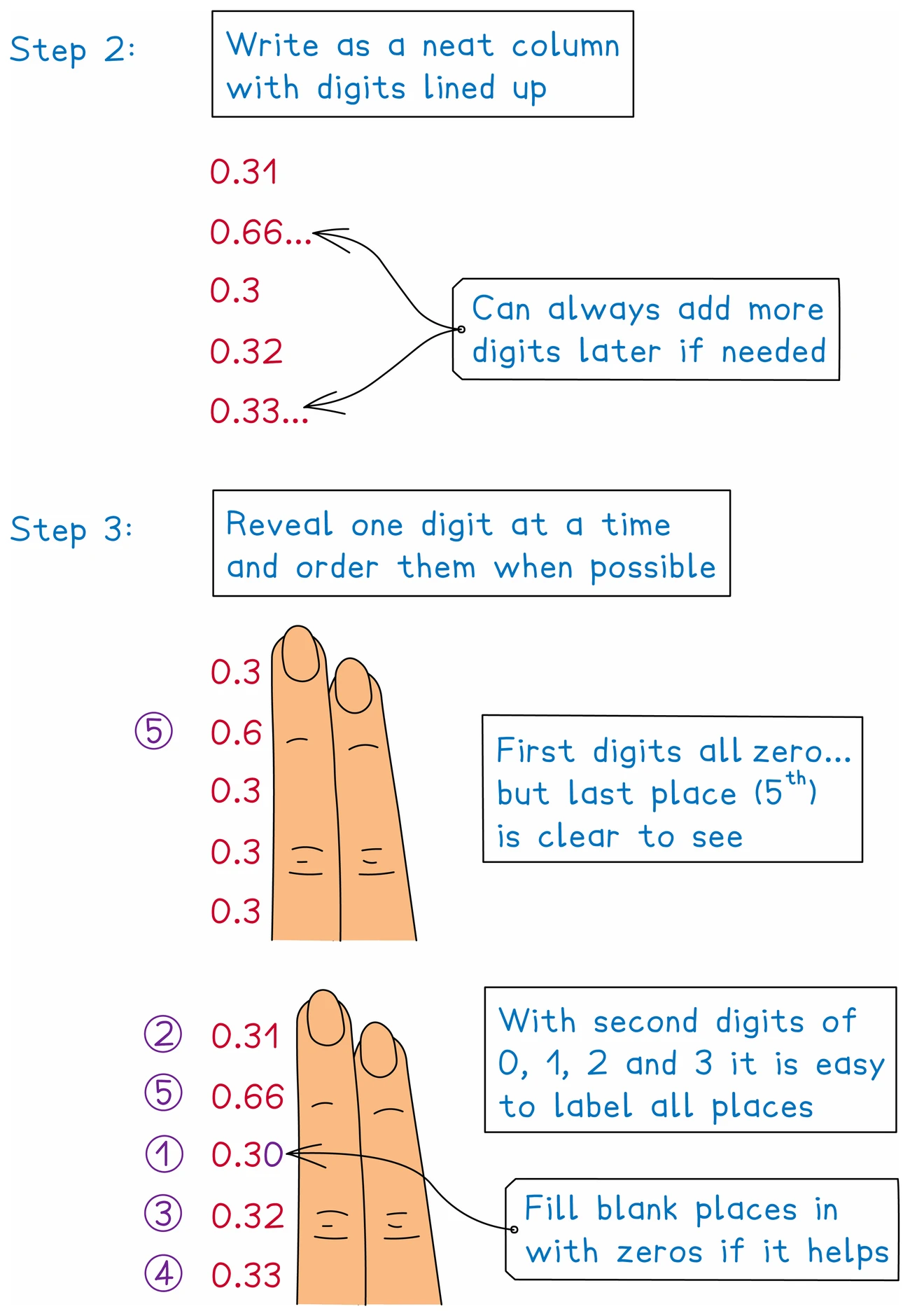
- Order the decimals, then rewrite each in its original form
Comparison symbols
- A chain of values can be joined with the inequality symbols rather than listed
- 1/5 < 1/4 < 1/3
- Recall that > is greater than, < is less than, ⩾ is greater than or equal to, and ⩽ is less than or equal to
Worked example
Ordering a mixed list without a calculator
Write these values in ascending order: 0.62, 5/8, 63%, 3/5
Solution:
- Convert each to a decimal
- 0.62 is already a decimal
- 5/8 by repeated halving: 5, 2.5, 1.25, 0.625
- 63% divided by 100 gives 0.63
- 3/5 is equivalent to 60/100, so 0.6
- Pad to three places: 0.620, 0.625, 0.630, 0.600
- Ascending order of the decimals: 0.600, 0.620, 0.625, 0.630
- Rewritten in their original forms: 3/5, 0.62, 5/8, 63%
4. Recurring decimals
Terminating and recurring
- Every rational number has a decimal form that behaves in one of just two ways
- A terminating decimal stops after a finite number of places
- 1/8 is 0.125
- A recurring decimal repeats a block of digits without end
- 3/11 is 0.272727…
- A dot above a digit marks the repeat; where a block repeats, dots sit on its first and last digits
- 0.888… is written with a single dot over the 8
- 0.272727… carries dots over the 2 and the 7
- Recurring decimals are rational, not irrational, because every one of them can be written as a fraction
Converting a recurring decimal to a fraction
- Set the decimal equal to x, written out far enough to show the pattern
- Multiply by 10 as many times as it takes for two of the lines to carry exactly the same endless tail
- Where the block starts immediately after the point, one multiplication is enough, by 10 raised to the length of the block: one digit needs 10, two digits need 100, three need 1000
- Where the repeat starts later, two multiplied lines are needed instead: one that carries the point to the start of the block, and one a full block further on
- For 0.1666… the lines 10x = 1.666… and 100x = 16.666… share a tail, and subtracting gives 90x = 15, so x = 1/6
- Subtract the two matching lines, so the endless tails cancel
- Divide to make x the subject, then cancel to lowest terms
Exam tip
Show the subtraction, then cancel fully
Writing a recurring decimal as a fraction is set in 8 of the 21 papers, always on Paper 2. The subtraction of your two lines, or the equation it gives (90x = 35 for 0.3888…), earns the method mark even if the rest goes wrong, so write it down. When the simplest form is asked for, the last mark is only for the fully cancelled fraction: 35/90 earns every mark but the last, and 7/18 earns them all.
Worked example
A recurring decimal with a two-digit block
Write 0.272727… as a fraction in its lowest terms.
Solution:
- Let x = 0.272727…
- The repeating block is two digits long, so multiply by 100
- 100x = 27.272727…
- Subtract the first line from the second, so the endless tails cancel
- 100x − x = 27.272727… − 0.272727…, giving 99x = 27
- Divide by 99: x = 27/99
- Cancel by the common factor 9: 3/11
Worked example
A fraction plus a recurring decimal
Work out 2/3 + 0.1555… and give the result as a single fraction, fully cancelled.
Solution:
- Let x = 0.1555…; only the 5 repeats, starting at the second decimal place
- Make two lines with the same endless tail: 10x = 1.555… and 100x = 15.555…
- Subtract: 100x − 10x = 15.555… − 1.555…, giving 90x = 14, so x = 14/90
- Write 2/3 over the same denominator: 2/3 = 60/90
- Add: 60/90 + 14/90 = 74/90
- Cancel by 2: 37/45
- Check: 37 ÷ 45 = 0.8222…, the same as 0.6666… + 0.1555…