1. The four transformations
Object, image and what changes
- The starting shape is the object and the result is the image, with the image's vertices labelled A′, B′, C′ to match A, B, C
- Three of the four keep the shape exactly the same size, so object and image are congruent: reflection, rotation and translation
- Only enlargement changes the size, and even then the shape stays similar
- A point that does not move under a transformation is invariant
- A ruler must be used for every straight edge, which the syllabus states directly
What each transformation needs
| Transformation | What a question can ask for |
|---|---|
| Reflection | a mirror line that is any straight line, including y = x and y = −x |
| Rotation | any centre, through a multiple of 90° |
| Enlargement | positive, fractional and negative scale factors |
| Translation | a column vector |
| Combinations | two transformations one after the other, described as a single one |
2. Reflection
Doing one
- A reflection flips the shape across a mirror line, so the image is the same size but the wrong way round
- Every point and its image sit the same perpendicular distance from the mirror line, on opposite sides
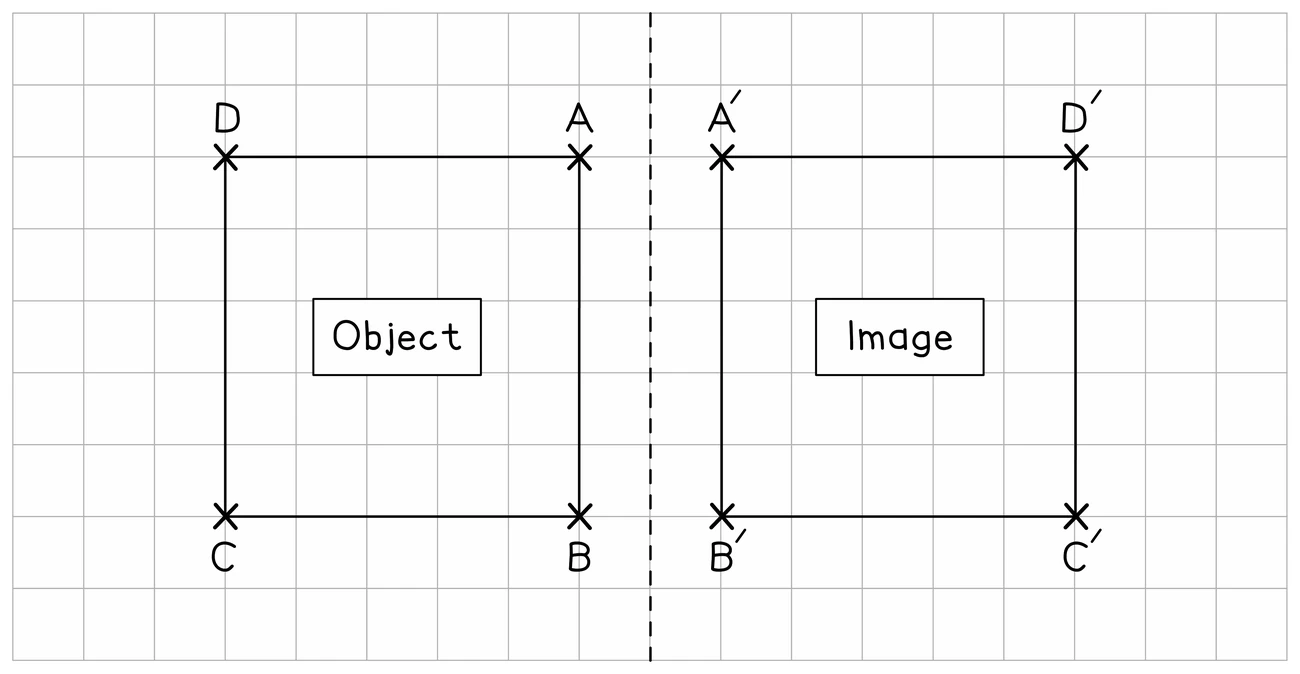
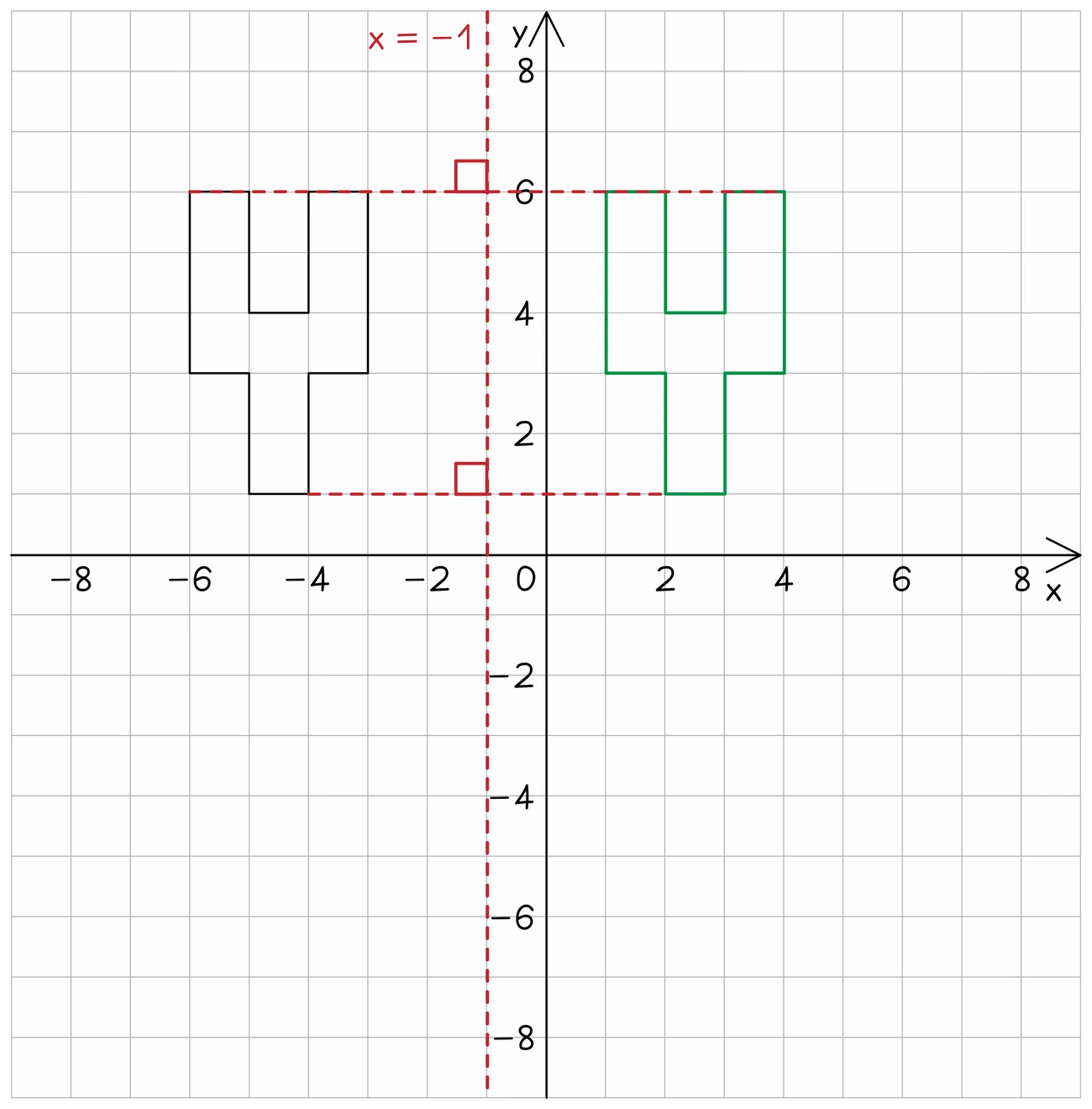
- Take one vertex at a time, count squares straight across to the line at right angles, then continue the same count past it
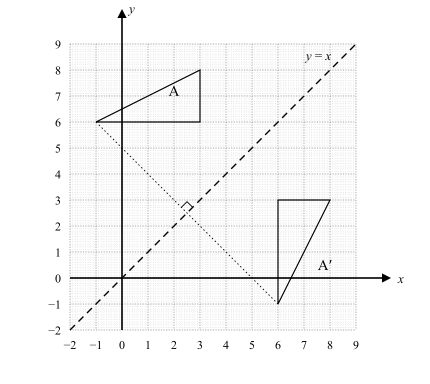
- For a diagonal mirror line such as y = x, count diagonally across the squares rather than horizontally
- Any vertex sitting on the line itself stays exactly where it is, making it invariant
- Where the mirror line passes through the shape, part of it reflects each way
Worked example
Reflecting in the line y = x
Triangle A has vertices (−1, 6), (3, 6) and (3, 8). Reflect A in the line y = x and draw its image.
Solution:
- Draw the mirror line first, with a ruler: y = x runs diagonally through (0, 0), (1, 1), (2, 2) and so on
- A reflection in y = x swaps the two coordinates of every point, so (a, b) goes to (b, a)
- (−1, 6) goes to (6, −1), (3, 6) goes to (6, 3), and (3, 8) goes to (8, 3)
- Check one pair: (−1, 6) and (6, −1) have midpoint (2.5, 2.5), which lies on y = x, so they sit the same distance either side of the line
- Plot the three points and join them with a ruler: the image has vertices (6, −1), (6, 3) and (8, 3)
- Swapping the coordinates and also changing both signs would reflect in y = −x instead, sending (−1, 6) to (−6, 1)
Describing one
- Say reflection, then state which line the shape was flipped across, written as an equation
- Vertical lines are x = k and horizontal lines are y = k, which is the pair most often swapped over
- The diagonal through the origin sloping up is y = x, and the one sloping down is y = −x
Worked example
Describing a reflection fully
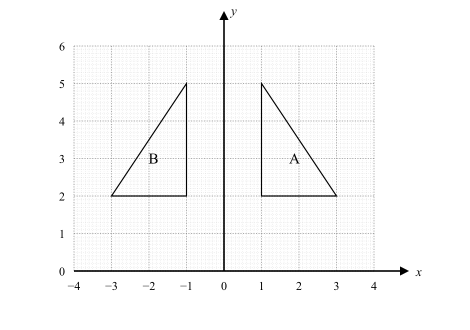
Triangle A has vertices (1, 2), (3, 2) and (1, 5). Its image B has vertices (−1, 2), (−3, 2) and (−1, 5). Describe fully the single transformation that maps A onto B.
Solution:
- The shape is the same size and the same way up, but it has been flipped, so this is a reflection
- Compare one pair of matching points: (1, 2) becomes (−1, 2)
- The y coordinate is unchanged and the x coordinate has changed sign
- The mirror line is therefore vertical, midway between 1 and −1, which is x = 0
- Check on a second pair: (3, 2) becomes (−3, 2), midway again at x = 0
- The answer is a reflection in the line x = 0
- Give the mirror line as its equation: x = 0 is the y-axis
3. Rotation
Doing one
- A rotation turns the shape about a fixed point, the centre of rotation, through a multiple of 90°
- Tracing paper may be used in the examination (ask for it, since you cannot bring your own), and it is by far the most reliable method
- Trace the object, press a pencil point onto the centre, turn the paper through the given angle, then copy the image across
- Drawing an arrow on the tracing paper first shows at a glance how far it has turned
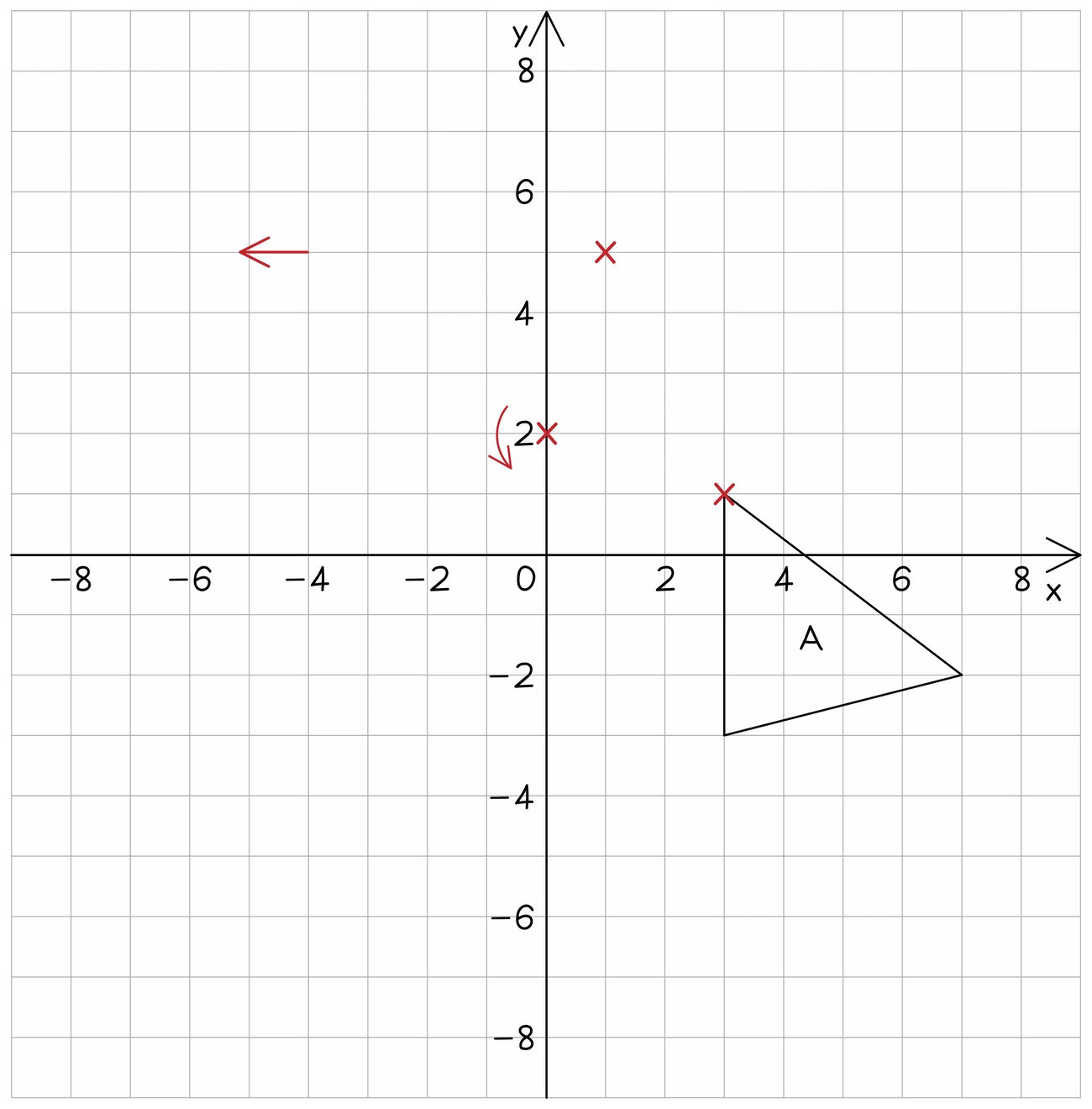
- The size and shape are unchanged, only the position and the orientation
- If the centre lies on the shape, that point is invariant
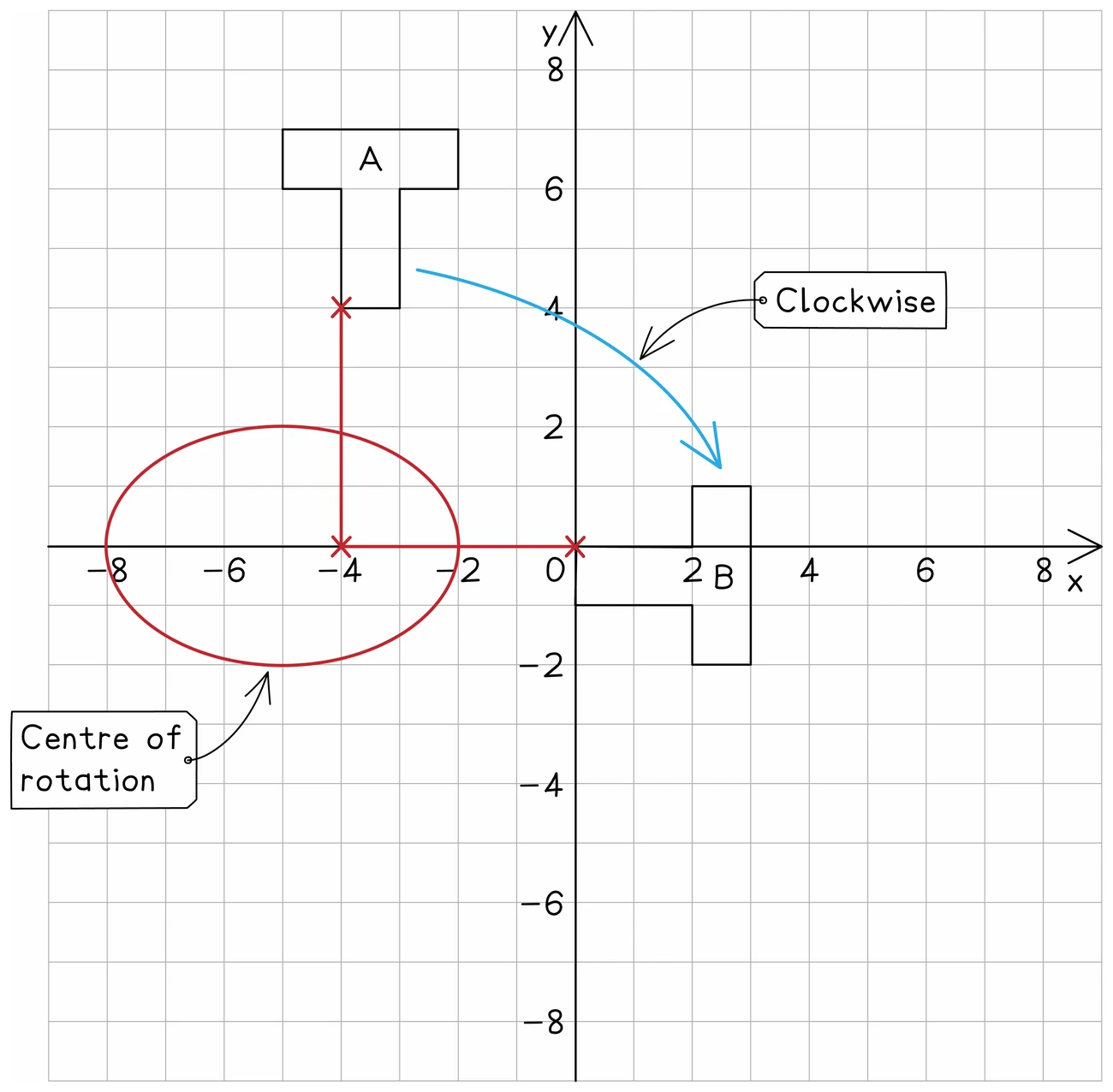
Describing one
- Say rotation, then give the angle with its direction, then the centre as coordinates
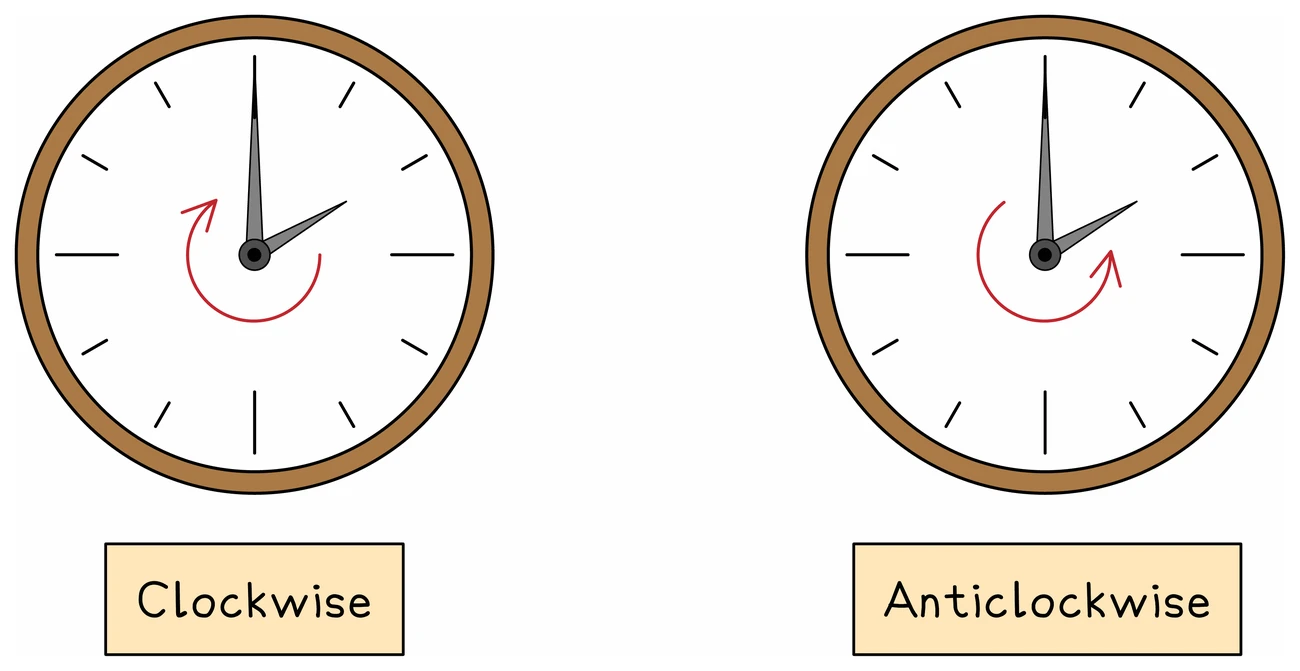
- Half turns need no direction, since 180° clockwise and anticlockwise give the same image
- Mark schemes accept equivalents such as 270° clockwise for 90° anticlockwise, and abbreviations like acw
Worked example
Describing a rotation
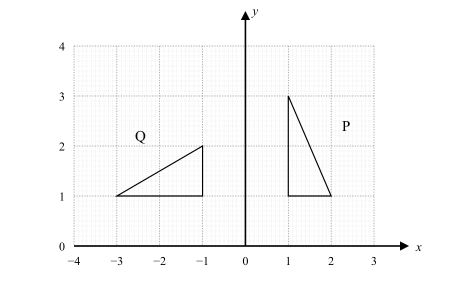
Triangle P has vertices (1, 1), (1, 3) and (2, 1). Triangle Q has vertices (−1, 1), (−3, 1) and (−1, 2). Describe fully the single transformation that maps P onto Q.
Solution:
- P and Q are the same size and shape, and Q is P turned, not flipped: from the right angle, P's longer side points up and its shorter side right, while Q's longer side points left and its shorter side up, so this is a rotation
- Tracing P and turning it shows a quarter turn fits, so the angle is 90°
- Turning anticlockwise takes the vertex (1, 3) round to (−3, 1), which matches Q
- Testing the origin as the centre: it is the same distance from (1, 1) as from (−1, 1), and likewise for the other pairs
- The full description is a rotation, 90° anticlockwise, centre (0, 0)
- Check: a 90° anticlockwise turn about the origin sends (x, y) to (−y, x), and (1, 1), (1, 3), (2, 1) do map to (−1, 1), (−3, 1), (−1, 2)
4. Translation
Doing and describing one
- A translation slides the shape without turning or resizing it, so the orientation is unchanged
- The movement is given as a column vector, with the top number the horizontal move and the bottom number the vertical one
- Positive top means right and negative means left; positive bottom means up and negative means down
- Move every vertex by the same vector, then join them up
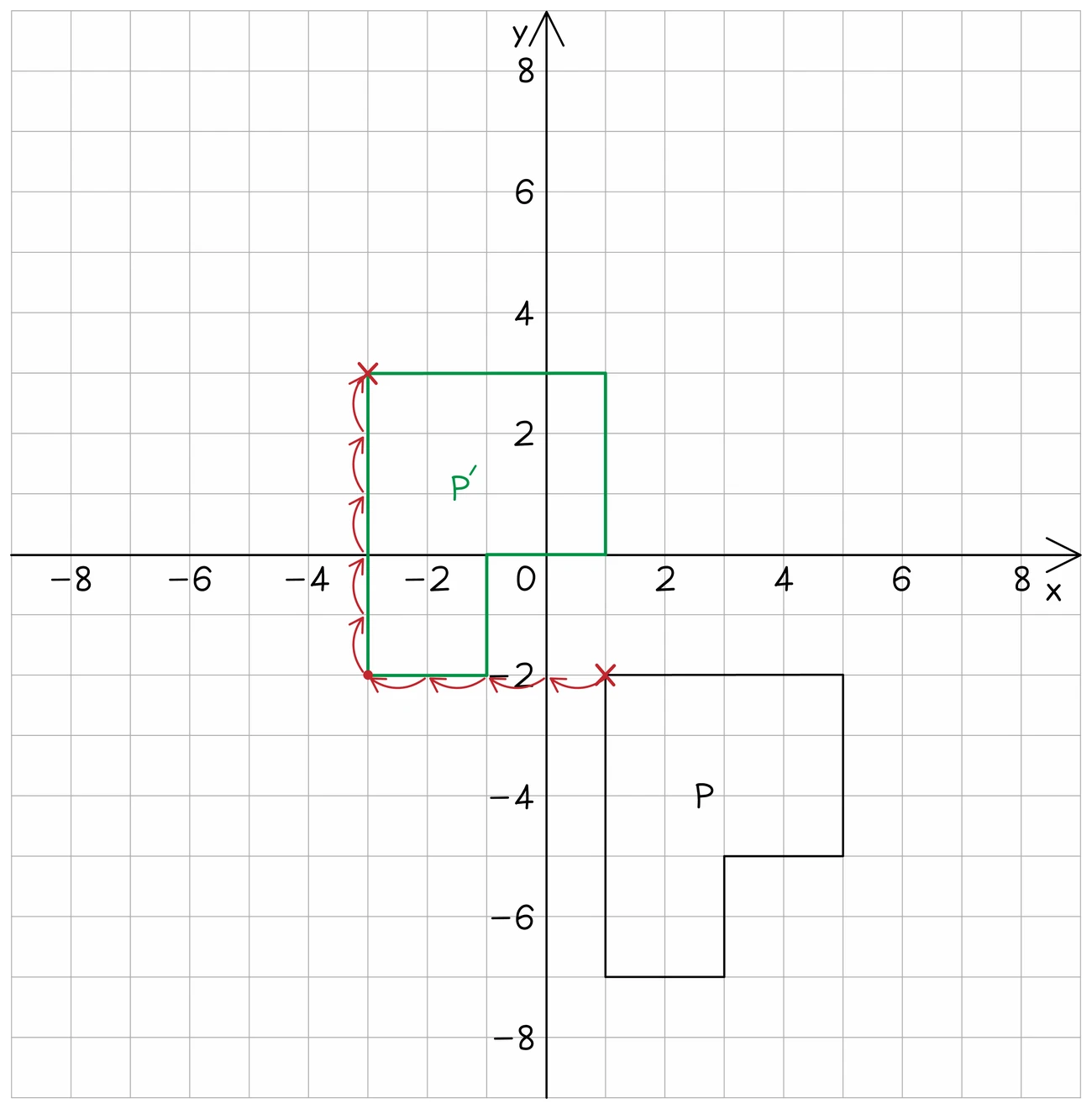
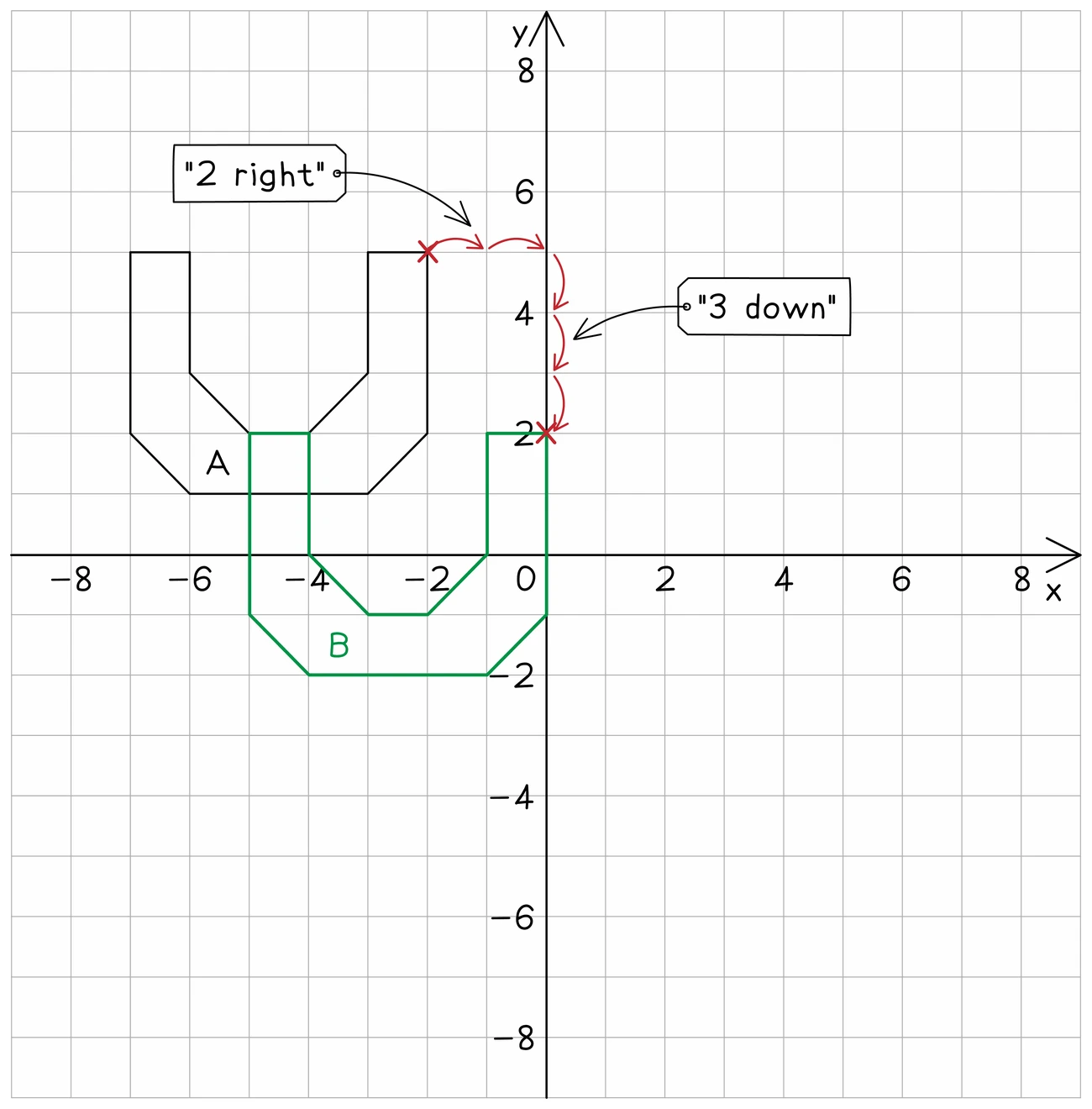
- To describe one, say translation and give the vector
- Mark schemes also accept the movement in words, such as "2 right, 7 down"
Worked example
Translating by a column vector
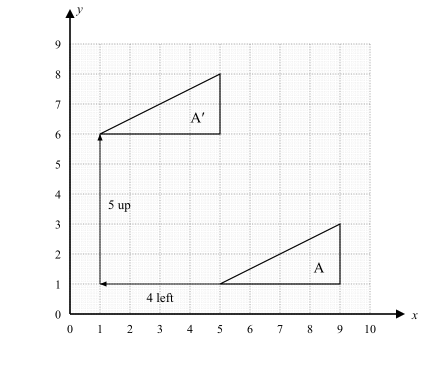
Triangle A has vertices (5, 1), (9, 1) and (9, 3). Draw the image of A after a translation by the column vector with top number −4 and bottom number 5.
Solution:
- The top number −4 means 4 squares to the left, and the bottom number 5 means 5 squares up
- Move every vertex by the same amount: (5, 1) goes to (5 − 4, 1 + 5) = (1, 6)
- In the same way, (9, 1) goes to (5, 6) and (9, 3) goes to (5, 8)
- Join the three points with a ruler: the image has vertices (1, 6), (5, 6) and (5, 8)
- Check: the image is the same size, shape and way round as A, and its base from (1, 6) to (5, 6) is horizontal and 4 long, like A's base from (5, 1) to (9, 1)
5. Enlargement
Doing one
- An enlargement resizes the shape by a scale factor from a fixed centre of enlargement
- Each vertex moves along the line from the centre through it, ending scale-factor times as far from the centre
- Multiply each distance from the centre, both across and up, by the scale factor
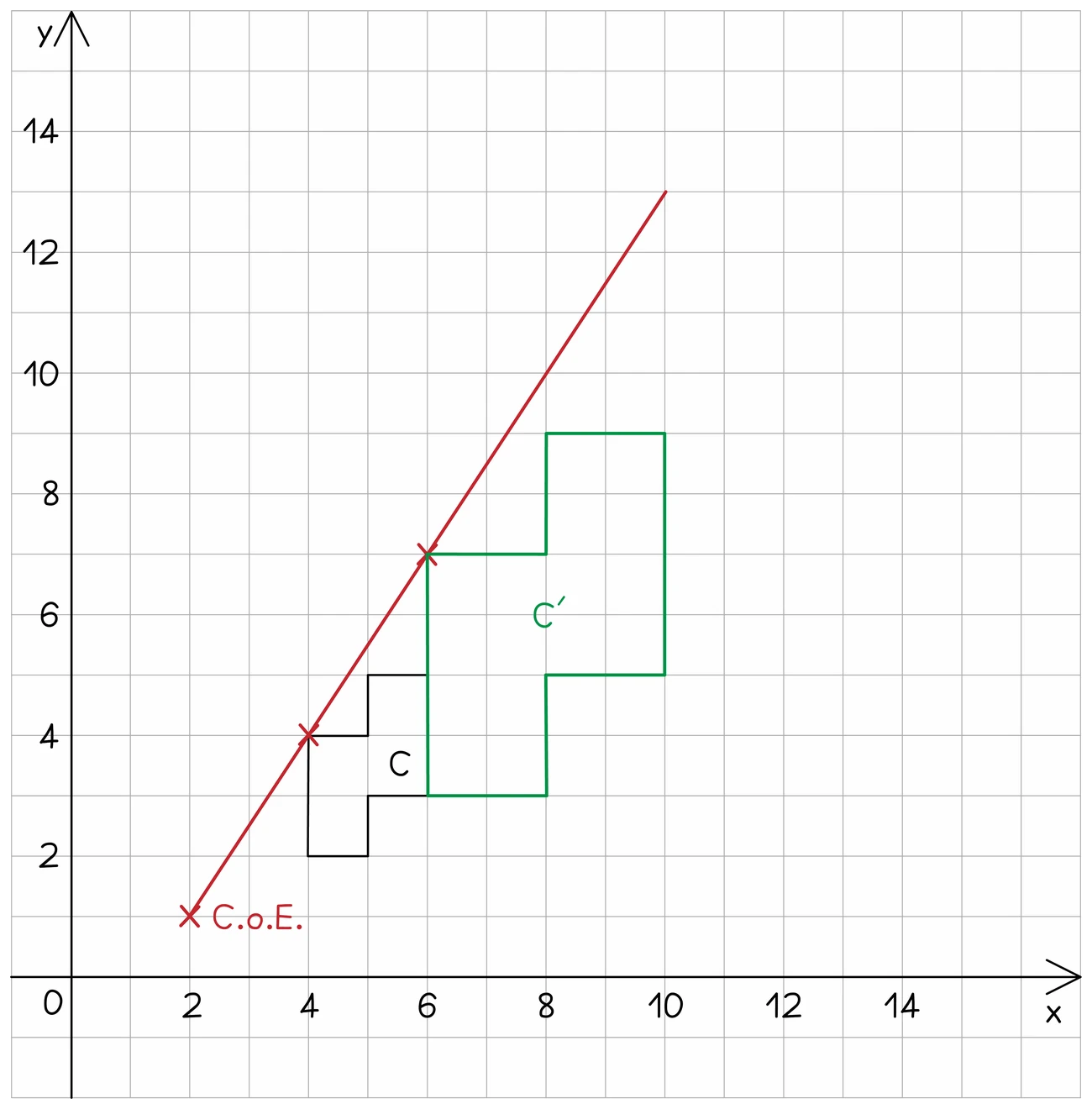
- A scale factor between 0 and 1 makes the image smaller, even though it is still called an enlargement
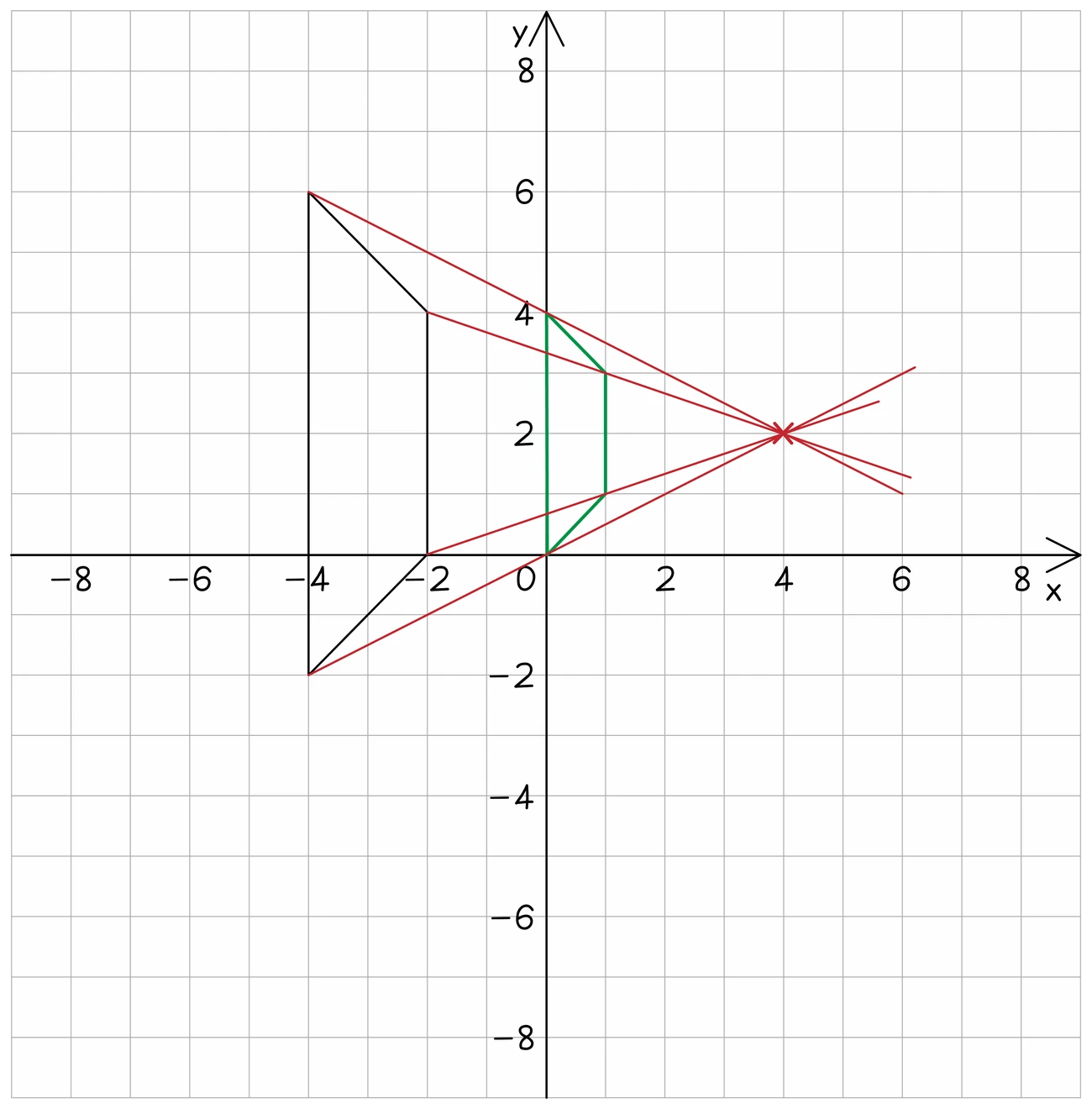
- A negative scale factor throws the image across to the far side of the centre and inverts it, so it acts as a 180° rotation as well as a resize
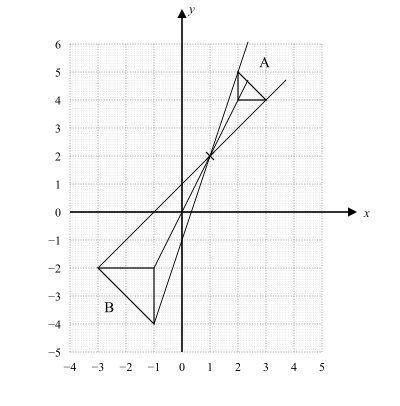
- Every length multiplies by the scale factor, so the image is similar to the object rather than congruent
Describing one
- Say enlargement, then give the scale factor, then the centre as coordinates
- Find the centre by drawing a line through each pair of corresponding vertices and seeing where they all cross
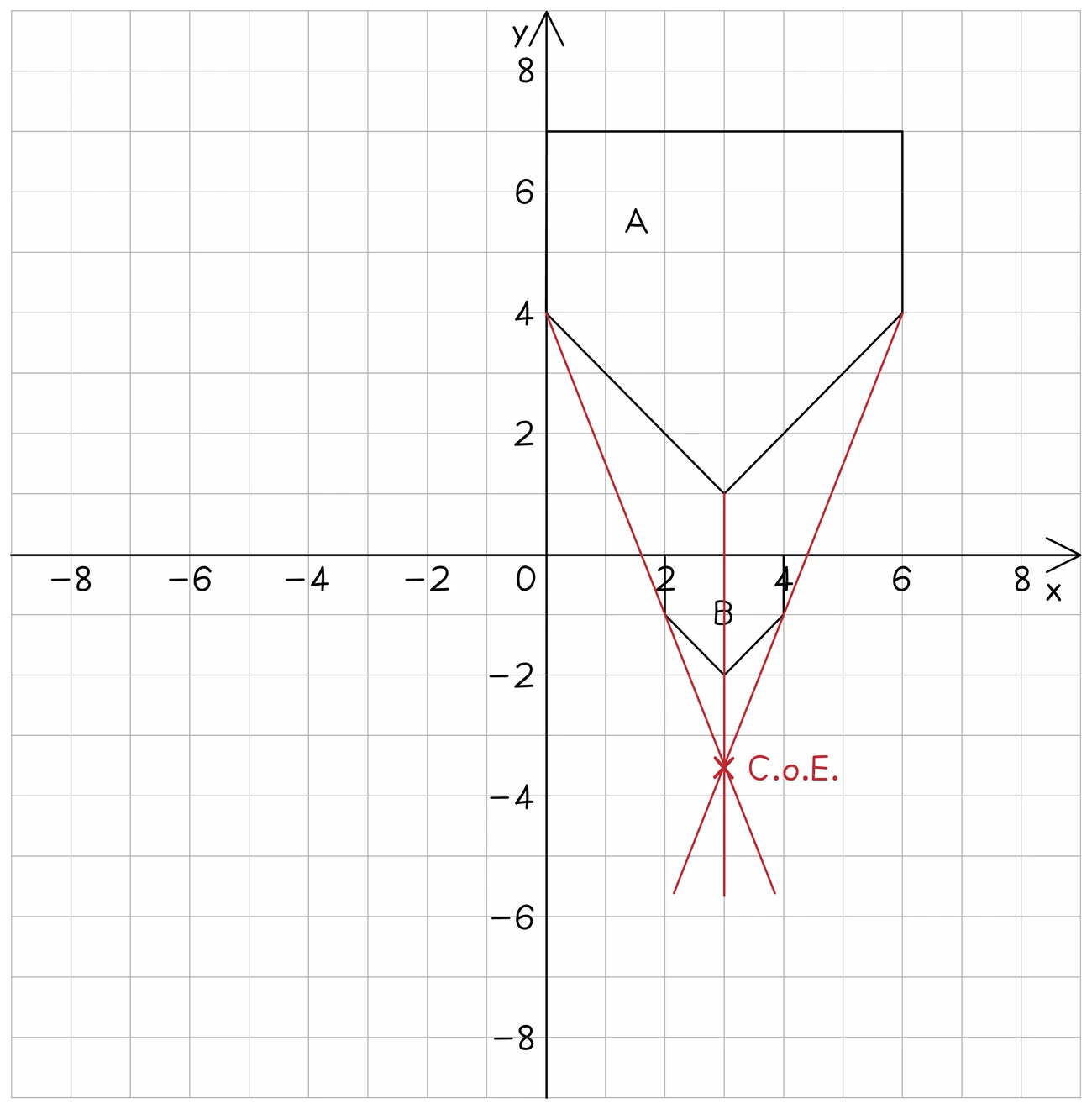
- Find the scale factor by dividing an image length by the matching object length
Worked example
Describing an enlargement
Triangle A has vertices (1, 1), (3, 1) and (1, 2). Triangle B has vertices (2, 2), (6, 2) and (2, 4). Describe fully the single transformation that maps A onto B.
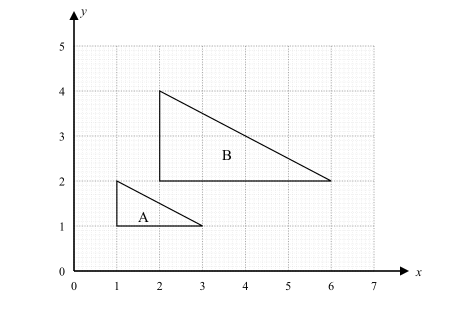
Solution:
- B is bigger than A, so the only candidate is an enlargement: the other three keep the size the same
- Compare a pair of matching sides: A has a base from (1, 1) to (3, 1), which is 2 units, and B has a base from (2, 2) to (6, 2), which is 4 units
- Scale factor = 4 ÷ 2 = 2
- Draw a line through (1, 1) and (2, 2), another through (3, 1) and (6, 2), and a third through (1, 2) and (2, 4)
- All three meet at the origin, so that is the centre
- The full description is an enlargement, scale factor 2, centre (0, 0)
- Check: each vertex of B is exactly twice as far from the origin as the matching vertex of A
Exam tip
One transformation, every property
Name exactly one transformation, in its proper word: rotation, not turn or spin; enlargement, not dilation or reduction. Naming two scores nothing for the whole part, so a negative scale factor is one enlargement, never a rotation plus an enlargement. The name and each property (angle with direction, centre, scale factor, vector) earn a mark each, so write every one even when unsure of one. Describing a single transformation is set in 11 of the 21 papers.
Worked example
An enlargement with a negative scale factor
Triangle A has vertices (−1, 2), (−3, 2) and (−1, 6). Triangle B has vertices (5, −1), (6, −1) and (5, −3). Describe fully the single transformation that maps A onto B.
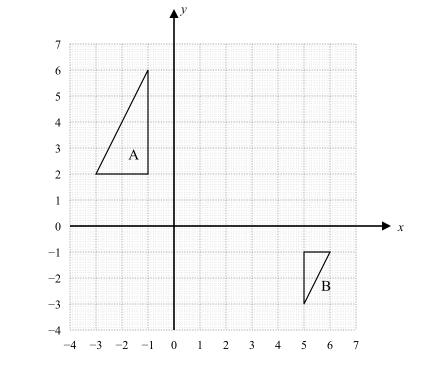
Solution:
- B is smaller than A, so this is an enlargement, the only one of the four transformations that changes size
- Compare matching sides: A's vertical side from (−1, 2) to (−1, 6) is 4 units, and B's from (5, −1) to (5, −3) is 2 units, so the size factor is 2 ÷ 4 = ½
- B is upside down: from the right angle, A's sides run up and to the left, while B's run down and to the right, so the image is inverted and the scale factor is negative, −½
- Join each pair of matching vertices: (−1, 2) to (5, −1), (−3, 2) to (6, −1), and (−1, 6) to (5, −3)
- The three lines cross at (3, 0), between the two shapes, which is where the centre of a negative enlargement always lies
- Check from the centre: (−1, 2) is 4 left and 2 up from (3, 0), and −½ of that is 2 right and 1 down, which lands on (5, −1)
- The full description is an enlargement, scale factor −½, centre (3, 0)