1. Units of time
Conversions to know
- Time does not use the decimal system, so its conversions have to be learned rather than derived
| Unit | Equals |
|---|---|
| 1 minute | 60 seconds |
| 1 hour | 60 minutes |
| 1 day | 24 hours |
| 1 week | 7 days |
| 1 year | 12 months, taken as 365 days |
- This specification treats a year as 365 days unless a question states otherwise
- Month lengths are needed for date calculations: April, June, September and November have 30 days, February has 28 (29 in a leap year), and the remaining seven have 31
Minutes are not decimals of an hour
- Sixty minutes make an hour, so a part-hour written as a decimal is a fraction of 60, not of 100
- 15 minutes is 0.25 h, 30 minutes is 0.5 h, and 45 minutes is 0.75 h
- Writing 2 hours 30 minutes as 2.30 hours is wrong; it is 2.5 hours
Worked example
Changing a decimal time into hours and minutes
A calculation gives a journey time of 2.458 hours. Write it in hours and minutes, to the nearest minute. Another gives a time of 1427 seconds. Write it in minutes and seconds.
Solution:
- The whole hours stay as they are: 2 hours
- Only the decimal part is a fraction of an hour, so multiply it by 60: 0.458 × 60 = 27.48 minutes
- Round at this last step: the journey takes 2 h 27 min
- Rounding 2.458 to 2.46 first would give 0.46 × 60 = 27.6, which rounds to 28 minutes, one minute out
- For the seconds, find the whole minutes first: 1427 ÷ 60 = 23.78…, so 23 whole minutes
- Those 23 minutes are 23 × 60 = 1380 seconds, leaving 1427 − 1380 = 47 seconds
- The time is 23 min 47 s, not 23 min 78 s
Exam tip
Check the metric units before and after you calculate
Metric units go in powers of ten: 10 mm = 1 cm, 100 cm = 1 m, 1000 m = 1 km, 1000 g = 1 kg and 1000 ml = 1 litre. Put every quantity in one unit before you calculate, and finish in the answer line's unit: 2350 m is 2.35 km. A missed conversion, such as a distance left in metres or a kilogram never turned into grams, keeps the right digits but costs a mark.
2. The 12-hour and 24-hour clock
Reading each format
- A 12-hour clock runs twice through the day, distinguished by am and pm
- am covers midnight through to midday, and pm covers midday through to midnight
- A 24-hour clock runs once through the day using four digits, from 00 00 at midnight to 23 59
- Converting from pm to 24-hour form means adding 12 to the hours
- 7.40 pm becomes 19 40
- The hours before 10 am keep a leading zero
- 6.05 am becomes 06 05
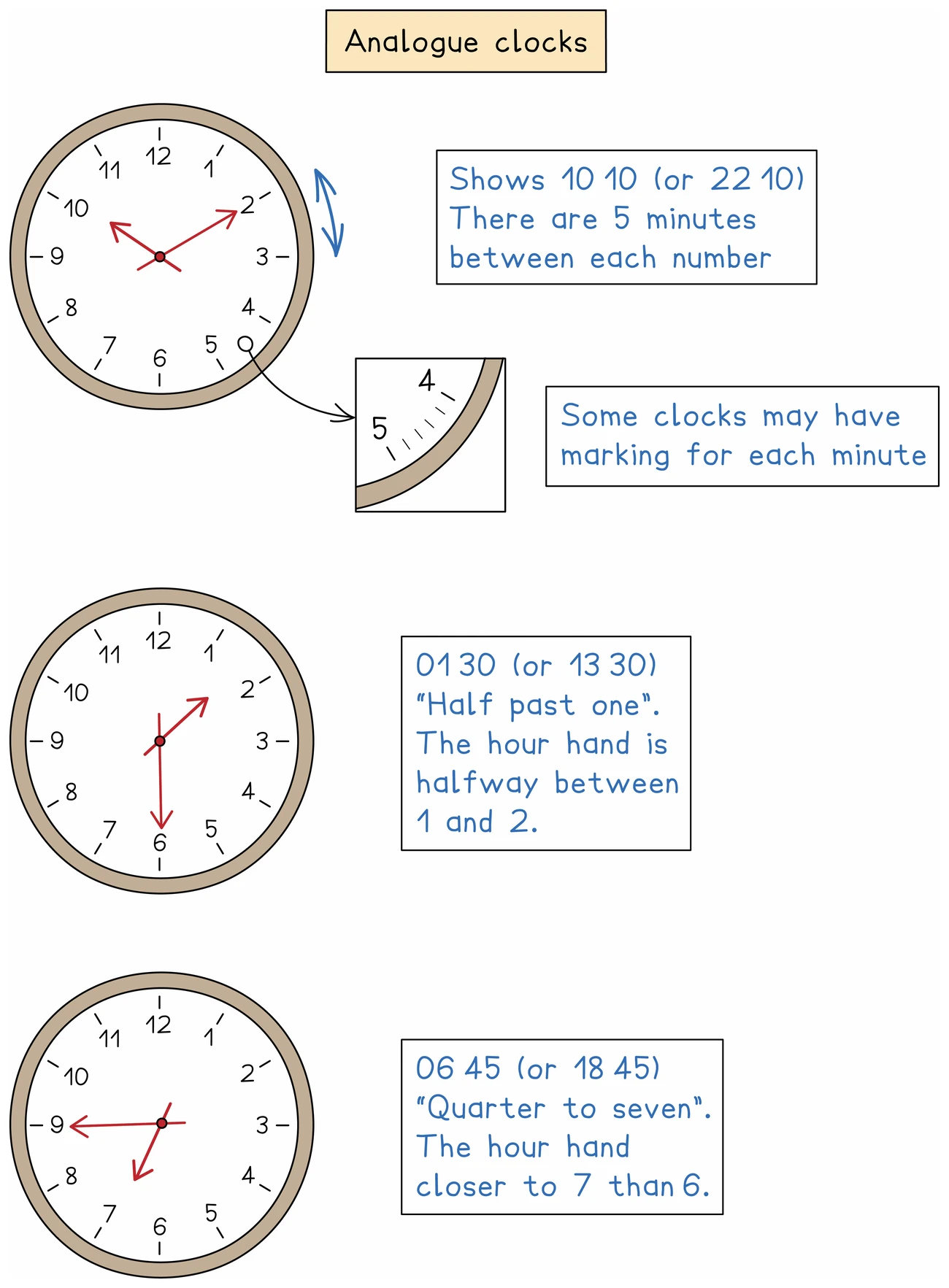
The two awkward cases
- Midnight is 00 00 in 24-hour form and 12 am in 12-hour form
- Midday is 12 00 and 12 pm, so 12 pm is not 24 00
3. Calculating with time
Finding a duration
- Subtracting clock times directly can give a wrong answer, because an hour is 60 minutes, not 100
- Count on instead: go up to the next whole hour, then in whole hours, then the remaining minutes
- From 14 25 to 18 10: 35 minutes reaches 15 00, then 3 hours reaches 18 00, then 10 minutes more, giving 3 hours 45 minutes
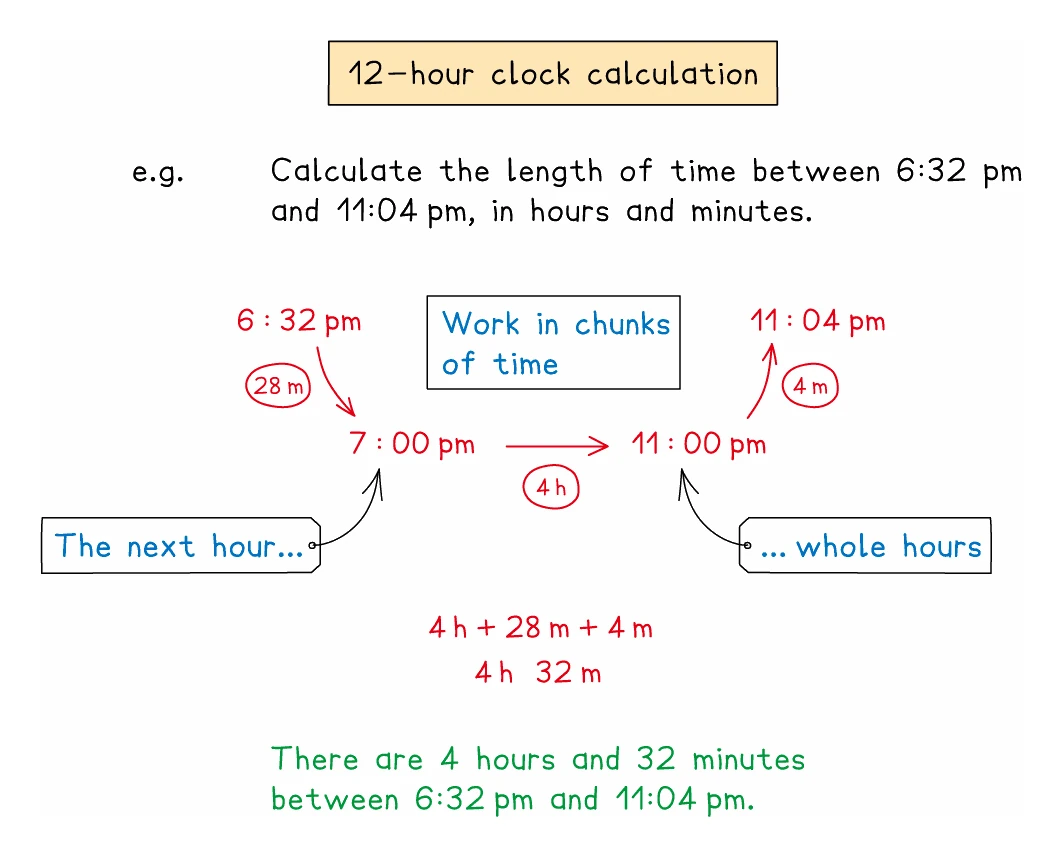
- Adding a duration works the same way, carrying 60 minutes as one hour
Worked example
Adding a duration to a time
A bus leaves at 14 35 and the journey takes 2 hours 50 minutes. Work out the arrival time.
Solution:
- Add the hours first: 14 35 + 2 hours = 16 35
- Then add the minutes: 35 + 50 = 85 minutes
- 85 minutes is more than an hour, so exchange 60 of them for 1 hour, leaving 25
- 16 35 + 50 minutes = 17 25
- The bus arrives at 17 25
- Adding 2.50 to 14.35 on a calculator gives 16.85, which is not a time at all: minutes are sixtieths, not decimals
Worked example
An arrival time after midnight
A coach leaves at 19 45 and the journey takes 7 hours 25 minutes. Find the arrival time.
Solution:
- Add the hours first: 19 45 + 7 hours = 26 45
- Add the minutes: 45 + 25 = 70 minutes, which is 1 hour 10 minutes, so the time reaches 27 10
- A day has only 24 hours, so take 24 off the hours: 27 10 is 03 10 the next day
- The coach arrives at 03 10, which is 3.10 am
4. Timetables and local time
Reading a timetable
- Timetable columns are journeys and rows are stopping points, so a single service is read down one column
- Times are given in 24-hour form, and a blank entry means that service does not call there
- A journey time is the difference between the departure and arrival entries in the same column
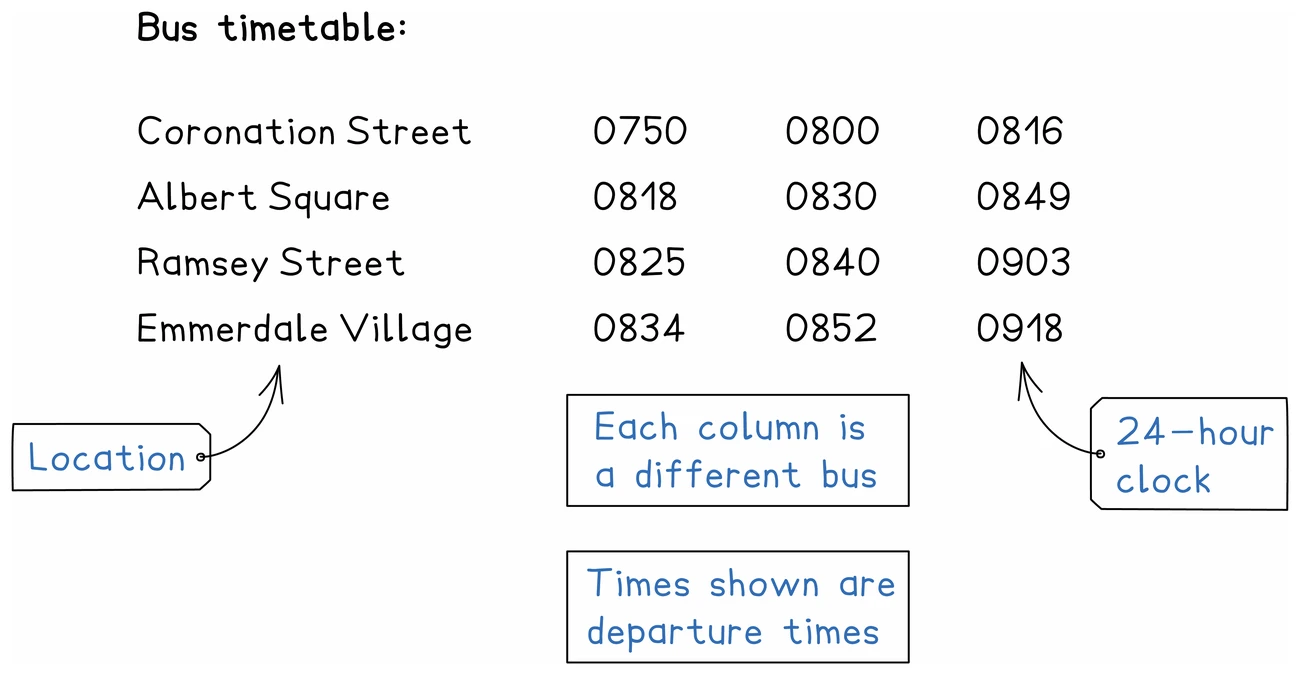
Local time and time differences
- Places in different time zones record different local times for the same instant
- A place ahead of another has its local time later by the difference, and a place behind has it earlier
- Add the difference when travelling to a place that is ahead, and subtract when it is behind
- Where a question gives a flight duration, apply the duration first and the time difference second, keeping the two steps separate
5. Money and currency
Calculating with money
- Amounts are normally written to two decimal places, and the second decimal is kept even when it is zero
- A calculator showing 1.4 is written as £1.40
- For large amounts the context may justify rounding to the nearest whole unit instead
- Money questions frequently combine with percentages, so read carefully for a discount, an increase or a rate of interest
Converting between currencies
- An exchange rate states what one unit of a currency is worth in another
- Converting in the direction the rate is written means multiplying, and converting back means dividing
- With £1 = $1.24, a sterling amount is multiplied by 1.24, and a dollar amount is divided by 1.24
- Where two currencies have no direct rate, convert through the one they share, in two separate steps
Exam tip
Write each converted amount on its own line
When a currency question takes more than one step, through a third currency or to compare two prices, write each converted amount down before going on, like the 40 875 yen below. That amount, or the conversion that gives it, earned a mark of its own in every such scheme, so a slip in the last step still keeps a mark.
Worked example
Converting through a third currency
The exchange rates are 1 euro = 163.5 yen and 1 pound = 187.9 yen. Convert 250 euros into pounds.
Solution:
- Convert euros to yen first, multiplying because the rate is written from euros
- 250 × 163.5 = 40 875 yen
- Convert yen to pounds, dividing because the rate is written from pounds
- 40 875 ÷ 187.9 = 217.535…
- Rounded to two decimal places, the amount is £217.54
Worked example
Comparing prices in two currencies
A phone costs 720 euros in France and £615 in the UK. The exchange rate is £1 = 1.18 euros. Find the difference between the two prices, in pounds.
Solution:
- The difference is wanted in pounds, so change the euro price into pounds first
- The rate is written from pounds, so euros to pounds is a division: 720 ÷ 1.18 = 610.169…
- Subtract: 615 − 610.169… = 4.830…
- The UK price is higher by £4.83
- Subtracting in euros instead (615 × 1.18 = 725.70, and 725.70 − 720 = 5.70 euros) gives the difference in euros, so it must still be changed into pounds: 5.70 ÷ 1.18 = £4.83