1. What a surd is
Exact values
- A surd is a root of a whole number that cannot be written as a whole number or a fraction, because the number underneath is not a perfect power
- √7 is a surd, whereas √49 is simply 7
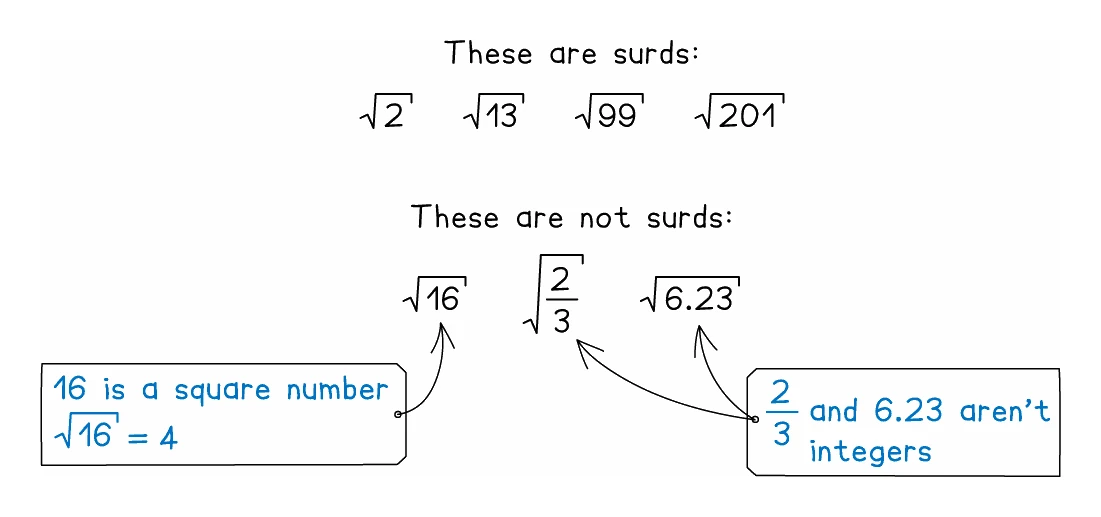
- Surds are irrational: their decimal form never ends and never repeats
- Leaving an answer as a surd keeps it exact, whereas a rounded decimal is only an approximation
- Rounding partway through a calculation and continuing loses accuracy, so surds are carried through the working and evaluated last, if at all
2. Calculating with surds
Multiplying and dividing
- Roots multiply and divide by combining what sits underneath
- √a × √b = √(ab), so √6 × √10 = √60
- √a ÷ √b = √(a/b), so √98 ÷ √2 = √49 = 7
- The reverse is just as useful: a root can be split across a factor pair, which is what makes simplifying possible
Worked example
Multiplying and dividing surds with numbers in front
Work out 2√5 × 3√20 and 12√18 ÷ 4√2. Both answers are whole numbers.
Solution:
- Deal with the whole numbers and the roots separately
- 2 × 3 = 6 and √5 × √20 = √100 = 10
- So 2√5 × 3√20 = 6 × 10 = 60
- For the division, 12 ÷ 4 = 3 and √18 ÷ √2 = √9 = 3
- So 12√18 ÷ 4√2 = 3 × 3 = 9
- Simplifying a surd first gives the same answer: √20 = 2√5, so 2√5 × 6√5 = 12 × 5 = 60
Adding and subtracting
- Only like surds combine, in the same way that only like terms collect in algebra
- 5√3 + 2√3 = 7√3
- Unlike surds stay as they are: √2 + √5 cannot be shortened
- Numbers under different root signs never combine by addition
- √9 + √16 is 3 + 4 = 7, which is not √25
Squaring a surd
- Squaring undoes the root, so (√a)² = a
- This is the property that clears roots from a denominator later
Worked example
Simplifying and then collecting
Simplify √50 + 3√8, giving your answer in the form a√b.
Solution:
- Simplify each surd separately by taking out the largest square factor
- 50 = 25 × 2, and 25 is a square number, so √50 = √25 × √2 = 5√2
- 8 = 4 × 2, so √8 = √4 × √2 = 2√2
- That makes 3√8 = 3 × 2√2 = 6√2
- Both terms now have the same root, so they can be collected like terms
- 5√2 + 6√2 = 11√2
- Adding the numbers under the roots would give √58, which is wrong: √50 + √8 is not √58
3. Simplifying surds
Taking out a square factor
- Look for a factor of the number that is a perfect square, then split the root across the factor pair
- Choosing the largest square factor finishes the job in one step
- 48 = 16 × 3, so √48 = √16 × √3 = 4√3
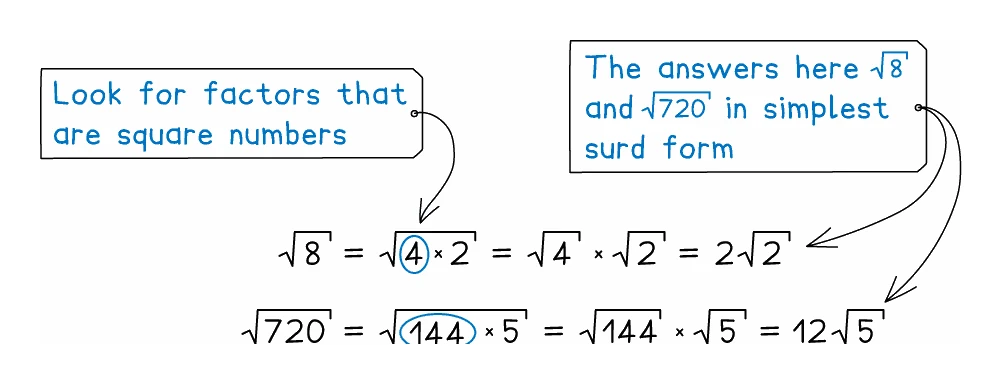
- A smaller square factor still works but leaves more to do afterwards
Collecting after simplifying
- Where several surds appear, simplify each one first: terms that looked unlike often become like
- √75 = 5√3 and √12 = 2√3, so √75 + √12 = 7√3
Expanding brackets
- Brackets containing surds expand exactly as algebraic brackets do, then simplify using (√a)² = a
- (2 + √5)(3 − √5) = 6 − 2√5 + 3√5 − 5, which collects to 1 + √5
Worked example
Expanding brackets that contain surds
Expand and simplify (4 + √3)(5 − 2√3), giving your answer in the form a + b√3.
Solution:
- Multiply each term in the first bracket by each term in the second, keeping every sign
- 4 × 5 = 20 and 4 × (−2√3) = −8√3
- √3 × 5 = 5√3 and √3 × (−2√3) = −2 × (√3)² = −2 × 3 = −6
- Write all four terms down: 20 − 8√3 + 5√3 − 6
- Collect the whole numbers and the root terms separately: 20 − 6 = 14 and −8√3 + 5√3 = −3√3
- The answer is 14 − 3√3, so a = 14 and b = −3
4. Rationalising the denominator
Why it is done
- A fraction with a root on the bottom has an irrational denominator
- Rationalising the denominator rewrites it as an equivalent fraction whose denominator is rational
- The numerator may still contain a root; only the denominator has to be cleared
A single root on the bottom
- Multiply numerator and denominator by that root
- This multiplies the fraction by 1, so its value is unchanged, and the denominator becomes a whole number
- 6/√3 becomes 6√3/3, which simplifies to 2√3
A sum or difference on the bottom
- Multiply numerator and denominator by the same expression with the middle sign reversed
- The denominator then expands as a difference of two squares, and both roots vanish
- (a + √b)(a − √b) = a² − b
Worked example
Rationalising a two-term denominator
Rationalise the denominator of 5 ÷ (4 + √2), giving the answer in its simplest form.
Solution:
- Reverse the sign in the denominator and multiply top and bottom by 4 − √2
- The numerator becomes 5(4 − √2) = 20 − 5√2
- The denominator is a difference of two squares: 4² − (√2)² = 16 − 2 = 14
- The result is (20 − 5√2) / 14
- The denominator now contains no root, which is the check that the work is finished
Exam tip
Finish every surd answer in its simplest form
After rationalising, cancel any common factor: (24 + 6√10)/6 must finish as 4 + √10. Stopping while a factor still cancels scored one mark less. The same last mark is lost in other topics on the non-calculator paper when a length, volume or quadratic root asked for in its simplest surd form, or in a given form such as a√b, keeps a square factor under the root or a root on the bottom: √72 and 12/√2 must both become 6√2.
Worked example
Rationalising two denominators
Rationalise the denominator of 6/√3, and of 5/(2 + √3).
Solution:
- For a single root, multiply top and bottom by that root
- 6/√3 × √3/√3 = 6√3/3
- Cancel: 2√3
- For a two-term denominator, multiply by the same expression with the middle sign changed
- 5/(2 + √3) × (2 − √3)/(2 − √3)
- The denominator becomes (2 + √3)(2 − √3) = 4 − 2√3 + 2√3 − 3 = 4 − 3 = 1
- The two middle terms always cancel, which is the whole point of changing the sign
- The numerator is 5(2 − √3) = 10 − 5√3
- The answer is 10 − 5√3, over a denominator of 1